
The moment the legacy problem became real
You know, I had an epiphany not too long ago, talking to an IT director at a community college. He said something that really stuck with me:
“It’s not broken so we keep it, but it’s never going to let us move quickly.”
I’ve heard that kind of thing so many times from IT leaders in the public sector. I see it in government agencies, universities, K-12 schools — the systems and processes aren’t exactly “broken,” but they’re stuck. And being stuck is the problem.
We’re living in an era where everything is moving at lightning speed: citizens want faster services, regulators expect more transparency, and budgets seem to shrink every year. So, why are we still operating on legacy systems that hold us back? Why are public sector IT teams still struggling to keep up?
Here’s the truth I’ve learned in my years working with public sector leaders, especially at EZO AssetSonar: The solution isn’t just new technology; it’s about rethinking the way we work, the way we automate, and the mindset we bring to the table.
The legacy trap: It’s more than just old tech
When I talk to public sector IT teams, the conversation usually goes something like this: “We’ve always done it this way. Why change?”
And I get it. Stability feels safer. There’s comfort in the familiar. But here’s the thing: legacy isn’t just about old software or outdated hardware. Legacy includes behaviors, processes, and decision-making frameworks that reward stability over innovation.
I’ve seen how these ingrained habits hold organizations back. In fact, a recent GovTech survey showed that 28% of IT leaders in the public sector cited lack of automation as a top barrier to progress but only 58% of organizations have adopted or even planned to adopt workflow automation.
So, what happens? Instead of driving change, IT teams end up spending their days maintaining the status quo, stuck in the weeds, and unable to focus on the bigger picture.
Automation, the game changer we’re overlooking
Now, here’s where automation comes into play.
At AssetSonar, I’ve seen firsthand how automation can flip the script for IT teams. It’s not just about saving a few hours here and there, it’s about fundamentally shifting the way we serve our customers and empower IT departments to work smarter, not harder.
Take the example of one Oregon-based community college I worked with. Their IT department was spending over 350 hours a month on manual updates, which included everything from asset tracking to syncing systems. That’s 350 hours lost that could’ve been spent on innovation, strategy, or customer-facing tasks.
By automating their asset tracking, we gave them the ability to sync device data in real-time, manage audits without all the manual back-and-forth, and eliminate the risk of human error. The result? A significant reduction in admin time and faster decision-making. That’s the kind of impact that changes how a team thinks about their work.
How automation drives transformation across departments?
I have witnessed this multiple times while working with public sector IT teams. Automation didn’t just improve efficiency, it changed the way departments collaborated and worked together.
One great example comes from a school district in Skokie, Illinois where the IT team implemented workflow automation for their asset management. It didn’t just streamline their operations; it inspired other departments to get on board. Once the IT team had real-time visibility into their assets, they saw immediate success. And here’s where it gets exciting: the libraries team, who had previously managed their own inventory manually, saw the benefits and joined in. They adopted automation to manage short-term loaner devices, something that hadn’t been coordinated before. That was a major win, not just for IT, but for the entire institution.
Similarly, I worked with an Ontarian K–8 school district that used lifecycle automation to manage their fleet of laptops and tablets. These devices were critical for their digital learning programs, and by automating their check-in/checkout workflows, the district was able to reduce administrative workload, speed up device turnaround times for students, and gain full visibility into asset health. The impact was clear: not only did they have better budget predictability but they also ensured continuous learning for students.
In both cases, the transformation began with a simple yet powerful shift i.e. reducing manual intervention and trusting automation to maintain operational accuracy.
And that’s where the magic happens! When you take that first step toward automation, it does more than just saving time. It also opens doors to more streamlined collaboration and better outcomes across the entire organization.
It’s not just about technology, it’s about shifting the mindset
Now, let’s talk about culture for a second.
I’ll be honest: the hardest part of automation isn’t the technology. It’s getting the people involved onboard. The fear, the resistance, the doubt. Public sector IT teams often face bureaucratic inertia i.e. long procurement cycles, multiple approval layers, and risk aversion that makes people hesitate to try something new.
But here’s the thing I’ve seen time and again. Change doesn’t happen until people start seeing the results. It’s not about pushing automation because it’s “the right thing to do”. It’s about showing teams that automation doesn’t replace their jobs; rather it frees them to do more valuable work.
At AssetSonar, our role as customer success reps is to hold the customer’s hand through this cultural shift as partners, not vendors. It’s about guiding them through the process by educating them, reassuring them, and showing them step-by-step how automation can actually amplify their impact.
What public sector IT automation enables in a modern IT department
A modern IT department in the public sector shouldn’t just be about keeping the lights on. It must bring innovation, collaboration, and strategic value to the organization.
Here’s what that looks like in action:
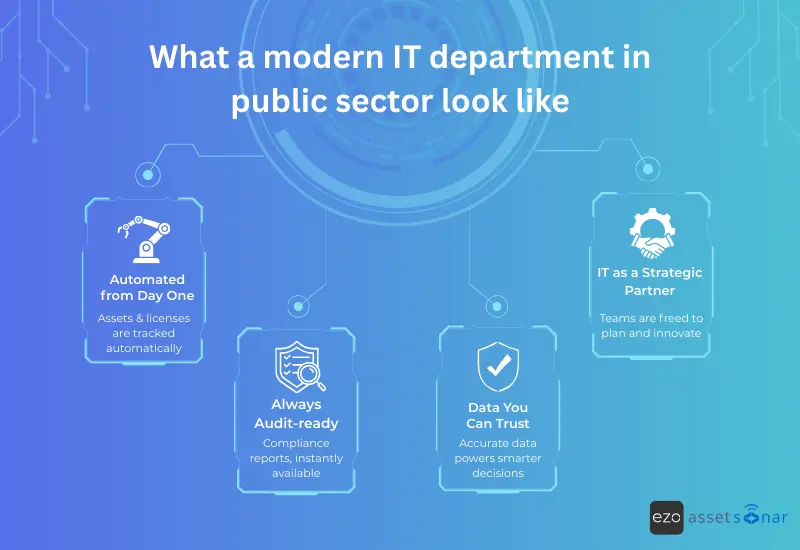
- Devices and licenses are automatically tracked from the moment they’re procured to when they’re retired. No more manual updates or lost assets.
- Compliance reports are instantly generated — no more scrambling to assemble them manually.
- Data accuracy drives everything from better budget forecasts and smarter procurement decisions to a more secure IT environment.
- Most importantly, IT teams are empowered to plan, innovate, and drive the future of their institutions.
This kind of shift doesn’t happen overnight. It’s a gradual transition. But once automation is woven into the fabric of your team’s operations, everything changes. IT evolves from being a reactive service provider to a proactive, strategic partner that shapes the future of the organization.
It’s all about starting small and trusting the process. That’s how you break free from the legacy trap and unlock real change.
The first steps to breaking the cycle: How you can start
Start with the low-hanging fruit.
Identify the manual workflows that are eating up the most time. Maybe it’s asset tracking, maybe it’s managing tickets, maybe it’s handling compliance audits.
Then connect the systems you already have. At AssetSonar, we focus on making automation as seamless as possible for our clients by integrating with their existing systems so they don’t have to do everything from scratch.
Here’s how you can start:
- Identify the top three manual tasks that consume the most time and energy.
- Automate them with the tools you already have.
- Measure the impact whether it’s time saved, data accuracy, or fewer errors.
- Expand automation as you build momentum.
And, importantly, track the ROI. When you start seeing the time saved and the improved service quality, it becomes a lot easier to convince leadership that this is a worthwhile investment.
Empowering your IT department to lead the change
At the end of the day, it’s about empowering your team. Automation isn’t just a tool, it’s a mindset shift. It’s about trusting your systems, freeing your team from manual tasks, and giving them the time and space to innovate.
If there’s one thing I challenge every public sector IT leader to do, it’s this:
What’s the one manual process you’re tolerating today that your future IT department wouldn’t?
And start there.
The answer will likely be the first step towards breaking free from the legacy cycle and building a future-ready, strategically empowered IT team.
Start today.
Identify the top manual workflows in your department and begin automating them. Trust me, your future IT team (and the citizens you service) will thank you for it.

![[How-To] Automate Apple Device Onboarding with AssetSonar’s Apple Business Manager (ABM) Integration](https://cdn.ezo.io/wp-content/uploads/2025/10/29182422/How-To-Automate-Apple-Device-Onboarding-with-AssetSonars-Apple-Business-Manager-ABM-Integration.webp)
![[How-To] Automate HP Warranty Tracking with AssetSonar](https://cdn.ezo.io/wp-content/uploads/2025/12/30071135/Automate-HP-Warranty-Tracking-with-AssetSonar.webp)
![[How-to] Automate IT Workflows in EZO AssetSonar](https://cdn.ezo.io/wp-content/uploads/2024/09/04125918/Automate-IT-Workflows-in-AssetSonar-1.jpg)