With enterprises continuing to scale and expand their digital operations in 2026, Enterprise IT asset management (ITAM) is no longer considered just a tracking tool. It has become a critical platform for maintaining operational efficiency, regulatory compliance, and financial oversight.
It’s now increasingly vital for enterprise IT teams to manage an ever-growing asset base, ensure compliance with complicated software license agreements, and maintain visibility across both physical and virtual assets.
Gone are the days when IT teams needed tools to only track, discover, and manage assets in real-time. Now, they require tools that can also help them automate their complex workflows, optimize lifecycle management, and provide detailed audit-ready reports.
Another major thing an ITAM solution must offer is its ability to seamlessly integrate with other existing systems like MDM (Mobile Device Management), IAM (Identity and Access Management), and security systems, offering actionable insights across all departments and organizations’ expansive IT ecosystem.
These capabilities are no longer just “nice-to-have”; they are mission-critical for protecting against security risks, optimizing spending, and enabling digital transformation at scale.
So, where does Oomnitza stand in between all of this? It is true that Oomnitza is often selected by organizations for its ability to centralize IT asset data and provide robust integration capabilities. However, many enterprises are now beginning to evaluate Oomnitza alternatives due to its few key limitations. Let’s find out why!
Looking beyond the Oomnitza ITAM solution does not necessarily reflect its failure. Enterprises want to evaluate Oomnitza alternatives because they are looking for an ITAM solution that provides deeper ITAM-specific outcomes.
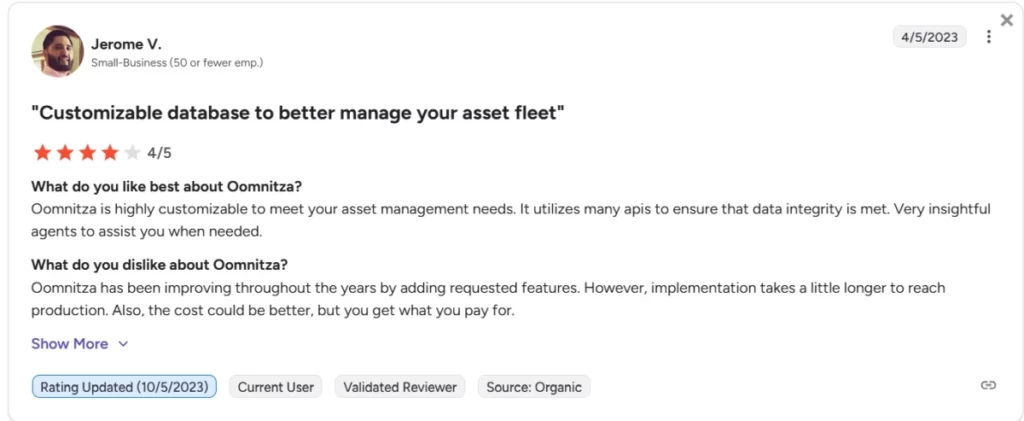
Some teams find their user interface (UI) challenging to use. They also find the performance slow and customization complexity time-consuming and resource-heavy. When added to high licensing and integration costs, this makes adoption harder.
As a result, many enterprises now prefer ITAM tools that are faster to deploy, easier to use, and deliver quicker ROI. In this listicle, we will explore the top 5 Oomnitza alternatives for 2026 that offer more comprehensive, user-friendly, and cost-effective enterprise ITAM solutions.
Why IT teams are evaluating Oomnitza alternatives
When enterprise IT teams are looking for Oomnitza alternatives, they share similar concerns. While Oomnitza is a popular ITAM solution, users often look for another alternative due to a few pain points. Let’s find out what users have said in their reviews and discussions regarding using Oomnitza alternatives.
User‑reported pain points
Cost & licensing issues
Several users have noted that Oomnitza’s pricing structure can be a barrier, especially for small to mid-sized companies. Oomnitza’s cost is often seen as better suited to large enterprises with larger budgets. This may push some mid-sized enterprises with resource constraints to consider more affordable ITAM alternatives. Some users have also said that licensing fees and additional charges for integrations or customizations have made Oomnitza feel more expensive.
UI & performance concerns
Many users have reported that Oomnitza’s user interface (UI) feels outdated, and the overall performance can be slow. As businesses grow and expand, users expect quick access to their asset data and smoother interactions within the platform. A clunky UI can create frustration among the teams, and performance lag may affect adoption, especially for large teams that rely on real-time updates for smooth operations.
Resource demands
When you’re using Oomnitza, you may require a significant amount of internal resources, such as IT staff or data experts, for the customization options. Some users find that setting up this ITAM solution requires more technical support and effort than expected, especially for customizing workflows or adapting the platform to unique business needs. This can be a challenge for teams with limited IT resources or those who prefer a solution that doesn’t demand heavy configuration work.
Lengthy implementation times
Implementation is another reason why users want to look beyond Oomnitza. Some users have said that getting Oomnitza up and running can take longer than expected. They have also mentioned that the trial process, setup, and evaluation phase may be time-consuming, which delays the go-live and ROI realization. Companies looking for fast deployment may find the long onboarding process a deterrent when considering Oomnitza.
Reporting limitations
A small group of users feels that Oomnitza’s reporting tools and dashboards could be improved. While the platform offers valuable insights, some reviewers have noted that it lacks the depth and customization they expect from an enterprise-level ITAM solution. For teams that rely on reporting for audits and license compliance, the inability to easily create tailored, detailed reports could be a dealbreaker.
How we compared the Oomnitza alternatives
When evaluating the best Oomnitza alternatives for an enterprise ITAM solution, we based our rankings on a comprehensive scorecard that helped us measure key capabilities of each solution. This scorecard helps readers easily compare how each ITAM solution delivers on the most critical requirements for modern ITAM, so they can make data-driven decisions while considering the solution. Every vendor on our list is evaluated based on the same criteria to maintain fairness and transparency.
Below, we outline each scorecard dimension, followed by a quick table that ranks the top 7 alternatives so you can see how they stack up.
Scorecard criteria for enterprise ITAM platforms
1. Discovery & inventory depth
- Why it matters: ITAM solutions need to provide comprehensive asset discovery across on-premises, cloud, and SaaS environments. The deeper and broader the discovery capabilities, the more accurate the inventory and asset management.
- What to look for: Coverage of both hardware and software, auto-discovery capabilities for endpoints, and integration with other asset discovery systems. This also includes the ability to detect shadow IT and provide visibility across all asset types (physical, virtual, mobile).
2. Data normalization & confidence
- Why it matters: ITAM data needs to be consistent, accurate, and normalized across systems. Poor data normalization leads to inconsistencies, which makes asset tracking and compliance management unreliable.
- What to look for: ITAM tools that clean and standardize asset data automatically, ensuring that the metadata and asset classifications are accurate and consistent.
3. Lifecycle governance
- Why it matters: Effective ITAM requires the ability to manage the entire lifecycle of an asset, from acquisition to deployment, maintenance, and finally to retirement.
- What to look for: Tools that provide strong asset tagging, status tracking, and asset movement history across departments and users. This also includes managing end-of-life (EOL) assets and ensuring compliance throughout the asset’s lifecycle.
4. Software license & compliance management
- Why it matters: Ensuring license compliance is critical to avoid costly fines and software audits. Platforms need to track not only what software is being used but also ensure that it matches the licenses acquired.
- What to look for: Features that support license management, entitlement tracking, usage monitoring, and the ability to reclaim unused licenses. Reporting and alert systems for non-compliance are also key components of this criterion.
5. Automation & policy enforcement
- Why it matters: Automation helps reduce the burden on IT teams and ensures policies are enforced consistently across the enterprise.
- What to look for: The ability to automate processes such as asset assignment, approvals, maintenance reminders, and compliance audits. Additionally, policy enforcement for asset control and security is critical.
6. Reporting & audit readiness
- Why it matters: Platforms need to produce auditable reports and real-time insights to ensure compliance with regulations and internal policies. The ease of generating customized reports is essential for IT managers, auditors, and C-level executives.
- What to look for: Built-in, customizable reporting for license compliance, asset inventory, and usage. Reports should be easy to export and present to leadership or auditors.
7. Scalability & ease of use
- Why it matters: As enterprises grow, ITAM platforms need to scale seamlessly to accommodate increased assets, users, and locations. At the same time, the platform must remain user-friendly to avoid slow adoption.
- What to look for: Solutions that can scale with your organization’s growth while maintaining a simple, intuitive interface. Look for ease of use for both IT admins and end users.
8. Integrations (HRIS, MDM, IAM, Endpoint, CMDB, Finance)
- Why it matters: Integration with existing enterprise systems (like HRIS, MDM, IAM, Endpoint Management, CMDB, and Finance systems) ensures that asset data is connected, making management more seamless and eliminating data silos.
- What to look for: Native integrations or API support for connecting with enterprise systems, reducing manual entry, and ensuring that asset data is synced across platforms.
| Tool | Discovery & Inventory Depth | Data Normalization & Confidence | Lifecycle Governance | Software License & Compliance Management | Automation & Policy Enforcement | Reporting & Audit Readiness | Scalability & Ease of Use | Integrations (HRIS, MDM, IAM, etc.) |
| Oomnitza | High | High | High | Medium | High | Medium | Medium | High |
| AssetSonar | High | High | High | High | High | High | Medium | High |
| Flexera | High | High | High | Very High | Medium | High | Medium | High |
| Snow Software | Medium | High | High | Very High | High | High | Medium | High |
| Ivanti Neurons | Medium | High | Medium | High | High | High | High | High |
| USU Software | High | High | Very High | Very High | Medium | High | Medium | Medium |
| Lansweeper | Very High | Medium | Medium | Medium | Medium | Medium | Very High | High |
| Device42 | Very High | High | High | Medium | Medium | Medium | High | High |
At‑A‑Glance: 5 Best Oomnitza Alternatives for Enterprise ITAM (2026)
| Tool | Best For | Discovery Strength | Automation | Compliance Support | Ease of Setup | Implementation Effort | Highlight Differentiator |
| AssetSonar | End‑to‑end ITAM (hardware + software + lifecycle) | Strong – automated asset discovery across hardware & software using multiple methods (agent + network) | Strong – automated workflows for lifecycle management (provisioning, retirement) | Strong – license tracking, audit‑ready reporting | Moderate – SaaS, guided onboarding | High – fast deployment with prebuilt integrations | Unified ITAM with lifecycle automation and compliance tracking |
| Lansweeper | Discovery‑focused asset inventory and network scanning | Very Strong – broad network, endpoint, and IoT discovery capabilities (agentless + agent options) | Moderate – automation mainly around asset scanning and inventory refresh | Moderate – supports compliance indirectly through asset data accuracy | Easy – quick to deploy, minimal setup required | Low–Moderate – setup for asset discovery is fast but lacks deep lifecycle features | Best for fast discovery and network visibility across hybrid IT environments |
| Device42 | Infrastructure mapping and asset dependency tracking | Very Strong – comprehensive infrastructure asset discovery, including cloud and on-prem | Moderate – automation of asset discovery and dependency mapping | Moderate – compliance support through asset visibility | Moderate – initial setup requires detailed configuration | Moderate – designed for complex infrastructures with detailed dependency mapping | Strong asset dependency mapping and infrastructure visibility |
| Ivanti Neurons for ITAM | Endpoint‑centered ITAM with unified asset inventory | Strong – real‑time visibility into endpoint devices, software, and cloud assets | Strong – automates lifecycle processes and integrates with endpoint status | Moderate – compliance via lifecycle tracking and contract management | Moderate – typical setup for enterprise environments | Moderate – setup requires configuration of workflows and integrations | Endpoint‑driven ITAM with lifecycle automation and integration to endpoint management |
| Flexera/Snow | Hybrid ITAM + SAM for large enterprises with software compliance needs | Strong – hybrid discovery for hardware, software, and cloud assets | Moderate – automated license position updates and software lifecycle management | Very High – industry‑leading license optimization and compliance | Moderate – requires planning and configuration for enterprise needs | High – longer setup for large-scale implementations | Strong license optimization and audit defense for hybrid IT and software assets |
1) AssetSonar: Best overall for enterprise ITAM outcomes
Best for
AssetSonar is a perfect choice for organizations that prioritize asset lifecycle governance, compliance, and operational readiness. It is designed for teams that require a comprehensive ITAM solution that covers all major aspects of an asset’s lifecycle, from procurement and deployment to maintenance and retirement.
Enterprises looking for complete visibility and control over their IT assets, reducing compliance risk, and automating key workflows across the IT lifecycle can significantly benefit from this ITAM solution. It’s also suitable for teams that manage complex asset estates across multiple departments, locations, or even global operations. Organizations in regulated industries (like healthcare, finance, and government) will also find AssetSonar’s compliance tracking features invaluable.
Scorecard fit
Below is how AssetSonar scores across key ITAM criteria:
| Criteria | AssetSonar Rating |
| Discovery & Inventory Depth | High – Tracks all asset types (hardware, software, network) and provides deep visibility into asset location and lifecycle. |
| Data Normalization & Confidence | High – Ensures data is accurate, up-to-date, and normalized, providing a reliable source of truth for decision-making. |
| Lifecycle Governance | High – Full lifecycle management from procurement to disposal, with strong asset tracking and maintenance management. |
| Software License & Compliance Management | High – Comprehensive license tracking and compliance features, including audits and software entitlement management. |
| Automation & Policy Enforcement | High – Strong automation for asset provisioning, check-ins/outs, and end-of-life processes. |
| Reporting & Audit Readiness | High – Built-in, customizable compliance and audit reports, with real-time data for asset audits. |
| Scalability & Ease of Use | Medium – Scalable for global enterprises, with an intuitive interface and low implementation effort. |
| Integrations (HRIS, MDM, IAM, Endpoint, CMDB, Finance) | High – Seamlessly integrates with key systems such as MDM, procurement, asset discovery and scanning, IAM, and SaaS integrations to provide a centralized view of all assets. |
Typical enterprise strengths
- Ease of Implementation: AssetSonar is known for its user-friendly interface and fast onboarding, with minimal setup required for basic asset tracking functionalities. Most users report a shorter implementation timeline compared to competitors like Oomnitza, making it an attractive option for enterprises looking to deploy ITAM quickly.
- Clear Custody and Lifecycle Models: AssetSonar provides clear models for asset ownership, location tracking, and status updates that are simple to understand and configure. This makes it easier to track asset movements across locations, departments, and teams, ensuring that organizations can maintain complete control and visibility of their assets at all times.
- Built‑in Compliance and Reporting: AssetSonar’s compliance tracking features, such as license optimization and audit‑ready reporting, are built into the platform and don’t require external tools or add-ons. This enables enterprises to reduce the risk of non‑compliance and stay audit‑ready at all times.
- Native Integrations: Users appreciate AssetSonar’s native integrations with major endpoint management platforms, which significantly enhance and streamline their overall asset management experience.
Watch‑outs
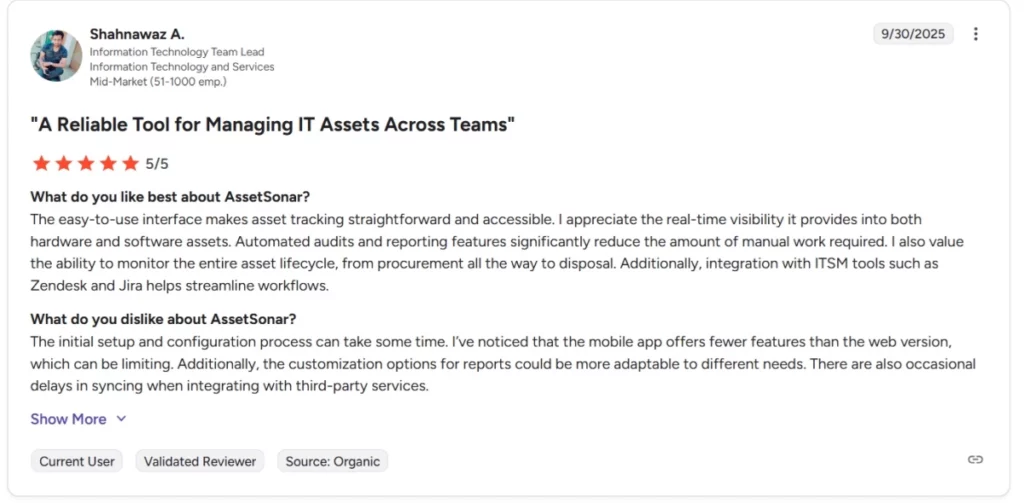
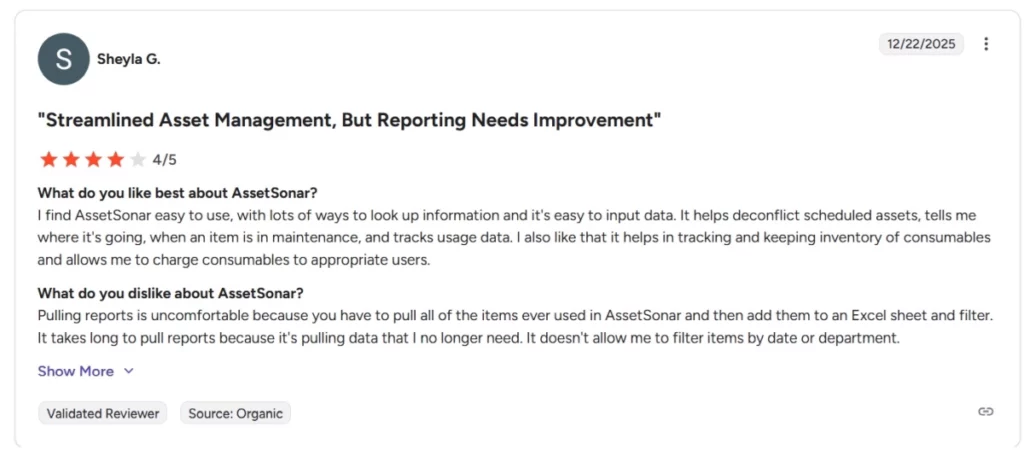
- Filtering Issues: Users find AssetSonar’s filtering functionality frustrating, which makes generating reports tedious and time-consuming.
- Inadequate Reporting: Users struggle with limited filtering options and slow data retrieval, making it difficult to generate detailed and efficient reports.
Bottom line
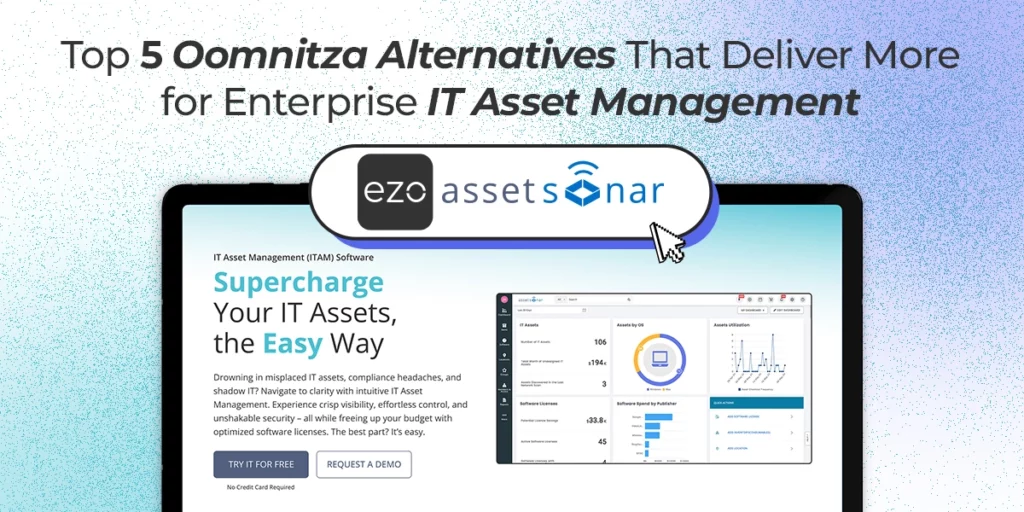
AssetSonar is the leading ITAM‑focused alternative to Oomnitza, addressing many of the common challenges users face when adopting platforms like Oomnitza. It stands out for its comprehensive ITAM capabilities, user-friendly interface, faster time-to-value, and strong audit and compliance features.
Take a look at this interesting Reddit thread comparing AssetSonar and Oomnitza to see what users recommend.
2) Lansweeper: Best for discovery‑first asset visibility
Best For
Lansweeper is best suited for teams needing fast and thorough asset discovery across hybrid IT environments. It excels in environments where the primary goal is visibility, including discovering hardware, software, network devices, and even IoT assets. Lansweeper’s strength lies in its ability to automate asset scanning and provide deep insights into complex environments with relatively low setup compared to full ITAM platforms.
Scorecard Fit
| Criteria | Lansweeper Rating |
| Discovery & Inventory Depth | Very High – Broad network, endpoint, and cloud discovery capabilities with auto-scanning. |
| Data Normalization & Confidence | High – Normalizes and enriches discovered asset data for consistent inventory views. |
| Lifecycle Governance | Medium – Primarily focused on discovery; lacks deep lifecycle management features. |
| Software License & Compliance Management | Medium – Software visibility, but not a full SAM solution. |
| Automation & Policy Enforcement | Moderate – Limited automation, mainly focused on inventory and scanning. |
| Reporting & Audit Readiness | Moderate – Basic reporting features for asset visibility; lacks advanced compliance reports. |
| Scalability & Ease of Use | High – Easy to deploy with scalable solutions for small to large environments. |
| Integrations (HRIS, MDM, IAM, Endpoint, CMDB, Finance) | High – Integrates well with ITSM, security, and CMDB systems. |
Typical enterprise strengths
- Ease of Setup: Lansweeper is known for its quick deployment and easy configuration. Teams can start using it almost immediately, without extensive training or custom configuration. Its auto-discovery feature works right out of the box, providing value quickly after installation.
- Discovery Depth: It is particularly valuable for teams that prioritize comprehensive network visibility. It tracks devices across network ranges, subnets, and cloud environments, offering unparalleled asset discovery in hybrid environments.
- Unified Asset Inventory: Lansweeper acts as a centralized asset inventory, with data normalization that helps IT teams maintain consistency across hardware, software, endpoints, and network devices.
- Integrations: It integrates seamlessly with various tools, including CMDBs, ITSM systems, and security platforms. This makes it a great starting point for a broader IT asset management solution.
Watch‑outs
- Limited Lifecycle Management: While Lansweeper offers strong discovery and inventory features, it lacks robust lifecycle management features like asset provisioning, retirement, and detailed maintenance tracking that are core to complete ITAM solutions.
- Compliance & Reporting: Lansweeper doesn’t provide deep compliance management or auditing features, meaning teams focused on license compliance or regulatory reporting will need to integrate it with more specialized tools.
- No Full ITAM/ITSM Integration: Lansweeper is primarily focused on asset visibility and discovery, so teams seeking a full ITAM solution or an ITSM solution may need to pair it with another platform for complete governance and ticketing.
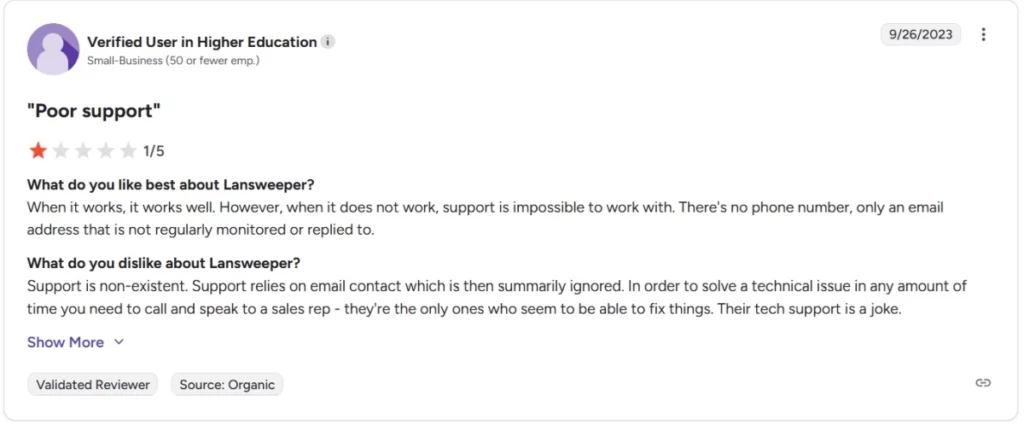
- Poor Support: Users report that Lansweeper’s support is difficult to access and largely unresponsive, with email queries often going unanswered. Many say the only way to resolve technical issues quickly is to contact a sales representative rather than the technical support team.
Bottom line
Lansweeper is an excellent foundational tool for organizations looking to gain deep visibility into their asset inventory, particularly in hybrid environments. Its automatic discovery capabilities, network visibility, and easy setup make it a strong choice for enterprises that need a comprehensive asset database but do not yet need full lifecycle management or compliance features. Pair it with a more compliant-focused platform for complete ITAM coverage and governance. For teams primarily focused on asset discovery, Lansweeper offers significant value and scalability.
3) Device42: Best for infrastructure mapping
Best for
Device42 is ideal for organizations needing deep dependency mapping and infrastructure asset context. It excels in environments with complex IT infrastructures, such as data centers or enterprise networks, where understanding asset interdependencies is crucial.
Scorecard fit
| Criteria | Device42 Rating |
| Discovery & Inventory Depth | Very High – Comprehensive discovery for physical, virtual, and cloud environments. |
| Data Normalization & Confidence | High – Normalizes discovered infrastructure data for consistent inventory and mapping. |
| Lifecycle Governance | Medium – Limited lifecycle management, ideal for discovery and mapping. |
| Software License & Compliance Management | Medium – Basic software tracking, lacks detailed SAM functionality. |
| Automation & Policy Enforcement | Moderate – Focuses on automated discovery rather than policy-driven automation. |
| Reporting & Audit Readiness | High – Strong infrastructure reports and dependency visualizations (not compliance audits) |
| Scalability & Ease of Use | High – Scales well for large environments with a structured setup. |
| Integrations (HRIS, MDM, IAM, Endpoint, CMDB, Finance) | High – Integrates with CMDB, ITSM, and security tools. |
Typical enterprise strengths
- Detailed Infrastructure Mapping: Device42 offers visual dependency mapping, helping IT teams understand how assets are connected and interdependent. This is crucial for large environments like data centers and enterprise networks.
- Strong Discovery: The platform provides primarily agentless discovery across hardware, software, and network assets
- Ease of Setup: Known for its user-friendly interface and relatively quick deployment compared to traditional CMDB tools. Device42 is easy to set up and start using, especially for teams focused on infrastructure management.
- Scalable: It can handle large-scale environments, making it suitable for enterprises managing thousands of assets.
Watch‑outs
- Limited Full ITAM Capabilities: While Device42 excels at discovery and mapping, it lacks comprehensive lifecycle management, such as asset provisioning or retirement, making it incomplete for full ITAM needs.
- Software License Management: It does not provide advanced software license tracking or optimization capabilities, which are essential for SAM-focused organizations. Device42 is better used in combination with other SAM tools.
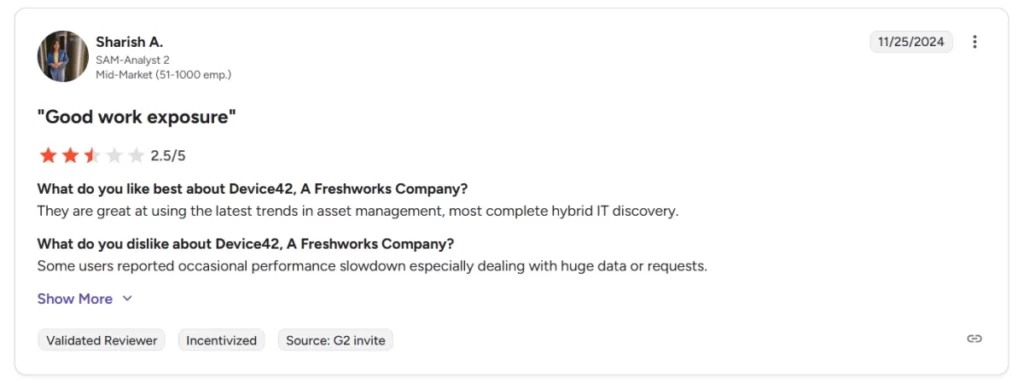
- Performance Slowdowns: Some users report occasional performance slowdowns, particularly when handling large volumes of data or processing extensive requests.
Bottom line
Device42 is an excellent choice for infrastructure management and dependency mapping. It provides comprehensive asset discovery and visualizes asset relationships, which is invaluable for complex environments. However, for teams seeking full lifecycle ITAM or detailed software management, it should be paired with a more specialized ITAM or SAM tool.
4) Ivanti Neurons for ITAM: Best for unified asset inventory + endpoint signals
Best for
Ivanti Neurons for ITAM is best for IT teams that need strong endpoint-centric asset visibility and lifecycle tracking. It’s particularly effective when endpoint data, from laptops, desktops, servers, and mobile devices, is central to your asset management strategy. Organizations with large distributed fleets or those already using Ivanti’s endpoint and UEM solutions will benefit most from its integration strengths.
Scorecard Fit
| Criteria | Ivanti Neurons Rating |
| Discovery & Inventory Depth | High – Comprehensive endpoint and software discovery with frequent/near-real-time (agent-/connector-driven) updates. |
| Data Normalization & Confidence | High – Consolidates endpoint and inventory data for consistent views. |
| Lifecycle Governance | High – End‑to‑end lifecycle tracking, particularly for endpoint assets. |
| Software License & Compliance Management | Moderate – Provides visibility for software installed on endpoints, but not deep SAM analytics. |
| Automation & Policy Enforcement | High – Configurable workflows and automation tied to asset state and lifecycle. |
| Reporting & Audit Readiness | Moderate – Provides basic asset reporting and compliance features, but lacks deeper SAM/ITAM compliance. |
| Scalability & Ease of Use | High – Scales well for large enterprises, user-friendly for IT teams. |
| Integrations (HRIS, MDM, IAM, Endpoint, CMDB, Finance) | High – Works well with UEM/MDM, endpoint management tools, and ITSM/CMDB systems. |
Typical enterprise strengths
- Endpoint-Focused Visibility: Ivanti excels at discovering and tracking endpoints and associated software. Its strength lies in gathering detailed device data and consolidating it into a central inventory.
- Endpoint Lifecycle Workflows: The platform supports automation workflows tied to device lifecycle events (like assignment, change of state, or retirement), helping reduce manual effort.
- Integration with Endpoint & Management Tools: Ivanti’s asset data can be integrated with its own UEM/MDM tools and external ITSM/CMDB systems, creating a tighter flow between asset inventory and operations.
- Scalable for Large Fleets: Ivanti is built to scale and can handle large, distributed environments with diverse endpoint types.
Watch‑outs
- Not a Full SAM Solution: While Ivanti tracks software installed on endpoints, it does not provide deep software asset management features like entitlement reconciliation or advanced license optimization found in dedicated SAM platforms.
- Audit Reporting: Reporting capabilities are strong for inventory and basic compliance, but for detailed audit readiness or regulatory reporting, enterprises often leverage additional tools or integrations.
- Best Within a Broader Ecosystem: Ivanti Neurons for ITAM works best as part of a broader ITAM ecosystem, especially for teams that need full-lifecycle governance across hardware and software beyond endpoints.
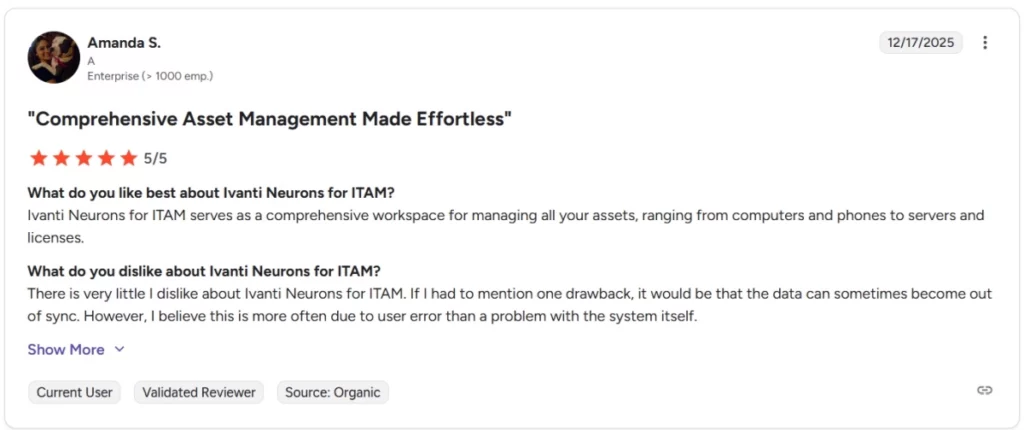
- Occasional Data Sync Issues: Some users note that data can occasionally fall out of sync. However, this is often attributed to user error rather than a flaw in the system itself.
Bottom line
Ivanti Neurons for ITAM is a solid choice for organizations where endpoint visibility drives asset management. It combines endpoint discovery, lifecycle workflows, and automation in a way that’s effective for managing distributed device estates. However, it isn’t a complete, standalone ITAM or SAM solution in the broader sense — teams often pair it with dedicated SAM tooling or broader ITAM platforms for compliance-focused or multi-asset-class strategies. For endpoint-centric ITAM with automation and integrated workflows, Ivanti remains a notable alternative to Oomnitza in 2026.
5) Flexera: Best for enterprise hybrid ITAM + SAM
Best for
Flexera is best for organizations balancing device and software governance across hybrid environments. It excels in managing both hardware assets and software licenses, making it ideal for large enterprises with complex IT estates and compliance needs. Flexera is particularly strong in environments where managing cloud, on-premise, and SaaS assets is crucial.
Scorecard Fit
| Criteria | Flexera Rating |
| Discovery & Inventory Depth | High – Broad visibility via agents, connectors, and integrations across hybrid IT |
| Data Normalization & Confidence | High – Strong normalization of software, license, and entitlement data. |
| Lifecycle Governance | High – Strong lifecycle governance, with deepest coverage in software assets. |
| Software License & Compliance Management | Very High – Industry leader in license optimization, compliance, and audit readiness. |
| Automation & Policy Enforcement | Moderate – Automation of software lifecycle and compliance processes. |
| Reporting & Audit Readiness | High – Strong reporting tools for compliance and audit defense. |
| Scalability & Ease of Use | Moderate – Designed to scale for large enterprises with complex IT estates |
| Integrations (HRIS, MDM, IAM, Endpoint, CMDB, Finance) | High – Integrates with CMDB, cloud platforms, SaaS tools, and enterprise systems via connectors and APIs |
Typical Enterprise Strengths
- SAM depth (primary strength): Flexera is widely used for license optimization, compliance calculations, and audit preparedness, especially in complex enterprise software environments.
- Strong Compliance & License Optimization: Flexera is widely regarded for its software license management capabilities, helping enterprises ensure license compliance and optimize license usage across their environments.
- Audit Defense: It provides audit‑ready reports and tools to defend against software audits, which is critical for large enterprises with high compliance demands.
- Enterprise Scalability: Flexera is built for large-scale environments and can handle the complexity of global enterprises with diverse asset portfolios. It integrates seamlessly with other enterprise systems to offer a centralized view of asset and license data.
Watch‑Outs
- Complex Setup: Flexera’s extensive features may require longer setup and configuration, which can be a challenge for teams without dedicated IT resources.
- Not Focused on Discovery-First ITAM: While Flexera provides robust asset management, it doesn’t specialize in discovery-first ITAM. Teams seeking a simple discovery and inventory tool may find Flexera’s extensive capabilities overwhelming.
- License Management Focused: Its primary strength is in software license management and SAM, so organizations seeking more hardware-focused ITAM might find it lacking in depth for managing non-software assets. Flexera excels more in the license optimization space rather than offering full hardware lifecycle management.
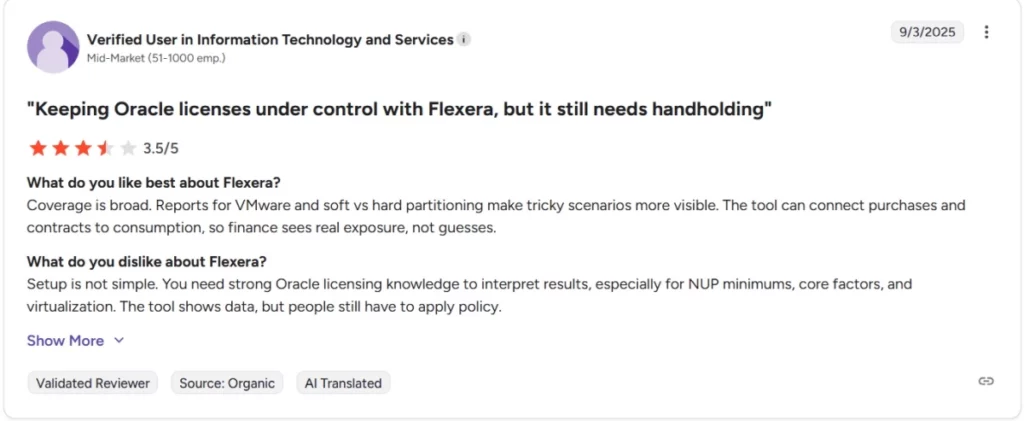
Bottom Line
Flexera is a great fit for large enterprises with complex IT environments, particularly those focused on software license optimization and compliance. It offers enterprise-grade SAM with hybrid IT asset visibility, making it ideal for organizations that need advanced license management. However, if your organization is looking for a simpler, discovery-first ITAM solution, Flexera may be more complex than necessary. Flexera shines when license governance and audit defense are top priorities.
How to choose the right alternative
Before choosing an ITAM solution, you must know about your organization’s unique needs. You can use the following buyer-centric questions to help you self-choose the ITAM platform that aligns with your business needs.
Priority no. 1: Audit & compliance?
If audit readiness and software compliance are your primary concerns, consider Flexera for its license management and audit defense capabilities. It’s a leader in helping organizations track software entitlements and stay compliant with licensing agreements.
However, AssetSonar is also a strong alternative, offering real-time audit-ready reports and license tracking across the asset lifecycle. AssetSonar’s comprehensive compliance features make it a compelling option for organizations looking for efficient license management and audit readiness without the complexity of large-scale platforms.
Priority no. 2: Endpoint and cloud discovery?
For real‑time visibility into endpoints and cloud assets, Ivanti Neurons for ITAM is the ideal option. It offers unified discovery for both endpoints and cloud environments, ensuring seamless asset tracking across all devices.
AssetSonar also provides endpoint discovery and cloud asset management, offering robust visibility with a simple, intuitive setup. While Ivanti may have an edge in endpoint-specific environments, AssetSonar’s unified asset lifecycle management ensures comprehensive visibility from discovery through to compliance, making it a great all-in-one ITAM solution.
Priority no. 3: License & contract governance?
If your focus is on software license governance and contract compliance, Flexera offers comprehensive tools for license tracking, optimization, and contract management, making it a top choice for large enterprises with complex software portfolios.
On the other hand, AssetSonar offers comprehensive software license tracking and automated renewal reminders, ensuring license compliance across the entire asset lifecycle. It might not have the advanced optimization features of Flexera, but for most enterprises looking for strong compliance management and asset lifecycle visibility, AssetSonar is a solid fit without the overhead.
Priority no. 4: Infrastructure dependency mapping?
For infrastructure mapping and asset dependency visualization, Device42 is the best choice. It specializes in mapping IT infrastructure, providing detailed relationship diagrams showing how assets interact and depend on one another, which is crucial for data centers and enterprise networks.
If dependency mapping is a secondary concern, Lansweeper is another solid alternative. It offers network discovery and visibility into endpoints and cloud infrastructure, though it lacks the same depth in asset relationship mapping as Device42. AssetSonar, while not as specialized in mapping infrastructure dependencies, provides comprehensive asset tracking, including dependencies throughout the asset lifecycle, making it a more well-rounded ITAM solution for most teams.
Which alternative is best for your enterprise ITAM needs?
As mentioned before, choosing the right ITAM solution depends on your organization’s priorities and needs. If compliance and software license optimization are top of mind for your organization, then Flexera is an excellent choice. For endpoint and cloud discovery, Ivanti Neurons for ITAM stands out, while Device42 excels in infrastructure mapping and dependency relationships. Lansweeper is perfect for teams prioritizing fast discovery and visibility into hybrid environments. Lastly, AssetSonar offers a comprehensive ITAM solution that combines lifecycle automation, audit readiness, and strong compliance management on a single platform.
Want to explore these tools further? Download our buyer’s checklist to evaluate your needs and choose the best fit for your ITAM strategy.