
“Wait, where’s the receipt for that cloud server renewal from the last quarter?” asked Peter, the head of IT operations, as an unplanned compliance check hit his inbox.
Amanda, the Procurement Specialist, was already looking for it within the folders. “It should be in SharePoint. Or maybe, we can check with the Accounts department.”
Meanwhile, John, the Network Engineer, realized he had no record of who approved the new firewall purchase or who even updated its firmware the previous month. When the auditors requested proof of software license compliance, the team began scrambling through spreadsheets that had not been updated in over a month.
Does this ring a bell for you? Well, this is the reality when IT is unmanaged and without any trail. Some common examples include missing purchase records, a lack of time-stamped trails, and limited visibility into sanctioned or unsanctioned software usage.
As a CIO of a mid-market IT firm, you would know that managing your company’s IT assets goes beyond just tracking hardware and software. Audit trails and compliance reporting are two crucial aspects of an effective IT asset management (ITAM) strategy that you simply can’t ignore. These capabilities in an ITAM tool can help ensure regulatory compliance and provide complete transparency, reduce risks, and simplify internal processes.
In this guide, we’ll walk you through the key criteria for evaluating top ITAM tools with a specific focus on audit trails and compliance reporting. Plus, we’ll compare leading ITAM tools—including EZO AssetSonar, our top recommendation—to help you make the best decision for your organization.
What do we mean by audit trails and compliance reporting in ITAM?
Audit trail
Imagine a situation where your company replaces 100 employee laptops. When an internal audit takes place after a few months, the Finance department needs to know who authorized each purchase, when they were assigned, and which ones were later reimaged or retired. Without an audit trail in place, you are left scrambling through emails and spreadsheets.
An audit trail in ITAM automates this by recording every change to an asset. For instance, who made it, when, and from which device. Let’s consider this example: If an engineer updates the firmware on a router or changes software access rights for a user, ITAM logs that information immediately. This digital paper trail becomes important during compliance checks or incident investigations.
Compliance reporting
Compliance reporting in ITAM isn’t a full compliance solution—it focuses specifically on risks tied to technology assets, software usage, and device governance. It won’t replace security, legal, or regulatory systems, but it does help reduce exposure wherever assets are involved.
Two common facets of compliance reporting are:
- Software licensing compliance
This is a contractual and financial risk. For example, if 15 of 100 Adobe licenses are expired or still assigned to former employees, the company is instantly exposed during a vendor audit. ITAM helps flag these gaps early by tracking entitlements and usage.
- Device & data governance compliance
This is a security and regulatory risk. A lost, untracked laptop in a GDPR or HIPAA-regulated industry can trigger a reportable breach and fines. ITAM doesn’t fully comply with all regulations, but it provides the visibility needed to know where devices are and whether they’ve been properly wiped or retired.
Where ITAM helps reduce compliance exposure
ITAM tools don’t solve compliance end-to-end, but they do help organizations:
- Track software licenses and usage to avoid over-deployment
- Verify device ownership and configuration status
- Support secure offboarding and asset disposal
- Maintain audit trails required for investigations or vendor audits
- Align with standards like ISO/IEC 19770 around asset governance
In other words, ITAM strengthens compliance where assets are involved, but it’s one component of a larger governance ecosystem that may also include GRC, security, legal, and data privacy programs.
Why audit trails and compliance reporting are core ITAM requirements
In today’s increasingly regulated digital landscape, keeping track of assets, their usage, and changes made to them is not optional; it is essential. Here are some reasons why:
Costly fines for licensing or data privacy violations
Without audit trails and compliance reporting, organizations leave themselves vulnerable to vendor audits, license violations, and data privacy infractions. For example, suppose software licenses are found to be over-deployed or mismanaged. In that case, companies can face hefty fines or penalties from vendors, especially amid increasing scrutiny from vendors such as Oracle, Microsoft, and Adobe.
In regulated industries like healthcare or finance, failure to track data properly can result in fines for violating privacy laws such as GDPR or HIPAA. ITAM tools with built-in compliance reporting help companies avoid these risks by monitoring license entitlements and usage in real time, keeping everything aligned and reducing the chance of costly non-compliance.
Operational blind spots due to missing or incomplete records
If you don’t have a solid audit trail, it’s easy to lose track of who has access to what assets, where devices are, and how software is being used. Missing or incomplete records can lead to blind spots in your operations, meaning critical assets might go untracked, lost, or exposed.
For instance, you might not be aware of obsolete or under-utilized software, or you could find yourself in a situation where a device was not properly wiped before being reassigned or disposed of. This lack of visibility can create significant risks, from security vulnerabilities to inefficiencies in asset management. With audit trails and compliance reporting, all asset actions are logged, making it easier to manage and secure assets throughout their lifecycle.
Excessive manual work during audits, consuming time on compiling information from disparate sources
The absence of proper audit trails means that during an audit, IT and compliance teams are left scrambling to gather information from disparate sources: spreadsheets, email chains, and scattered documents. This can lead to delays, errors, and manual inefficiencies, consuming time that could be better spent on proactive IT initiatives like security, system optimization, or digital transformation.
With a centralized ITAM system that supports automated compliance reporting, the entire process becomes streamlined. Audit data is readily available, eliminating the need for manual work and reducing the time spent preparing for vendor or regulatory audits. AssetSonar, for instance, automatically tracks assets, licenses, and user access, so your team can generate audit-ready reports with a single click.
Higher risk of shadow IT and unauthorized applications
Shadow IT, or the use of unsanctioned devices or software, is one of the biggest risks for modern IT teams. When employees bypass IT’s control to use personal or unauthorized apps, it creates potential security and compliance vulnerabilities.
Without SaaS usage visibility or device tracking, these risks often go unnoticed, leaving critical gaps in your organization’s security posture and compliance reporting. However, ITAM tools like
AssetSonar makes it easier to identify and remediate shadow IT by providing visibility into unapproved apps and devices in use. This proactive tracking ensures that all software and hardware are properly managed, reducing the risk of data breaches or compliance violations from untracked assets.
Audit trails and compliance reporting aren’t just essential features of an ITAM. Think of them like an insurance policy against chaos, compliance failures, and unnecessary costs. ITAM software isn’t the whole compliance puzzle, but it’s a critical piece for knowing what assets you have, who’s using them, and whether they meet licensing and governance requirements.
Criteria for choosing the best ITAM tool for audit trail and compliance reporting
It is important to consider key criteria while evaluating ITAM tools for audit trail and compliance reporting.
1. Core functional criteria
- Asset discovery & inventory depth: The tool should support comprehensive discovery of all hardware, software, and cloud assets in your environment. This includes not only physical devices, such as laptops and servers, but also virtual assets, including cloud infrastructure and SaaS applications.
- Detailed change tracking/event history: Look for tools that track and log every change made to assets—whether it’s a hardware change, software installation, or user action. Audit trails should be tamper-proof and viewable by relevant stakeholders. It’s even better if they’re time-stamped and user-attributed.
- Compliance reporting & license management: A good ITAM solution should offer out-of-the-box license compliance reporting for key software vendors. The ability to automatically track and report on software usage helps avoid over- or under-licensing and reduces the risk of audit fines.
- Regulatory & policy compliance support: Ensure the ITAM tool offers reporting that can support the regulatory frameworks your company operates under, such as ISO/IEC 19770 for asset management, SOC 2 for security, and GDPR for data privacy.
- Data integrity & chain of custody: The tool must ensure data integrity by maintaining immutable logs and providing proof of the chain of custody for all assets.
- Dashboarding & custom reporting: The ability to generate customizable, audit-ready exportable reports is essential. Look for tools that allow you to create reports tailored to your specific compliance requirements and export them easily for audit purposes.
- Integration with ITSM / CMDB / GRC tools: Integration with IT service management (ITSM), configuration management databases (CMDB), and governance, risk, and compliance (GRC) tools enhances the ITAM system’s ability to provide a holistic view of assets, risks, and compliance across your entire IT ecosystem.
2. Operational & risk-related criteria
- Scalability & multi-site / hybrid support: If your organization operates across multiple locations or a hybrid IT environment (on-prem and cloud), the ITAM tool should scale to handle assets across different regions and platforms.
- Security & access controls: Look for tools with role-based access controls (RBAC) to ensure that sensitive asset and audit data is only accessible to authorized personnel.
- Implementation and maintenance effort: Consider the time and resources required to deploy and maintain the ITAM tool. Solutions that are easy to implement and don’t require heavy ongoing management will save time and reduce costs, especially when your audit notice is about to land in two weeks.
- Vendor support & updates: Choose a tool from a vendor that regularly updates the product to keep pace with changing regulations and audit requirements. Ongoing support for compliance and audit features is crucial.
- Cost vs ROI & audit readiness value: The ROI of an ITAM tool should be clear, whether it’s reducing the time and cost of audit preparation or minimizing compliance-related risks.
- User-experience & adoption: An ITAM tool should be intuitive and easy to adopt by your teams. A tool that’s hard to use will lead to inefficiencies and slow compliance checks.
3. Differentiation criteria for top ITAM tools
- Audit-ready workflows: Tools should automate key processes like audit preparation, evidence capture, and policy enforcement.
- Shadow IT/SaaS discovery: The tool should be able to track assets that may be outside of traditional IT control, especially with increasing SaaS usage, as this relates to license compliance.
- Agentless/agent-based hybrid discovery: The flexibility to use agentless discovery for remote or cloud assets and agent-based discovery for on-prem devices ensures comprehensive tracking.
- Flexible export & archiving of logs: Make sure the tool offers flexible ways to export and archive audit logs for compliance reviews and future audits.
- Vendor neutrality & licensing independence: Look for ITAM tools that support a wide range of third-party software vendors and licenses, giving you flexibility in your asset management.
- Patch management visibility: A top-tier ITAM tool should track patch status across assets, helping ensure systems remain secure and compliant with internal and external policies.
Top ITAM tools in audit trail & compliance reporting
To help CIOs make an informed decision, we break down how the leading ITAM platforms perform specifically in audit trail depth, compliance reporting, and overall operational fit. You may also refer to our CIO’s utilization playbook to understand how they can leverage IT visibility to drive budget wins.
1. EZO AssetSonar (Top recommendation)
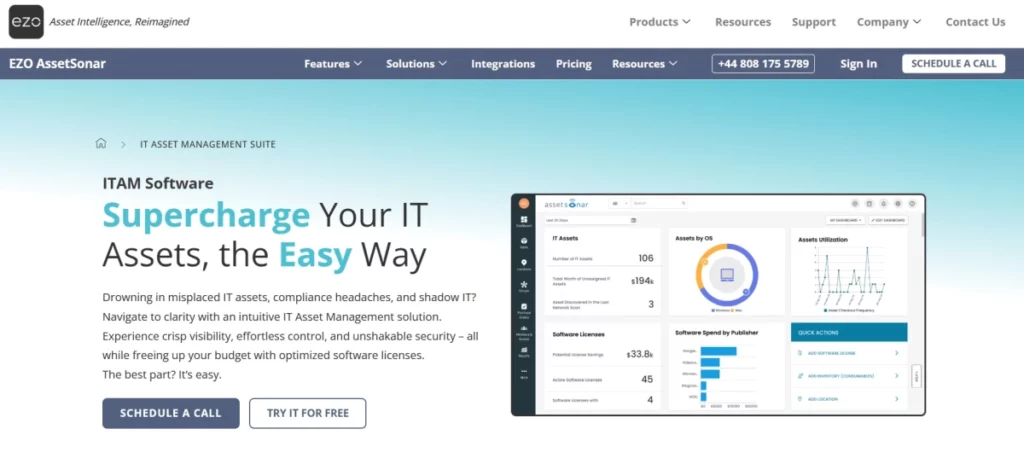
Best For: Mid-market enterprises, fast-growing IT teams, audit-heavy environments
Audit trail features
- Real-time, immutable audit logs covering every asset event
EZO AssetSonar provides real-time, tamper-proof logging of every change made to assets, ensuring that every action is tracked with full transparency. This is essential for both internal audits and compliance reporting, as it provides an irrefutable record of all asset activity. - Complete change tracking: users, timestamps, status changes, installations, offboarding, ownership transfers
EZO AssetSonar automatically records what changed, when it changed, and who made the update. While teams can optionally add comments to explain why a change occurred, the system itself ensures that all core activities, including installations, offboarding actions, and ownership transfers, are fully tracked for audit visibility. - Hardware + software level audit visibility with agent-based and agentless discovery
EZO AssetSonar supports both agent-based and agentless discovery for hardware and software, providing full visibility across your organization’s IT landscape, including remote devices and virtual assets. This flexibility ensures comprehensive coverage for all assets, whether on-premises or in the cloud. - Long-term log retention for audit-preparedness
EZO AssetSonar stores audit logs for extended periods, ensuring that your organization is always ready for audits, even if they happen months or years after an event. This long-term retention supports your compliance strategies, especially when dealing with regulations that require historical data.
Compliance reporting features
- Automated license compliance reporting (usage vs entitlements)
EZO AssetSonar automatically tracks software usage against entitlement limits, ensuring that you are fully compliant with software licensing agreements. It reduces the risk of over- or under-licensing and helps avoid fines or penalties during vendor audits. - SaaS usage visibility and unauthorized app detection (Shadow IT mitigation)
The tool helps uncover hidden SaaS applications (Shadow IT) that employees may be using without IT’s knowledge. It offers visibility into these apps and allows you to track their usage, ensuring compliance with company policies and preventing unauthorized software from being deployed across your network. - Hardware compliance for warranties, lifecycle, and EOL/EOS alerts
EZO AssetSonar provides automatic monitoring of hardware assets, including warranty statuses and lifecycle events. The system alerts you when devices approach their end-of-life (EOL) or end-of-service (EOS), helping you plan for hardware replacements and avoid unapproved or outdated devices from operating in your environment. - Exportable audit-ready reports (CSV, PDF, dashboard snapshots)
You can easily export compliance reports in multiple formats, including CSV and PDF, directly from the AssetSonar dashboard. These reports are ready for auditing purposes and can be shared with internal teams or external auditors with minimal effort. - Supports ISO/IEC 19770 processes, SOC2, GDPR-aligned workflows
EZO AssetSonar is built to support international compliance standards, including ISO/IEC 19770 for IT asset management, SOC2 for security and privacy controls, and GDPR for data protection. This makes it easier for organizations to maintain compliance across global operations.
Strengths
- Modern UI, extremely fast deployment (agent + integrations)
EZO AssetSonar’s user interface is clean and intuitive, allowing for a seamless experience across various teams. Its fast deployment process—whether through agent installation or integrations—ensures that teams can quickly get up and running with minimal downtime. - Unified hardware + software + SaaS compliance visibility
Unlike many traditional ITAM tools, EZO AssetSonar provides a single platform where IT teams can track not only hardware and software but also SaaS usage, offering a comprehensive view of all organizational assets in one place. This visibility helps streamline compliance efforts and resource management. - Minimal setup compared to enterprise ITAM-bundled tools
EZO AssetSonar requires less configuration than many enterprise ITAM tools, making it easier for organizations with smaller IT teams to implement and maintain. This ease of setup significantly reduces the time and effort required for full deployment. - Highly scalable for distributed teams and hybrid infrastructure
EZO AssetSonar is designed with scalability in mind, supporting growing teams and infrastructure. Whether your organization operates on-prem, in the cloud, or in a hybrid environment, AssetSonar can handle the increased demands of asset management, reporting, and compliance. - Easier to adopt and maintain than heavier legacy platforms
EZO AssetSonar offers a simpler alternative to legacy, enterprise-grade solutions that can be cumbersome and difficult to use. With its user-friendly interface and cloud-based architecture, it’s much easier to adopt, manage, and maintain—saving time for your IT and compliance teams. - Designed for mid-market IT teams that need enterprise-grade rigor without enterprise complexity
EZO While many enterprise tools are designed for large, complex environments, AssetSonar is tailored for mid-market organizations, offering the same level of compliance and audit rigor without the complexity and overhead often associated with enterprise ITAM solutions.
Weaknesses
- Fewer advanced policy-governance templates
While EZO AssetSonar provides strong foundational compliance reporting features, it lacks some of the more advanced policy-governance templates. This may be a limitation for organizations that require highly customized compliance enforcement or intricate policy frameworks. - Some audit views require custom report configurations (still easy to create)
Certain audit views and custom reports in EZO AssetSonar may need to be manually configured to fit specific compliance needs. While this process is straightforward, it might require some initial setup to fully tailor the system to your organization’s audit and compliance requirements.
2. ServiceNow ITAM
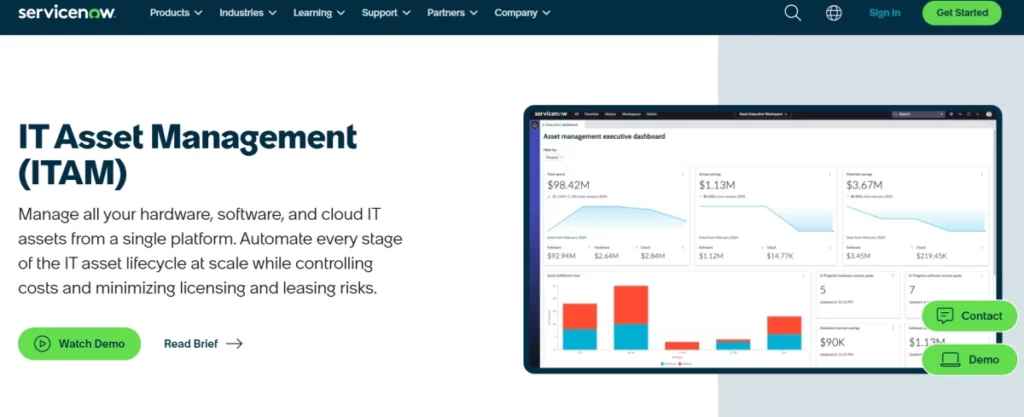
Best For: Very large enterprises with complex workflows, mature ITSM + CMDB environments
Audit trail features
- Granular, role-based audit logs integrated into the CMDB
ServiceNow ITAM provides detailed, role-based audit logs, ensuring that every change made to assets is traceable by user, action, and timestamp. These logs are fully integrated with the Configuration Management Database (CMDB), offering a comprehensive view of how assets interact with services and incidents across the organization. - Tracks configuration changes, incident linkages, approvals, and lifecycle events
The tool not only tracks asset configuration changes but also records the connections between incidents, approvals, and lifecycle events. This feature is especially valuable in complex environments where assets are frequently tied to multiple services and processes. It helps auditors and IT teams trace the full history of each asset. - Strong governance controls across hardware and software
ServiceNow offers robust governance controls, allowing IT teams to enforce strict policies on both hardware and software assets. This includes ensuring that assets comply with organizational standards and regulatory requirements, while providing visibility into the entire IT asset lifecycle from procurement to retirement.
Compliance reporting features
- Robust enterprise-level license reconciliation
ServiceNow excels in license management, offering automated license reconciliation that ensures all software licenses are correctly accounted for. This feature helps prevent under-licensing or over-licensing, ensuring that organizations stay compliant with software vendor agreements and avoid costly penalties. - Automated discovery and entitlement normalization
With automated discovery, ServiceNow tracks all assets, including those running on cloud platforms or unmanaged devices. The tool also normalizes entitlement data, ensuring that license usage is properly aligned with actual deployments, eliminating discrepancies and minimizing the risk of non-compliance. - Advanced policy compliance enforcement via ITSM + GRC modules
ServiceNow integrates ITAM with its IT Service Management (ITSM) and Governance, Risk, and Compliance (GRC) modules, providing advanced policy enforcement and risk management capabilities. This integration allows organizations to enforce compliance policies across the entire IT landscape, from asset tracking to incident management and policy-driven audits. - Supports large enterprises with heavy audit requirements
Designed with large enterprises in mind, ServiceNow ITAM provides the tools necessary to meet the rigorous demands of global organizations. It offers the scalability and customization required to handle complex audit trails and compliance reporting for enterprises with diverse IT environments and multiple regulatory requirements.
Strengths
- Deep workflow automation and cross-department governance
ServiceNow’s strength lies in its ability to automate workflows across various departments, making it an ideal solution for large, distributed enterprises. It automates asset lifecycle management, change requests, approval processes, and compliance checks, reducing manual efforts and minimizing errors. - Excellent fit for organizations already using ServiceNow ITSM
If your organization is already using ServiceNow for IT Service Management, integrating ITAM into this ecosystem is a seamless process. This integration allows you to tie asset management data directly into incident management, problem management, and service desk workflows, providing a unified platform for managing IT assets and services. - Highly customizable enterprise compliance dashboards
ServiceNow provides enterprise-level dashboards that are fully customizable, allowing IT teams to tailor compliance and asset visibility to their specific needs. These dashboards provide real-time insights into asset health, license status, and audit readiness, which can be critical for large enterprises managing thousands of assets across multiple regions.
Weaknesses
- Very expensive licensing and implementation
While ServiceNow ITAM offers powerful features and capabilities, it comes with a significant price tag. Licensing, implementation, and ongoing maintenance costs can be prohibitively expensive for organizations with limited budgets. This makes it less suitable for mid-market companies or businesses with fewer IT assets to manage. - Complex setup requiring long onboarding cycles
The complexity of ServiceNow’s ITAM tool means that its setup and configuration process can be time-consuming. Large organizations may require dedicated implementation teams to ensure that the tool is properly customized and integrated into existing ITSM or CMDB systems, leading to longer onboarding cycles. - Overkill for mid-market teams with limited IT staff
ServiceNow ITAM is designed for large enterprises with complex IT infrastructure and large IT teams. For smaller organizations or those with limited IT staff, ServiceNow may feel like overkill. Its extensive features may go underutilized, and the implementation complexity might outweigh the benefits for smaller teams.
3. Ivanti Neurons for GRC
Best For: Enterprises seeking AI-driven GRC, risk mitigation, predictive insights, and automated compliance management
Audit trail features
- Comprehensive audit trail for risk management changes
Ivanti Neurons for GRC captures a detailed history of every compliance and governance-related change, from policy updates to risk assessments. This ensures that all modifications are logged with timestamps and user details, providing a transparent, immutable record that aligns with audit requirements. - Real-time discovery, automated risk reconciliation, and normalization
Ivanti Neurons offers real-time risk discovery, ensuring that all compliance-related changes, such as policy updates or security configurations, are continuously tracked. It flags discrepancies immediately, providing a live audit trail that reflects the most current compliance status across the organization. - Integration with service management/CMDB to link changes with incidents and approvals
Ivanti Neurons integrates seamlessly with IT service management (ITSM) systems and Configuration Management Databases (CMDB). This linkage allows changes to risk management or compliance to be linked to incidents, approval workflows, and configuration updates, ensuring that the audit trail reflects end-to-end compliance across systems.
Compliance reporting features
- Real-time compliance tracking, regulatory reporting & contract/license management
Ivanti Neurons continuously tracks compliance with external regulations (e.g., GDPR, SOC2) and internal policies. It helps organizations manage regulatory reporting by ensuring that compliance obligations are met in real time. - Lifecycle management plus vendor performance and contract data for compliance context
The platform tracks the entire lifecycle of governance and compliance processes, from policy creation to contract renewals. It also incorporates vendor performance metrics and contract compliance to ensure vendors fulfill their obligations and meet compliance standards. - Flexible deployment (cloud or on-prem), enabling compliance across varying environments
Ivanti Neurons can be deployed either in the cloud or on-premises, giving organizations the flexibility to choose the best deployment model based on their size, infrastructure, and compliance needs. Whether your company operates in a hybrid environment or has purely cloud-based systems, Ivanti Neurons scales to meet these demands.
Strengths
- AI-driven insights and automation for predictive risk management
Ivanti Neurons uses artificial intelligence to identify emerging risks and predict future compliance issues, allowing organizations to proactively mitigate them before they become problems. - Strong endpoint-to-cloud visibility and unified compliance reporting
Ivanti Neurons offers complete visibility across all environments, including endpoints, cloud, and hybrid infrastructures. This ensures that organizations have a unified view of their compliance status, regardless of where their assets reside. - Highly customizable workflows for complex organizations
Ivanti Neurons allows organizations to tailor workflows specific to their GRC needs, enabling businesses to customize risk assessments, compliance checks, and incident response processes.
Weaknesses
- High implementation costs and resource requirements
Ivanti Neurons can be expensive to implement, especially for organizations without dedicated GRC or IT teams. The cost of initial deployment and ongoing management may be a consideration for smaller businesses. - Complexity may overwhelm smaller teams or environments with fewer compliance demands
Due to its robust and comprehensive nature, Ivanti Neurons may feel overly complex for smaller organizations with less intricate compliance needs. For these teams, the setup process and learning curve might outweigh the tool’s benefits. - User interface and speed of some workflows may lag behind newer cloud-native tools
While Ivanti Neurons offers powerful capabilities, some users report that the user interface (UI) is not as modern or intuitive as newer, cloud-native solutions, and workflows can be slower.
4. Flexera One
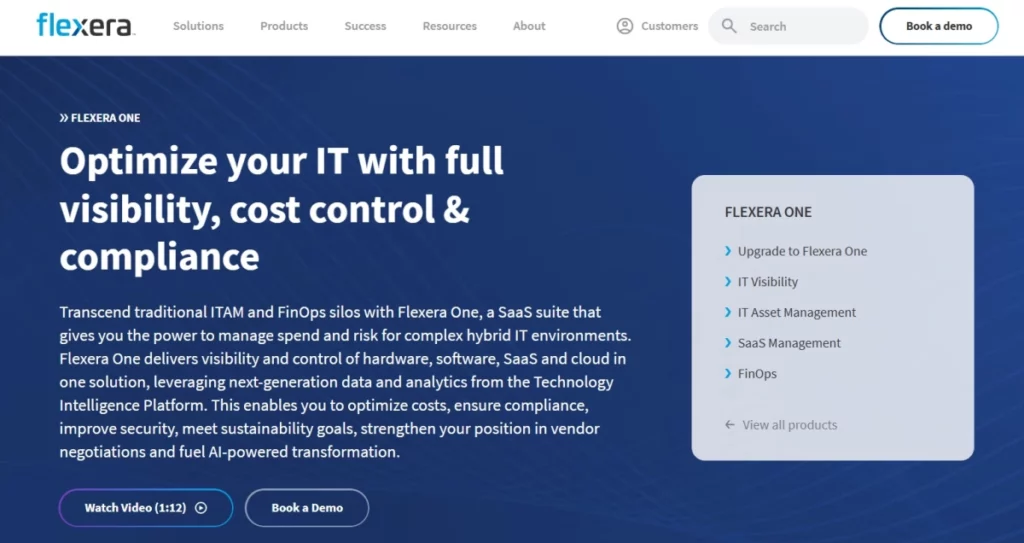
Best For: Large enterprises with heavy software spend, frequent vendor audits, and complex hybrid IT/Cloud environments
Audit trail features
- Tracks software deployments, usage trends, and consumption logs
Flexera One offers comprehensive tracking of software installations, usage patterns, and licensing consumption across the enterprise. The audit trail captures all relevant events, from initial deployments to ongoing usage, and provides detailed records of each asset’s lifecycle. - Deep audit trail capabilities for complex vendor licensing (Oracle, IBM, SAP)
Flexera One excels in environments with frequent vendor audits, offering deep visibility into license consumption, contractual obligations, and vendor-specific rules. Its audit capabilities extend to major software vendors like Oracle and IBM, ensuring enterprises are fully compliant during vendor audits. - Integrates with infrastructure monitoring tools for deeper telemetry
The tool integrates seamlessly with monitoring and cloud management platforms, offering enriched telemetry for assets running in hybrid or cloud environments. This integration extends the audit trail to infrastructure-level changes, ensuring that all asset events are tracked.
Compliance reporting features
- One of the strongest license optimization platforms in the market
Flexera One provides industry-leading software asset management (SAM) capabilities, offering automated license optimization and compliance reporting. It helps organizations track software usage and ensure they are neither over- nor under-licensed, minimizing audit risk and reducing unnecessary licensing costs. - Automatic reconciliation for contracts, entitlements, and true-up requirements
Flexera One simplifies the complex process of license reconciliation by automating the matching of software deployments to entitlements. This reduces the risk of non-compliance and ensures that businesses are always aligned with their software vendor agreements. - Detailed audit history tracking for external vendor audits
Flexera One is designed to support external audits, offering comprehensive audit history tracking that ensures businesses are always ready to meet vendor requests. Its detailed compliance reports provide transparency into licensing usage and entitlements, ensuring organizations can defend themselves during vendor audits.
Strengths
- Industry-leading SAM capabilities
Flexera One is widely regarded as one of the best platforms for software asset management, offering robust compliance reporting and license management.
- Comprehensive support for hybrid and multi-cloud environments
Flexera One supports all types of IT environments, including on-premises, hybrid, and multi-cloud infrastructures, making it ideal for global enterprises.
- Strong audit defense capability
Many large enterprises choose Flexera One to ensure audit readiness and defend against audits, thanks to its detailed tracking and reporting features.
Weaknesses
- Expensive and resource-intensive deployment and operation
The high implementation costs and ongoing operational requirements can be a barrier for smaller organizations.
- UI can feel clunky and overly complex
Some users find Flexera One’s user interface to be less intuitive compared to newer, more agile solutions.
- Overkill for mid-market organizations
For smaller businesses with less complex IT environments, Flexera One may offer more features than necessary, making it an expensive and cumbersome solution.
5. ManageEngine ADAudit Plus
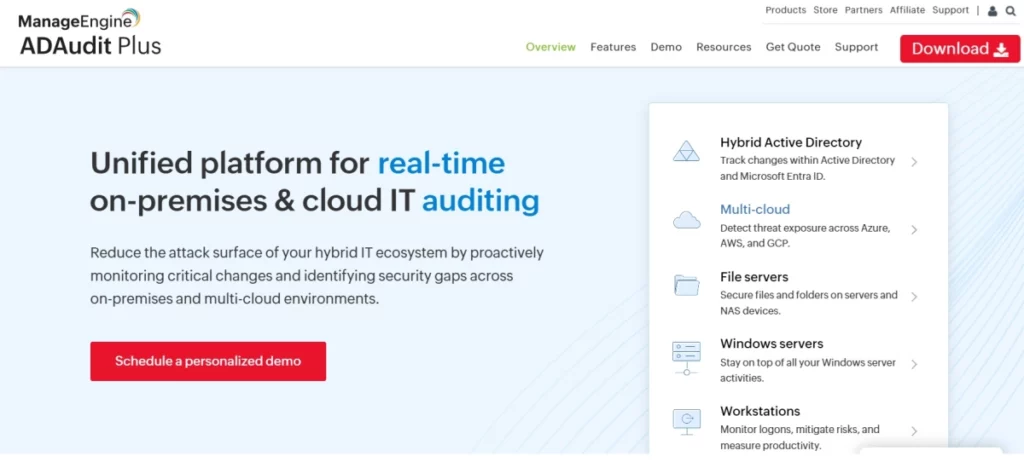
Best For: Mid-market businesses seeking a comprehensive solution for Active Directory auditing, identity governance, and compliance reporting.
Audit trail features
- Comprehensive Change Logging:
ADAudit Plus tracks all key changes within Active Directory, including user provisioning, password resets, group modifications, and permission changes. Each action is fully logged with timestamps and associated user/device information, ensuring complete accountability for all AD-related activities. - Detailed Event Tracking:
The tool captures granular events such as account creation, deletions, group membership changes, and login attempts. These logs help ensure traceability and provide a clear audit trail for forensic investigations and compliance audits. - Scheduled & Exportable Reports:
Admins can schedule automated reports and export them in various formats like PDF, XLSX, or CSV. Retention policies can be applied to ensure that audit logs are preserved for compliance audits, helping meet regulatory requirements.
Compliance reporting features
- Pre-built Regulatory Reports:
ADAudit Plus comes with out-of-the-box reports that align with major compliance frameworks, such as HIPAA, SOX, PCI DSS, and GDPR. These pre-configured reports simplify audit preparation and ensure your organization meets necessary compliance standards. - Custom Dashboards & Exports:
Users can customize dashboards to reflect key compliance metrics relevant to their department, region, or asset type. The platform also supports exporting data in formats that meet specific regulatory requirements. - Lifecycle & Access Automation:
The platform automates identity governance by integrating workflows for user onboarding/offboarding, access certification, and policy-based alerts. This reduces manual effort while ensuring consistent enforcement of compliance policies.
Strengths
- Robust Compliance Reporting:
ADAudit Plus provides detailed audit logs and pre-built compliance reports, which help organizations stay audit-ready and ensure continuous Active Directory monitoring. Users praise its ability to streamline compliance reporting, offering peace of mind during audits. - User-Friendly Interface:
The interface is intuitive and user-friendly, making it accessible for IT administrators of all technical skill levels. The easy navigation and role-based reporting features reduce training time and allow for quick adoption by users. - Ideal for SMBs:
ADAudit Plus is specifically designed to cater to mid-sized businesses. It offers the necessary compliance and identity management features without the complexity and high cost of enterprise-grade solutions, making it a great fit for SMBs.
Weaknesses
- Customer Support Concerns:
Some users have reported delays or challenges with support responsiveness, particularly during critical upgrade processes or troubleshooting, which could lead to downtime in some cases. - Limited Customization:
While ADAudit Plus offers flexibility, its UI and reporting tools may not provide the level of deep customization required by large enterprises or organizations with highly complex compliance needs.
Comparison table for Top ITAM tools in audit trail & compliance reporting
| Tool | Audit Trail Features | Compliance Reporting Features | Strengths | Weaknesses | Best For |
| EZO AssetSonar | Real-time, immutable audit logs; complete change tracking | Automatic license management and compliance reporting | Fast deployment, user-friendly, highly scalable | Limited advanced policy compliance templates | Mid-market enterprises, fast-growing teams |
| ServiceNow ITAM | Advanced logging, role-based access | Robust for enterprise-level software compliance | Excellent for large enterprises with complex workflows | Complex setup, expensive for small businesses | Large enterprises with complex ITAM needs |
| Ivanti Neurons for GRC | Comprehensive audit trail for compliance and risk management changes | Real-time compliance tracking, regulatory reporting, contract/license management | AI-driven insights, predictive risk analysis, customizable workflows | High implementation costs, steep learning curve, resource-intensive | Enterprises needing AI-driven GRC and risk mitigation |
| Flexera One | Strong integration with external monitoring tools | Excellent license compliance and audit history tracking | Comprehensive SaaS, hardware, and software support | Clunky interface, expensive | Large enterprises with heavy software use |
| ManageEngine ADAudit Plus | Tracks Active Directory and Microsoft 365 changes with full logs | Pre-built reports for HIPAA, SOX, GDPR, and more | Strong identity-based compliance, easy to use | Support responsiveness and limited UI customization | SMBs needing identity + asset compliance |
Why EZO AssetSonar is the ideal choice for audit trail & compliance reporting in mid-market companies
While there are several excellent ITAM tools available, EZO AssetSonar is the ideal choice for mid-market companies looking for an affordable, easy-to-deploy solution that offers a powerful audit trail and compliance reporting.
Here’s why EZO AssetSonar stands out for specific use cases:
Comprehensive audit trail
Best for: Organizations seeking reliable, transparent audit logs at an affordable price.
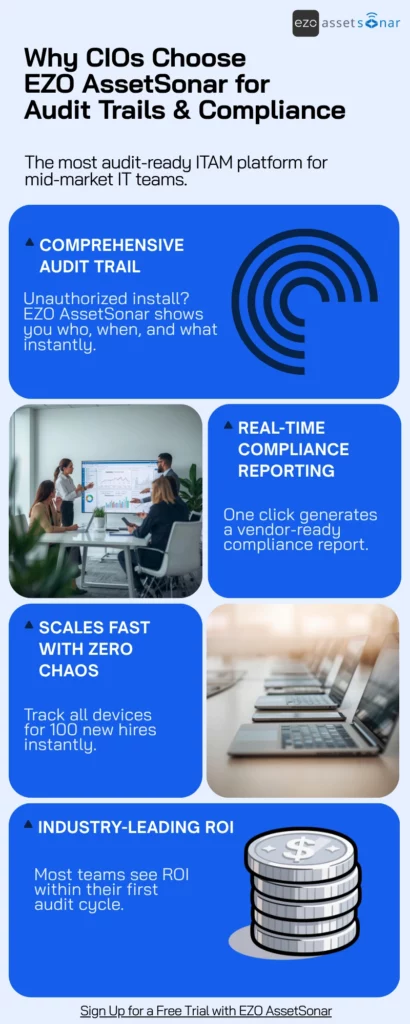
EZO AssetSonar records every change made to IT assets, from software installations to user access modifications. The unchangeable audit trail ensures data integrity and audit-readiness.
Example: If an employee installs an unauthorized application on a company laptop, EZO AssetSonar logs the exact time, user, and installation details. Your IT team can see it right away and use that information as clear evidence during audits.
When it may not be the best choice: For enterprises with highly complex IT infrastructures or those that need more granular tracking of non-IT assets (such as physical devices), other solutions might offer deeper insights.
Real-time compliance reporting
Best for: Companies needing to stay compliant with major standards without excessive complexity.
EZO AssetSonar offers real-time tracking of software licenses, hardware usage, cloud assets, and SaaS activity, ensuring your organization is always audit-ready. Compliance with frameworks like GDPR, SOC 2, and ISO/IEC 19770 is made easy.
Example: If a software company comes to audit you, EZO AssetSonar can instantly show how many licenses were purchased and how many are being used. This helps avoid penalties or disputes.
When it may not be the best choice: For organizations with diverse, complex software compliance needs, other ITAM solutions may offer more comprehensive, customizable compliance reporting capabilities.
Ease of use and scalability
Best for: Mid-market and fast-growing teams that need a simple, quick-to-deploy ITAM solution.
EZO AssetSonar excels in environments that require fast deployment and scalability across hybrid or multi-location teams. It’s designed for IT teams with limited time and resources to invest in complicated setups.
Example: A company onboarding 100 new employees can deploy the ITAM agent across all new devices within minutes and achieve complete hardware/software visibility without a complex setup or a dedicated admin team.
When it may not be the best choice: Large enterprises with very specific compliance or asset management requirements might find other ITAM solutions to be a better fit, as they offer greater customization and integration with existing enterprise systems.
ROI and affordability
Best for: Mid-market organizations or teams looking to achieve fast ROI without the overhead of more complex solutions.
EZO AssetSonar offers an affordable price point, quick implementation, and reduces manual audit work, making it an excellent choice for organizations that need enterprise-grade features without enterprise-level cost.
Example: Companies that switch from spreadsheets or legacy ITAM platforms often reduce audit preparation time by up to 70%, allowing IT teams to focus on bigger priorities rather than spending time on manual compliance work.
When it may not be the best choice: Larger enterprises or organizations with a wide array of IT assets and highly customized needs may benefit more from other ITAM solutions, which offer deeper AI-powered insights and greater customization for larger environments.
Best practices for audit-ready ITAM implementation
Consider these best practices to make sure your organization is always audit-ready:
1. Build compliance into the foundation
Embed audit trail and compliance requirements into your ITAM program from day one to reduce surprises and ensure audit readiness is not an afterthought.
2. Prioritize data accuracy and completeness
Maintain data quality by ensuring asset records are always up-to-date, complete, and standardized for reliable audit outcomes.
3. Automate audit reporting
Automate compliance reporting and configure the system to generate scheduled audit-ready reports, minimizing manual work and errors.
4. Enable cross-platform integrations
Integrate your ITAM software with ITSM, GRC, SIEM, and CMDB tools to create a centralized source of truth and streamline governance.
5. Conduct routine internal audits
Perform regular internal audits to proactively catch issues, reinforce compliance culture, and ensure you’re always ready for external reviews.
Trends and future of ITAM for audit and compliance
1. Cloud and SaaS sprawl
Gone are the days when the definition of “assets” was limited only to physical hardware. In today’s world, organizations are increasingly adopting cloud infrastructure and subscription-based SaaS tools.
Let’s consider an example here. A global marketing firm is using over 40 SaaS apps, including Salesforce, HubSpot, and Asana. The firm used an ITAM tool to centralize visibility, track subscription usage, and manage renewals. This helped the firm avoid shadow IT and duplicate licenses during an internal compliance audit.
2. Increased regulatory scrutiny
Governments and industry bodies are tightening regulations on software licensing, GDPR, HIPAA, and data security, increasing the stakes for non-compliance.
Let’s give you an example of a healthcare provider in the U.S. that uses an ITAM tool to maintain HIPAA-compliant records of all IT assets, including encrypted laptops and cloud-hosted EHR systems. This audit-ready documentation helped them pass a regulatory audit without penalties.
3. AI-driven ITAM
AI is being infused into ITAM platforms to increase predictive analytics, automate compliance workflows, and flag risks before they become serious.
Consider this example. A multinational consulting firm deploys AI-powered alerts within an ITAM tool to detect anomalies in software installations and usage patterns. This helped them proactively flag unlicensed software and generate real-time compliance reports for quarterly audits.
Hence, it is safe to say that audit trail and compliance reporting are essential components of modern IT asset management. Choosing the right ITAM tool can save time, reduce risks, and ensure compliance with regulatory frameworks.
While there are many options available, EZO AssetSonar is the best choice for mid-market companies due to its ease of use, scalability, and strong audit trail and compliance reporting features.
Start your ITAM journey today by signing up for a free trial and see how EZO AssetSonar can help you manage your IT assets more effectively.