


In rental businesses, equipment availability determines the course of operations.
Projects continue for the long term. Equipment is deployed across multiple locations. Some equipment is due for delivery. While some are “in transit.” When you receive a request from a contractor to replace an excavator or provide a new one, you should be able to answer these three questions:
- What’s the current location of the excavator?
- Is it available or awaiting service?
- Can it be reassigned without disrupting another contract?
The real problem arises when operations managers cannot determine the exact location of their rental equipment with certainty.
Location data becomes outdated as soon as your equipment leaves the yard. Manually checking the location of each piece of equipment can be time-consuming; by the time you find its exact location, it’s usually too late. At this point, decision-making can be flawed because it relies on manual data management rather than statistical analysis.
Location tracking should not be a hurdle you need to overcome. Let’s help you understand how you can accurately track your equipment location with GPS tracking without relying on manual checks.
What is GPS tracking in the heavy equipment rental industry
GPS tracking is not just about getting a live update on your equipment’s location. For rental businesses, this means going a step further by tracking your equipment as soon as it leaves the yard.
Many rental companies rely on telematics dashboards that pinpoint equipment’s location on a map. But this data usually lives in a system external to the company’s primary rental asset management system. This leads to another problem: Updating equipment data in two disparate systems that can be time-consuming and also create data siloes.
Heavy equipment rental companies need a system that brings rental equipment data and GPS information into one place. A system that connects live location data — often from telematics providers like Samsara, John Deere, and Hapn— directly into rental operations using APIs. Location updates flow automatically into asset records, orders, and availability status inside the rental system.
For heavy equipment companies, knowing whether equipment is at the jobsite, in the yard, or in the warehouse is critical. It helps determine whether the equipment can be reallocated or its utilization has maximized. In peak season, in particular, a lack of visibility into equipment utilization can pose a real threat, as rental companies may end up purchasing more equipment than is required. This not only requires a heavy investment but also requires resources that could have been used elsewhere. GPS tracking addresses this by providing an accurate picture of your equipment landscape, helping you make better decisions. And in heavy equipment rentals, facts move faster than phone calls ever could!
Why location tracking is a “Must-have” for heavy equipment rental companies
1. Automating equipment tracking
Heavy equipment is not like small rental equipment.
A generator’s disappearance will not affect your revenue. But a lost excavator will quickly turn into a massive loss. Take the example of a large transportation fleet. Hundreds of vehicles and trailers move in and out of a yard. Operations managers handling the equipment will not remember what location each trailer was delivered to. And that’s where problems start compounding:
- A delivery truck is marked “in transit” even though it’s been parked at a depot for two days.
- A trailer is reported missing, only to turn up at a secondary yard with no record of the transfer.
- Additional vehicles are approved for purchase because capacity looks maxed out, while underused trucks sit idle across the network.
Typically, equipment underutilization goes unnoticed, even though it is one of the most expensive operational problems. Records may not be updated regularly, which means assets may be marked as available on paper while they sit idle.
The current status of vehicles that are idle or in transit cannot be determined unless they are manually checked, requiring unnecessary guesswork. GPS tracking helps eliminate this guesswork by consolidating information in one place and showing the vehicle’s actual location. You do not need to worry about keeping manual records to check where your equipment is currently located; just check the map on the dashboard of your equipment rental software to see its most up-to-date location.
2. Overcoming the problem of “underutilization”
Revenue reports do not accurately reflect how well these assets are being used. Equipment that does not generate value may be overreported, thereby increasing operational costs. Their actual underutilization value would not be accurately reflected simply because the equipment’s movement was not tracked accurately.
This is where intelligent location tracking makes all the difference!
Simple location labelling does not tell the full story. It does not tell you in real time whether the equipment is in transit, at a yard, or moving without a warehouse. It helps determine whether your equipment has moved from one location to another, so you can let clients know its current location.
For instance, a fleet manager notices through GPS data that three delivery vehicles assigned to different regions have not moved in two days. Instead of assuming normal downtime, they investigate. It turns out that route demand dropped temporarily, but no one flagged the excess capacity.
With complete location visibility, those vehicles are reassigned to a high-demand corridor before additional rentals or purchases are considered.
3. Eliminating “Phantom demand”
One of the most common drivers of unnecessary purchases is perceived scarcity. Rental managers may decide to purchase new equipment when they believe that insufficient resources are available to meet current rental demand. And this might not always hold true!
Operations teams request additional assets because:
- They believe the fleet is fully deployed.
- They cannot confidently identify idle units.
- Asset movement is unclear across regions.
GPS tracking provides objective proof. According to EZRentOut’s State of the Rental Industry Report, 5.9% of respondents plan to implement GPS tracking to monitor the location of large fleets. This indicates a growing trend toward adopting GPS technology, so rental companies do not waste precious resources on manual location-tracking methods.
With GPS data, operations managers can analyze dwell time patterns:
- Which depots experience the longest idle gaps?
- Which customers consistently hold equipment beyond need?
- Where does equipment typically stall in the handoff process?
With this data, turnaround processes tighten. Assets return to circulation faster. Revenue per equipment increases without adding new inventory.
4. Faster mid-rental adjustments
Let’s suppose you get a call from a contractor saying that they need a generator at a construction site immediately. The generator may appear unavailable in the rental system, but in reality, it has been sitting idle at the warehouse without anyone’s notice. The rental system shows no availability until next week. Traditionally, this would mean either:
- Turning down the request, or
- Rushing to purchase or source externally at a higher cost.
But GPS tracking tells a different story.
The generator has not moved in 18 hours. It’s still marked as “active rental,” but it’s idle at a jobsite just 12 miles away from the new request. Without visibility into your equipment’s location, you cannot assess its exact position or verify whether it has moved. GPS tracking helps capture revenue by ensuring that every location is accurately tracked and monitored. Reflecting on whether the equipment has moved at all helps businesses make smarter allocation decisions.
5. Improved customer relationship management
The heavy equipment industry builds and nurtures on the values of trust and integrity. If a customer needs an update on the location of their booked equipment, you can quickly respond by checking its GPS coordinates. You would have access to the equipment’s live coordinates, and all you need to know is its location. When they call for an urgent swap or extension, they expect immediate clarity. Delays signal operational weakness. Quick answers help build trust.
With location visibility:
- Sales confirms availability instantly.
- Operations verifies proximity before committing.
- Delivery timelines are realistic and accurate.
This helps build client confidence and improve the turnaround time. Instead of teams struggling to immediately retrieve the equipment location, they simply see, decide, and act, so actions turn into money.

Why GPS tracking must be embedded in your rental system
Idle equipment and equipment theft are two reasons GPS tracking is important in the heavy equipment rental industry. Dominick Perez, the owner of DomCo Direct, says, “The GPS allows me to know where my equipment is at all times, and, of course, for theft prevention.” In certain areas, theft of heavy equipment could be a major concern. For instance,
- A bulldozer rented for a single jobsite suddenly travels 85 miles overnight.
- A generator assigned to a downtown construction project moves to a rural highway at 2:00 a.m.
- A trailer travels outside its approved operating region.
Those are not normal usage patterns. They indicate that the equipment is moving beyond the yard or warehouse.
1. Idle to income through visibility
Let’s take the example of an idle excavator ordered by an operations manager and requiring immediate adjustments to the order. Here’s a quantified breakdown of these “last-minute adjustments.”
Scenario: One Idle Excavator
- Average rental rate (heavy excavator): $1,200/day
- Idle time without GPS visibility: 2 days before retrieval
- Idle time with GPS-triggered reassignment: 4 hours
Without intelligent tracking:
2 days lost × $1,200 = $2,400 in lost revenue
And that’s just one unit.
Now scale that across:
- 40 similar assets
- Even 1 preventable idle day per asset per quarter
That’s:
40 × $1,200 × 4 quarters = $192,000 in preventable annual revenue leakage
And this doesn’t even factor in:
- Fuel and logistics waste
- Customer churn due to slow response
- Emergency third-party sourcing
Equipment underutilization compounds quietly. GPS tracking stops it early!
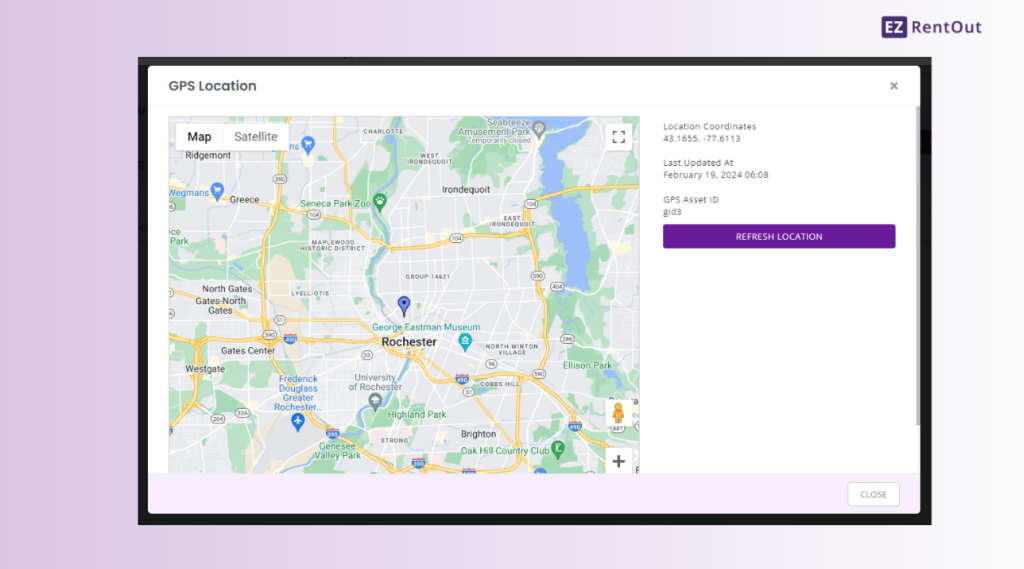
Rental software, like EZRentOut, offers a convenient way for heavy equipment businesses to benefit from GPS tracking by connecting to telematics platforms such as Samsara, Hapn, and John Deere. You can integrate your system with these platforms to sync equipment data. Once the data syncs, the location of your equipment, as marked on your rental platform, will automatically appear on the built-in location map. Not only that, you can check the location coordinates of each piece of equipment and assign a GPS ID to uniquely identify it.
When your location data lives outside a rental system, your team will not be able to notice inactivity, especially if the equipment is marked active or ready to dispatch in the records. The chances of incorrectly marking the equipment state are also high; for instance, the operations team might confuse two excavators with different IDs if they are not labelled properly. Submitting these to clients without properly verifying them can delay shipments and jeopardize your reputation.
With GPS tracking embedded in your rental system, you can identify which excavators are idling and which are on the move.
2. From loss to location
Expensive equipment and machinery are prone to theft due to their high resale value. With GPS tracking, you can also see how far your equipment travelled to reach a specific location. With distance tracking, you can see if your equipment leaves the geofenced zone, helping you quickly detect any suspicious activity.
Because the first 24-48 hours after equipment moves are highly critical, not knowing where your equipment was last time can make its recovery very difficult. GPS tracking shows the exact distance covered, the route taken, and the direction of the movement. This way, the recovery does not require chasing behind the equipment. Distance data turns theft response from reactive to strategic.
It also acts as a psychological deterrent. When customers and subcontractors know that equipment movement is being monitored and that location data is logged, the likelihood of unauthorized movement decreases.
Here’s a table explaining the risk posed due to the absence of a GPS tracking system:
| Example: A rental company operates 100 heavy machines, each worth an average of $90,000.One excavator disappears overnight. | |
| Without GPS | With GPS |
| Theft was discovered 18 hours later No movement history No route or direction data Asset potentially 200+ miles away Total impact: Asset loss: $90,000 Lost rental revenue (30 days × $1,200/day): $36,000 Insurance deductible + premium increase Total exposure: $125,000+ from one incident | At 2:07 a.m., the machine exits its geofenced jobsite. An alert triggers immediately. The system logs: Exact location Distance traveled Direction of movement By morning, law enforcement tracks it 52 miles away along a defined route. Recovery happens within hours. Loss avoided: $125,000+ |
Moving beyond just visibility: How GPS tracking offers more
GPS tracking is not solely about equipment tracking and enhancing its visibility. It’s about increasing operational control and intelligently handling your asset tracking operations.
It helps move beyond “where is my equipment” to answer questions like “what does movement data tell me about my business?” This is essential for managing equipment during peak seasons, especially when demand from specific project sites is particularly high. For example, if 60% of your excavators repeatedly move between two specific regions every quarter, that signals a permanent demand pattern. Instead of constantly shuffling equipment (and paying transport costs), you strategically reposition inventory.
This converts GPS tracking from a mere equipment-tracking technique to a strategic tool guiding operational decisions.
When GPS is integrated with a rental system, it provides a wide range of operational capabilities that can help prevent revenue leakage and also improve your overall ROI. Let’s see how:
1. Reducing transportation and fuel costs
In rental operations, equipment of any kind is mobile. It has to be moved from the warehouse to a jobsite to deliver what’s expected of it. Unlike stationary inventory, rental equipment constantly moves between yards, customer locations, and service facilities. Every unnecessary trip adds time, fuel costs, wear and tear, and opportunity cost which directly erode margins.
For instance, a misallocated piece of equipment might be sent on a 30-mile round trip only to discover that a different model was needed. In the same way, a trailer marked “available” in the system might already be sitting idle at a depot, but without GPS, another truck is dispatched unnecessarily.
These issues can occur when there is no system in place to consolidate and store equipment information accurately. By using GPS tracking integrated with a rental asset management system:
- Dispatchers know the exact real-time location of every asset.
- They can assign the closest available unit, avoiding wasted trips.
- They can plan efficient routes that minimize fuel and labor costs.
For example, 300 unnecessary miles per week per truck translates to $62,400/year. For rental businesses with dozens or hundreds of pieces of equipment, the savings multiply significantly.
2. SLA compliance and on-time equipment delivery
Construction clients operate on strict timelines. A delayed excavator or generator can stall an entire project, costing the contractor hundreds or even thousands per day. For rental companies, late deliveries not only risk client dissatisfaction but can also trigger billing disputes, penalties, or lost repeat business. This is where GPS tracking becomes critical.
GPS integration also ensures that equipment arrives at the correct location, not just anywhere within a city or region. It provides updates on when the equipment will be available. This helps ensure the equipment does not go missing en route and is available on time.
Also, disagreements over delivery times, rental periods, or usage are common in the heavy equipment industry. GPS logs provide an audit trail that protects both the rental company and the client.
For instance, a contractor claims a rental generator was not on-site during a critical night shift. GPS data proves the unit arrived hours earlier and remained on-site, avoiding a potential reimbursement or service credit.
3. Improved risk and insurance management
Insurance is a significant line item for heavy equipment rental businesses. Policies for high-value equipment like excavators and bulldozers are particularly expensive. Typically, insurers recognize GPS-monitored equipment as lower-risk items that are regularly monitored and therefore less likely to be stolen.
For instance, the annual premium for unmonitored equipment is $5000. The same excavator GPS tracking would cost $4,250 (15% discount). By adding location visibility, you could save $37,500 annually if you scale across 50 units.
Similarly, GPS provides a verifiable audit trail. If an asset is stolen, insurers will see the equipment’s location alerts, route history, and recovery efforts. This improves claim legitimacy and accelerates reimbursement.

4. Asset lifecycle and maintenance management
GPS not only shows where machinery is, but it also shows how fast it moves and what is in greatest demand. When integrated into your rental system, movement data helps answer:
- Which excavators are in constant high demand?
- Which machines sit idle for long stretches?
- Which regions cause the most wear and tear?
So, instead of planning calendar-based maintenance, you can schedule maintenance based on the equipment’s usage, i.e., how often it moves between locations. You can easily identify if a piece of equipment is frequently checked out to a specific location, so you can automate maintenance scheduling. Targeted maintenance significantly improves equipment lifespan and balances equipment usage across locations.
5. Increased internal coordination
In large rental operations, miscommunication can quietly erode efficiency and accountability. Your dispatch team may assume the yard released the equipment, the yard may believe the driver is en route, and the driver may claim scheduling delays, creating a cycle of “I thought it was delivered.”
Without a single source of truth, resolving these gaps takes time, phone calls, and manual verification. GPS tracking embedded in the rental system eliminates this ambiguity by creating a precise record of every piece of equipment’s movement. Managers can see exactly when equipment left the yard, when it arrived at the jobsite, how long it remained idle, and even track transfer timelines between locations.
This transparency strengthens internal discipline, streamlines workflows, and improves coordination across branches. Instead of relying on assumptions, teams operate on verified data, reducing operational friction and ensuring smoother, more accountable rental operations.
For example, a contractor calls at 9:15 AM, asking why the excavator scheduled for delivery at 8:00 AM has not arrived yet. The dispatch team believes it left on time. The yard confirms it was loaded. The driver insists they reached the site. Instead of escalating the issue, the operations manager checks the GPS log and sees that the machine arrived at 7:52 AM but was parked at the wrong entrance of a large construction site. The team immediately guides the driver to the correct access point, resolving the issue within minutes.
Conclusion: Visibility as a strategic revenue driver
In the heavy equipment industry, revenue does not just disappear. It quietly leaks through gaps caused by idle days, duplicate dispatches, billing disputes, theft, unnecessary purchases, and avoidable downtime. And all of these leaks are rooted in the same operational problem: lack of visibility.
When a rental system is used with GPS integration, it becomes more than a tracking tool. It becomes a powerhouse of visibility, strategy, control, and optimization, which are the real driving forces behind high revenue. For rental operations managers, that shift is powerful.
- Instead of reacting to problems, you prevent them.
- Instead of buying more equipment, you optimize what you already own.
- Instead of chasing missing assets, you track them strategically.
GPS converts equipment into revenue opportunities. Make the most out of your rental system by integrating it with GPS tracking providers and upgrade your rental operations.

![[How-to] Enable Location Tracking for Assets via API in EZRentOut](https://cdn.ezo.io/wp-content/uploads/2024/02/How-to-Enable-Location-Tracking-for-Assets-via-API-in-EZRentOut.png)
![[How-to] Get Started with EZRentOut: The EZ Way to Manage Rentals!](https://cdn.ezo.io/wp-content/uploads/2025/10/21081148/Getting-Started-Guide-With-EZRentOut-1-1.png)
![[How-To] Use Samsara Integration with EZRentOut for Automatic GPS Location](https://cdn.ezo.io/wp-content/uploads/2026/01/30074248/Samsara-Integration-1.png)