AssetSonar vs HaloITSM
Resolve Faster Without Configuration Overhead
While powerful, HaloITSM’s flexibility comes at a cost: workflows need to be built, context must be stitched together, and execution depends on how well everything is configured.
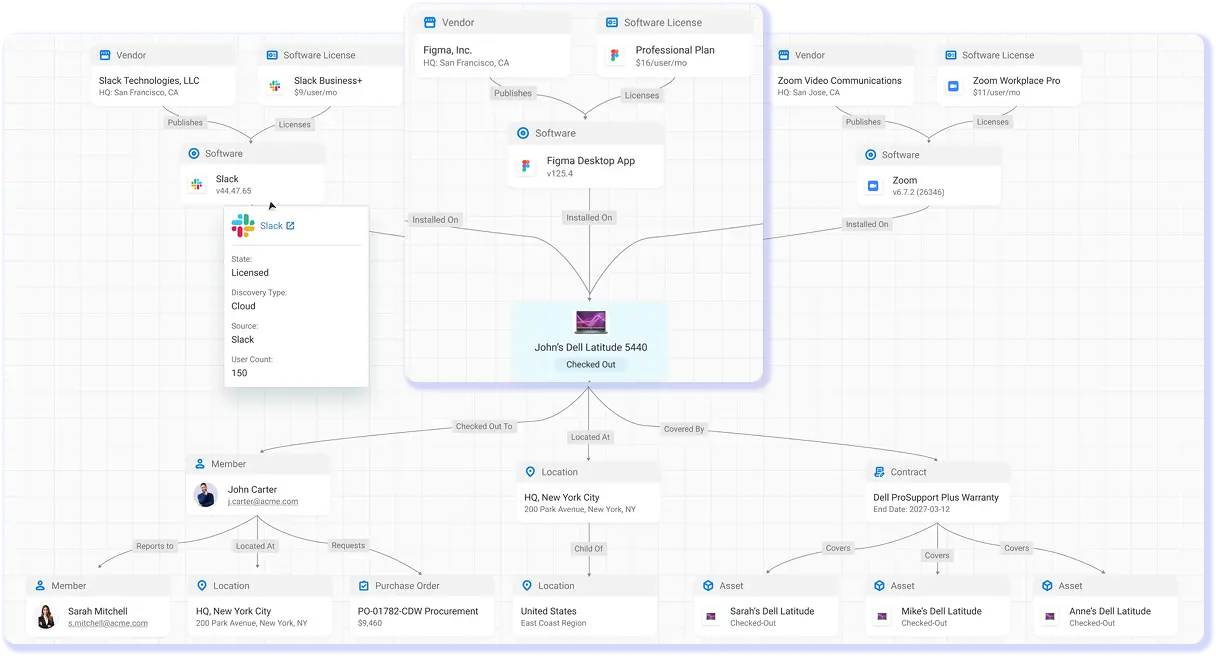
AssetSonar takes a different approach. It connects every ticket, workflow, and automation to a unified IT Graph of users, devices, software, and licenses, so work runs on real operational context; not configuration alone.
Less setup. Fewer manual steps. Faster resolution.
Trusted by Teams Running Modern Operations






AssetSonar vs HaloITSM: Head-to-Head Comparison
Product Comparison

|
Table Header
|
||
|---|---|---|
|
Incident Ticketing |
✔ |
✔ |
|
Service Catalog & Requests |
✔ |
✔ |
|
Knowledge Base |
✔ |
✔ |
|
SLA Dashboard & Escalations |
✔ |
✔ |
|
Workflow Automations |
✔ Execution-focused |
⚠️ Routing-focused |
|
Rule-based Approval Workflows in Service Requests |
✔ |
✔ |
|
Teams/Slack Ticket Intake |
✔ |
✔ |
|
Change Management |
✔ |
✔ |
|
Problem Management |
✔ |
✔ |
|
Release Management |
❌ |
✔ |
|
CMDB/CI Relationships |
✔ Robust Unified IT Graph |
✔ |
|
Real-Time Asset Context in Tickets |
✔ Native & Real-time |
⚠️ Via CMDB |
|
Asset Lifecycle Tracking |
✔ Full Lifecycle |
⚠️ CMDB-Based |
|
Hardware Discovery |
✔ Continuous & Normalized |
⚠️ Integration-Based |
|
Scheduled Returns & Reservations |
✔ |
⚠️ Limited |
|
Warranty + Contracts Tracking |
✔ |
⚠️ Limited |
|
Purchase/Procurement Tracking |
✔ |
✔ |
|
Location Hierarchy/Nested Locations |
✔ |
⚠️ Limited |
|
License Tracking & Compliance |
✔ Built-in |
⚠️ Via Asset Records |
|
SaaS Discovery/Visibility |
✔ |
⚠️ Via integrations only |
|
Software Usage Metering |
✔ |
❌ |
|
Automated Software Normalization |
✔ |
❌ |
|
Native Patch Management |
✔ |
⚠️ Via N-able Package |
|
Shadow IT Visibility |
✔ |
❌ |
|
ITSM Reporting & Dashboards |
✔ |
⚠️ Limited |
|
API + Integrations |
✔ API-first |
✔ 200+ integrations |
|
AI Capabilities |
✔ Context-aware |
✔ Broad AI layer |
|
Custom Roles/Access Controls |
✔ |
✔ |
|
Table Header
|
|
|---|---|
|
Incident Ticketing |
|
|
✔ |
✔ |
|
Service Catalog & Requests |
|
|
✔ |
✔ |
|
Knowledge Base |
|
|
✔ |
✔ |
|
SLA Dashboard & Escalations |
|
|
✔ |
✔ |
|
Workflow Automations |
|
|
✔ |
⚠️ |
|
Rule-based Approval Workflows in Service Requests |
|
|
✔ |
✔ |
|
Teams/Slack Ticket Intake |
|
|
✔ |
✔ |
|
Change Management |
|
|
✔ |
✔ |
|
Problem Management |
|
|
✔ |
✔ |
|
Release Management |
|
|
❌ |
✔ |
|
CMDB/CI Relationships |
|
|
✔ |
✔ |
|
Real-Time Asset Context in Tickets |
|
|
✔ |
⚠️ |
|
Asset Lifecycle Tracking |
|
|
✔ |
⚠️ |
|
Hardware Discovery |
|
|
✔ |
⚠️ |
|
Scheduled Returns & Reservations |
|
|
✔ |
⚠️ |
|
Warranty + Contracts Tracking |
|
|
✔ |
⚠️ |
|
Purchase/Procurement Tracking |
|
|
✔ |
⚠️ |
|
Location Hierarchy/Nested Locations |
|
|
✔ |
⚠️ |
|
License Tracking & Compliance |
|
|
✔ |
⚠️ |
|
SaaS Discovery/Visibility |
|
|
✔ |
⚠️ |
|
Software Usage Metering |
|
|
✔ |
❌ |
|
Automated Software Normalization |
|
|
✔ |
❌ |
|
Native Patch Management |
|
|
✔ |
⚠️ |
|
Shadow IT Visibility |
|
|
✔ |
❌ |
|
ITSM Reporting & Dashboards |
|
|
✔ |
⚠️ |
|
API + Integrations |
|
|
✔ |
✔ |
|
AI Capabilities |
|
|
✔ |
✔ |
|
Custom Roles/Access Controls |
|
|
✔ |
✔ |
Legend:
✔ = Explicitly offered
❌ = No clear public evidence
⚠️ = Supported, but dependent on configuration, integrations, or narrower scope

Why AssetSonar?
While HaloITSM is built to deliver broad ITSM coverage on a single platform, AssetSonar is built to solve a different problem: why do service teams still struggle to execute, even with a full ITSM suite?
The gap is a siloed context. Service data lives in one system, while asset reality lives somewhere else.
Halo helps manage service processes. AssetSonar connects those processes to devices, software, ownership, and lifecycle so tickets don’t just move forward, they drive real operational outcomes.
If your priority is ITSM breadth, Halo checks the boxes. If your priority is execution, visibility, and control, AssetSonar powers how your IT actually runs.
What We Bring to the Table

Automation That Executes, Not Just Routes
AssetSonar executes the outcomes required of tickets. Powered by real-world asset and software context, it automates the groundwork that IT spends hours scrambling to do, such as provisioning access, enforcing entitlements, and triggering asset-driven actions so tickets get completed rather than queued.
HaloITSM, on the other hand, automates ticket movement through robust workflows.

Context-Aware AI Diagnostics
HaloITSM promotes a broad AI layer that includes ticket clustering, AI triage, knowledge generation, and virtual agents.
AssetSonar doesn’t try to out-hype that. Instead, it fixes the foundation first. In AssetSonar, automation runs on real-world asset and software contexts, with AI supporting diagnosis, recommendations, and resolution, so workflows are already grounded in operational data.
Without context, AI relies on patterns. With context, it can guide more accurate and actionable decisions.
Less Configuration, More Control
HaloITSM offers extensive configurability, which gives teams flexibility in designing workflows. In practice, this can require ongoing setup and administrative ownership as systems scale.
AssetSonar reduces that dependency by embedding asset and software context directly into workflows, helping teams standardize execution of repeatable workflows with nimble, low-code configuration.
Customer Testimonials


Proven by users, Recognized by G2





Reduce Ticket Load. Resolve Issues With Context Built In.
Frequently Asked Questions
HaloITSM is known for its flexibility and configurability, which allows teams to tailor workflows, forms, and processes to their exact requirements. This makes it a strong option for organizations with defined ITIL processes or dedicated admin resources.
However, that flexibility can also mean more time spent on initial setup, greater reliance on configuration guides and documentation, and ongoing admin ownership to maintain and evolve workflows.
AssetSonar takes a more structured approach. Because asset, software, and service data are already unified, many workflows come pre-aligned with real operational context. This reduces the need for extensive configuration and allows teams to get up and running faster.
In practice:
- HaloITSM offers more flexibility, with a higher setup and configuration investment
- AssetSonar offers faster time-to-value with less dependency on ongoing configuration
The right choice depends on your priorities i.e. customization depth vs operational simplicity and speed.
HaloITSM offers solid asset tracking through its CMDB, making it effective for linking assets to tickets and managing service relationships. It works well when asset data is primarily used to support ITSM workflows.
However, its capabilities are more focused on tracking and relationships rather than deep lifecycle or software asset management. Advanced areas like SaaS visibility, usage tracking, and license optimization are limited or require additional tools.
AssetSonar, on the other hand, is built as a dedicated ITAM + SAM platform. It provides deeper lifecycle control, real-time software visibility, and asset data that actively powers workflows.
In short: Halo helps you track assets for service. AssetSonar helps you manage and act on them end-to-end.
HaloITSM can go beyond basic ticket routing and support provisioning workflows, but this typically relies on runbooks, scripts, or integrations with external systems (e.g., identity providers or MDM tools).
Out of the box, its automation is strongest in:
- Ticket routing
- SLA-based actions
- Approvals and workflow triggers
Provisioning (like user access or software deployment) is possible, but usually requires additional configuration and integration setup to execute reliably.
AssetSonar takes a more execution-first approach.
Because workflows are already tied to real-time asset, user, and software context, provisioning actions such as access control, license assignment, or lifecycle-based triggers can be automated directly within the system without heavy setup.
In short: Halo can automate provisioning, but it often needs to be built out. AssetSonar enables provisioning as part of native, context-driven workflows.
Steep setup and learning curve
Many users highlight that Halo is powerful but complex, requiring significant time to configure properly and understand workflows.
Heavy reliance on configuration
Its flexibility can become a drawback. Teams often need to design and maintain workflows themselves, which can get messy over time.
Requires admin ownership
In real-world setups, teams often need a dedicated admin or partner to implement and manage the system effectively.
Inconsistent integrations and data sync
Users report that some integrations (especially asset/data syncing) can be unreliable or require custom workarounds.
Performance and stability issues (in some cases)
There are mentions of slow responsiveness, timeouts, or bugs, particularly in more complex environments.
HaloITSM is powerful but many downsides come from the same place: High flexibility → higher complexity, setup effort, and ongoing maintenance.
That’s why buyers often ask not just “Can Halo do this?” but “How much work will it take to make it work?”
HaloITSM:
- Setup can be configuration-heavy, especially when tailoring workflows, reports, and permissions
- Teams often need to rely on guides, partners, or dedicated admins to get things right
- Complexity increases with scale (multiple teams, departments, integrations)
- Some setups (e.g., reporting/data access) can feel tedious or require technical workarounds
AssetSonar:
- Initial effort goes into data cleanup and standardization (assets, users, licenses)
- Teams need to align processes to a unified system rather than customizing everything
- Less configuration overhead but requires discipline in data hygiene upfront
Bottom line
- HaloITSM challenges = configuration complexity + setup effort
- AssetSonar challenges = data readiness + process alignment
👉 Halo takes more effort to configure the system
👉 AssetSonar takes more effort to get your data right but runs smoother after
Several enterprise ITSM platforms offer strong integration ecosystems. These tools can connect with identity providers, endpoint management systems, collaboration tools, and other parts of the IT stack.
HaloITSM stands out for its broad, all-inclusive integration library, making it easy to connect multiple systems within a service-first environment.
AssetSonar, on the other hand, focuses on deeper, operational integrations linking asset, software, and service data into a unified system. This allows workflows to not only integrate across tools but also execute actions based on real-time context.
In complex environments, the key difference isn’t just the number of integrations, it’s how effectively those integrations support end-to-end IT operations and automation.
Yes. AssetSonar not only matches HaloITSM’s asset-tracking capabilities but also significantly extends them. HaloITSM provides CMDB-based asset tracking that links assets to tickets and service workflows, which works well for service visibility.
AssetSonar goes further as a dedicated ITAM + SAM platform. It offers full asset lifecycle tracking, real-time software visibility, license management, usage insights, and audit-ready history—all connected to service workflows. This means assets aren’t just tracked. They actively power automation, decisions, and resolution.
In practice: Halo helps you track assets for service context, while AssetSonar helps you manage and act on them across the entire lifecycle.
AssetSonar takes a more automated, data-driven approach to maintaining asset and configuration data compared to HaloITSM.
HaloITSM offers CMDB capabilities and workflow automation, but keeping data accurate often depends on how well integrations and configurations are set up, sometimes requiring ongoing manual oversight.
AssetSonar continuously syncs asset and software data through integrations and discovery sources, reducing the need for manual updates. Workflows then run on this real-time data, keeping records accurate by default.
In practice: Halo helps structure your CMDB, while AssetSonar helps keep it automatically updated with minimal manual effort.
Both AssetSonar and HaloITSM offer mobile access for technicians to manage tickets and updates on the go. HaloITSM focuses primarily on service workflows—allowing technicians to view, update, and resolve tickets remotely.
AssetSonar extends mobile access beyond ticketing by providing real-time asset context in the field, including device details, ownership, software, and history. Technicians can scan assets, verify information, and take action without switching systems.
In practice: Halo helps technicians manage tickets remotely, while AssetSonar enables them to resolve issues faster with full operational context in hand.
Which ITSM solutions offer CMDB functionality similar to HaloITSM for multi-location operations?
Several ITSM platforms offer CMDB capabilities to manage assets and configuration items across multiple locations.
HaloITSM provides a structured CMDB with relationship mapping, making it effective for tracking assets and dependencies across distributed environments. This works well for maintaining service context across locations.
AssetSonar takes a broader approach by combining CMDB-like relationships with real-time asset lifecycle tracking, ownership visibility, and software context across locations. This ensures that data is not only mapped, but continuously updated and actionable.
In multi-location environments: Halo helps you organize and visualize assets, while AssetSonar helps you manage and act on them consistently across sites.
