



ITSM Built for 360° IT Service Delivery
AssetSonar runs IT in a real-asset context, bringing structure, control, and consistency to every workflow. No fragmented tools. No disconnected workflows. Just ITSM that actually works with ITAM. Zendesk serves employees, but lacks IT depth at scale.
Trusted by Teams Running Modern IT Operations


AssetSonar vs Zendesk: Head-to-Head Comparison
Product Comparison
|
Table Header
|
||
|---|---|---|
|
Incident Ticketing & Management |
✔ |
✔ |
|
Service Catalog & Request Fulfillment |
✔ |
⚠️ Forms-based |
|
Knowledge Base & Self-Service Portal |
✔ |
✔ |
|
SLA Management & Escalation Rules
|
✔ |
✔ |
|
Workflow Automation |
✔ |
✔ |
|
Approval Workflows in Service Requests |
✔ |
✔ |
|
Change Management |
✔ |
⚠️ Not a primary pillar |
|
Problem Management |
✔ |
⚠️ Limited |
|
ITSM Reporting & Dashboards |
✔ |
⚠️ Limited in lower tier plans |
|
Multi-Channel Support (Email, Portal, Teams, Slack) |
✔ |
✔ |
|
AI-Powered Ticket Routing & Triage |
✔ |
✔ |
|
AI Copilot for Agent Productivity |
✔ In-built |
⚠️ Add-on |
|
AI-Powered Diagnostics |
✔ |
❌ |
|
ITIL-Aligned Service Processes |
✔ |
✔ |
|
Purpose-Built for IT Teams |
✔ |
❌ |
|
Native IT Operations Context |
✔ |
⚠️ Via integrations |
|
IT-Specific Reporting & Compliance Dashboards |
✔ |
⚠️ Limited |
|
CMDB/Configuration Management |
✔ |
❌ |
|
Service Discovery |
✔ |
❌ |
|
Table Header
|
|
|---|---|
|
Incident Ticketing & Management |
|
|
✔ |
✔ |
|
Service Catalog & Request Fulfillment |
|
|
✔ |
⚠️ |
|
Knowledge Base & Self-Service Portal |
|
|
✔ |
✔ |
|
SLA Management & Escalation Rules |
|
|
✔ |
✔ |
|
Workflow Automation |
|
|
✔ |
✔ |
|
Approval Workflows in Service Requests |
|
|
✔ |
✔ |
|
Change Management |
|
|
✔ |
⚠️ |
|
Problem Management |
|
|
✔ |
⚠️ |
|
ITSM Reporting & Dashboards |
|
|
✔ |
⚠️ |
|
Multi-Channel Support (Email, Portal, Chat) |
|
|
✔ |
✔ |
|
AI-Powered Ticket Routing & Triage |
|
|
✔ |
✔ |
|
AI Copilot for Agent Productivity |
|
|
✔ |
⚠️ |
|
AI-Powered Diagnostics |
|
|
✔ |
❌ |
|
ITIL-Aligned Service Processes |
|
|
✔ |
⚠️ |
|
Purpose-Built for IT Teams |
|
|
✔ |
❌ |
|
Native IT Operations Context |
|
|
✔ |
⚠️ |
|
IT-Specific Reporting & Compliance Dashboards |
|
|
✔ |
⚠️ |
|
CMDB/Configuration Management |
|
|
✔ |
❌ |
|
Service Discovery |
|
|
✔ |
❌ |
Legend:
✔ = Explicitly offered
❌ = Not offered or documented
⚠️ = Supported with limitations
Why AssetSonar?
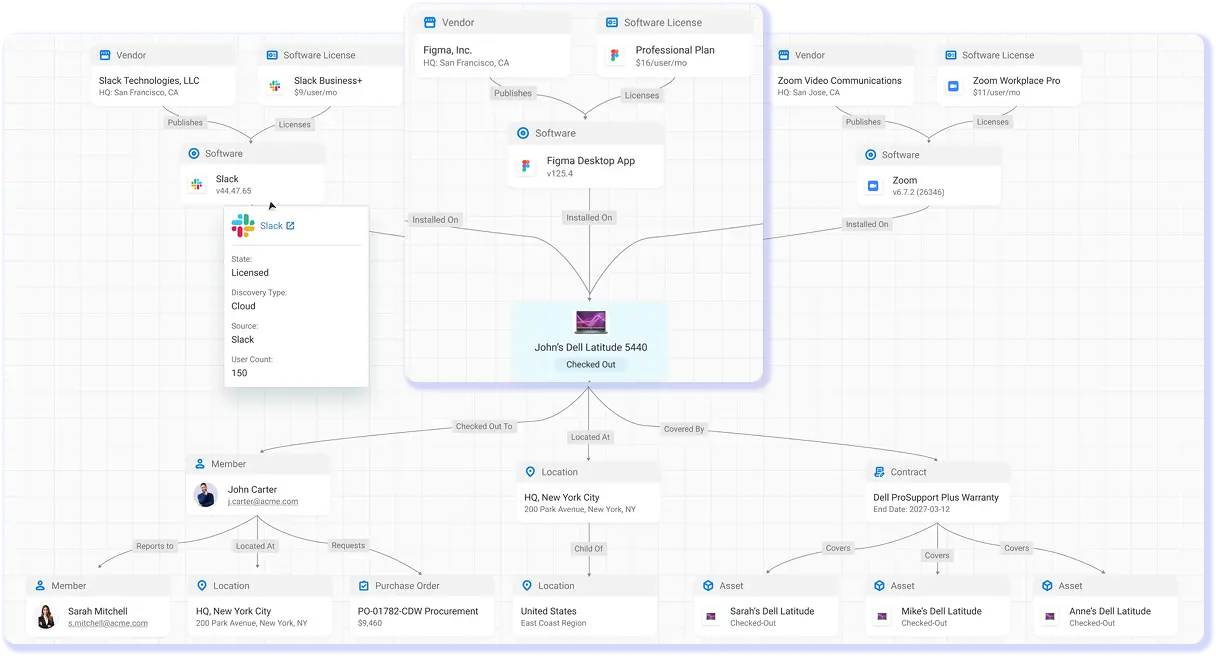
Why stop at internal customer-level support? Take a step beyond Zendesk and experience AssetSonar’s complete ITSM suite, powered by its native ITAM functionality. Its unified IT Graph, contextual AI, and service management workflows built on ITAM depth provide broader operational control across hardware, software, ownership, lifecycle, and execution.
What We Bring to the Table
Built For IT, Not Borrowed From CX
Mid-market IT teams don’t just need tickets to move; they need operations to execute. AssetSonar is purpose-built for IT, with ITSM built on a native ITAM foundation. Every workflow runs with a real device, software, and lifecycle context already in place. Zendesk takes a different path. It extends a customer-service platform into IT, layering asset data via custom objects and add-ons rather than building a service on top of it.
AI Grounded in IT Context, Not Bolted On
More Than Just Ticketing and Approvals
Ready to move beyond ticketing and approvals? AssetSonar gives mid-market IT teams scaling up full ITSM coverage, including incident, change, and problem management, built into a single system. Run automated workflows where escalations, approvals, and routing happen intelligently and on time, without heavy setup or ongoing configuration.
Zendesk can handle service workflows, but often relies on configuration layers to support more complex ITSM processes. AssetSonar keeps it simpler, structured, fast, and powered by real context.
Customer Testimonials
Proven by users, Recognized by G2
Run Help Desk Ops Beyond Tickets
Frequently Asked Questions
AssetSonar and Zendesk differ in how they approach ITSM. Zendesk is a customer-service-first platform adapted for internal support, making it strong for ticketing, self-service, and quick adoption. However, deeper ITSM workflows often rely on configuration, custom objects, or add-ons.
AssetSonar is purpose-built for IT, with ITSM running on a native ITAM foundation. This means incidents, requests, and automation are enriched with real asset, software, and lifecycle context from the start.
For mid-sized IT teams, Zendesk improves support operations, while AssetSonar enables more structured, context-driven ITSM as complexity grows.
Yes, AssetSonar is a strong alternative to Zendesk for IT teams, especially those needing more than just ticketing. Zendesk excels at customer-style support workflows, but AssetSonar goes further by combining ITSM with deep asset visibility and lifecycle context.
It enables teams to manage incidents, requests, and automation with real-time insight into hardware, software, and ownership, improving accuracy and decision-making.
For IT teams dealing with growing complexity, AssetSonar offers a more structured, context-driven approach, while Zendesk is better suited for simpler, support-focused environments.
Zendesk does not offer a traditional, fully native CMDB like dedicated ITSM platforms. While it provides basic asset management capabilities such as creating asset records and linking them to tickets, these are typically modeled using custom objects, fields, or integrations.
Zendesk can support configuration management workflows to some extent, especially when integrated with external CMDB or ITAM tools. However, for deeper configuration management such as relationship mapping, dependency tracking, and lifecycle governance, teams often rely on third-party integrations rather than built-in functionality.
In short, Zendesk supports lightweight asset tracking, but full CMDB capabilities usually require extensions or external systems.
A dedicated ITSM platform for mid-market IT teams should include core capabilities like incident, request, change, and problem management, along with SLA tracking and a structured service catalog. It should offer workflow automation for routing, approvals, and escalations to reduce manual effort.
Strong reporting and dashboards are essential for tracking performance and improving operations. A knowledge base and self-service portal help deflect tickets and improve user experience.
Most importantly, the platform should provide contextual visibility by connecting tickets to assets, users, and services, enabling teams to resolve issues faster and scale operations without added complexity.
Zendesk scales well for growing teams in terms of ticket volume, user expansion, and multi-channel support, making it a strong choice for improving internal service experience. However, as IT environments become more complex, teams may need additional tools or integrations to maintain visibility and consistency.
AssetSonar is built to scale with operational complexity, not just volume. It provides unified visibility across assets, software, and service workflows, helping teams maintain accuracy, control, and compliance as they grow.
In short, Zendesk scales support operations, while AssetSonar scales structured ITSM with connected data and control.
Yes, AssetSonar natively combines asset lifecycle management with ITSM workflows in a single system. It tracks assets from procurement through retirement, linking them directly to incidents, requests, and service workflows.
This means every ticket is enriched with real-time context—such as device details, software, ownership, and dependencies—so IT teams can resolve issues faster and more accurately.
By connecting asset data with service activity, AssetSonar ensures lifecycle visibility and incident management work together seamlessly, reducing manual effort and improving operational control.
Yes, AssetSonar is built to scale with both team growth and operational complexity. As professional services firms expand, IT environments become more distributed and workflows more structured. AssetSonar supports this by connecting incidents, requests, and automation to real asset, software, and lifecycle data, ensuring consistency as volume increases.
Its unified approach reduces reliance on multiple tools and manual coordination, helping lean IT teams maintain control without added overhead.
As a result, AssetSonar not only handles growth in ticket volume but also ensures service quality, visibility, and governance improve as the organization scales.
AssetSonar offers more context-driven workflow automation, where actions are triggered based on real asset, software, and lifecycle conditions; not just ticket data. This allows professional services firms to automate escalations, approvals, and resolutions with greater accuracy and consistency as operations grow.
Zendesk provides strong automation for ticket routing, AI-assisted responses, and deflection, helping teams manage high ticket volumes efficiently . However, its automation is primarily focused on service interactions rather than on a deeper IT operational context.
In short, Zendesk automates support workflows, while AssetSonar automates end-to-end IT processes with real-world context.