




Meet the help desk that knows your IT from day one.

Assetsonar Vs Jira Service Management

Workflows Don’t Fix IT. Context Does.

AssetSonar enables teams to execute flexible workflows in real-world IT conditions. Every request, approval, and automation runs on live assets, software, and ownership context, so work doesn’t just move forward; it gets resolved accurately.

No Credit Card Required

Trusted by Teams Running Modern Operations

AssetSonar vs Jira Service Management: Head-to-Head Comparison

Product Comparison

Ezo assetsonar logo
Jira Service Management
Ezo assetsonar logo

Jira Service Management

Table Header

Incident Management

Service Catalog & Request Fulfillment

Knowledge Base & Self-Service

(Via Confluence)

SLA Management & Escalations

Workflow Automation

Approval Workflows

Change Management

Problem Management

ITSM Reporting & Dashboards

Multi-Channel Support (Email, Portal, Chat)

AI-Powered Ticket Routing & Triage

Virtual Service Agent/AI Deflection

AI-Powered Diagnostics

⚠️
Limited

Workflow Automation Builder

Assets/CMDB

CI Relationship & Dependency Mapping

Asset Discovery (Agent + Agentless)

Native ITAM Foundation

⚠️
Not modeled separately

Software Governance & License Visibility

⚠️
Not a documented pillar

Native Patch Management

Table Header

Incident Management

Service Catalog & Request Fulfillment

Knowledge Base & Self-Service


SLA Management & Escalations

Workflow Automation

Approval Workflows

Change Management

Problem Management

ITSM Reporting & Dashboards

Multi-Channel Support (Email, Portal, Chat)

AI-Powered Ticket Routing & Triage

Virtual Service Agent/AI Deflection


AI-Powered Diagnostics

⚠️

Workflow Automation Builder

Assets/CMDB

CI Relationship & Dependency Mapping

Asset Discovery (Agent + Agentless)


Native ITAM Foundation

⚠️

Software Governance & License Visibility

⚠️

Native Patch Management

Legend:

= Explicitly offered

= No clear public evidence

⚠️ = Supported, but dependent on configuration, integrations, or narrower scope

Why AssetSonar?

AssetSonar connects ITAM and ITSM into a single system, so every incident and request runs on a live model of users, devices, and software, not just ticket fields and rules. While Jira Service Management brings flexibility and deep integration within the Atlassian ecosystem, this flexibility relies on configuration and add-ons to build context across tools.
AssetSonar removes this dependency. Workflows execute on real asset state, ownership, and software context, so routing, escalation, and resolution happen with full visibility, and IT operations run on connected data, not stitched-together systems.

What We Bring to the Table

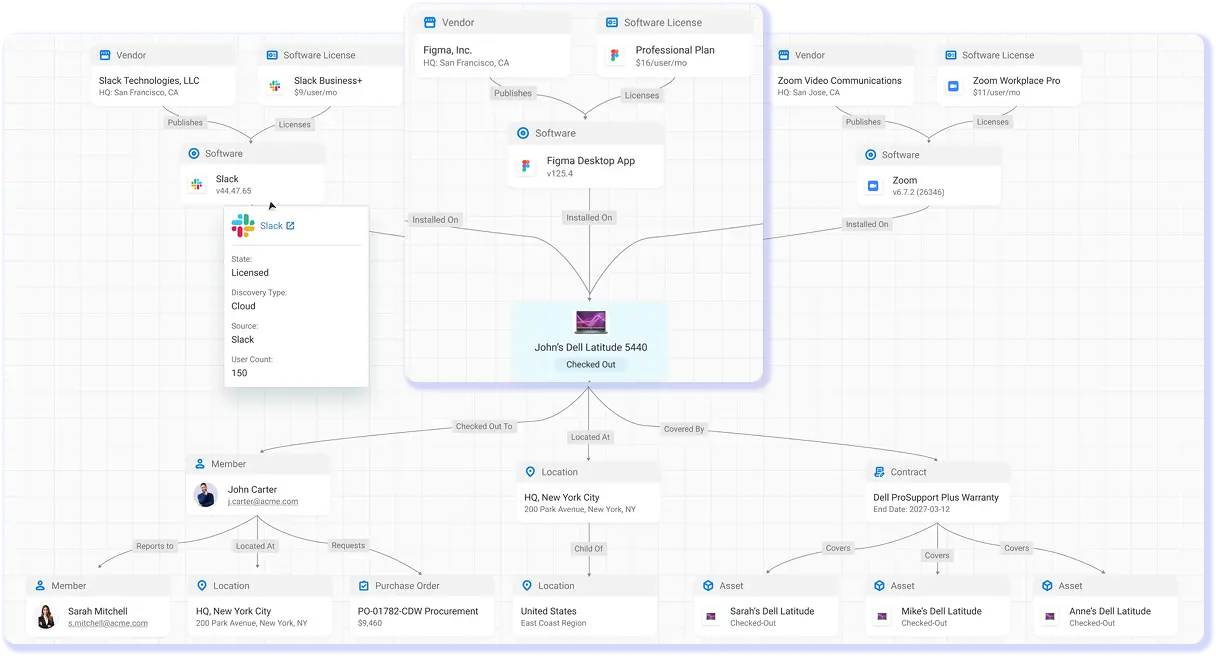
IT Graph showing asset, software, license, vendor, contract, and user relationships.

Flexibility Rooted in IT Context

AssetSonar gives you built-in context, while Jira Service Management gives you flexibility if you’re willing to configure it through add-ons and ecosystem integrations. Teams often have to build and maintain workflows, stitch together context, and rely on multiple systems to keep data in sync.
AssetSonar removes that layer. ITSM runs directly on a unified model of users, devices, and software, so processes align with ITIL best practices without heavy configuration. Resolutions are driven by real infrastructure context rather than by how well workflows were configured.

Automation That Executes on Real IT Conditions

Want automation that executes on real operational conditions, not just ticket rules? AssetSonar runs ITSM on a unified IT graph, triggering workflows based on asset state, software compliance, lifecycle stage, and ownership, not just ticket fields.
Jira Service Management provides powerful rule-based automation. But those rules depend on how well workflows are configured and how accurately context is maintained across systems. AssetSonar removes that dependency. Workflows execute on live infrastructure data, so routing, escalation, and remediation reflect what’s actually happening in your environment, not just what’s been defined in a rule.

Software Governance Built into IT Service

AssetSonar embeds software usage, license status, and compliance directly into every ticket and request. That means approvals, escalations, and remediation are made with real-time visibility into what’s installed, who’s using it, and whether it’s compliant.
Jira Service Management can surface asset data through integrations, but that context often lives across systems and depends on how well it’s maintained. AssetSonar removes that gap. Software governance isn’t referenced; it’s executed within the workflow itself.

Customer Testimonials

Proven by users, Recognized by G2

AssetSonar consistently ranks among the top solutions for improving IT Asset and Service Management with real-time asset visibility, software governance, and IT control.
Business-Software.
Best Meets Requirements.
Momentum Leader.
Mid Market Leader
Trusted vendor badge

Run Workflows With Real Asset Context

Eliminate the guesswork and resolve issues faster with AssetSonar so ticketing and helpdesk decisions are driven by real system conditions, not just predefined logic.

Frequently Asked Questions

The core difference lies in how each platform approaches IT operations.

Jira Service Management is an ITSM-first platform, offering flexible workflows and deep integration within the Atlassian ecosystem. It often relies on configuration, add-ons, and integrations to connect asset data and operational context.

AssetSonar takes an ITAM-first approach, where ITSM is built on a unified model of users, devices, and software. This means every ticket, workflow, and automation runs on real asset context, not just ticket data.

The result is less configuration overhead, more accurate execution, and IT operations that scale on connected data rather than stitched-together systems.

SLA managment in Jira Service Management is highly flexible, with customizable SLAs based on ticket fields, priorities, and workflow states. It’s powerful but often depends on how well rules and configurations are set up.

AssetSonar supports SLA tracking and escalation as well, but with a key difference: SLAs are enforced using real-time context from assets, users, and service conditions.

This means priorities, routing, and escalations can adjust based on factors like asset criticality, ownership, or compliance status; not just ticket inputs.

The result is SLA management that’s more aligned with actual operational impact, reducing manual overrides and improving response accuracy as environments scale.

Yes, AssetSonar is an effective enterprise ITSM solution for CMDB and licensing because it doesn’t treat them as separate add-ons.

Traditional ITSM tools often require dedicated CMDB modules and separate licensing tiers to manage configuration data and software entitlements.

AssetSonar, by contrast, builds CMDB capabilities directly into its ITAM foundation. Assets, users, software, and licenses are automatically connected in a unified model, giving teams real-time visibility into configurations and entitlements without additional licensing layers.

This approach simplifies governance, reduces cost complexity, and ensures workflows, automation, and compliance tracking run on accurate, continuously updated data.

Both platforms support multi-site IT operations, but they approach it differently.

Jira Service Management offers strong flexibility for managing multiple teams, projects, and service desks across locations, often relying on configurations and integrations to unify data and workflows.

AssetSonar, by contrast, manages multi-site operations through a unified ITAM-first model. Assets, users, locations, and service workflows are all connected in a single system, giving teams consistent visibility and control across sites without stitching together multiple layers.

This means standardized processes, location-based asset tracking, and workflows that execute with full context; helping distributed teams operate more efficiently as they scale.

AssetSonar supports structured change management workflows, but its advantage isn’t just in workflow design. It’s in execution.

Unlike platforms such as Jira Service Management, where change workflows rely heavily on configured rules and approvals, AssetSonar ties changes directly to a live model of assets, software, and dependencies.

This means impact analysis, approvals, and execution can be driven by real-time context—like affected devices, software versions, or ownership—rather than static ticket data.

The result is more accurate change planning, fewer unintended disruptions, and workflows that align with actual infrastructure conditions, not just predefined processes.

A mid-market IT team should choose AssetSonar when they need ITSM to run on real asset context, not just ticket workflows.

Jira Service Management is a strong fit for teams already invested in the Atlassian ecosystem and looking for highly customizable workflows. But it often requires configuration, add-ons, and integrations to connect asset and service data.

AssetSonar is the better choice when you want a unified ITAM + ITSM platform where assets, users, and software are already connected.

This reduces setup overhead, improves automation accuracy, and enables faster, more consistent resolution, especially for teams scaling operations without adding complexity.

AssetSonar offers strong knowledge management capabilities, but its advantage lies in how that knowledge is used.

It includes a centralized, structured knowledge base for articles, FAQs, and troubleshooting guides, helping teams standardize information and enable self-service. But more importantly, this knowledge is directly tied to tickets, assets, and workflows—so agents get relevant guidance in context, not just static documentation.

Traditional ITSM platforms (like Jira Service Management) also offer robust knowledge bases, often with strong content management features.

The difference is that AssetSonar connects knowledge to real asset and service context, making resolutions faster and more consistent rather than just better documented.

Yes, AssetSonar does offer customization for ITSM workflows, but it’s designed to balance flexibility with execution.

Teams can configure workflows using triggers, conditions, and actions, link forms to tickets, tasks, approvals, and define routing logic based on specific inputs or scenarios.

However, unlike traditional ITSM tools that rely heavily on manual workflow design, AssetSonar’s customization is grounded in its ITAM foundation. Workflows can adapt based on real-time asset data—like device status, ownership, or software compliance—rather than just ticket fields.

This means you still get flexibility, but with less configuration overhead and more reliable execution driven by actual IT context.