

Imagine this: it is the end of the quarter, and you are auditing your rental equipment. You discover that the excavator generating the most revenue is unexpectedly unprofitable. The equipment has been generating higher-than-expected expenses, draining your profits without you even realizing it. You dig deeper into it only to discover a blind spot: poorly calculated depreciation.
Without fully realizing how quickly your equipment has been depreciating, your business continues to underprice it and spend heavily on repairs. Your balance sheets show a slow revenue leak that disrupts your cash flows and revenue.
Accurately calculating depreciation is key to making wiser decisions regarding rental equipment management. Depreciation is not just an accounting tool to account for your business’s profitability; it is a vital decision-making tool that guides repair and replacement decisions.
This blog provides a breakdown of rental equipment depreciation, common challenges in its calculation, and how miscalculated depreciation can slow down your operations.
What is rental equipment depreciation?
Rental equipment depreciation refers to the gradual decline in the value of rental equipment due to wear and tear, obsolescence, and frequent use. The cost of the equipment is spread over its useful life, making it easier for businesses to manage their equipment effectively and make informed equipment replacement decisions.
The purpose of calculating depreciation is to help rental businesses understand how much value an asset loses over time and to ensure the cost of using the equipment is correctly reflected in rental rates and pricing strategies.
By calculating depreciation, rental companies can:
- Set rental prices that cover costs and margins
- Decide when to repair vs. replace equipment
- Forecast cash flow and asset lifecycle costs
For instance, if a $50,000 generator has an estimated useful life of 5 years and a salvage value of $5,000, the annual straight-line depreciation would be:
(50,000−5,000) ÷ 5 = 9,000 per year
This $9,000 is considered an annual expense, helping the business recover the asset’s cost over its useful life.
Depreciation methods used in the rental industry
Picking the right method for calculating your rental equipment depreciation forms the foundation of your revenue calculations. Every rental business uses a different depreciation method based on its fleet size, industry, rental model, tax strategy, and usage data.
The following are the key depreciation methods for calculating the rate at which your rental equipment is losing its value:
1. Straight-Line depreciation
Straight-line is the most commonly used method for calculating depreciation. The asset loses value evenly across its useful life.
Formula:
(Purchase Cost−Salvage Value)÷Useful Life
AV media rental companies, healthcare equipment rental companies, and general equipment rental companies are more than likely to use this depreciation method. The main reasons for businesses choosing straight-line depreciation method are:
- It’s simple, predictable, and makes financial planning easier
- Works well for equipment with consistent usage patterns
- Helps stabilize rental pricing year over year
Example: A $40,000 forklift with a 10-year useful life and $5,000 salvage value depreciates by $3,500 per year.
For fleets with steady demand, such as forklifts, generators, and skid steers, this method works well.
2. Declining Balance depreciation
The equipment loses more value in the early years and less as it ages. Rental businesses use the Declining Balance Depreciation method to calculate accelerated depreciation. This type of depreciation is best suited for enterprises that manage heavy equipment, such as excavators, boom lifts, cranes, and high-tech inspection equipment.
The main reasons for using this method include:
- Heavy equipment often loses value faster in the first few years
- Matches real-world usage patterns where wear-and-tear is front-loaded
- Helps with long-term tax benefits due to early higher depreciation expense
- Useful for assets that quickly become outdated or lose resale value
Equipment that is highly utilized early in its life benefits from accelerated depreciation.
3. Units of Production
Depreciation measured using the Units of Production method is based on actual usage (hours, miles, cycles).
Formula:
(Purchase Cost−Salvage Value) ÷ Total Expected Usage
Then multiply by the actual hours used each year. Rental businesses use this depreciation method due to the following reasons:
- Most accurate method for high-variation utilization
- Reflects real, operational wear rather than time
- Ideal for equipment rented hourly or heavily in some seasons
This depreciation method is the most suitable for the following types of equipment:
- Excavators measured in operating hours
- Trucks measured in mileage
- Compressors measured in cycles
Example: If a skid steer is expected to run 10,000 hours in its lifetime and it runs 1,200 hours in a year, depreciation is recorded only for those 1,200 hours.
4. Sum-of-the-Years’ Digits (SYD)
SYD is an accelerated depreciation method in which depreciation is higher in the early years and decreases over time. Rental businesses use this depreciation method for the following reasons:
- Useful when assets rapidly lose value at the start
- Helps align depreciation with high initial maintenance and repair costs
- Better matches the actual value drop of specific heavy equipment
This method is less common but can be beneficial for high-wear assets.
5. Tax-specific depreciation (MACRS in the U.S.)
Many rental businesses use tax-based depreciation methods, such as the Modified Accelerated Cost Recovery System (MACRS), for reporting because they allow accelerated depreciation early on.
Tax-specific depreciation helps rental businesses improve their cash flow, especially in the early years of fleet ownership, and offsets the cost of investing in new equipment. Higher depreciation in early years equates to significant tax savings and improved fleet optimization.
Factors influencing equipment depreciation
Several factors influence depreciation, which impacts your cash flows and rental operations:
1. Usage and utilization
The more frequently a piece of equipment is rented, the more likely it is to depreciate. High equipment utilization contributes to wear and tear on the machinery, whether it’s a heavy-duty excavator digging through rough terrain or a compact generator powering an event.
Understanding the relationship between utilization and depreciation is crucial for guiding your rental pricing strategies. If you monitor equipment utilization, it becomes easier to schedule and manage maintenance based on how the equipment is actually being used.
2. Age of equipment
The depreciation of an older piece of equipment accelerates faster as it is prone to extensive wear and tear. Physical damage, rough handling, and heavy loads can deteriorate equipment’s condition, reducing its lifespan.
3. Maintenance practices
The frequency of maintenance for your equipment determines how quickly it wears and tears. Well-maintained equipment lasts longer than poorly maintained equipment. Regular inspections, properly lubricated machines, and sticking to manufacturer manuals for use can generate consistent revenue for rental businesses.
For example, imagine a skid steer rented daily but serviced only occasionally. Over time, minor issues like hydraulic leaks or worn tracks compound into major mechanical failures, prompting your rental company to either replace or sell the equipment earlier than expected.
4. Technological obsolescence
Depreciation starts to eat into your profits when your rental equipment is outdated, i.e., not up to date with technological advances. Your customers would not want to rent equipment that is old and obsolete, as it is less likely to be efficient and productive. Technologically obsolete equipment will eventually fully depreciate as a newer, more effective model replaces it.
To manage this risk, rental businesses must stay informed about industry trends, plan for timely fleet upgrades, and adjust their rental pricing strategies to reflect the competitive landscape. Integrating technological forecasting into depreciation calculations enables rental operators to make informed decisions about when to retire, sell, or replace equipment, ensuring their fleet remains profitable and attractive to customers.
5. Market value and equipment demand
Rental equipment in higher demand depreciates more slowly, particularly certain types such as skid steers, forklifts, and generators. This type of heavy equipment holds greater value due to its high utilization and serves as a steady source of income. Usually, such equipment is sold at a higher price at the end of its useful life.
However, equipment that’s not frequently used or rented out tends to depreciate faster as newer versions replace older equipment, reducing revenue.
Top 7 depreciation KPIs for an equipment rental business
In addition to considering factors influencing depreciation, an equipment rental business needs to actively track KPIs and financial metrics to assess equipment performance while accounting for depreciation. Here are some top KPIs:
| KPI | Definition / Formula | Relevance to Depreciation & Rental Business |
| Equipment Utilization Rate | (Time Rented ÷ Total Available Time) × 100% | High utilization helps recover asset cost faster and reduces the relative impact of depreciation per rental period. |
| Depreciation Expense per Asset/Per Hour | Annual Depreciation ÷ Hours of Use | Tracks actual cost of using equipment, informs pricing, and ensures depreciation is covered in rental rates. |
| Book Value/Net Asset Value (NAV) | Purchase Cost – Accumulated Depreciation | Shows the current financial value of equipment, guiding replacement and investment decisions. |
| Maintenance-to-Depreciation Ratio | Total Maintenance Cost ÷ Depreciation Expense | Indicates if assets are being over- or under-maintained relative to their declining value. Helps balance upkeep with depreciation. |
| Return on Asset (ROA)/ Asset Profitability | Net Profit from Asset ÷ Book Value of Asset | Measures the efficiency of each asset in generating profit relative to its depreciating value. |
| Fleet Age/Average Age of Equipment | Sum of Equipment Ages ÷ Number of Assets | Older fleets typically incur higher depreciation and maintenance; tracking age helps schedule timely replacements. |
| Residual Value Realization/ Salvage Value Recovery | Actual Resale Value ÷ Estimated Residual Value | Compares estimated versus realized asset value; identifies accelerated depreciation or poor asset management. |
Tracking essential depreciation KPIs helps rental equipment businesses calculate optimal rental rates, ensuring they yield the right amount of revenue. You can better plan the use of your equipment by knowing which pieces are approaching the end of their life and which are in high demand, making informed purchase decisions accordingly.
Depreciation is not just an accounting tool; it’s a strategic approach to budget planning, capital expenditure forecasting, and more intelligent decisions about equipment use and disposal—efforts geared toward enhancing your rental revenue.
How miscalculated depreciation impacts rental operations
Miscalculated depreciation poses a long-term impact on your fleet. It not only disrupts the flow of operations but also creates a ripple effect that affects how you set your rental rates. Miscalculations result in lower or higher-than-expected rental rates, prompting potential customers to turn to your competitors.
Incorrect depreciation calculations can lead to:
1. Distorted equipment valuation
For any rental business, actively tracking equipment depreciation is crucial for evaluating the equipment’s actual financial value and, in turn, determining revenue. Equipment rental businesses rely heavily on the value of their equipment to decide on their rental rates and utilization patterns.
Imagine you own a rental company that purchased a boom lift for $80,000 with an expected useful life of 8 years and a salvage value of $8,000. Using straight-line depreciation, your annual depreciation is:
(80,000 − 8,000) ÷ 8 = 9,000 per year
This means the boom lift loses $9,000 in value every year, or around $25 per day.
If you set your rental price at $120/day without considering this depreciation rate, you may be earning a healthy margin. But after subtracting depreciation ($25), maintenance ($15), insurance ($5), and operating overhead ($20), your real profit is only:
120 − (25 + 15 + 5 + 20) = 55 per day
If depreciation had been miscalculated, say you assumed it was only $5,000/year, you would end up overestimating your profit. Consider the drastic impact this would have on your rental operations, while your books present a misleading image of your profitability.
2. Skewed maintenance scheduling
A significant portion of a rental company’s costs may be dedicated to maintaining its equipment. Scheduling errors can lead to increased maintenance costs and accelerated equipment depreciation. Similarly, the impact is two-way. If wear and tear is not recorded on time, the equipment’s servicing and repairs would be delayed, potentially slowing operations.
The risk of equipment failure also increases significantly as downtime increases and equipment utilization decreases.
3. Poor cash flow forecasting
Depreciation miscalculations disrupt cash flows and create budgeting blind spots. For instance, if your excavator is not regularly checked for anomalies or potential malfunctions, the cost of replacing parts can suddenly be overwhelming.
Depreciation planning helps rental businesses track depreciation alongside maintenance schedules and forecast revenue by accounting for unexpected breakdowns, regularly servicing equipment, and adjusting equipment utilization to maintain steady cash flows. Depreciation reports generated by rental asset management software help standardize depreciation methods throughout the useful life, enabling accurate revenue and expense forecasting.
4. Compliance-related issues
Rental businesses need accurate depreciation plans not only for internal planning, but also to stay compliant with regulatory requirements. This particularly applies to rental companies, which regularly file taxes and prepare for audits. Depreciation calculations help rental businesses stay audit-ready and comply with accounting standards, such as GAAP (Generally Accepted Accounting Principles) or IFRS (International Financial Reporting Standards).
Additionally, if you use rental equipment management software to calculate and manage depreciation, you can remain compliant with GDPR regulations.
5. Insufficient capital allocation
Accurate depreciation helps rental businesses determine when to repair, refurbish, or replace equipment. Miscalculations can lead to inefficient capital allocation in two ways.
If depreciation is underestimated, aging equipment may remain in service longer than it should, resulting in higher maintenance costs, unexpected downtime, and reduced customer trust. On the other hand, overestimating depreciation can cause businesses to replace equipment prematurely, tying up capital unnecessarily and missing the opportunity to maximize returns from assets that still have usable life.
In both scenarios, miscalculated depreciation disrupts strategic investment decisions, limiting the company’s ability to allocate resources effectively toward new or high-demand equipment and ultimately impacting long-term growth.
5 best practices to manage the depreciation of your rental fleet
Identifying your equipment categories and ensuring that their depreciation is accurately recorded is vital to creating comprehensive depreciation records.
1. Choose the right depreciation method
The depreciation method you choose depends on the type of equipment you want to depreciate. Each piece of equipment differs in type, use, and expected useful life. Therefore, not every depreciation method can accurately estimate your equipment’s salvage value; you need to select the appropriate method.
For example, heavy machinery such as excavators and forklifts experience wear and tear based on usage hours, making the units-of-production method more accurate. Meanwhile, equipment that loses value quickly and early can be depreciated using the declining balance method. If an asset has a long, stable lifespan, the straight-line method might be the best option.
Any rental equipment business must assess the type of equipment it owns and how rapidly it ages to ensure its values are reported accurately.
Reporting distorted numbers disrupts reporting workflows and also impacts your taxable income. For instance, accelerated depreciation results in higher deductions from revenue and lower taxable income. On the other hand, straight-line depreciation ensures steady revenue flows.
Choosing the right depreciation method makes all the difference! It determines how you manage your expenses, choose the right rental pricing strategy, and align your depreciation calculations with revenue.
2. Track equipment utilization
Track equipment utilization periodically to assess which pieces are used more frequently. Monitoring utilization goes beyond simply knowing how often an item is rented; it involves tracking hours of operation, workload intensity, and even the type of tasks it performs. High-utilization equipment, such as excavators or generators, naturally experiences greater wear and tear, accelerating depreciation compared to lightly used assets.
By closely tracking utilization, rental businesses can:
- Adjust depreciation models to more accurately reflect the actual decline in asset value. For example, a heavily used excavator may require an accelerated or usage-based depreciation method rather than a straight-line approach.
- Schedule preventive maintenance more effectively to reduce the risk of breakdowns that can accelerate depreciation and increase repair costs.
- Make informed pricing decisions by ensuring rental rates reflect the faster depreciation of high-usage equipment.
Tracking the utilization of your equipment is beneficial not only for calculating depreciation but also for maximizing and optimizing your equipment use.
3. Invest in a rental equipment management software
The key to building an intelligent rental equipment fleet and achieving accurate depreciation numbers is investing in equipment rental software. Rental software like EZRentOut is beneficial for a business like yours as it provides a consolidated platform for creating and operationalizing your rental catalog. All you need to do is populate your account with information about your depreciable equipment, select the depreciation method, and the software will automatically calculate the depreciation rate.
Automatic depreciation calculation is vital to saving time and resources, as managing the depreciation of a large fleet can be time-consuming and tedious. The solution serves as a single source of truth, consolidating rental schedules and maintenance logs in a single location. This allows managers to see an asset’s current value, remaining useful life, and maintenance status at a glance. This real-time visibility helps make informed decisions about pricing, repairs, or replacements.
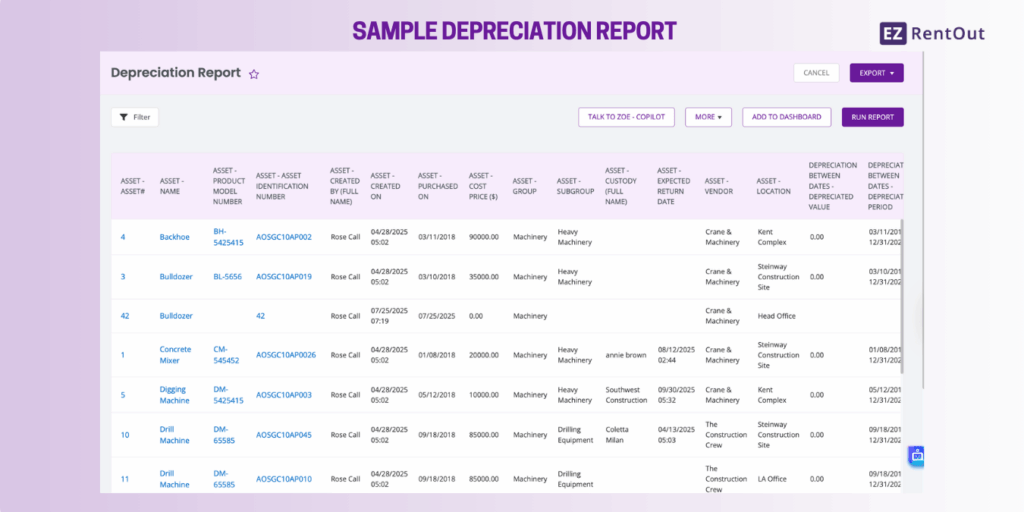
You can also build audit-ready depreciation reports to guide operational and financial decision-making.
The following image shows a sample depreciation report in EZRentOut:
4. Depreciation-based rental strategies
Your rental strategies can be guided by how quickly your equipment depreciates over time. Your rental rates need to account for the depreciation of your equipment. Inability to do that results in your business absorbing the expenses and making lower-than-expected profits.
For instance, consider a generator that costs $10,000, has a useful life of 5 years, and is expected to be rented for 1,000 hours over that period. Its per-hour depreciation would be:
Depreciation per hour = 1,00010,000 =10 USD/hour
If you set the hourly rental rate below this, you would incur a loss, and your depreciation would not be accurately reflected in your pricing.
So, depreciation-informed rental pricing helps ensure your rates are accurate and you are not incurring a loss.
5. Assess the valuable life of a piece of equipment
The salvage value of equipment keeps changing, as does its helpful life. Both these factors are based on the extent to which you use it. Some equipment may lose value quickly than others due to extensive wear and tear.
For example, a skid steer may have a useful life of 10 years, but in reality, it may lose its value after 7 years due to harsh, intensive use. If a rental business continues to depreciate its value for 10 years, it risks losing profits due to unrecovered costs.
By regularly reviewing the actual value of equipment, rental businesses can:
- Maintain accurate depreciation schedules that reflect real asset performance
- Make better pricing decisions that cover both operating costs and the decline in asset value
- Plan timely replacements and avoid costly surprises from unexpected failures or low resale returns
- Align fleet management with market realities, keeping the business competitive and profitable
Keep detailed maintenance logs and track the hours your equipment is used to accurately record its useful lifespan. Additionally, perform regular inspections and maintenance checks to compare the actual useful life of your equipment with the records, helping to prevent financial discrepancies.
Turning depreciation into a strategic advantage
Depreciation is an ongoing expense that affects your revenue and rental business operations. Every process and workflow of equipment procurement needs to be accurately recorded to avoid missing depreciation expenses.
As an equipment rental business, an error like a depreciation miscalculation can prevent your items from fully generating revenue. By simply automating depreciation calculations, you can turn an accounting tool into a revenue-driving strategy for your rental business.