


If you build software for heavy equipment rentals in industries like construction, you learn a simple truth fast. Features matter; people matter more.
Companies that thrive with our product aren’t necessarily the biggest or flashiest. They’re the ones that have something tangible at stake, equipment in the yard, teams in the field, and customers who depend on them. They don’t just need software that “works.” They need a partner who listens.
And this notion is very much rooted in reality!
It reminds me of one of my clients, who ensured every month that their company’s actual item count matched what the system showed; my client was tired of having to print a list of all their in-stock items and do a stock check with pen and paper. Except they only mentioned it somewhat in passing because they believed this was just how things had to be; that the annoyance they experienced was part of the job, and that my job was to listen to his one-and-a-half-liner, nod, and move on.
Instead, Item Audits were brought to EZRentOut so that my client won’t have to bring out that pesky pen and paper for stock checks ever again. That’s the power of human connection in the realm of rental software.
They speak, we listen! But that’s not where it ends. We go a step further and implement what might be considered a minor frustration.
Why customer success matters in the equipment rental industry
In industries like construction, manufacturing, and oil and gas, technology adoption doesn’t happen in a vacuum. These businesses move physical assets, operate on tight schedules, and juggle multiple responsibilities. When a single asset goes missing or a dispatch slips through, it’s not a minor hiccup; it’s a day lost on-site.
That’s why customer success isn’t optional here. It’s the bridge between a powerful system and a busy team that just needs it to work.
Here’s how it works in my job:
A significant portion of EZRentOut’s, our rental asset management software, user base comprises complex, multi-department organizations. These are companies where procurement teams, maintenance crews, logistics coordinators, accountants, and sales reps all rely on the same system to keep daily operations moving.
Typically, there’s a primary point of contact who keeps me (their Account Manager) informed about the company’s broader goals, evolving expectations, and how the software supports their overall workflow. But the real heart of Customer Success lies beyond that singular voice.
- It’s in the mechanic working late in the garage to get an offline truck repaired, relying on accurate service records.
- It’s in the accountant pulling financial data at month-end, expecting numbers to match down to the cent.
- It’s in the warehouse coordinator juggling inventory counts under pressure.
- It’s in the salesperson who needs quick access to availability to close deals on time.
They are all connected to the system through one Customer Success Manager. Each user, while part of an interconnected web, has a unique experience with EZRentOut and unique problems throughout the workday.
And this is where human-led Customer Success wins: by recognizing that every user is not just “a seat,” but a person with a job to do, a workflow to protect, and a problem that feels urgent to them. A practical CSM approach is based on the realization that every user is essential, and their issues are all equally valid, no matter how small or big. By recognizing their pain points and addressing them with intellect and care, you make the customer a champion, make every user feel valued, and convert the software into a partner that their entire organization believes in.
That’s why rental companies rely so heavily on their Customer Success Managers! They are the true support of SaaS-based companies, tying up loose ends and acknowledging customers’ struggles.

Mid-market is where software gets used deeply
Small teams are heroic. They move fast, solve problems on the go, and often run their entire rental business from a single desk. Their needs are about speed, simplicity, and visibility, getting quotes out quickly, tracking what’s out on rent, and making sure money comes in on time.
Mid-market companies, on the other hand, begin to add structure. They have a fleet lead. A maintenance coordinator. Someone who runs their accounting functions. The same product that feels heavy for a one-person shop becomes powerful when there’s a team sharing ownership.
That’s where modules like Work Orders, Purchase Orders, Custom Roles, APIs, and accounting integrations stop being “extra features” and start running the business.
Every company deserves software that fits how they work. For smaller teams, that means fewer clicks and faster setup. For mid-market firms, it means deeper functionality and richer collaboration.
Customer success sits right in the middle, making sure each finds the balance that keeps them moving forward.
One of our clients, a test equipment provider, is an excellent example of a large team with clearly defined departments and responsibilities, which is why it took full advantage of EZRentOut’s Custom User Roles feature to further segment user access controls. Individual teams and team members had maximum visibility into the aspects most relevant to them, while workshop technicians did not have access to rental/retail operations, and vice versa.
The Challenge: Balancing complexity and care
EZRentOut is no doubt a feature-rich platform; powerful but naturally layered. That means our customers sometimes face a learning curve before the product feels intuitive.
Customer success, then, becomes about translation: turning complexity into clarity.
A great example of this that I can remember is of one of our clients in the transportation rental industry who used EZRentOut’s Recurring Order functionality. Experience had already taught me that the feature seems a little daunting at first. But there’s a magic moment with some clients, when you demonstrate a feature that solves a problem that they didn’t know they had.
“This was exactly what we needed, and I hadn’t even thought of it… This is so cool,” said the company’s rental equipment manager.
It’s moments like these that remind me of the challenges Customer Success Managers go through. They need to develop a unique balance between complexity and care; quite simply, understanding the challenges customers face and addressing them with utmost care and understanding.
What customers actually need from a CSM
It is not a showy onboarding. It is not a wall of links. It is also not a quarterly parade of “look what we shipped.”
What works is simple:
- Ten minutes on the calendar, once a month. I put thirty minutes on the invite; we often use ten, but I’m not looking at the clock. What you want to discuss will get all the time it deserves.
- Respect for their attention. Some customers opt into a monthly touch. Some opt out, clearly. When someone says, “We are happy, please do not send health checks,” I put that in the CRM and honor it. Respect is part of the service.
- Workflow coaching, not product trivia. In our space, you focus on optimizing the job itself, not merely on defining the buttons. Helping a foreman think through how maintenance tickets flow into dispatch beats any feature tour.
- A person, not a bot. Holly at Bear Spray Shack once told us the difference was simple. “I know there is a human who listens.” In a market full of links and chatbots, a name and a face win.
Finally being able to schedule a call with a client in the global combustion and environmental solutions industry is a massive win for me. Due to the company’s high volume, communication was often fragmented, my email reach-outs went unnoticed, and our support team was contacted only when there was an issue. I was able to convert one of those support emails into a meeting; that meeting went so well because of our rapport and the mountain of minor optimizations I suggested. That one meeting turned into a monthly recurring meeting that greatly helped my client improve their efficiency with EZRentOut.
In my experience, here are the five basic principles that every CSM should follow to provide successful services to their clients:
- Know your customer. Industry, workflows, seasonality, and the pain behind the ticket.
- Know your solution. Features only matter when they resolve the pain.
- Listen to solve, not to defend. Lead with curiosity and care.
- Recognize the value of your product. You cannot guide if you do not believe.
- Be human. Reliability is a feature. Empathy is an advantage.
Recognizing the pain point, and most importantly, being human is the key to successful customer success operations!

Personalization beats promotion
There is a lot of talk about PLG. I like useful self-serve tools. I also know many rental teams will not dig for features that do not feel urgent today. That is not laziness. It is reality.
A pattern that works for us:
- Keep a simple mental map of who asked for what. If my client said, “I wish we could audit fast,” I would bring Item Audit back to them when it is real. “I have a surprise for you.”
- Show, then price. “Here is how it works. Here is what you already do that it replaces.” If there are savings versus a point solution they are paying for, I say it straight.
- Use the relationship loop. If marketing sends a monthly product digest, the call to action should point to a named CSM with a booking link. It keeps the message human and avoids duplicate blasts.
Tip: I would rather send one short, human email that leads to a real outcome than three glossy campaigns that get filtered.
Why listening styles matter
Customer success is often presented as sunny. The work is not always sunny. People bring you their pain when they are busy, and the clock is ticking. You can either listen to solve or listen to defend. Only one of those creates trust.
- Listen to solve. Treat the pain as real, even if the fix is simple. No one needs to feel foolish for pushing a pull door.
- Recognize the value of your product. You cannot advocate for your customer if you do not also believe in what you are advocating. It is possible to be honest about gaps and still proud of the whole.
- Be human. Ask about the kid who was in the hospital last week. Ask about the wildfires if they are in California. And actually MEAN IT. People remember care, and they can tell when that care is not sincere.
During especially rough calls, it’s important for me to remind myself that I’m not the only person who has a life outside my role at the company. We’re all ultimately finding our way through life. Sometimes that can bleed into our work, making small pain points feel massive. This reminder helps center me and softens the toxicity that antagonism stokes.
Why some customers “do not respond” and what that means
I hear two common scenarios.
- Rental is one of many responsibilities. The main contact may be a program or software lead across divisions. They open your email if the message is urgent or clearly useful. If things are stable, your message can wait. In that world, your job is timing and relevance.
- Rental is the whole business, but time is scarce. Owners like Jarek at Princeton Violins run sales and rentals end-to-end. Even a small disruption is significant. In that world, you keep the product stable, keep the path clear, and avoid creating noise.
In both cases, the measure of good customer success is not volume of contact. It is about knowing where the customer is and where you are, without any nasty surprises.
The Future of Customer Success
The next chapter of customer success will blend empathy with smart automation. AI might help us respond faster, summarize notes, or surface insights, but the relationship will always need a human.
Because in industries that build the world’s infrastructure, trust is the infrastructure.
The role of AI in this space is that of a convenient assistant – speeding up tasks and keeping up with data, but leaving the actual relationship building to a human. Human interaction is essential to maintaining earthiness in the relationship.
Here’s what one of our clients has to say about EZRentOut:
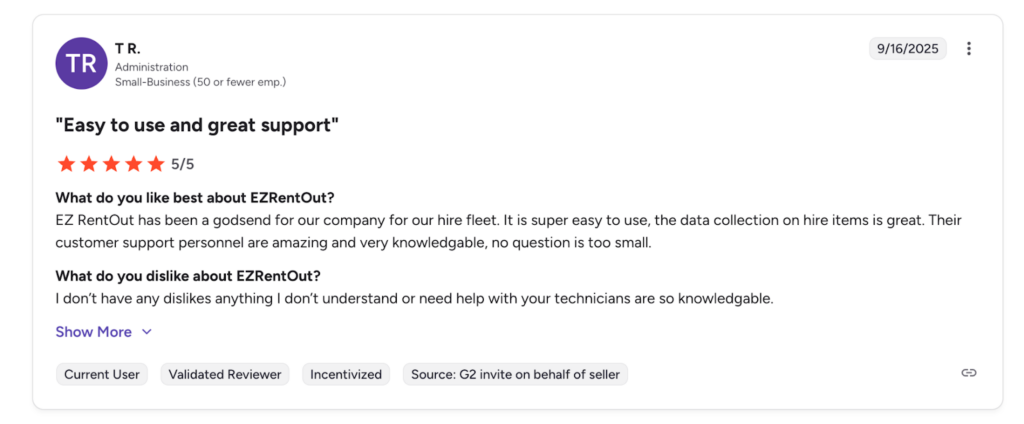
Source: G2
The quiet moat
There are many rental software vendors. Some have slick websites. Some shout automation. Fewer show up each month, remember your operation, and help your team run a little more smoothly over time.
That is the quiet moat. In heavy-equipment and construction, the firms that win blend capable software with steady, human success. That is the work I am proud to do here. If you want to talk through your workflow, I will put 30 minutes on the calendar, and we will probably use 10, unless you need 90, which I am always happy to oblige.

![[How-to] Get Started with EZRentOut: The EZ Way to Manage Rentals!](https://cdn.ezo.io/wp-content/uploads/2025/10/21081148/Getting-Started-Guide-With-EZRentOut-1-1.png)
![[How-to] Ensure B2B Customer Management in EZRentOut](https://cdn.ezo.io/wp-content/uploads/2021/11/Support-Blog-Header-5.png)
![[How-to] Refer EZRentOut To Your Peers and Earn](https://cdn.ezo.io/wp-content/uploads/2025/11/03084625/Referral-Program.png)