
When it comes to equipment rental customer experience, most people assume price is the deciding factor. It isn’t.
Picture this: It’s 6:45 AM on a Monday. Your crew is on site, the subcontractors are clocked in, and the excavator you rented from that cheaper company hasn’t shown up. You call. It rings out. Someone eventually picks up, tells you there’s been a scheduling issue, and promises delivery by noon. Your crew stands around. The subcontractors bill you for the wait. And that $80 you saved on the daily rate? It evaporated before breakfast.
This is the hidden tax of chasing the lowest bid.
When you rent equipment, you’re not just paying for the machine; you’re paying for it to show up on time, work as expected, and be backed by someone who answers the phone. The rate on the quote sheet is only part of the story. The rest shows up in your project timeline, your crew’s billable hours, and your client’s patience.
Research shows that more than 80% of customers place great emphasis on service quality and availability when choosing a vendor or service provider. The customers who keep coming back aren’t choosing you because your equipment is the cheapest. They’re choosing you because the equipment shows up, and when something goes wrong, so do you.
Speed and service aren’t premium add-ons in equipment rental. For most customers, they’re the whole point.
The real cost of downtime: Why speed isn’t a luxury for rental customers
The idle job site has a price tag
Let’s talk numbers for a second.
Say you’re running a mid-sized construction crew, eight workers at $35 an hour each. An idle morning costs you $1,120 in labor alone, before you factor in equipment sitting unused, subcontractor fees, and the very real possibility of a late-delivery penalty baked into your client contract.
Now look at that $80 difference in daily rental rates again. It doesn’t seem like much of a win anymore.
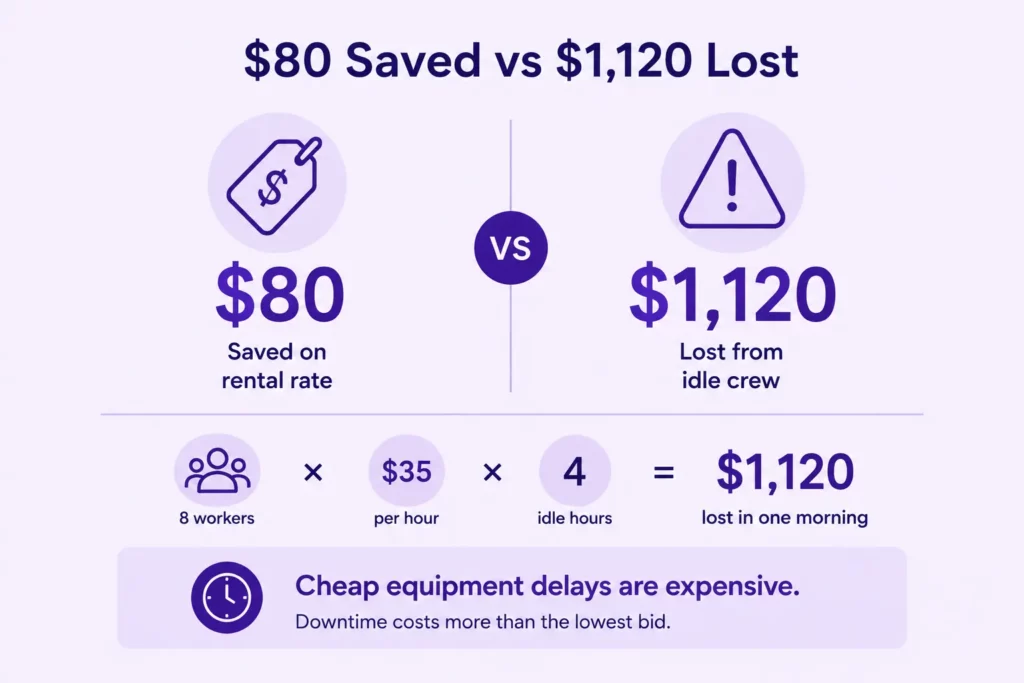
This is the math most rental customers have already done, consciously or not. They know that a job site that stops moving doesn’t just cost time; it costs money, reputation, and sometimes the next contract.
What you’re actually paying for
And this is precisely what a reliable equipment rental company is actually selling you. Not just a machine but a guarantee that your operation keeps moving. A well-maintained fleet with dependable availability means your operators aren’t standing around waiting, your deadlines stay intact, and your client doesn’t start asking uncomfortable questions by 9 AM.
That reliability has a measurable price tag that customers are genuinely willing to pay. A contractor will readily pay 15% more for equipment if the rental company guarantees same-day delivery, online booking, and round-the-clock support. That premium isn’t irrational; it’s a straightforward calculation.
Paying a little more upfront to eliminate the risk of a $1,000-an-hour standstill is just good business.
Why the equipment rental customer experience is a tangible metric
Response time, delivery reliability, and equipment readiness directly affect your bottom line, and your customers know it, even if they can’t always articulate it that way. Equipment rental customer experience isn’t a feel-good measure you track in a satisfaction survey.
It shows up in project margins, client retention, and whether your crew ends the week ahead or behind schedule.
The equipment rental companies winning in the long term aren’t the ones with the lowest rate card. They’re the ones whose customers never have to wonder whether the equipment will show up.
What rental customers actually want (It’s not what you think)
Ask most equipment rental business owners what their customers care about most, and they’ll say price. Ask those same customers directly, and you get a very different answer. The gap between what rental companies think drives decisions and what actually does is wider than most realize.
Here’s what customers are really evaluating when they choose an equipment rental partner.
1. Availability certainty, not just availability
There’s a difference between a rental company that has equipment and one that can confirm the equipment is yours. Customers aren’t just looking for a catalog; they want certainty. When a project start date is locked in and crew schedules are set, we should have one available, doesn’t cut it.
Equipment rental partners that earn repeat business are the ones who can say with confidence: it’s reserved, it’s ready, and it’s showing up at 7 AM Tuesday.
2. A quote that keeps up with the job
Urgent jobs don’t wait for business hours. When a project timeline shifts or equipment fails unexpectedly, your customer needs a quote confirmed in minutes, not a callback the following morning.
Speed of quoting and booking confirmation has quietly become one of the sharpest competitive edges in equipment rental, particularly for contractors managing multiple moving pieces at once. The equipment rental company that responds first, clearly and completely, almost always wins the job.
3. Transparency throughout, not just at booking
Customers today expect more than a confirmation email and radio silence until delivery. Accurate availability, straightforward pricing with no surprise charges, and live updates on where their equipment is and when it’s arriving; these aren’t elevated expectations anymore, they’re baseline ones.
Gaps in communication don’t just frustrate customers; they erode the trust that brings them back next time. A good equipment rental customer experience is really just consistent, honest communication at every stage of the rental.
4. The flexibility to change course
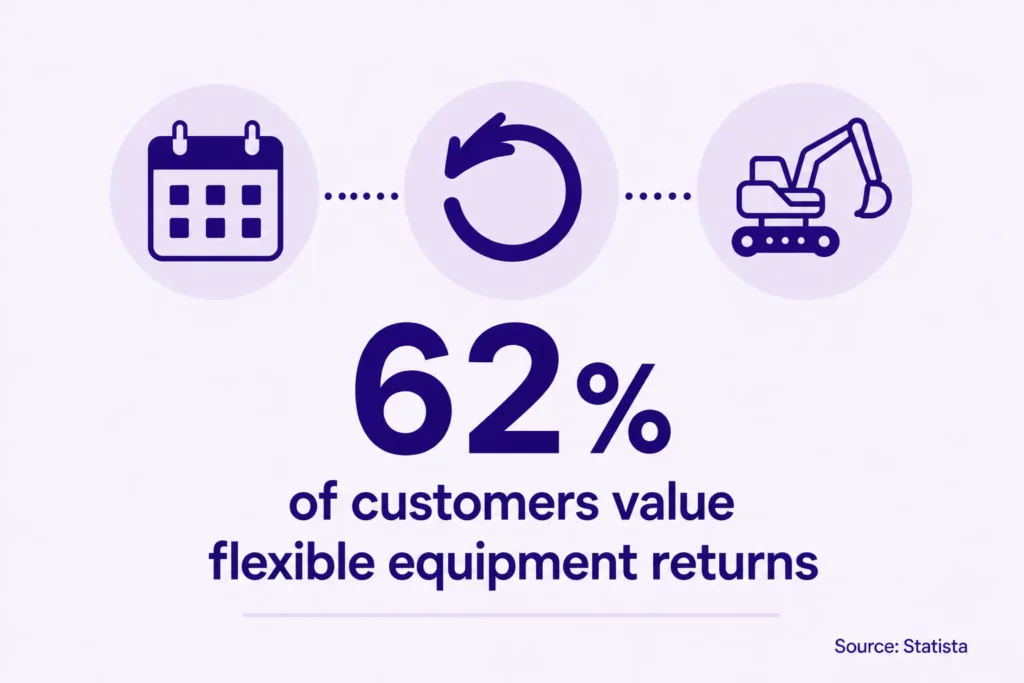
Here’s a statistic that often surprises rental operators: 62% of customers cite the flexibility to return equipment as their primary reason for renting in the first place. Not price. Not even availability, but flexibility.
Projects shift, scopes change, and timelines get compressed. Customers gravitate toward equipment rental companies that treat those changes as a normal part of doing business rather than a penalty-worthy inconvenience. That kind of flexibility signals that you’re a partner, not just a vendor.
Trust is built before the first invoice in the equipment rental business
By the time a customer picks up the phone to place a rental order, they’ve already made a judgment call about you. They’ve visited your website, tried to check availability, looked for a way to get a quote, and either walked away impressed or quietly started Googling your competitor.
That pre-rental experience is where trust is won or lost. And most equipment rental businesses aren’t paying nearly enough attention to it.
Your digital presence is your first handshake
The first question a rental customer asks before they ever speak to anyone on your team isn’t, What’s your daily rate? It’s can I figure out what I need without jumping through hoops?
Can they check whether the equipment they need is actually available? Can they request a quote without waiting for someone to call them back during business hours?
This isn’t a nice-to-have anymore. The numbers make that clear. United Rentals, the largest equipment rental company in the US, reported that 70% of its revenue came through digital channels.
That isn’t just a technology story. It’s a customer behavior story. The booking experience has become the service experience, and customers are making decisions accordingly.
Convenience is no longer a differentiator; it’s the expectation
Whether your customer is a seasoned contractor managing a commercial build or someone renting a compact excavator for a weekend landscaping project, they’re arriving with the same baseline expectation. They want to browse, check availability, and confirm a reservation without making a single phone call.
That’s the standard set by every other industry they interact with daily, and equipment rental is now being held to it, too.
Equipment rental businesses that still rely entirely on phone-in orders and manual quote processes are creating friction at the exact moment a customer is deciding whether to trust them. A clean, functional online storefront where customers can see what’s available, get accurate pricing, and book a reservation removes that friction entirely and signals professionalism before a single piece of equipment moves.
This is where platforms like EZRentOut make a genuine operational difference. An online webstore built into your rental workflow means customers can self-serve at any hour, check real-time availability, and place orders without your team having to field every inquiry manually. The customer gets convenience; your team gets fewer interruptions and more confirmed bookings.
In the equipment rental industry, one bad experience travels fast
The equipment rental industry, particularly in the construction sector, runs on relationships and reputation. It’s a smaller world than it looks. A contractor who has a poor experience with your company will have told three colleagues about it, and those colleagues are your potential customers.
The inverse is equally true. A smooth booking process, rental equipment that arrives as promised, and clear communication throughout don’t just satisfy a customer; they become the story that gets told at the next job site.
Word of mouth in this industry isn’t a marketing tactic. It’s a direct reflection of your equipment rental customer experience, and it compounds over time in whichever direction you point it.
The service gap: Where most equipment rental businesses lose customers
There’s a quiet contradiction sitting at the heart of the equipment rental industry. Customers expect faster responses, real-time availability, and seamless communication, and most rental operators genuinely want to deliver that. The gap isn’t in intention. It’s in infrastructure.
The operational reality most equipment rental businesses won’t admit
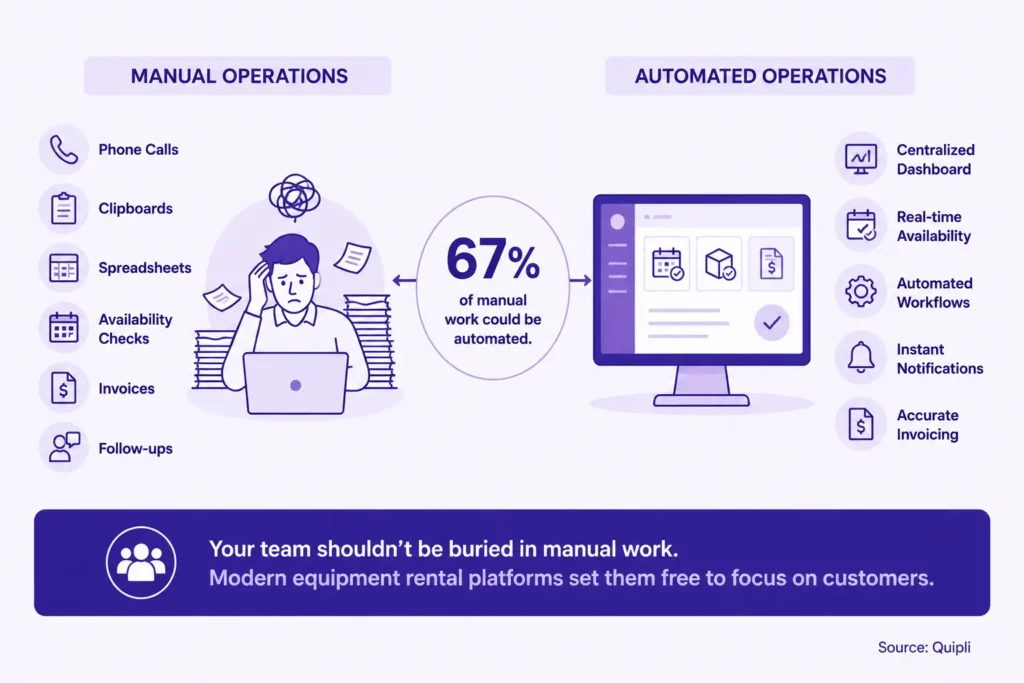
A surprising number of equipment rental companies are still running their day-to-day rental operations on a combination of legacy software, shared spreadsheets, and phone calls. Orders get missed. Availability gets miscommunicated.
A customer waiting for a quote confirmation is staring at their phone while your team manually cross-checks a clipboard against a calendar.
The industry data is uncomfortable, but telling. 83% of rental operators are already stretched thin by staffing shortages; 67% are still directing that limited human bandwidth toward tasks that modern technology could handle automatically, scheduling follow-ups, updating availability, processing returns, and generating invoices. That’s not a staffing problem. That’s a systems problem wearing a staffing problem’s clothes.
Every manual step is a decision point for your customer
Here’s what that friction looks like from the customer’s side. They submit an availability request and hear nothing for two hours. They call to confirm a delivery window and get transferred twice.
They return the equipment and wait three days for an invoice. Each of these moments is a small test of your reliability, and each is also a moment when a competitor with a smoother process starts to look more attractive.
Every manual touchpoint in the equipment rental workflow, from the first availability check to the final return, is a potential exit point for your customer. And in a market with plenty of options, customers don’t have to tolerate friction. They just leave, often without telling you why.
Closing the gap with the right equipment rental tools
This is where the difference between a good rental business and a great equipment rental customer experience becomes operational.
Platforms like EZRentOut are built precisely to address this gap, giving rental teams real-time visibility into their fleet, automating the back-and-forth that slows bookings, and ensuring nothing falls through the cracks between an inquiry and a confirmed order.
The goal isn’t to replace the human side of your business. It’s to free your team from the administrative drag that’s currently eating into the time they could spend actually serving customers. When your systems handle the repetitive work, your people can focus on relationships, and that combination turns a transactional rental into a long-term account.
What good service actually looks like in equipment rental operations
Customers experience good service as a feeling; equipment shows up on time, communication is clear, and the whole process just works.
But behind that feeling is a set of very specific operational decisions your equipment rental business either has or hasn’t made. A good equipment rental customer experience doesn’t happen by accident. It’s engineered. It could be through quality customer service, timely order fulfillment, or simply through a smart pricing strategy.
So what does it actually take to deliver it consistently?
Knowing what you have, before your customer has to ask
The first building block is deceptively simple: knowing exactly what’s in your fleet, where it is, and when it’s available at any given moment. Without real-time inventory visibility, your team is guessing, and customers can tell.
When a staff member has to say “let me check and call you back” for a basic availability question, confidence in your operation takes a hit before the rental even begins.
Real-time fleet visibility means your team can answer availability questions instantly, catch scheduling conflicts before they become delivery failures, and allocate equipment across jobs without double-booking. It’s the difference between running your equipment rental business and reacting to it.
Quotes and confirmations that move at the speed of the job
A customer with an urgent need isn’t going to wait for a manually prepared quote to land in their inbox the next morning. Automated quoting and digital order confirmations compress the time between inquiry and commitment, which matters enormously when your customer is choosing between you and whoever responds first.
Beyond speed, digital confirmations also eliminate the ambiguity that comes with verbal agreements and handwritten orders. Everyone is working from the same information, and there’s a clear paper trail if questions come up later.
Equipment that shows up ready to work
None of the above matters if the machine arrives on site and breaks down by mid-morning. Proactive maintenance tracking, knowing which assets are due for service, which have flags against them, and which are genuinely field-ready, is what separates a reliable rental fleet from an unreliable one.
Customers aren’t just renting equipment. They’re renting the assurance that it will perform.
Predictive maintenance scheduling means problems get caught in your yard, not on your customer’s job site. That’s a distinction that quietly defines your reputation over time.
The system behind the service
Modern rental management platforms bring all of this together. Real-time fleet visibility, automated billing, customer communications, and maintenance scheduling all under one operational roof, eliminating the gaps that manual processes inevitably leave open.
This is precisely what EZRentOut is built to do. It’s not just software for tracking assets, it’s the operational backbone that makes fast, reliable, consistent service actually deliverable at scale.
When your team has the right tools, good service stops being a goal and starts being a byproduct of how you run your equipment rental business every day. And that’s the version of service your customers are willing to pay for, return for, and tell others about.
Conclusion
Price will always be part of the conversation. That’s not going away. But in equipment rental, it’s rarely the reason a customer stays or leaves.
The contractors who keep calling the same rental company aren’t doing it because the rate is the lowest on the market. They’re doing it because a project deadline was saved, because a replacement showed up without an argument, and because the process was simply easier than anywhere else.
That’s the standard your customers are quietly holding you to. Not the cheapest bid, but the most dependable one.
Competing on price alone results in shrinking margins and an exhausting strategy. Competing on equipment rental customer experience? That’s a reputation. And in this industry, reputation compounds through referrals, repeat bookings, and customers who don’t bother getting a second quote because they already know who they’re calling.



![[How to] Convert Individual Customers to Business Contacts in EZRentOut](https://cdn.ezo.io/wp-content/uploads/2022/06/EZR-Spot-migration-1.jpg)