As enterprise organizations scale, cost accounting no longer remains just a calculating problem. It transforms into a complex multi-departmental issue that spans across assets, maintenance schedules, vendors, and finance teams. Oftentimes, the expansion of departments creates data silos where each cost center is operating on its own:
- Procurement tracks purchase orders and vendor spend in one system
- Maintenance teams manage work orders and repair costs in another
- Inventory managers monitor stock levels and carrying costs separately
- Finance attempts to reconcile everything after the fact
Since the systems never talk to each other, critical cost KPIs are never fully clear. Equipment managers are often left wondering what the total cost of ownership is, why we are leaking out budget when everything seems on track? Without the proper tools in place, enterprises can lose control of spiraling costs and end up mismanaging budgets, leaving behind thin margins.
Why unified cost data matters for enterprise organizations?
Business growth comes with a few operational challenges. What worked once for a small team no longer supports teams across locations. The need for real-time financial visibility becomes critical as their priorities shift. In order to retain stable spending power throughout the year, enterprise-level equipment managers need to detect deviations in budgets early on, monitor against forecasts, and adjust procurement.
Failure to do so can lead to the following consequences:
1. Operational inefficiencies:
When organizations have a transparent view of how money is being spent across asset lifecycles, they can identify inefficiencies that would otherwise be hidden. Inability to calculate costs accurately can lead to redundant purchases, excess inventory carrying costs, and poor utilization practices.
2. Audit readiness and compliance:
Large organizations are under a lot of pressure to produce transparent cost records at all times. Fragmented systems can result in manual reconciliation, putting the organization at risk of penalties.
3. Inaccurate strategic planning:
When cost systems are not talking to each other, long-term planning becomes guesswork. There is no single source of truth to report how assets are being utilized, leaving the total cost of ownership at best an estimate. Maintenance events are scheduled without accounting for piling expenses, and this spreads across locations and departments.
EZO: A central cost center for enterprise needs
EZO is a physical asset management system that brings together fundamental cost centers into a centralized platform. The software combines 4 critical modules: procurement, maintenance, asset and inventory, and analytics to provide holistic insights to equipment managers. Let’s delve into how each center works for your enterprise:
1. Procurement cost management: Tracking purchase requests and vendors
Pain points
One of the biggest pain points for equipment managers is disconnected purchase workflows. This occurs because purchase decisions need to pass through multiple teams, each having a process of its own. Some requests come through email, others are a random tap on the door.
What ends up happening?
Delayed approvals or even no approvals at all due to lost requests. All this, combined with limited visibility into vendors’ pricing and rates, makes it tough for you to keep track of all the procurement spend.
How does EZO help?
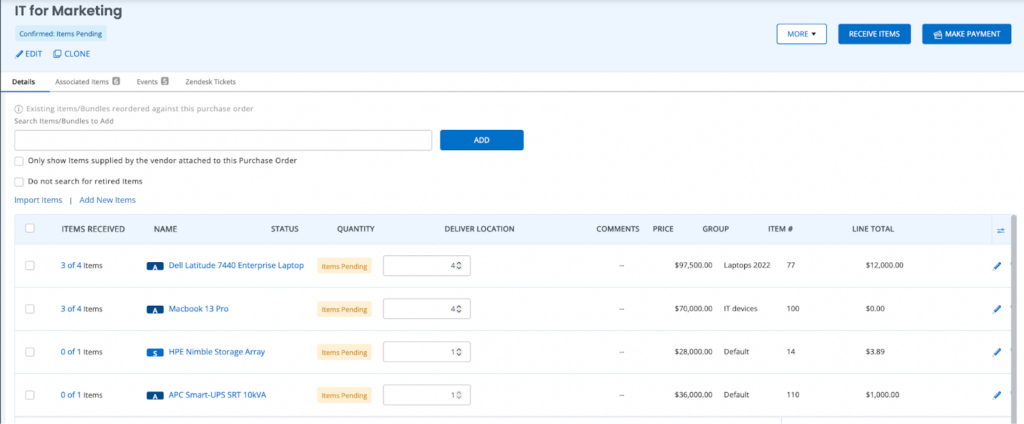
Multi-currency POs: Large enterprises often operating with offices worldwide need a system to cater to multiple currencies. EZO offers procurement managers the ability to record POs in different currencies according to the exchange rate to make vendor management easier.
Tax calculations: When setting up a PO in EZO, procurement managers can simply enable tax calculations to ensure all items are accounted for. Different tax percentages can be set up depending on the current requirements, making PO cost calculations accurate.
Purchase order approvals: As a part of the automation engine in EZO, enterprise asset managers can set up layered authorization workflows for high-value purchases. For example, if a purchase order falls within $100-$200 value, it will go to approver A, above $200 to approver B, and so on. This way EZO helps maintain a direct chain of audit for procurement approvals and budget spends.
Enterprise value
With consolidated vendor spend data, equipment managers can foster better supplier relationships by getting high-volume or seasonal discounts on inventory. Real-time insights into how money is being spent on procurement enable asset managers to reduce redundant expenses and channel budgets towards necessary purchases.
2. Maintenance management: True cost of asset uptime
Maintenance is one of the most underestimated cost drivers. While procurement costs are prominent at the time of purchase, the ongoing costs of keeping assets operational over time silently accumulate through service events, labor, and spare parts purchases.
Pain points
Many large organizations struggle with finding a single system to track labor hours, consumed inventory, and annual repairs when it comes to maintenance. This also occurs due to the presence of a reactive culture where maintenance is not planned but a consequence of asset failure. Last-minute maintenance schedules contribute to higher overall repair costs, decreased lifespans, and disrupted operations.
How does EZO help?
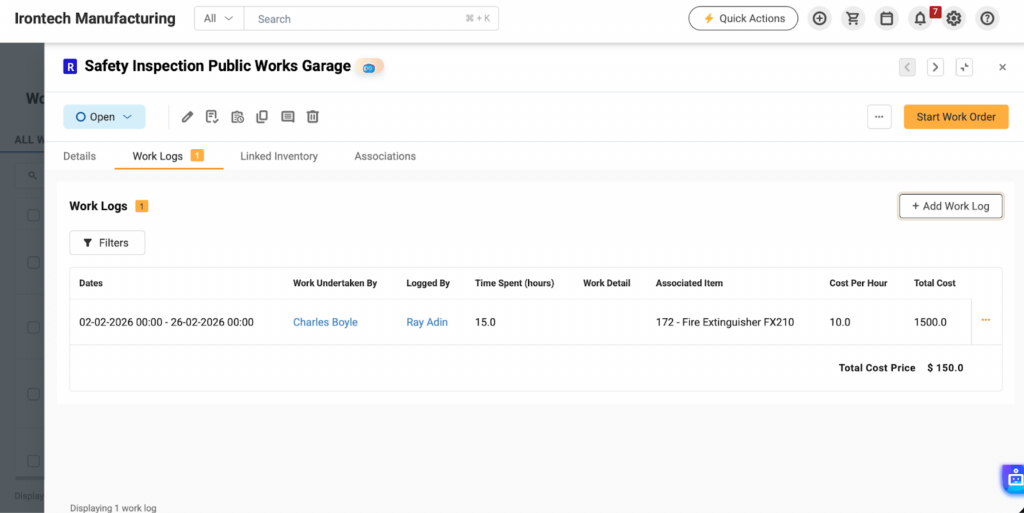
Work order logs: Maintenance managers can track each and every cost related to maintenance in work order logs. Starting from labor hours, task duration, and work progress, all are documented in one place.
Linked inventory and spare parts: EZO combines inventory tracking with maintenance management, so every inventory consumed in the process is linked with the work order. Any spare parts and resources used up are directly displayed as costs incurred in the maintenance event.
Asset maintenance history: All assets being tracked in EZO CMMS have a record of maintenance history being documented. Such history logs report service costs, parts consumed, and work performed; all of which present a holistic picture of the ongoing costs an asset incurs over its lifespan.
Enterprise value
With a unified platform to record maintenance data, enterprises can actively reduce the number of unplanned downtimes, resulting in improved performance and lower emergency repair costs.
3. Asset & inventory costs: Full lifecycle financial visibility
Enterprise assets and inventory form a significant part of capital investments and the ongoing operational process. A lack of insight into how asset costs accumulate over their lifecycle can result in over- or under-utilization of resources, wasting budgets and months of planning.
Pain points
With fragmented systems in place, asset managers don’t get accurate insights into the total cost of ownership, making it difficult to calculate depreciation and identify underperforming assets. Such practices result in enterprises trying to accumulate surprise demand peaks with buffer stock. This results in working capital being tied to large amounts of stock, which end up never being used.
How does EZO help?
Lifecycle cost tracking with custom fields: Enterprise organizations often operate with custom requirements that don’t fall within standard fields provided by systems. To accommodate such needs, EZO provides custom fields to track asset and inventory lifecycle costs. Custom fields can be created for warranty details, compliance attributes, and usage metrics.
Group-based depreciation: Similar assets can be categorized into groups for easy depreciation management. Equipment Ops managers can create groups for IT assets, hardware, fleet vehicles, and apply depreciation standards to multiple assets at once.
Inventory valuation: In order to consume inventory in the right manner, it is critical to follow valuation rules. EZO offers valuation and costing methods to ensure inventory is consumed in the right manner.
Enterprise value
With clear insights into asset and inventory costs, enterprises can make smarter investment decisions by prioritizing high ROI assets and eliminating unnecessary purchases. The right data to manage assets and inventory leads to significant cost savings along with better utilization practices. When asset usage, maintenance, and cost data live together, organizations gain a clear picture of asset productivity.
4. Reports and AI-driven analytics
Enterprise-level companies accumulate large volumes of data over time. However, all this data without analysis does not deliver much value. Legacy spreadsheets lag behind when it comes to insightful reports and can only do so much.
Pain points
Commonly, asset managers struggle with maintaining an updated data repository. By the time reports reach the leadership, they’re either delayed or weeks old. Even if organizations have the data, they lack insight from custom-built reports.
How does EZO help?
Built-in reports: EZO provides built-in reports that eliminate the need for manually compiling data. These reports use the data already in the system and are highly useful for targeting common enterprise cost needs. Some of the main cost reports include maintenance cost reports by assets/location, procurement/vendor spend reports, and total cost of ownership for assets and inventory.
Custom reports for enterprise-specific KPIs: Designed for specialized cost KPIs, asset managers can set up their own reports in EZO with the required filters and timestamps. These reports can be scheduled on a regular basis and shared with the stakeholders automatically.
AI-driven intelligence: The AI bot in EZO shared reports on demand. Instead of running a report every time, equipment ops managers can simply ask the bot to run a maintenance cost report for the past month.
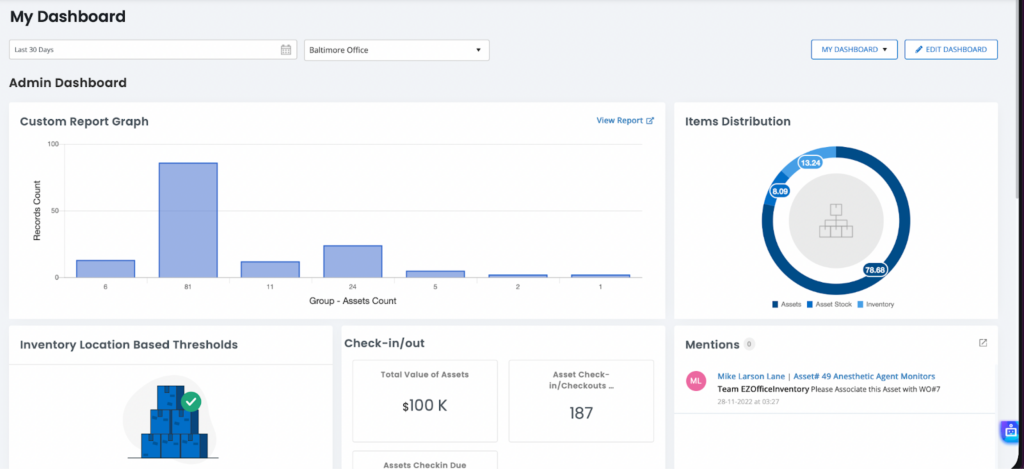
Unified cost dashboards: EZO consolidates data from procurement, maintenance, asset, and inventory management into a single dashboard populated with critical KPIs. Here, equipment ops leaders can easily track total operational spend, maintenance cost trends, and capital allocation.
Enterprise value
Built-in, custom, and AI-driven reports enable faster and more accurate decision-making. Access to cost analytics makes it easier to spot anomalies in spending patterns and adjust them before the next budget cycle.
Conclusion: From cost tracking to cost intelligence
In a large organization, where there are far too many assets and inventory items, data ends up being stored in multiple systems to keep operations running. This fragmentation creates a fundamental challenge. Leaders may know how much the organization spends overall, but understanding where those costs originate, how they evolve over time, and how they impact asset performance becomes difficult. As a result, decision-making often relies on delayed reports, incomplete information, or manual analysis.
EZO addresses this challenge by bringing together all cost centers in one place, where the system acts as the single source of information. Procurement, maintenance, asset, and inventory lifecycle costs are all updated in real-time.
To keep your enterprise operations running smoothly, documenting costs is simply not enough. The next step after cost viability is cost intelligence. EZO offers this through reports and an AI-driven insights module that helps you drive financial decisions to forecast future budget spends.

![[How-to] Apply Valuation And Costing Methods for Items in EZO](https://cdn.ezo.io/wp-content/uploads/2021/06/EZO-inventory-valuation-1.png)
![[How-to] Set Up Work Order Costs in EZO to Boost Efficiency](https://cdn.ezo.io/wp-content/uploads/2021/03/EZO-WO-costs-1.png)
![[How-to] Track Cost Of Carts in EZO](https://cdn.ezo.io/wp-content/uploads/2023/06/tracking-cost-of-cart-2.jpg)