

Managing heavy rental equipment can be risky and high-stakes. A single excavator sitting idle, or worse, double-booked, can delay projects, inflate costs, and strain customer relationships. Yet many rental businesses still rely on fragmented systems to manage some of their most expensive assets.
That’s where systems like Texada, Rentrax, and EZRentOut come into action. These systems are designed to help address these challenges intelligently and provide structure for your rental workflows. Heavy equipment rental operations are highly dependent on precision and control, which these platforms make easier to achieve.
These are customizable solutions designed to address rental equipment tracking challenges across industries such as transportation, construction, oil and gas, and energy.
Let’s have a detailed look at the factors you should be careful about when deciding what heavy equipment rental software to go for:
Factors influencing the decision to purchase a heavy equipment rental operations software
The heavy equipment rental industry has specific requirements owing to the nature of its operations and the associated risks. Considering this, rental business owners need to carefully evaluate an automated rental asset management platform that does not cost them an arm and a leg and is compatible with their existing rental framework.
1. Fleet utilization and availability
- Heavy equipment rental companies need complete and timely visibility into each asset to maximize utilization. Assets sitting idly lower a company’s overall utilization and eventually drain profits.
- Rental software must track which machines are on rent, idle, or under maintenance, helping reduce idle time and increase revenue per asset.
- The ability to forecast availability for upcoming projects is critical in construction-heavy markets.
2. Preventive maintenance and equipment longevity
- Heavy equipment is expensive to repair, and the downtime required for these repairs can significantly increase your costs.
- Rental software should allow scheduled maintenance alerts, track service history, and monitor machine health.
- Integration with IoT or telematics can provide diagnostics for fleet maintenance.
3. Asset tracking and location management
- Equipment may be distributed across multiple job sites, making equipment tracking difficult.
- The rental software should offer barcode or RFID tracking to know exactly where each machine is.
- Proper location management helps businesses stay up to date on the exact quantity of their equipment at different locations. This helps maintain inventory and ensures you do not run out of frequently rented equipment.
4. Complex billing and rental agreements
- The nature of heavy equipment often requires businesses to use tiered rental rates, mileage-based, or hours-based pricing to accurately reflect the equipment’s value and achieve an ROI.
- The rental equipment management software should support customizable contracts, multiple billing structures, and record damage/loss charges.
- The system should store rental agreements digitally and be customizable, allowing you to adjust the terms and conditions as needed.
5. Integration with existing systems
- Systems that integrate easily with external solutions, such as ERP, accounting, or CRM systems, are preferred by heavy equipment rental companies due to the complexity of their operations. These integrations expand the scope of operations and enable these businesses to manage them more holistically.
- Seamlessly integrated software reduces duplicate data entry and provides a single source of truth for operations.
6. Operational Scalability
- Heavy equipment businesses need to rely on rental software that scales as their operations expand. For instance, a construction rental company may provide equipment for multiple construction projects, necessitating
- Supports centralized fleet management, multi-location inventory, and standardized workflows.
Texada vs Rentrax vs EZRentOut: Which solution is the most optimal for heavy equipment rental operations?
Texada, Rentrax, and EZRentOut are all top-notch rental solutions for efficiently managing heavy equipment rentals. Each tool offers a vast suite of features for managing different aspects of rental operations. While almost all solutions are designed with an “all-in-one” approach to managing rental workflows, whether they are compatible with your overall operations cannot be truly determined until you try them yourself.
The following are the industries that Texada, Rentrax, and EZRentOut provide heavy equipment rental services to:
| Platform | Heavy equipment rental industry | Other rental industries |
| EZRentOut | ✔ Construction and heavy equipment rentals (live tracking, utilization, maintenance workflows tailored to industrial‑class assets). | Oilfield equipment (oil and gas rental), plus broader sectors like tool rentals, AV/media, medical, dumpsters and trailers, and event gear (varies by customer use case). |
| Texada | ✔ Heavy equipment and construction equipment rental (excavators, loaders, material handling), purpose‑built for these workflows and operations. | Agriculture, Mining, Landscaping (related industrial rental segments) |
| Rentrax | ✔ Heavy equipment and construction rentals (excavators, loaders, tools, fleet rentals) support industrial‑scale equipment alongside other gear. | Equipment and tool rentals, recreational (bikes/scooters), party and event rentals, motorized vehicle rentals, and tourism/experiences. |
In conclusion:
- Texada: Primarily built for heavy construction and industrial equipment rental with a deep fleet, maintenance, and utilization capabilities.
- Rentrax: Supports heavy equipment and construction rental as part of a wider multi‑vertical platform that also handles tools, recreational rentals, and specialty gear.
- EZRentOut: Designed to serve construction and heavy equipment rental businesses, along with a broad set of other industries such as oilfield, AV/media, and materials handling.
Heavy equipment rental software comparison: An operational deep dive
To accurately identify how the above-mentioned software can help minimize your costs, structure your operations, and help increase ROI, it’s essential to move past the basics and fully understand them.
For that purpose, we went a step further and analyzed each platform’s features, pricing, usability, and accessibility to its users in-depth. We tried breaking down how these platforms address logistical and operational challenges faced by businesses in the heavy equipment industry.
EZRentOut: Mastering the art of smooth rental operations, built for flexibility
With a focus on heavy equipment rentals for medium- to enterprise-level organizations across construction, oil and gas, and transportation, EZRentOut is designed to address your rental challenges efficiently and effectively. Defining it as an “all-in-one” platform does not justify the extent of its functionalities, as it helps its users simplify their workflows by going a step further.
It is built with the “flexibility-first” mindset to help manage a diverse range of heavy equipment. The platform is adaptable, making it easier to onboard different teams without requiring a specialized operations-first workflow like Texada. Its goal is to simplify multi-asset rental operations, giving rental managers and owners control over bookings, returns, inventory status, and revenue tracking in one place.
It covers the entire rental lifecycle, allowing businesses to manage equipment from check-out to maintenance and reporting. This includes:
- Rental operations and contracts: Automated booking through the Orders module, contract creation and management, customer-level rental pricing, pickup/delivery scheduling, and digital approvals through e-signatures.
- Maintenance and service management: Maintenance tracking and service alerts to prevent downtime and ensure equipment readiness.
- Financial and accounting integration: Enables users to track payments and invoices via integrations with advanced tools such as QuickBooks, Xero, and Sage.
- Reporting and analytics: Provides comprehensive operational and financial reports, asset utilization dashboards, and data-driven insights for instant decision-making.
- Customer experience: Rental website builder to make customized rental websites. Web orders are saved in the system, including complete booking history, invoices, and notifications, to streamline interactions.
- Mobile and field access: Team members can scan items, update reservations, check in/checkout items, and log inspections on mobile devices. The mobile app also has an offline functionality, enabling field workers to work even with weak internet connectivity.
Designed to provide a flexible and practical solution to rental asset management challenges, EZRentOut reduces operational friction. EZRentOut offers workflows best suited to heavy equipment to track and manage their entire lifecycle. Heavy equipment rental teams typically consist of yard staff, loaders, dispatchers, and sales personnel, and they may not be well-equipped to use complex software. EZRentOut simplifies data logging and provides clean workflows that require minimal training and short implementation cycles.
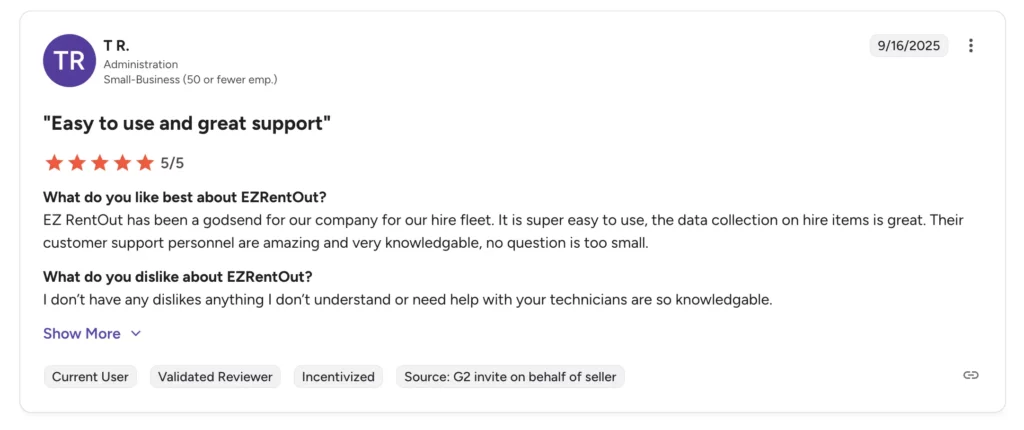
Cody at Superior Construction Services says, “EZRentOut is super easy to use and learn. The name does what it says.” EZRentOut helped the company handle 300+ construction projects in more than 9 locations, saving nearly 200k through improved resource management.
Core win: Enhancing equipment utilization with enhanced visibility
EZRentOut’s strongest feature is its ability to centralize equipment data and provide real-time visibility into your rental landscape. Rental managers can do:
- Centralize rental data: Consolidate rental workflows from booking to return into a single location and ensure the data is readily available to rental managers when needed. Keep equipment information, including procurement records, depreciation records, rental history, rental rates, and manuals, intact so rental managers can access them.
- Multi-location management: Track equipment status, quantity, rental status, and location across multiple sites. Ensure the equipment is tagged for easy identification across locations.
- Prevent scheduling errors: Avoid double bookings and reduce idle time by monitoring availability in real time through the availability calendar. Check the status of each piece of equipment to ensure you do not book the same equipment twice.
- Manage long-term and short-term rentals: EZRentOut helps set rental rates based on the rental duration, whether it’s yearly, monthly, or weekly. You can leverage the recurring orders functionality to automate monthly or yearly invoices for extended rentals. You can even create custom fields to label the orders as “short-term” or “long-term” for easy identification.
- Streamline sub-rentals: If you are procuring a machine from another rental business, you can record the equipment as a sub-rental. You can assess the profit you are making from it through the sub-rental report, as EZRentOut calculates the rate at which you procured it and the rate at which you rented it to a customer.
- Stay updated with equipment condition: Ensure timely maintenance and updates on the location, quantity, and condition of the equipment. Conduct regular inspections to avoid last-minute on-site breakdowns and prevent maintenance issues.
- Rental webstore: Enhance customer experience by enabling customers to rent equipment directly on the website. Customize your website with pre-built templates. If you are in the construction industry, leverage construction-specific themes and equipment categorization options to make the rental experience easier for your customers.
- Accounting integrations: EZRentOut provides accounting integrations with platforms, including QuickBooks, Sage, Xero, and Avalara, to manage invoices and billing details. This way, you get an accurate picture of your cash flows and revenue and ensure that the invoices match your actual rentals.
This makes EZRentOut particularly effective for rental businesses that need to keep their fleet organized and operational without complex automation.
Selling point: Ease of Use and implementation
EZRentOut is built for quick deployment and usability in the following ways:
- Intuitive interface: Minimal training required, making it easy for teams to start using immediately.
- Fast setup: Can be implemented quickly without extensive back-and-forth with the provider.
- Flexible workflows: Allow rental managers and owners to adjust booking and maintenance processes without rigid operational constraints.
EZRentOut is a specialized heavy-equipment platform ideal for businesses that want operational control without the complexity.
Source: G2
Limited native accounting depth for enterprise finance teams
While EZRentOut integrates with accounting tools and supports invoicing and billing, it is not a full ERP-grade financial system. Heavy equipment rental businesses that require complex multi-entry accounting, advanced revenue projections, and deeper financial analysis may struggle with EZRentOut.
Advanced logistics and yard management are not core strengths
EZRentOut supports pickup, return, and basic delivery tracking, but it is not purpose-built for complex yard logistics, such as:
- Real-time yard mapping
- Automated dispatch routing
- Advanced delivery fleet optimization
Heavy equipment rental businesses with complex logistics may need specialized logistics tools, in addition to EZRentOut, to fully manage the logistics side of the equipment.
Pricing Structure
EZRentOut follows a subscription-based pricing model, typically with transparent tiers and optional add-ons:
- Per-user subscription: A recurring fee based on the number of users and modules activated (rentals, maintenance, reporting, etc.). This option offers a lot of flexibility as your team can grow and scale whenever needed. All you need to do is get the number of users upgraded.
- Module-based add-ons: Advanced features like custom reports, integrations, or API access are optional. This way, you only pay for the tools you need, without having to buy a complete package if you don’t.
- Transparent pricing and trial: EZRentOut often provides clear pricing tiers and a 7-day free trial, allowing businesses to test before committing. Ideal for cost-conscious teams and heavy equipment rental companies that need to compare software quickly and do not want to speak with sales to get custom quotes.
Compared to Texada and Rentrax, EZRentOut’s pricing offers greater flexibility and accessibility for heavy equipment rental businesses, making it easier to evaluate without engaging sales.
Conclusion
- Opt if: You value ease of deployment, user-friendly workflows, and quick adoption, and want to centralize equipment tracking, booking management, and invoicing without complex operational controls.
- Consider alternatives if: If your heavy equipment rental business needs rigid, non-negotiable workflows, such as mandatory, strict dispatch sequences, EZRentOut’s flexibility may feel limiting.
Texada: A heavy equipment rental operations powerhouse with nuances
Texada is not just an “all-in-one” platform; it is specifically designed to handle heavy equipment rental operations, especially in the construction, transportation, and manufacturing industries. It aims to solve rental challenges, including double-bookings, maintenance downtime, asset utilization, and customer management.
It covers the entire rental lifecycle to enable rental business manage their equipment from procurement to disposal. This includes:
- Rental operations and contracts: Contract creation, pricing, pickup/delivery scheduling, digital signatures, and rental adjustments.
- Maintenance and service management: Automated maintenance scheduling and alerts to reduce breakdowns and unplanned downtime.
- Financial and accounting integration: Automated billing, invoicing, accounts receivable/payable tracking, and integration with tools like QuickBooks.
- Reporting and analytics: Business performance insights and operational reporting to support decision‑making.
- Customer experience: Customer portals and online rental options for bookings and contract history.
- Mobile field access: Field teams can update job statuses, capture inspections, and sync offline, ensuring timely data management.
Built with a “rental-operations first” mindset, it tries to cater to the specific needs of heavy equipment rental businesses. It stems from the fact that heavy equipment requires specialized care because it’s costly, sensitive, and complex. Therefore, its workflows are optimization- and maintenance-oriented to help users minimize idle time and downtime when operating across multiple locations.
Core win: Maximizing fleet visibility
One area where Texada excels is providing visibility into equipment status, equipment quantity, rental status, location, and customer details. By centralizing asset data, it helps rental managers maximize the use of high-value equipment, reducing idle time. Managers and owners have complete access to real-time equipment updates, helping prevent loss and theft.
It ties the entire rental workflow together, making it easier to track when and where a piece of equipment is due to be returned and whether it needs to be sent for maintenance. From quoting, contracting, delivery, and invoicing to returns and service, it handles the full rental lifecycle seamlessly through data centralization.
Since fleets are highly complex, keeping track of their maintenance schedules, bookings, availability, and shipping can be a real struggle. Texada simplifies these workflows for rental owners by providing dedicated features for each functionality.
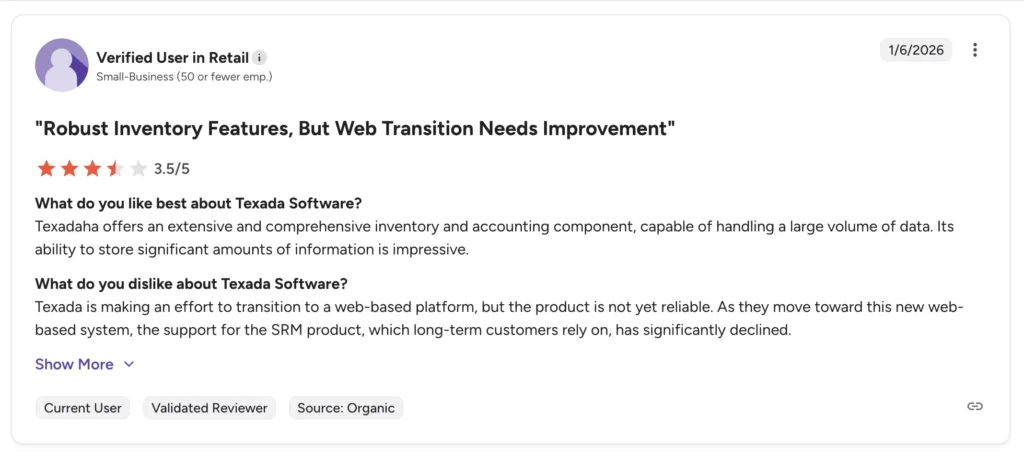
Source: G2
Delayed implementation, requiring extensive learning
While Texada meets all the checkboxes for fully automated rental asset management, some users find the interface complex and time-consuming to implement. It does not support a quick setup that might require back-and-forth with the software provider. Teams need role-based training, as most of its features are bundled together.
It is not an “inventory-first software”
Unlike lighter tools that treat equipment peripherals as consumables, Texada treats each asset as a separate unit with history, condition, and constraints. So, users need to maintain an operational discipline to manage heavy equipment peripherals as well; there are no workarounds for mistakes that can impact your rental workflow.
Pricing structure
- Subscription licensing (per user/ per module): A recurring software subscription fee that depends on the number of users and the modules you activate (e.g., rental, service, CRM, accounting). This is useful for growing rental businesses with complex needs.
- Deployment and implementation fees: Setup, data migration, configuration, and training are typically quoted separately. This is valuable for larger fleets and multi-location setups, but a turnoff for smaller heavy equipment rental businesses looking for simplicity.
- No free trial or transparent tier: Texada does not offer a free trial or clear tiered pricing online; pricing is quote-on-request only. This can be a downside for cost-conscious businesses looking to quickly compare prices.
Conclusion
- Opt if: You operate a medium to large-sized heavy equipment rental business with high-value assets and complex day-to-day operations for automated rental workflows.
- Consider alternatives if: You run a small or early-stage rental business with a limited fleet and straightforward rental workflows.
Rentrax: A financial powerhouse for heavy equipment rentals
Built with the mindset that billing accuracy and contract compliance drive profitability, Rentrax puts financial control at the center of every rental operation. It’s especially suited for companies handling high-value fleets, where every hour a piece of equipment is in operation counts.
While Rentrax focuses on operational management of heavy equipment, it ensures revenue doesn’t slip through the cracks; it safeguards your revenue. Rentrax manages the entire workflow with a core focus on contracts and financial management of orders:
- Rental contracts and billing logic: Handles complex rental contracts, rate structures, time-based billing, damage waivers, fuel charges, and partial-period rentals that are common in heavy equipment rentals where assets stay out for weeks or months.
- Equipment utilization and availability: Tracks equipment status, rental history, and availability to support better fleet usage and revenue recovery, particularly for high-value assets.
- Maintenance and service tracking: Supports maintenance scheduling and service records to help keep equipment rental-ready, though this is more operationally supportive than optimization-driven.
- Financial controls and reporting: Lays strong emphasis on invoicing accuracy, revenue reporting, branch-level performance, and audit-friendly financial data, critical for mature rental organizations.
- Multi-location operations: Designed to support branch-based operations, helping rental businesses manage equipment, customers, and revenue across locations.
Core win: Built with a “finance-and-contracts first” mindset
Rentrax reflects the reality that heavy equipment rentals are financially complex. Equipment is expensive, rental periods are long, and billing errors can quickly compound into revenue leakage. As a result, its workflows prioritize:
- Accurate contract execution
- Reliable billing and invoicing
- Financial traceability across assets and branches
Operational flexibility exists, but it is clearly structured around protecting revenue and enforcing financial consistency rather than optimizing day-to-day field workflows.
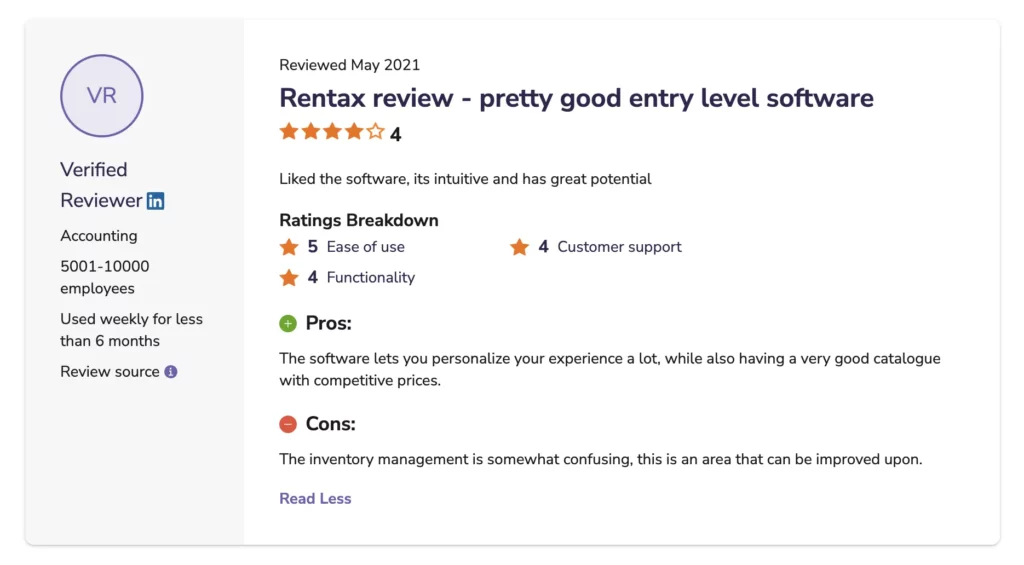
Source: SoftwareAdvice
Complex interface and learning curve
Rentrax offers deep functionality, but that depth introduces complexity. Teams often require training to fully understand contract management, billing rules, and reporting.
This makes Rentrax better suited to organizations with dedicated admin or finance staff rather than lean teams managing complex, varied rental operations. It usually takes time to adopt this platform, which can delay tracking your rental operations.
Limited advanced maintenance capabilities
While Rentrax tracks maintenance schedules and service history, it does not offer deep lifecycle or predictive maintenance capabilities. For heavy equipment rental businesses, this can be a constraint because:
- Equipment is high-value and complex, often requiring component-level tracking (hydraulics, engines, attachments).
- Predictive maintenance, downtime forecasting, and usage-based alerts are limited or manual, making it harder to proactively prevent breakdowns.
- Long-term fleet optimization, which guides asset retirement, redeployment, or refurbishment, is not deeply integrated into the system.
Pricing structure
- License-based subscription: Typically charged per user or module, aligning with company size and scope.
- Implementation and setup fees: Onboarding and configuration are usually included in the investment, reasonable for large fleets but costly for smaller operators.
- No self-serve trial: Rentrax pricing is generally quote-based, requiring engagement with sales.
Opt for Rentrax if: You operate a medium to large-sized heavy equipment rental business where billing accuracy, contract integrity, and revenue protection are mission-critical.
Consider alternatives if: Your top priorities are rapid deployment, operational flexibility, or field-team usability, rather than finance-first workflows.
Texada vs EZRentOut vs Rentrax: A deep dive into their core functionalities
The following table breaks down the functionalities that each of these software provides:
| Feature | EZRentOut | Texada | Rentrax |
| Real-time inventory & equipment tracking | ✔ Tracks availability & locations with updates across sites | ✔ Centralized real-time tracking & availability | ✔ Availability calendar & inventory updates |
| Multi-location management | ✔ Supported (multiple branches/sites) | ✔ Enterprise multi-location support | ✔ Multi-location dashboard & operations |
| Rental booking & reservations | ✔ Online & backend booking with calendar | ✔ Online booking, quotes, e-commerce capabilities | ✔ Flexible order forms, online and in-store reservations |
| Contract creation & digital signatures | ✔ Built-in rental contracts & digital signatures | ✔ Instant contract creation with digital signatures | ✔ E-waivers & signatures in bookings |
| Maintenance scheduling & history logs | ✔ Preventive maintenance tracking | ✔ Automated maintenance alerts & history logs | ✔ Maintenance logging & scheduled upkeep |
| Mobile & field access (offline usable) | ✔ Mobile app with field features | ✔ Mobile access & offline work orders | ✔ Mobile app access for bookings & inventory |
| Customer self-serve portal / webstore | ✔ Online storefront for customers | ✔ Customer e-commerce and reservation portal | ✘ Not emphasized as a dedicated webstore feature (general booking forms only) |
| Financial & accounting integration | ✔ Integrates with QuickBooks/Xero | ✔ Built-in billing, AP/AR, and reports | ✔ Payment & billing processing (Stripe/Square, etc.) |
| Complex/tiered pricing & billing rules | ✔ Flexible pricing and recurring rentals | ✔ Tiered billing + real-time pricing | ✔ Recurring invoices, security deposits |
| Reporting & analytics | ✔ Built-in dashboards & reports | ✔ KPI reporting with dashboards | ✔ Real-time & premium reporting tools |
| Predictive maintenance / advanced lifecycle tools | ✘ Basic maintenance only | ✔ Advanced fleet lifecycle controls | ✘ Standard maintenance logs |
| Transparent pricing & free trial | ✔ Public pricing tiers + free trial | ✘ Quote-only pricing | ✔ Transparent pricing plans available |
| Best for | Flexibility, quick setup, centralized rentals | Deep operational control & fleet lifecycle | Broad rental ops with flexible orders |
Conclusion: Choosing the best rental asset management software
While Texada, Rentrax, and EZRentOut all offer comprehensive feature sets to support smooth rental asset management, the choice depends on the scale of your operations, your fleet size, and the type of equipment you manage. These platforms differ from each other in the following ways:
- EZRentOut shines for medium to large rental businesses that value flexibility, speed, and ease of use. It centralizes bookings, maintenance, and multi-location asset tracking, making it perfect for teams that need to simplify workflows and onboard staff quickly without sacrificing control.
- Texada is ideal for rental businesses that need deep operational control, maintenance optimization, and full fleet visibility. Its strength lies in helping managers maximize equipment utilization while minimizing downtime, making it a true powerhouse for operational efficiency.
- Rentrax is best suited for organizations where billing accuracy, financial control, and contract compliance are mission-critical. Its finance-first approach ensures that revenue is protected and tracked meticulously, though operational flexibility may take a back seat.
Choose a solution that offers flexibility with deep operational control for heavy equipment management. Make sure the solution is optimized for workflows that best meet your heavy equipment requirements.

![[How-to] Refer EZRentOut To Your Peers and Earn](https://cdn.ezo.io/wp-content/uploads/2025/11/03084625/Referral-Program.png)
![[How-To] Use Samsara Integration with EZRentOut for Automatic GPS Location](https://cdn.ezo.io/wp-content/uploads/2026/01/30074248/Samsara-Integration-1.png)