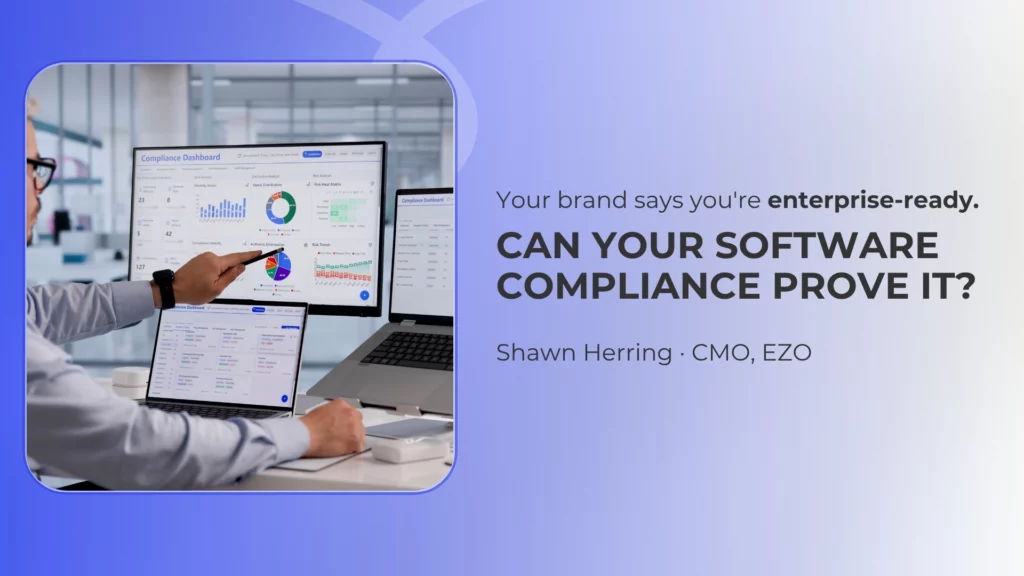
Most brand risk does not start in a campaign.
It starts in the operating gaps that a company cannot explain when a customer, auditor, investor, or security reviewer asks for proof.
For marketing leaders, that distinction matters. We spend a great deal of time shaping how the market sees the company: the message, the positioning, the proof points, the customer stories, the analyst validation, the website, the sales narrative. But brand trust is not built by messaging alone. It is reinforced or weakened by the company’s ability to operate in ways that align with its promise.
Software compliance is one of those areas where the gap can become visible quickly.
A company can position itself as secure, mature, efficient, and enterprise-ready. But if it cannot clearly show which tools store customer data, who has access to those tools, which licenses are assigned, which applications are approved, when former employees or agency users were removed, or who owns each renewal, the brand story becomes harder to defend.
That is why software compliance is not only an IT, Finance, or audit issue. For B2B companies, especially those selling into enterprise or regulated markets, it is part of brand governance.
Brand credibility depends on what the company can prove
Enterprise buyers do not evaluate a vendor only through its messaging. They evaluate the operating reality behind the message.
That reality often shows up during security reviews, procurement checks, onboarding conversations, renewal discussions, and customer diligence. A buyer may ask:
Who has access to customer-facing systems?
Which tools store customer or prospect data?
How quickly is access removed when an employee, contractor, or agency partner leaves?
Are software licenses assigned based on role, need, and usage?
Who owns each application and renewal?
Can IT, Finance, Security, and the business owner give the same answer?
These questions may sound operational, but they shape perception. When the answers are clear, the company feels disciplined. When the answers are slow, inconsistent, or reconstructed manually, the buyer begins to see risk.
That is the point where an internal software compliance gap becomes a market credibility issue.

Marketing teams are often where the risk begins
Marketing is one of the fastest-moving software environments inside a B2B company.
That is not a criticism. It is the nature of the function. Marketing teams need tools for campaigns, attribution, analytics, webinars, content, SEO, GEO, review management, enrichment, events, design, automation, AI workflows, social media, and sales enablement. The stack changes quickly because the market changes quickly.
But speed can create blind spots.
I have seen this most often in urgent campaigns. A launch date is fixed. Paid media is booked. Sales is waiting on leads. The team needs a landing page, form, integration, or reporting workflow live by Friday. In that moment, a new tool can feel like the fastest path to execution.
The risk is not usually bad intent. It is a bypassed ownership.
Who approved the tool? Where is the data stored? Who owns the account? Who has admin access? Is the tool already covered by an existing platform? What happens when the campaign ends? Who removes access when an agency, contractor, or temporary user is no longer involved?
Those questions are easy to defer when the business is moving fast. But they become much harder to answer when a customer asks for evidence, especially regarding CRM systems.
Agency-managed accounts can quietly weaken control
Another common marketing risk is the agency-owned or agency-managed account.
A company brings in an agency for paid media, SEO, creative, events, analytics, or content operations. To move quickly, the agency creates dashboards, manages platform access, handles credentials, exports data, or runs work through tools that sit adjacent to the company’s approved software inventory.
The work gets done. The campaign runs. The report is delivered.
Months later, it may not be clear who still has access, whether credentials were removed, whether customer or prospect data was exported, whether the account belongs to the company or the agency, or whether the tool is visible to IT and Finance at all.
From the customer’s perspective, that distinction does not matter. They do not separate “our internal team” from “a vendor we used for the campaign.” They see the brand. If customer data, even when housed in an agency-owned tool, is compromised, the credibility risk falls on the company.
That is why CMOs should care about software compliance. Not because marketing should own every software workflow, but because marketing cannot afford to become a blind spot in the company’s trust story.
Poor software compliance slows enterprise confidence
Software compliance issues rarely damage brand trust through one dramatic failure. More often, they create friction.
A buyer asks whether former employees still have access to a customer-facing platform. The answer takes days because IT, Security, and the business owner need to reconcile records.
Procurement asks who owns a renewal. Finance has the contract, IT sees the application, and the department assumes someone else is accountable.
A security questionnaire asks which internal tools store customer data. Marketing knows some tools, RevOps knows others, and an agency knows a few more.
A contractor leaves, but no one is entirely sure whether their access to analytics, creative files, advertising accounts, or campaign dashboards has been removed.
Each of these moments may be manageable on its own. Together, they create doubt. They suggest that the company’s claims about security, maturity, governance, and operational control may not be fully backed by internal discipline.
For B2B SaaS companies in the ITAM space, that is especially important. Many sell products that promise better governance, productivity, visibility, security, or accountability. If the vendor’s own software environment appears unmanaged, the brand promise becomes less convincing.
Software waste can signal weak ownership
Unused licenses are often treated as a cost problem. They are that, but they can also reveal a deeper ownership problem.
A license assigned to a former employee is not only a waste of spend. It raises questions about offboarding discipline.
A tool with no clear owner is not only a renewal headache. It raises questions about accountability.
A duplicated application is not only inefficient. It may indicate that teams lack a shared view of what the business already owns.
An agency-managed platform outside the approved software inventory is not only a procurement gap. It may create uncertainty around access, data, and control.
This is where software compliance becomes relevant to the brand. The issue is not simply whether the company has too many tools. The issue is whether the company can show that software access, usage, ownership, and renewals are governed with the same discipline it promises its customers.

What CMOs should expect the business to know?
CMOs do not need to become software compliance owners. But they should expect the business to maintain a reliable proof layer around the software environment, especially the marketing stack.
At minimum, marketing leaders should be able to partner with IT, Finance, Security, and RevOps to answer a few practical questions:
- Which marketing tools are approved and actively used?
- Which tools store customer, prospect, campaign, or performance data?
- Which employees, contractors, agencies, and partners have access?
- Which licenses are inactive, duplicated, or assigned to people who have changed roles?
- Which tools are coming up for renewal, and who owns the decision?
- Which applications have admin access, integrations, or data exports that require closer review?
The goal is not to slow marketing down. It is to make speed safer.
A high-performing marketing team should be able to launch quickly without creating software records that the company has to reconstruct later.
Compliance needs connected context, not scattered records
Software compliance breaks down when an application’s story is scattered across different systems.
Finance may know the contract. IT may know the application. Security may know the risk profile. Marketing may know the business use case. Procurement may know the renewal. HR may know whether the user is still employed. The agency may know who actually has day-to-day access.
When those records are disconnected, every review becomes an investigation.
That is why connected IT asset management matters. Effective ITAM and software asset management practices help teams bring software, users, devices, contracts, tickets, ownership, usage, and lifecycle activity into a more reliable operating view.
For marketing leaders, the value is not that marketing suddenly owns ITAM. The value is that the company can answer trust-related questions with more confidence and less scrambling.
Which tools are approved? Who owns them? Who has access? Are they still being used? What changed when someone left? What evidence exists if a buyer, auditor, or internal stakeholder asks?
Those answers are part of brand credibility.
Where AssetSonar fits
AssetSonar is relevant here because software compliance rarely sits within a single record or team.
AssetSonar’s IT Graph helps connect context across assets, software, users, contracts, tickets, and configuration items. That connected view can help IT teams identify exceptions, clarify ownership, support license reclamation, review usage, and keep a more reliable record of software-related activity.
For a CMO, the point is not to turn software compliance into a marketing-owned workflow. The point is to ensure the company has an operational foundation that supports the brand’s claims about trust, security, maturity, and control.
That is the difference between compliance as periodic cleanup and compliance as brand infrastructure.
Software governance should become part of brand governance
Brand governance usually focuses on voice, visual identity, messaging, customer proof, and public claims. Those things matter. But they are not enough.
If a company says it is secure, it needs evidence of access control.
If it says it is enterprise-ready, it needs disciplined software ownership.
If it says it is efficient, it needs visibility into waste and duplication.
If it says it is customer-centric, it needs confidence that customer-facing systems are governed responsibly.
Software compliance supports all of that. It gives marketing, sales, customer success, IT, Finance, Security, and leadership a shared foundation for answering hard questions.
The companies that handle this well do not treat software records as back-office hygiene. They treat them as part of how the business proves control.
What CMOs should do next?
CMOs should not try to own software compliance alone. But they should help reframe it.
Start by treating software compliance as a trust issue, not only a cost or audit issue. Bring it into conversations about enterprise readiness, customer confidence, security reviews, procurement friction, and brand credibility.
Then review the marketing stack with IT and Finance. Look for tools that store customer or prospect data, support inactive users, include duplicate functionality, have unclear ownership, allow agency access, grant admin privileges, and track upcoming renewals.
Next, push for evidence instead of assumptions. It is not enough to believe access was removed, licenses were reclaimed, or an agency account was closed. The company should be able to see what happened, who owned the action, and what record remains.
Finally, make software governance part of the brand standard. A company’s brand is not only what it says externally. It is also how reliably it operates internally when customers ask for proof.
Software compliance may never become a headline campaign. But it can quietly strengthen or weaken every claim a company makes about trust, maturity, and control.

![[How-to] Automate IT Workflows in AssetSonar](https://cdn.ezo.io/wp-content/uploads/2024/09/04125918/Automate-IT-Workflows-in-AssetSonar-1.jpg)
![[How-to] Manage Software Licenses And Ensure Compliance With AssetSonar](https://cdn.ezo.io/wp-content/uploads/2019/06/13115346/software-licenses--scaled.jpg)
![[How-to] Monitor Software Utilization and Identify Shadow IT in AssetSonar](https://cdn.ezo.io/wp-content/uploads/2025/07/03084730/Monitor-Software-Utilization-and-Identify-Shadow-IT-scaled.jpg)