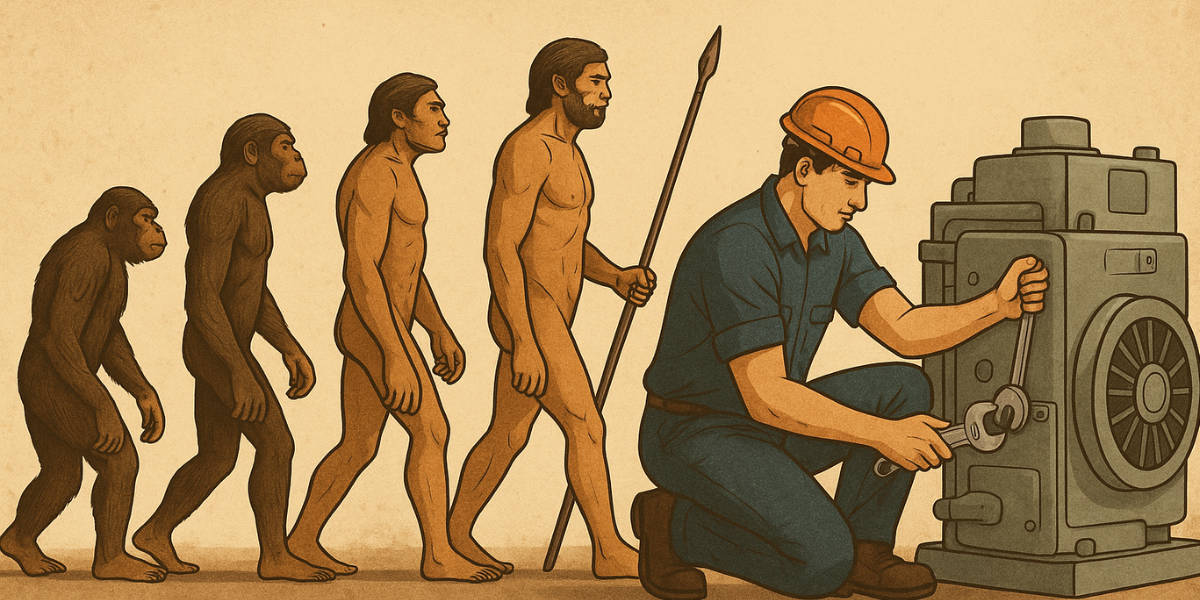
The Evolutionary Flaw That Is Bankrupting Your Fleet
Imagine being offered a single extra year of life, but at the cost of everything you own. For many, this isn’t a hypothetical scenario; it is the tragic reality. Spending a fortune on eleventh-hour treatments to buy back time that could have been secured with inexpensive habits years earlier. We possess a dangerous blind spot: we ignore our greatest assets until they are in critical condition.
This isn’t a character flaw, it’s biology. For millennia, human survival depended on reacting to immediate threats like predators or storms, not anticipating problems decades away. We are hardwired to fight fires, not prevent them.
But here is the problem: You are bringing this same ancestral survival instinct to your construction site. By prioritizing urgent deadlines over asset health, you are effectively choosing the expensive “eleventh-hour treatment” for your equipment every single day. The “run-to-failure” mindset isn’t a strategy; it’s an evolutionary trap, and it is costing you more than you think.
Are We Wired to Let Things Break?
Just as your health and vital bodily functions are critical to your well-being, the condition of a company’s assets is essential for its productivity and survival. The same paradox we discussed for our health, creeps its way into governance of approach towards physical equipment. We instinctively follow the seemingly easy path of running machinery until it breaks, a decision that inevitably leads to catastrophic failure, chaotic downtime, and exorbitant emergency repair costs. This painful way is chosen over the disciplined, proactive path of scheduled maintenance, which guarantees control, predictability, and long-term savings.
The Psychology of Deferred Maintenance
Why do we choose the “painful way”? To understand this, we have to look at a cognitive bias known as Hyperbolic Discounting. This is the human tendency to choose smaller, immediate rewards over larger, later rewards. In the context of a job site, the “immediate reward” is keeping a machine running for an extra four hours to hit a daily milestone. The “later reward” is a machine that lasts ten years instead of five.
Our brains are not naturally wired to weigh the $500 oil change today against the $50,000 engine failure three years from now. The $500 feels real and painful now; the $50,000 feels abstract and distant. We treat our equipment like we treat our bodies, assuming that because we feel “fine” today, we are invincible tomorrow.
Skipping preventive maintenance isn’t a cost-saving measure; it’s an acceptance of future failure on the most inconvenient terms. A purely reactive strategy is rooted in the dangerous and flawed assumption that a machine working today will continue to work indefinitely without intervention.
“If our maintenance program is purely reactive, we will not expend manpower dollars or incur capital cost until something breaks. Since we do not see any associated maintenance cost, we could view this period as saving money. The downside is reality. In reality, during the time we believe we are saving maintenance and capital cost, we are really spending more dollars than we would have under a different maintenance approach.” – U.S. Department of Energy, O&M Best Practices Guide
In essence, the hard work to avoid preventive maintenance was never actually avoided and there wasn’t even a pay-off at the end that could justify the avoidance of effort.

Why Companies Fail to go Preventive?
Despite the clear benefits, many companies struggle to adopt a preventive maintenance culture due to deeply ingrained psychological and operational hurdles. The most insidious barrier is the invisibility of success. When a PM program works perfectly, the result is a non-event i.e. a crisis that never happens. Unlike the visible heroism of fixing a catastrophic breakdown, there’s no immediate glory or obvious reward for preventing one. This psychological hurdle reinforces the dangerous “if it ain’t broke, don’t fix it” mentality.
The Heroism Bias
In many organizations, the “hero” is the mechanic who stays up all night to fix a broken crane so the project can resume at dawn. We celebrate that person. We don’t celebrate the technician who noticed a frayed belt three weeks ago and replaced it in twenty minutes during a scheduled break. One is a dramatic story of salvation; the other is a boring story of a non-event. To move to a preventive culture, leadership must stop rewarding the “firefighters” and start rewarding the “fireproofers.”
Beyond the cultural resistance, there are significant operational challenges. Implementing a formal PM program requires an upfront investment in management systems, specialized training, and potentially more staff costs that are immediate. For businesses operating at maximum capacity, the very idea of scheduling downtime can feel impossible when every hour is needed to meet customer demand.
The Utilization Trap
This is the “Availability Paradox.” We believe we are too busy to maintain the machines that allow us to be busy. This creates a death spiral:
- We skip maintenance to maximize uptime.
- The machine’s condition degrades, leading to more frequent, minor interruptions.
- These interruptions make us fall behind schedule.
- Because we are behind schedule, we feel we definitely can’t afford maintenance now.
- The machine suffers a catastrophic failure.
Breaking this cycle requires acknowledging that planned downtime is an investment, while unplanned downtime is a cost. Machine breakdowns cause more than just the cost of repairing them. It costs you the loss of revenue and productivity you missed out on.
- The Idle Labor Surcharge: You aren’t just paying the mechanic; you are paying for a 15-person crew to stand around at $50–$80 an hour with nothing to do. Every hour that machine is down, your payroll is burning a hole in your margin with zero output to show for it.
- The Opportunity Cost Penalty: In construction, time is the only resource you can’t buy back. A week of downtime doesn’t just push your current project back; it prevents you from moving your resources to the next revenue-generating project. You aren’t just losing money on the current job; you are losing the ability to bid on or start the next one.
- The “Rush” Premium: When a machine breaks unexpectedly, you lose your bargaining power. You end up paying “whatever it takes” for emergency rentals, expedited shipping on parts, and overtime for technicians.
- Reputational Liquidated Damages: Beyond the contractual penalties for missing milestones, there is the long-term cost of being the contractor who “can’t stay on schedule.” That loss of trust from owners and general contractors is a tax on your future pipeline that is impossible to calculate but devastating to your bottom line.
A Simple Blueprint for Preventive Maintenance
The idea of overhauling your entire maintenance strategy can feel daunting. But true transformation is rarely achieved in one giant leap, it comes from small, deliberate steps that build momentum over time.
You are one Afternoon Away
The hardest part of preventive maintenance is getting started. The truth is, you’re just one afternoon away from breaking that inertia. Block out a quiet window in your schedule and:
- Step 1: Choose one critical piece of equipment. Don’t try to fix the whole fleet. Pick the “linchpin”—the machine that, if it fails, stops the entire project.
- Step 2: Identify three preventive tasks that would prevent its most common failures. These aren’t complex overhauls. They are the “low-hanging fruit”: fluid checks, filter replacements, or track tension adjustments.
That’s it, you’ve created your first PM plan. It may feel small, but it’s more than a task list. It’s a shift from reactive firefighting toward proactive control.
You are one Example Away
Preventive maintenance often struggles because success feels invisible. A breakdown avoided doesn’t get the same attention as one that happens. The best way forward is to prove it works with one clear example. When your team sees a single machine run longer, smoother, and with fewer interruptions, it creates a ripple effect. Buy-in spreads, and suddenly the path to broader adoption becomes clear.
To make this example stick, you need to track the data. If you can show that “Excavator A” (on the PM plan) had 95% availability this month while “Excavator B” (reactive) had 70% and cost $4,000 more in emergency parts, the argument for PM wins itself. You are moving from an emotional debate to a financial one.
You are one Quarter away
Excellence isn’t about heroic responses; it’s about quiet preparation. Just as great musicians make brilliance look effortless through years of steady practice, great operations build habits that make reliability second nature.
It takes about 66 days to form a habit (European Journal of Social Psychology). That means in less than a quarter, technicians following the same checklists over and over again for preventive maintenance, gets built into their working DNA. Over time, those small, repeated actions compound into a culture where equipment reliability is expected, not hoped for.
Excellence in maintenance is no different than other habits you build. Start small. Prove the value. Build the habit. One afternoon, one example, and one quarter at a time is all it takes to break the cycle of reactive chaos.

The Economic Reality: The 1:10:100 Rule
To add more weight to this “blueprint,” we should look at the financial framework often used in high-stakes manufacturing, known as the 1:10:100 Rule.
- $1 spent on Prevention: This is your “afternoon” investment. It’s the cost of a scheduled inspection or a cheap replacement part.
- $10 spent on Correction: This is the cost when you catch a problem just as it starts to fail. The machine is still in the shop, but the repair is more extensive because the wear has spread.
- $100 spent on Failure: This is the catastrophic breakdown. It includes the repair, the idle crew, the liquidated damages for a late project, and the cost of an emergency rental.
When you frame maintenance this way, you realize that every time you “save” a dollar by skipping PM, you are actually signing a promissory note for $100 that will be called in at the worst possible time.
Bridging the Gap with EZO CMMS
That’s the foundation we have built EZO CMMS’s Preventive Maintenance module on. We recognize that the gap between “knowing” maintenance is important and actually “executing” it is where most firms stumble. EZO isn’t just a digital logbook; it is the engine that makes the 1:10:100 rule work in your favor.
Proof that Starting Small Works
A U.S. manufacturer of spare parts learned their lesson the hard way. For years, maintenance was not a priority, so much so that the company operated without a permanent maintenance manager. Unsurprisingly, equipment breakdowns, extended downtime, and productivity losses became the norm.
“We didn’t have a permanent maintenance manager for several years, and our maintenance processes were not as robust as they should have been. We were in full-on fire-fighting mode.” – Plant Manager
With support from TBM Consulting, the company hired a dedicated maintenance manager and began addressing its most critical pressure points through preventive maintenance. By focusing on targeted improvements, starting with the conveyors, they quickly achieved measurable results: a 48% drop in conveyor incidents and a 24% reduction in overall downtime.
The Lesson: They didn’t fix every machine at once. They fixed the conveyors, the literal veins of the plant. By stabilizing the most critical bottleneck, they created the breathing room needed to fix everything else. This is a vital lesson for construction: find your “conveyor”, the asset class that causes the most pain, and start there.
Preventive Maintenance Starts Before the Software
There’s no shortage of tools available today to support preventive maintenance. At one end of the spectrum, you’ll find comprehensive platforms like CMMS (Computerized Maintenance Management Systems) and EAM (Enterprise Asset Management) systems that provide full visibility, automated scheduling, downtime tracking, and metrics such as MTTR (Mean Time to Repair) and MTBF (Mean Time Between Failures).
On the other, there are lighter, more accessible options such as spreadsheets, mobile apps, and even simple checklists that can still make a big impact if used consistently.
Data as the “New Biology”
While our evolutionary biology makes us reactive, modern data makes us predictive. Telematics and IoT sensors are effectively a “central nervous system” for your equipment. They can tell you when a machine’s temperature is rising or when its fuel efficiency is dropping, symptoms that might be missed by human operators.
However, even the most advanced AI cannot help if the culture isn’t ready to listen. If the sensor says “Service Soon” and the Project Manager says “Keep Working,” the technology is useless.
The important thing to remember is that technology is an enabler, not the starting point. Preventive maintenance begins with a mindset shift: the discipline to act before failure, rather than after. Whether you’re using a paper log, a shared Excel sheet, or an enterprise platform, the key is to start small, prove the value, and then scale into more advanced tools as your needs grow.
Conclusion: Rewiring the Business
We may be biologically wired to respond to fires, but as leaders, we are professionally obligated to build a business that doesn’t burn. The transition from reactive to proactive maintenance is more than just a technical change; it’s a psychological victory over our own short-term instincts.
By integrating your equipment into your plan, by acknowledging that machines, like people, need care and “rest” to perform, you turn your fleet from a liability into a competitive weapon. The “one afternoon” you spend today setting up a PM plan for your most critical asset might be the most profitable afternoon your company has this year.