
Key Takeaways:
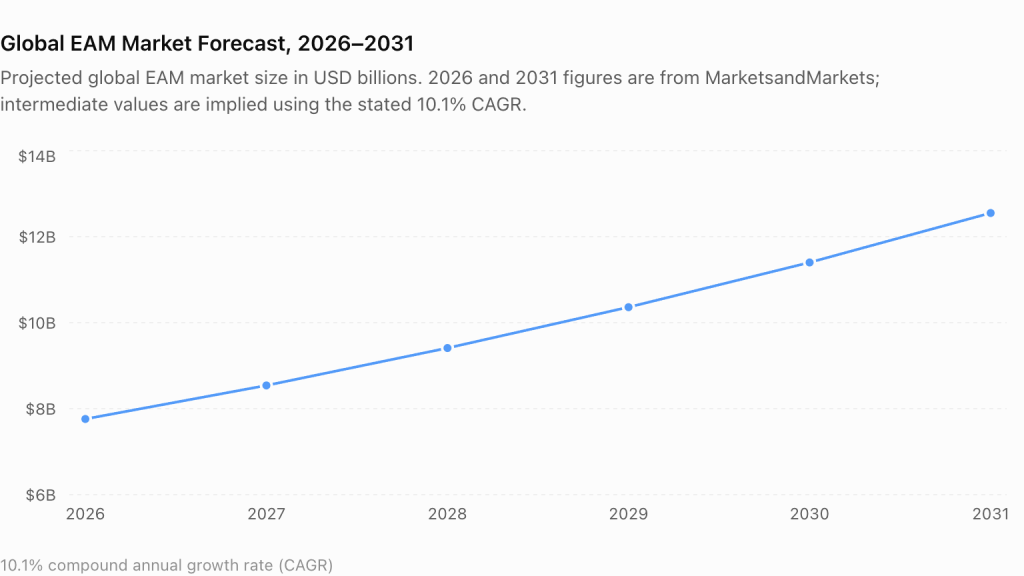
- The global EAM market is projected to grow from $7.76 billion in 2026 to $12.55 billion by 2031 at a 10.1% CAGR.
- EAM is shifting from a system of record toward a system of execution that turns asset data into operational action.
- Cloud, mobile, IoT, predictive maintenance, and SaaS are reshaping how organizations manage distributed asset operations.
- Data fragmentation and integration complexity make unified asset data and open APIs increasingly important to EAM strategy.
- AI-driven EAM is moving beyond recommendations toward controlled workflow execution, making governance and permissions critical evaluation criteria.
- EAM buyers should evaluate total cost across users, assets, capabilities, integrations, implementation, and expected growth.
The enterprise asset management market is rapidly expanding, driven by digital transformation, predictive maintenance, and the need for real-time asset visibility. Organizations are shifting toward cloud-based, AI-powered EAM systems to improve asset reliability, reduce downtime, and scale operations efficiently across distributed environments.
Publisher disclosure: EZO publishes this article and makes EZO EAM, one of the enterprise asset management platforms covered here.
If you’re a CEO or CIO managing operations at scale, asset performance is no longer a back-office concern. It directly impacts revenue, risk, uptime, and operational continuity.
The enterprise asset management market is growing as organizations invest in connected asset operations, predictive maintenance, and real-time visibility. According to MarketsandMarkets’ September 2026 forecast, the global EAM market is projected to grow from $7.76 billion in 2026 to $12.55 billion by 2031, representing a 10.1% compound annual growth rate (CAGR).
Mid-market and scaling companies are adopting enterprise-grade EAM earlier because operational blind spots are becoming too costly.
The sections below examine the forces shaping the market, how EAM adoption is changing, and what leaders should watch next.
Enterprise asset management market overview
The enterprise asset management market is expanding rapidly as organizations move from basic asset tracking to connected, lifecycle-based asset operations. Growth is being driven by rising infrastructure complexity, stricter compliance needs, higher uptime expectations, and increased adoption of cloud, IoT, AI, and predictive maintenance technologies. For leaders, EAM is becoming less of an operational tool and more of a strategic system for improving reliability, reducing risk, and scaling asset-heavy operations.
What is the current size and growth of the EAM market?
The latest MarketsandMarkets forecast cited above projects the global enterprise asset management market to reach $12.55 billion by 2031, growing at a 10.1% CAGR from 2026 to 2031.
The forecast points to continued investment in EAM as organizations seek better asset lifecycle management, connected maintenance operations, real-time asset data, and more scalable digital infrastructure.
What is driving this growth?
There are three main reasons why this market is growing:
- Digital transformation: Companies are adopting modern tools and systems to run their operations more efficiently.
- More complex operations: Organizations now manage more assets across multiple locations, making tracking and control harder.
- Need for real-time visibility: Teams want to know where their assets are, how they’re performing, and what needs attention, instantly.
Key insight
EAM is becoming a system of execution, helping organizations act on asset data in real time to improve maintenance, reliability, and asset performance.
Key market trends driving EAM adoption
Five shifts are reshaping EAM adoption: cloud deployment, mobile operations, connected assets, predictive maintenance, and SaaS delivery.
1. Cloud-based asset management
Organizations are rapidly moving from on-premises systems to cloud-based EAM platforms.
Instead of maintaining servers and infrastructure internally, everything is hosted in the cloud, making it easier to scale and manage operations across locations.
Why this matters:
- Easily manage assets across multiple sites
- Faster setup and implementation
- Lower IT overhead and maintenance costs
A construction company managing equipment across 20+ job sites uses a cloud-based EAM solution to track equipment availability in real time. Instead of calling different site managers, they can instantly see where assets are and reallocate them, reducing delays and idle equipment.
2. Mobile-first asset operations
Today’s teams are not sitting at desks; they’re in warehouses, hospitals, construction sites, or the field.
Mobile-enabled EAM platforms let teams update asset information on the spot using phones or handheld devices.
Why this matters:
- Update asset status instantly
- Resolve issues faster
- Improve coordination between teams
In a hospital, technicians use a mobile app to scan and update the status of medical equipment during rounds. If a device needs maintenance, it’s logged immediately, reducing downtime and ensuring equipment is always available when needed.
3. IoT and connected assets
IoT (Internet of Things) devices allow assets to send data automatically, like usage, temperature, or performance, without manual input.
This takes asset lifecycle management from reactive to proactive.
Why this matters:
- Continuous monitoring of asset health
- Automatic alerts when something goes wrong
- Better control over asset performance
A manufacturing plant installs IoT sensors on machines to track vibration and temperature. If a machine starts overheating, the system triggers an alert, allowing maintenance teams to act before the machine fails.
4. Predictive maintenance – AI
AI-powered EAM solutions analyze historical and real-time data to predict when an asset is likely to fail.
Instead of waiting for breakdowns, organizations can fix issues before they happen.
Why this matters:
- Reduce unexpected downtime
- Lower repair costs
- Plan maintenance more effectively
An airline uses predictive maintenance tools to monitor aircraft components. Instead of servicing parts on a fixed schedule, they replace them only when data shows signs of wear, reducing unnecessary maintenance and improving safety.
5. Shift to SaaS platforms
Traditional software required large upfront investments and a complex setup. Today, organizations prefer SaaS-based EAM solutions, where they pay a subscription and get continuous updates.
Why this matters:
- Lower upfront cost
- Faster adoption
- Continuous improvements without manual upgrades
Important shift:
SaaS-based EAM platforms are increasingly targeting mid-market and scaling organizations that need asset lifecycle management without the complexity of traditional enterprise deployments.
Illustrative scenario: A logistics company could use a SaaS-based EAM platform to centralize fleet records, monitor asset availability, and coordinate maintenance across locations.
These technology shifts are also changing the economics and adoption barriers around EAM.
Market dynamics: What shapes the EAM market today?
A mix of drivers, restraints, opportunities, and challenges shapes the EAM market.
As organizations adopt modern EAM solutions, they are adapting to more complex operations, higher expectations, and tighter control requirements across the asset lifecycle.
Drivers
These are the main factors pushing organizations to adopt EAM systems:
- Real-time asset visibility: Companies need instant access to where assets are, how they’re being used, and their current condition. This is critical for making faster operational decisions.
- Downtime reduction through predictive maintenance: Preventing failures before they happen helps reduce costly downtime and improves overall asset performance.
- Enterprise-wide digital transformation: Organizations are replacing manual processes and disconnected tools with integrated systems that support end-to-end asset lifecycle management.
Restraints
These factors can slow down adoption, especially with traditional systems:
- High implementation costs for legacy systems: Older EAM platforms often require large upfront investments, long deployment cycles, and dedicated IT resources.
- Complex integrations with existing infrastructure: Connecting EAM systems with ERP, ITSM, or other tools can be difficult, especially when systems are outdated or not built to integrate easily.
Opportunities
These trends are creating new growth areas in the EAM market:
- Rise of mid-market and scaling organizations: More growing companies now need enterprise-level visibility and control, creating demand for flexible, scalable EAM solutions.
- Expansion of API-driven ecosystems: Modern platforms are built to integrate easily with other systems, allowing organizations to connect asset data across tools and workflows.
Challenges
These are ongoing concerns organizations must manage as they scale:
- Cybersecurity risks: As asset data becomes more connected and cloud-based, protecting sensitive operational data becomes critical.
- Data fragmentation across systems: When asset data is spread across multiple tools, it becomes harder to maintain accuracy, consistency, and a single source of truth.
The EAM market is not just growing; it’s evolving.
Organizations are moving toward connected, flexible systems that can handle complex operations while still being easy to deploy and scale. The biggest advantage will go to those who can unify asset data and act on it in real time.
These market forces are influencing which EAM deployment models, organization types, and use cases are gaining traction.
Enterprise asset management market segmentation
How is the EAM market segmented?
The EAM market can be segmented based on deployment type, organization size, and application areas.
Each segment reflects how organizations adopt EAM solutions based on their operational complexity, scale, and specific use cases.
By deployment
Cloud – SaaS
EAM solutions are becoming an increasingly common choice for modern organizations. These systems are hosted online, allowing teams to access them from anywhere without managing infrastructure.
Key benefits:
- Lower upfront costs
- Faster implementation
- Remote access across locations
- Vendor-managed updates and maintenance
- High flexibility and scalability
What’s changing:
SaaS-based EAM platforms are seeing rapid adoption, especially among mid-market and scaling organizations that need enterprise-grade capabilities without long deployment cycles.
On-Premise
On-premise EAM systems are installed and managed internally within an organization’s infrastructure.
They are typically used by organizations with strict security, compliance, or data control requirements.
Key characteristics:
- Higher upfront investment
- Longer implementation timelines
- Internal responsibility for maintenance and upgrades
- Limited flexibility compared to cloud solutions
Comparison: Cloud vs On-Premise
| Factor | Cloud (SaaS) | On-Premise |
| Cost | Lower upfront | High upfront |
| Scalability | High | Limited |
| Deployment Time | Fast | Slow |
| Maintenance | Vendor-managed | Internal |
| Flexibility | High | Low |
By organization size
EAM adoption varies by organization size, with different requirements for scale, customization, deployment, and integration.
Large enterprises
Large enterprises typically manage complex, distributed asset environments across multiple regions and business units.
They often require:
- Deep customization and enterprise integrations
- Advanced analytics and reporting
- Support for complex operational workflows
- Cloud, on-premise, or hybrid deployment options
These organizations may have dedicated IT and asset management teams to support larger EAM implementations.
Small and medium-sized enterprises (SMEs)
SMEs typically prioritize ease of deployment, flexibility, and manageable implementation requirements.
They often look for:
- Faster implementation
- Cloud-based deployment
- Lower upfront investment
- Straightforward asset and maintenance workflows
Mid-market organizations generally fall within the broader SME segment, although EAM vendors may target mid-market companies as a distinct customer group.
By component
The EAM market can also be viewed by software and services. Software includes the EAM platforms used to manage asset data, maintenance, workflows, and lifecycle processes, while services can include implementation, integration, consulting, and ongoing support.
By application
EAM solutions are also segmented based on how they are used across different operational areas:
Asset lifecycle management
This focuses on managing assets from procurement to disposal.
It helps organizations:
- Track asset usage and performance
- Optimize lifecycle costs
- Improve long-term planning
Maintenance management – CMMS
This includes scheduling, tracking, and optimizing maintenance activities.
Key outcomes:
- Reduced downtime
- Longer asset lifespan
- Better maintenance planning
Inventory Management
This ensures visibility into asset availability and stock levels.
It helps:
- Prevent asset loss
- Avoid overstocking or shortages
- Improve asset utilization
Work Order Management
This involves creating, assigning, and tracking maintenance or service tasks.
Why it matters:
- Improves operational workflows
- Ensures accountability
- Speeds up issue resolution
The way organizations choose EAM solutions depends on how complex their operations are and how quickly they need to scale.
The strongest trend seen across all segments is that the organizations are moving toward flexible, cloud-based systems that combine asset tracking, maintenance, and workflow execution in one platform.
By industry vertical
EAM adoption varies by industry because asset complexity, maintenance requirements, compliance obligations, and operational risks differ. Common EAM-intensive sectors include manufacturing, healthcare, construction, energy and utilities, transportation, and field services.
Top enterprise asset management software solutions
Several leading software solutions are shaping the EAM market by offering advanced asset tracking, maintenance, and analytics capabilities. These tools help organizations move beyond spreadsheets and disconnected systems toward unified asset lifecycle management.
How we evaluated these platforms: We considered the deployment model, asset lifecycle management, maintenance capabilities, integrations, usability, scalability, and implementation complexity. Vendor capabilities and positioning may vary by product edition and configuration.
Leading EAM software providers
Here’s a quick look at some of the top EAM solutions available today:
- EZO EAM: Cloud-based asset management platform designed for mid-market and enterprise teams, with asset lifecycle visibility, maintenance workflows, and flexible deployment.
- IBM Maximo: Enterprise-grade EAM platform known for advanced analytics, AI-driven insights, and deep customization. Best suited for large organizations with complex infrastructure.
- SAP EAM: Asset management solution integrated within the SAP ecosystem, enabling seamless connection with ERP, finance, and procurement systems.
- Asset Panda: Flexible and customizable asset tracking platform with a focus on ease of use and configurable workflows.
- UpKeep: Mobile-first CMMS and asset management solution built for field teams, emphasizing maintenance and work order management.
Comparison of top EAM tools
| Tool | Deployment | Key Features | Target Users |
EZO EAM | Cloud (SaaS) | Asset tracking, maintenance, lifecycle visibility | Mid-market & enterprise |
| IBM Maximo | Cloud / On-premise | AI analytics, predictive maintenance, deep customization | Large enterprises |
| SAP EAM | On-premise / Cloud | ERP integration, asset lifecycle management | Large enterprises |
| Asset Panda | Cloud (SaaS) | Custom workflows, asset tracking | SMB–mid market |
| UpKeep | Cloud (SaaS) | Mobile CMMS, work orders, maintenance tracking | Field teams & maintenance teams |
Example: EZO EAM
What it does:
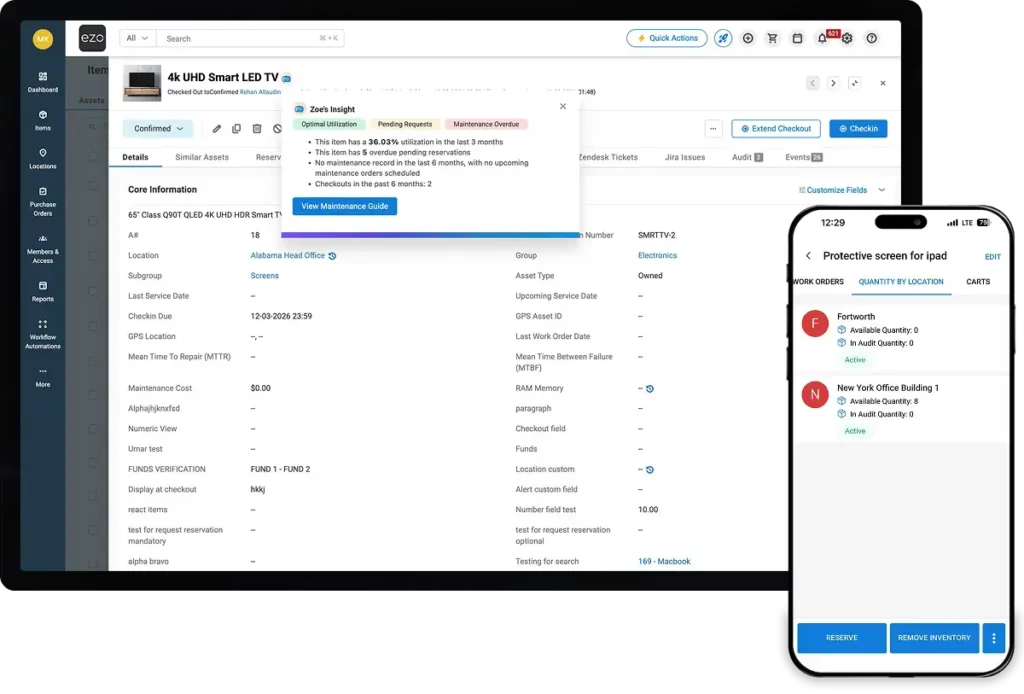
EZO EAM is a cloud-based asset tracking software that helps organizations track, manage, and maintain assets across their entire lifecycle, from procurement to disposal.
Key features
- Asset tracking: Use QR codes and barcodes to get real-time visibility into asset location, usage, and status
- Check-in / check-out system: Track asset movement across teams, locations, and projects with full accountability
- Maintenance management: Schedule preventive maintenance, set alerts, and maintain a complete service history
Who it is for
- Mid-market and enterprise organizations that need structured asset operations
- Teams looking for a simple, scalable SaaS-based EAM solution
- Industries with heavy asset usage, such as:
- Construction
- Healthcare
- Warehousing
- Manufacturing
The EAM market includes both complex enterprise systems and modern SaaS platforms.
The key difference today isn’t just features; it’s how quickly teams can deploy, adopt, and act on asset data.
Modern tools like EZO EAM are helping bridge that gap by combining enterprise-level capabilities with operational simplicity.
Use cases of enterprise asset management software
Enterprise Asset Management software is widely used across industries to improve asset visibility, reduce downtime, and streamline operations.
From factories to hospitals to field operations, organizations rely on EAM solutions to manage assets in real time, maintain performance, and ensure accountability across the entire asset lifecycle.
Manufacturing equipment management
In manufacturing, managing heavy equipment and production assets is critical to keeping operations running smoothly. Even a small delay or breakdown can impact output and revenue.
Use case:
Manufacturers use EAM solutions to monitor equipment, schedule maintenance, and track performance over time.
Key capabilities:
- Preventive and predictive maintenance scheduling
- Real-time performance monitoring
- Complete asset history and service logs
Business value:
- Reduced unplanned downtime
- Lower maintenance and repair costs
- Improved operational efficiency
Illustrative scenario: A manufacturing plant could use an EAM platform to schedule preventive maintenance and receive alerts for upcoming service, helping maintenance teams address issues before they become unplanned work.
Healthcare asset tracking
In healthcare, asset availability isn’t just about efficiency; it directly impacts patient care. Hospitals must ensure that critical equipment is always available, functional, and compliant.
Use case:
Healthcare providers use asset tracking software to monitor medical equipment, track usage, and maintain compliance records.
Key capabilities:
- Real-time tracking of equipment location and status
- Maintenance tracking and compliance logs
- Audit-ready reporting
Pain points solved:
- Equipment loss or misplacement
- Delays in treatment due to unavailable devices
- Lack of visibility into maintenance status
Business value:
- Faster access to critical equipment
- Improved patient care and response times
- Better compliance and audit readiness
Illustrative scenario: A hospital could use an EAM platform to track equipment such as wheelchairs, infusion pumps, and monitors, giving staff better visibility into asset location and availability.
Construction & field service
Construction and field service teams operate in highly distributed environments, where assets constantly move between sites and teams.
Use case:
Organizations use mobile-first asset tracking software to monitor tools, equipment, and workforce activity across multiple locations.
Key capabilities:
- Tracking equipment across job sites
- Check-in/check-out workflows for accountability
- Mobile access for field teams
Business value:
- Reduced asset loss and theft
- Better accountability across teams
- Improved project efficiency and timelines
Illustrative scenario: A construction company could use mobile asset management to record equipment check-ins and check-outs across job sites, giving field teams better visibility into equipment custody and availability.
Regional Analysis
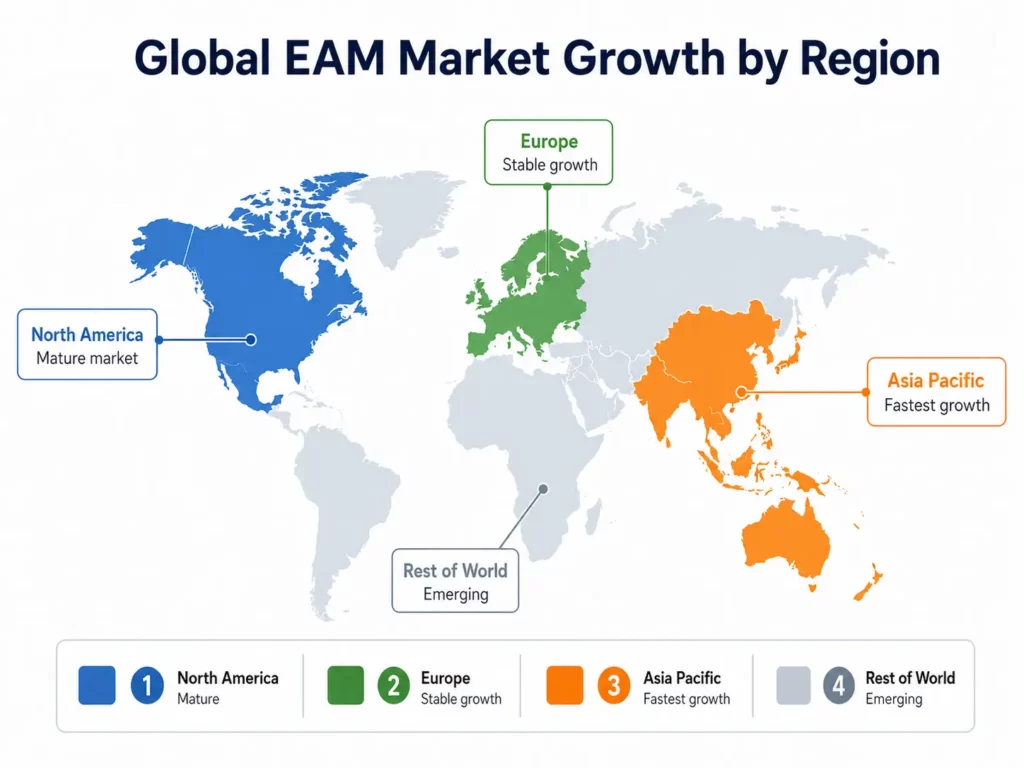
The adoption of EAM solutions varies across regions, driven by technological maturity, industrial activity, and digital transformation initiatives.
Different regions are at different stages of adopting enterprise asset management systems and asset tracking software, depending on how advanced their infrastructure and operations are.
North America
North America is the most mature and established market for EAM solutions.
Organizations in this region have been early adopters of advanced technologies such as AI, IoT, and cloud-based SaaS platforms.
Key characteristics:
- High adoption of modern EAM systems
- Strong presence of leading vendors
- Advanced asset lifecycle management practices
What this means:
Companies here are focused on optimization and innovation, using EAM not just to track assets but to drive predictive maintenance and operational efficiency.
Europe
Europe shows steady and stable growth in EAM adoption, particularly in industries like manufacturing, energy, and utilities.
Key characteristics:
- Strong focus on compliance and regulatory standards
- Emphasis on sustainability and efficient asset utilization
- Continued investment in digital infrastructure
What this means:
Organizations in Europe are using EAM solutions to balance efficiency with compliance, ensuring assets meet both operational and environmental standards.
Asia Pacific
Asia Pacific is the fastest-growing region in the EAM market. This growth is driven by rapid economic and industrial expansion.
Key drivers:
- Rapid industrialization
- Large-scale infrastructure development
- Increasing adoption of digital technologies
What this means:
Emerging economies are investing heavily in asset tracking software and modern EAM solutions to support growth, making this region a key driver of future market expansion.
Rest of the World
This category includes regions such as Latin America, the Middle East, and Africa, where EAM adoption is still developing but gaining momentum.
Key characteristics:
- Slower adoption compared to mature markets
- Growing interest in digital transformation
- Increasing infrastructure investments
What this means:
As industries expand and modernize, these regions present strong opportunities for EAM growth, especially with cloud-based solutions that are easier to deploy and scale.
Competitive landscape
The EAM market is highly competitive, with a mix of enterprise-grade platforms and flexible SaaS solutions targeting different segments.
The space is fragmented, with vendors focusing on different needs; some are built for large, complex enterprises, and others are designed for mid-market and scaling organizations that need speed, flexibility, and operational depth without heavy overhead.
How the EAM vendor landscape is divided
The EAM market includes a mix of large enterprise platforms and cloud-based SaaS providers, with vendors targeting organizations with different levels of operational complexity, customization, and deployment requirements.
Enterprise vendors: Platforms such as SAP and IBM are commonly positioned for large organizations with complex asset environments, deep integration requirements, and substantial customization needs.
SaaS providers: Cloud-based EAM platforms are increasingly targeting mid-market and scaling organizations that prioritize faster deployment, accessibility, and flexibility.
What this means for buyers: The EAM market is not divided simply by vendor size. Platform fit depends on operational complexity, integration requirements, deployment preferences, customization needs, and expected scale.
Vendor positioning
EAM vendors can be broadly grouped into two categories:
Enterprise-Grade Solutions e.g., SAP, IBM
These platforms are designed for organizations with complex, large-scale asset ecosystems.
Characteristics:
- Highly customizable and configurable
- Deep integration with ERP and enterprise systems
- Advanced analytics and reporting
- Longer implementation cycles
- Higher upfront and operational costs
Best suited for:
Large enterprises with dedicated IT teams and complex infrastructure needs
Mid-Market Focused SaaS Solutions (e.g., EZO EAM, Asset Panda)
These solutions are built for organizations that need enterprise-level capabilities without enterprise-level complexity.
Characteristics:
- Cloud-based and easy to deploy
- Faster onboarding and implementation
- Subscription-based pricing (lower upfront cost)
- Strong focus on usability and flexibility
Best suited for:
Mid-market and scaling organizations managing distributed assets and operations
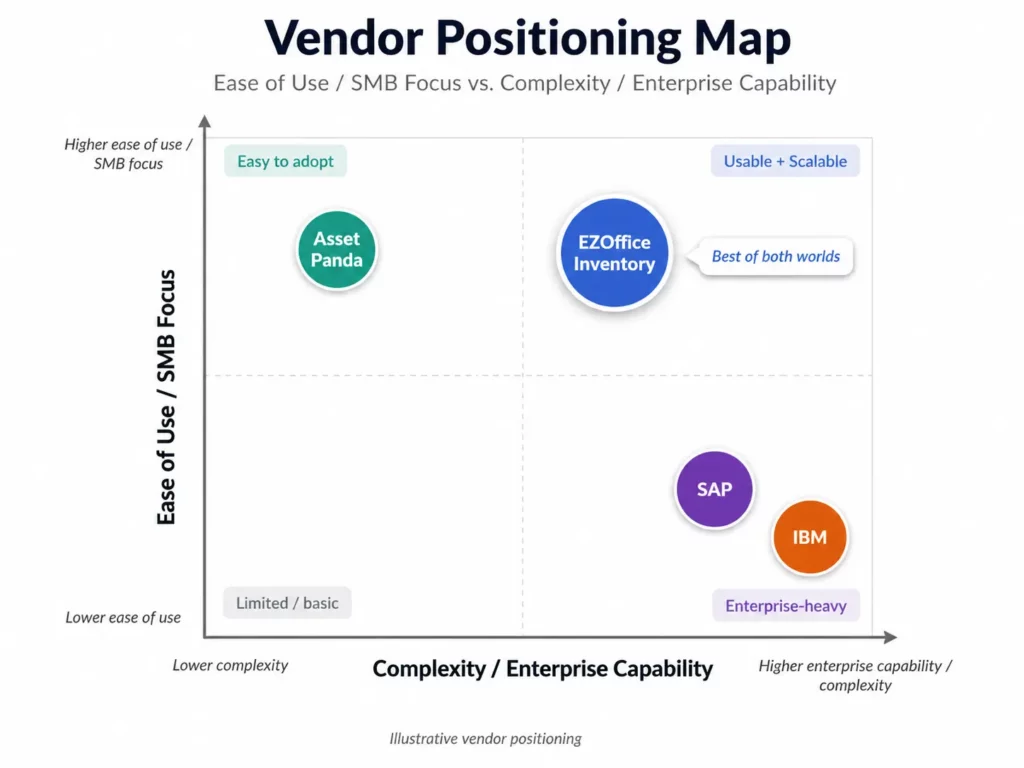
Vendor positioning map
How vendors compare
- SAP, IBM: High complexity, high enterprise capability
- Asset Panda: High usability, lower operational depth
- EZO EAM: Balanced positioning across enterprise capability and ease of use
What changed in the EAM market in 2026?
Several developments in 2026 show how the EAM market is expanding beyond traditional asset and maintenance management into connected operations, AI, and broader lifecycle workflows.
Autodesk completes MaintainX acquisition
In August 2026, Autodesk completed its acquisition of MaintainX, bringing the maintenance and operations platform into Autodesk’s Operations Solutions business. Autodesk said the move is intended to connect design, make, and operate workflows across the asset lifecycle.
IBM expands AI capabilities in Maximo
In June 2026, IBM released Maximo Application Suite AI Service 9.2.0, adding capabilities including Meta-Agent support and document abstraction use cases. The release illustrates IBM’s continued expansion of AI within its EAM platform.
IFS Cloud 26R1 expands asset-intensive operations
In May 2026, IFS released IFS Cloud 26R1, with enhancements across EAM, service management, maintenance, safety authorization, materials, and sustainability. The release reflects the broader shift toward connecting asset operations with adjacent business processes.
Future outlook of the EAM market (2026–2030)
The next phase of EAM will be shaped less by basic digitization and more by how intelligently platforms can interpret asset data and trigger operational decisions. Three areas warrant particular attention: AI-driven workflows, richer asset models, and more flexible approaches to platform consumption and pricing.
AI-driven workflows
EAM platforms are moving toward AI that can participate in operational workflows rather than simply surface recommendations. In 2026, ServiceNow introduced agentic workflows for EAM that can autonomously source requested assets, create transfer or purchase orders, and support asset repair processes.
IBM’s Maximo Application Suite 9.2, released in June 2026, similarly embeds AI into maintenance, reliability, field service, safety, and operations workflows.
What this means for buyers: EAM evaluations will increasingly need to consider what actions AI can take, what asset data those actions rely on, and what access controls govern automated execution.
Richer asset models
Future EAM platforms are likely to provide more context around individual assets by bringing together asset history, condition signals, failure patterns, maintenance records, and operational data. IBM’s current Maximo AI capabilities, for example, connect condition signals, anomaly detection, reliability strategies, asset history, and work data to support maintenance decisions.
This could make the asset record more than a static repository of specifications and maintenance history. It can become a richer operational model that helps teams understand asset condition, risk, maintenance needs, and the next appropriate action.
More flexible approaches to platform consumption and pricing
EAM licensing is also becoming less uniform. IBM Maximo Application Suite as a Service uses AppPoints, allowing organizations to allocate resources across capabilities from a shared pool, with usage tied to activated capabilities and business-value metrics rather than user seats alone.
ServiceNow also documents subscription-unit licensing for its Enterprise Asset Management for Data Center and Network Asset Management application, where subscription consumption is calculated from asset resource categories and predefined ratios.
These models mean buyers may need to evaluate EAM costs based on assets, capabilities, usage, users, and expected growth, rather than assuming a standard per-user subscription provides a comparable baseline.
What to watch through 2030
The EAM market is likely to differentiate increasingly on how well platforms connect asset context, AI-driven decisions, and operational execution. For buyers, that means evaluating AI governance, asset data depth, workflow automation, integration architecture, and licensing structure alongside traditional maintenance and asset-management capabilities.
What EAM leaders should prioritize
EAM investment should focus on operational outcomes rather than simply adding more features or digitizing existing processes. Leaders evaluating EAM platforms should prioritize these areas:
1. Consolidate asset data into a reliable system of record
Bring asset, maintenance, ownership, location, condition, and lifecycle information together so teams can work from consistent data across the organization.
2. Prioritize critical assets for condition-based maintenance
Identify assets where failure has the greatest operational or financial impact, then use condition data and maintenance history to determine where predictive or condition-based approaches can deliver the most value.
3. Require integration and open APIs
Evaluate how easily an EAM platform connects with ERP, IoT, finance, procurement, and other operational systems. Open APIs can reduce data silos as the technology environment evolves.
4. Evaluate AI based on controlled execution
Look beyond AI-generated insights. Assess what actions AI can initiate, what data informs those actions, and what permissions and controls govern automated workflows.
5. Compare total cost against future scale
Assess licensing, modules, integrations, implementation, users, assets, and expected growth together rather than comparing vendors on subscription price alone.
Final takeaway
The enterprise asset management market is no longer just about tracking assets; it’s about running operations on asset data.
Organizations are moving toward systems that combine enterprise-grade execution with the speed and flexibility scaling teams need.
If your operations depend on physical assets, EAM is becoming a foundational operating layer.