

Heavy equipment rental businesses face a different reality than general rental companies. When managing rentals, including checking them in and out, they need to ensure their equipment is well-maintained and properly tracked. Any piece of equipment that goes missing results in lost revenue quickly, as there is no equipment to rent to customers.
The heavy equipment market is a growing industry. ~40% of respondents in EZRentOut’s State of the Equipment Rental Industry Report stated that the heavy equipment market is expected to grow exponentially in 2026. The heavy equipment market functions on the values of trust and reliability. If you break your client’s trust once, chances are low that they will come back to you for another rental.
It’s pretty simple: Lost heavy equipment = missed rental = frustrated client
Heavy equipment businesses in construction, transportation, and oil and gas require an automated system to manage both rental processes and equipment. While Point of Rental is a popular choice for heavy equipment businesses, many growing construction and equipment rental companies look for alternatives when they need more flexibility, better operational visibility, or greater scalability.
In this article, we will explore the top alternatives to Point of Rental for heavy equipment rental management and what to consider if your operations need more than just rental management.
Point of Rental: A rental powerhouse lacking operational visibility into equipment
Point of Rental (PoR) is designed to meet the operational needs for heavy equipment rental management with a strong focus on fleet and contract management. It’s widely used by construction equipment rental businesses, industrial contractors, and multi-site operators to handle complex workflows for high-value machinery.
In the heavy equipment sector, PoR helps businesses track availability, optimize utilization, and streamline the entire rental lifecycle, from initial quote to equipment return. PoR is suitable for rental operations across multiple locations.
Core features
- Rental management: Seamlessly create quotes, contracts, and invoices for complex orders and machinery, including excavators, cranes, and loaders.
- Fleet tracking: Every piece of equipment is tagged so you can individually track the rental status of equipment, i.e., whether it’s on rent, reserved, under maintenance, or sitting idly.
- Maintenance and service management: Schedule preventive maintenance and service for heavy equipment, and track repair history, downtime, and safety inspections for each piece of equipment.
- Customer and contract management: Track rental agreements for construction projects and long-term industrial rentals, monitor payments, and maintain complete rental histories. This helps track overdue payments and missed rentals, as well as any violations of contract conditions.
- Multi-Location and yard management: Manage assets across multiple construction yards or rental depots and centralize visibility for teams coordinating large fleets.
Why do heavy equipment businesses go for Point of Rental?
Heavy equipment businesses that manage complex, high-value machinery and provide booking controls across multiple locations usually choose PoR. Heavy equipment teams need to optimize fleet utilization so the equipment can be utilized to its maximum capacity. Such teams choose PoR because the platform offers utilization reports that provide a holistic view of their current equipment usage. Alerts are generated automatically for underperforming and idle equipment.
Why heavy equipment businesses should go for Point of Rental
End-to-end rental lifecycle management
PoR takes precedence over other platforms by tracking and monitoring the complete equipment lifecycle. This includes:
- Quote: Generate accurate, equipment-specific quotes tailored to project requirements.
- Contract: Convert quotes into formal contracts with clear rental terms, insurance requirements, and project-specific clauses.
- Reservation: Reserve equipment in real-time across multiple yards or sites.
- Dispatch: Coordinate transport and delivery to the right job site on schedule.
- Return: Record the condition, usage hours, and any damages upon return.
- Invoicing: Automate billing, deposits, late fees, and project-based adjustments.
Projects involving heavy equipment, such as construction projects, usually span months and require data consolidation so rental data is readily available when needed. Having a system that enables you to track your rentals seamlessly, manage client bookings, schedule returns, and generate and send invoices works ideally in a heavy equipment environment.
Additionally, heavy machinery requires regular inspections, preventive maintenance, and regulatory compliance checks. PoR integrates maintenance processes directly into the rental workflow by enabling scheduling and tracking preventive maintenance. These service sessions or repairs are automatically logged into the system, allowing you to check the history if needed. You can easily record safety instructions in the inspection or repair details to ensure regulatory compliance.
Also, PoR helps users fully capture project revenue through accurate billing. PoR ensures that you fully record your rental revenue, including deposits, variable rates, and late fees. It automates invoicing for complex contracts, reducing manual errors, and integrates with accounting systems for accurate financial reporting. This way, you never miss any rental payments and can record equipment damage, preventing loss.
A notable function of PoR is that it treats heavy equipment rentals as a complete operational ecosystem rather than a series of transactions. From quoting to invoicing, dispatch to maintenance, and multi-site coordination, PoR enables businesses to efficiently manage high-value, complex fleets while maximizing revenue and uptime.
Limitations:
1. Missing advanced analytics and integration flexibility
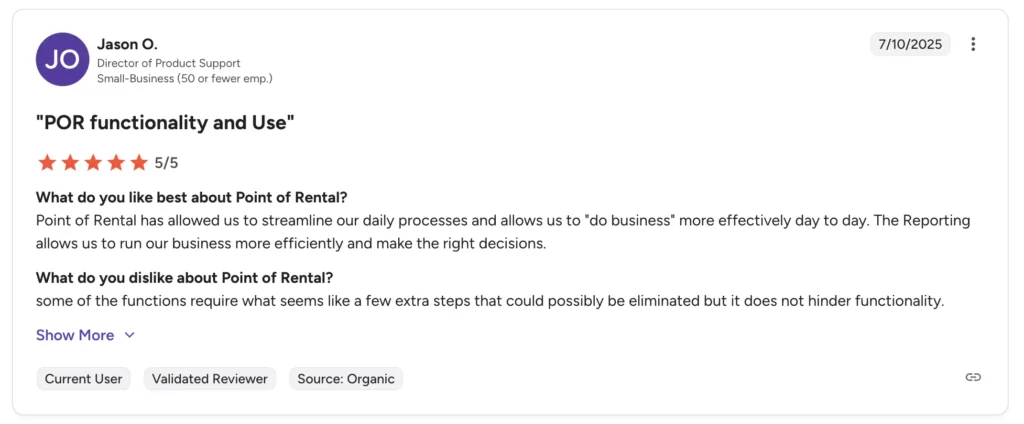
While PoR tracks basic rental metrics, such as which machines are rented, reserved, or idle, it does not provide the deep operational analytics that heavy equipment operators increasingly rely on. You cannot assign tags to equipment to see their condition. For instance, it will show as “not rented,” but it does not indicate whether the equipment is blocked for maintenance or awaiting an inspection. If a piece of equipment sits idle in a yard, it might remain at that location without being accurately recorded in the system for months.
2. Lack of insights into equipment maintenance
Heavy equipment requires proactive maintenance to avoid downtime. While PoR tracks maintenance schedules and logs repairs, it does not analyze patterns to forecast failures, predict optimal servicing windows, or optimize replacement cycles.
This is a significant limitation for businesses that rely on regular maintenance analytics to keep their equipment up to date. Without analytics, businesses can miss opportunities to reallocate or retire equipment when it is no longer needed.
Source: G2
Alternatives to Point of Rental: Market leaders defining the heavy equipment rental market
Based on the complexity of heavy equipment rentals, not every platform is capable of meeting the requirements of heavy rental businesses. You have to choose carefully to ensure your investment delivers a worthwhile ROI.
Let’s understand how the following alternative heavy equipment rental software compares to PoR and what they have to offer:
1. EZRentOut: A cloud-based rental solution for every heavy rental business with integrated operational visibility
While PoR is a feature-rich solution, it was primarily built for office use, so naturally, many legacy users still use it on desktop. Their cloud-based/web module, called RentalForce, can be used as an add-on, but some users may find it inconvenient. This is where EZRentOut comes in!
EZRentOut is a fully automated, cloud-based heavy equipment rental platform that is highly useful for field teams who do not have a desktop with them at all times. Teams can access EZRentOut from anywhere, including via its mobile app, and the data updates in real time. Multiple users can log in to the software with their own IDs, so reliance on a single person or desktop is not required. This means the implementation is also faster and more efficient than PoR.
Core features:
EZRentOut provides a holistic suite of solutions to your rental asset management needs, including:
- End-to-end heavy equipment asset management: EZRentOut streamlines the entire rental lifecycle for heavy equipment from the first customer inquiry to the final return and invoicing. Rental teams can create quotes, convert them into reservations, check equipment out to job sites, track rental durations, and close rentals without switching systems. It also supports partial returns, extensions, advanced maintenance workflows, and custom status creation.
- Multi-location and fleet visibility: EZRentOut supports rental operations across multiple locations by providing centralized visibility into the entire equipment fleet. It offers users an availability calendar that field teams can use to check which equipment is available for rent. Rental managers can also see which assets are located at which yard or site and move equipment between locations as demand shifts. This is especially valuable for growing heavy equipment businesses that operate across regions or serve multiple construction markets.
- Short-term and long-term rental management: The platform supports both short-term and long-term equipment rentals, making it suitable for daily hires and multi-month construction projects. Regular updates ensure that once equipment is booked or checked out, it’s immediately reflected in system availability, reducing scheduling conflicts and operational errors.
- Supports sub-rentals: You can procure equipment from third-party equipment providers and rent it to your customers. These items count as sub-rentals in EZRentOut, and the system allows you to record the rental profit, as it records both the rental and procurement rates.
- Cloud-based, mobile-first access: As a fully cloud-based platform, EZRentOut lets teams access rental data from anywhere, whether they’re in the office, at a depot, or on a job site. Field staff can check equipment availability, process check-outs and returns, and update rental statuses using the EZRentOut mobile app. The interface is straightforward and useful for large‑scale operations as it supports advanced features such as offline access and check‑in/check‑out scanning.
- Maintenance and downtime management: EZRentOut includes a built-in maintenance scheduler for tracking maintenance schedules, service history, and downtime for heavy equipment. Businesses can plan preventive maintenance based on time intervals or usage and automatically mark equipment as unavailable during service periods. This prevents unsafe or non-operational machinery from being rented out.
- Flexible rental pricing and billing: The platform allows heavy equipment rental businesses to define flexible pricing structures, including daily, weekly, monthly, or custom rental rates. It supports deposits, extensions, late returns, and variable billing periods, all of which are often required for long-running construction projects. EZRentOut also integrates with accounting systems, like QuickBooks, Xero, and Sage, to streamline invoicing and financial reconciliation. This flexibility helps rental businesses align billing with how contractors actually use heavy equipment, reducing disputes and manual adjustments.
- Payment gateways: You can set custom or customer-level pricing models and handle security deposits. Users can also process payments through integrated gateways like Stripe or Square to facilitate customers and provide a seamless payment experience.
- Utilization and performance reporting: EZRentOut offers reporting tools that help businesses understand how effectively their heavy equipment fleet is being used. Rental managers can track utilization rates by asset, category, or location to identify underused equipment or high-performing machines. They can track revenue per piece of equipment to assess whether their investment is worth it. These insights support smarter decisions around purchasing new equipment, retiring aging assets, or reallocating machinery to higher-demand regions or projects.
- 24/7 customer support: EZRentOut offers exceptional customer service with support agents available round the clock to answer customer queries. Specialized customer support is provided, along with onboarding and implementation sessions, to ensure users have the information they need to use the software.
EZRentOut: A solution for the field, not just the front desk
EZRentOut is designed to handle moving equipment, i.e., equipment moving around yards and sites. It helps track asset movements across locations and check their quantities and availability. Field teams know where equipment is located and in what condition, so if utilization is low at one location, they can take action to improve it.
You can track your equipment’s utilization so you know when it needs to be replaced. This data can be displayed on your dashboard, giving you access to the most up-to-date utilization and revenue stats.
This also helps prevent idle time, as you can judge if the equipment needs to be reallocated. As soon as a piece of equipment checks out to a customer, its status is automatically updated in the system. This helps avoid double-bookings and generally any clashes in reservations.
Using the mobile app, you can directly manage equipment in the warehouse rather than managing everything from an office desktop. Equipment can be assigned to specific job sites, projects, or crews, giving managers visibility into where machines are deployed and how long they have been there. This helps prevent equipment from “disappearing” across projects and makes it easier to rebalance assets when priorities shift.
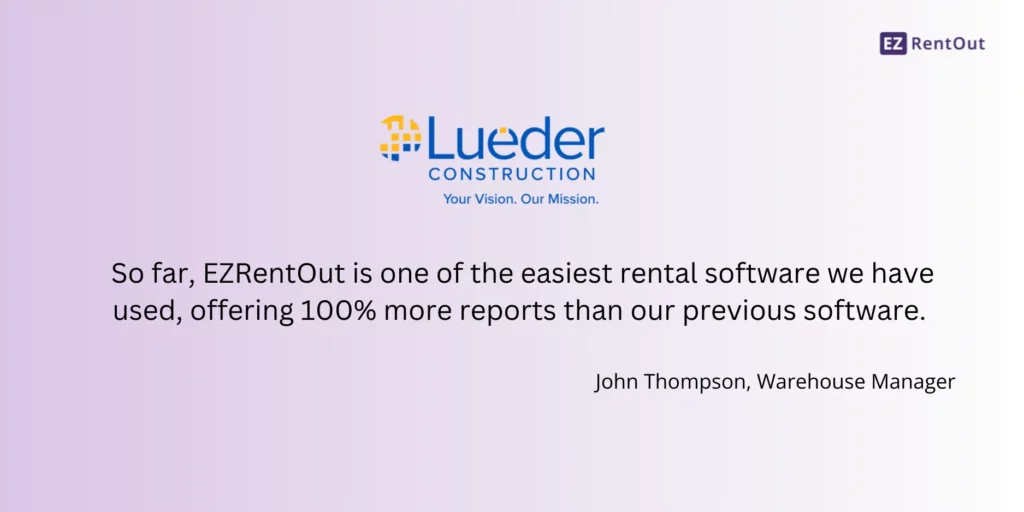
Leuder Construction saved time and cost on projects worth more than $50M using EZRentOut. This is what the company’s Warehouse Manager has to say about our rental asset management software:
Limitations:
1. Learning curve
Some users may find it challenging to start using EZRentOut immediately, as the depth and complexity of its features require training and understanding. The platform offers depth through workflows optimized for heavy equipment. This might not be ideal for small-scale rental businesses that require simpler workflows.
But EZRentOut is designed for ease, as the name suggests. Its intuitive dashboard and simple navigation make it easier for teams to understand and adopt. PoR, on the other hand, has a steeper learning curve as it supports a desktop version.
2. Reporting depth vs legacy systems
Heavy equipment businesses that rely on legacy systems for reporting may find it challenging to adapt quickly to EZRentOut. The platform does not provide extensive financial integrations, so if heavy equipment managers need detailed revenue reporting or contract analysis, they need to integrate with a third-party analytical platform.
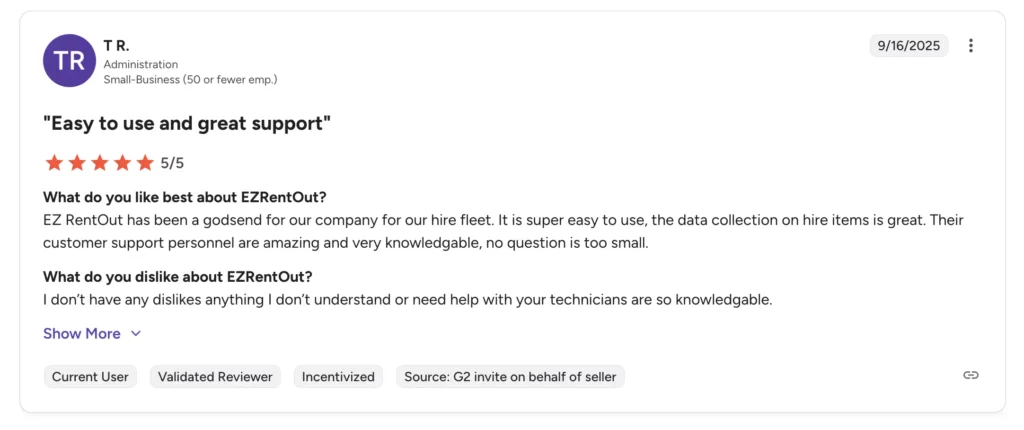
Source: G2
Move beyond the rentals: Prioritize asset-operations
Did you think EZRentOut was only about rentals? That’s a common assumption, and also where many heavy equipment businesses hit an operational ceiling.
Rentals are just one phase of the heavy equipment lifecycle. After a machine is rented out and returned, it needs to be inspected, tracked, maintained, and reallocated. This is where asset operations play a crucial role.
EZRentOut, when used with EZO, integrates rental operations with physical asset management. With a focus on asset-first operations, this power combo ensures your equipment is well-maintained and used to its full potential when rented out. EZO goes a step further by providing optimized solutions that can help maintain large fleets and improve their visibility.
With EZO and EZRentOut, heavy equipment businesses can:
- Maintain complete fleet visibility: Secure your asset information in a single source of truth so you can assess where equipment is, who is using it, and whether it can be rented. You do not need to maintain two different systems to track and rent equipment.
- Implement timely maintenance: When a machine is returned from a rental, automatically reserve it for inspection to assess its condition. Schedule maintenance, book the machine, and keep it up to date. If a machine is rented out more frequently, use EZO’s recurring maintenance feature to schedule it for repeat maintenance.
- Reduce downtime and prevent overbooking: Ensure that equipment under maintenance or inspection is automatically marked unavailable for rentals. This prevents unsafe machinery from being rented out and avoids scheduling conflicts that can disrupt project timelines.
- Optimize utilization across rentals and internal use: Understand how equipment is used across customer rentals and internal operations. Identify underutilized machines, rebalance fleet allocation, and avoid unnecessary purchases by making better use of existing assets.
- Control equipment movement across job sites: Track when equipment moves between yards, job sites, and internal projects. Maintain accountability for assets assigned to crews or locations and prevent equipment from being misplaced, overused, or left idle at remote sites.
- Implement GPS tracking: Use integrations like Samsara to track your equipment in transit and view its location on a map.
Magna IV Engineering report having increased its operational efficiency by 40% and saved thousands of dollars using EZO. Together, EZO and EZRentOut provide a complete solution for your rental and physical asset management needs, helping take your heavy equipment operations to the next level.
2. Rentrax: Powering rentals, from the warehouse to the worksite
Known for automating the entire rental process, Rentrax is a heavy equipment rental software that handles bookings, payments, inventory tracking, and order processing. It offers a centralized dashboard for reserving equipment, tracking inventory, and reporting on equipment performance.
The aim is to ensure multi-site fleet management, provide long-term rentals with recurring invoices, and increase visibility into equipment such as excavators, skid steers, cranes, and other heavy tools.
Core features:
- Booking and reservation management: Rentrax handles bookings from multiple channels, including online, in person, or over the phone, all synced in real time. It supports multiple order forms, customizable renter details, and digital signatures or waivers.
- Inventory tracking and availability: The platform provides a calendar view of equipment availability, allows usage monitoring (e.g., runtime, fuel, or battery levels), and includes maintenance scheduling and service reminders.
- Pricing, billing, and payments: Customers can set custom pricing with flexible billing options for an improved billing experience.
- Flexible booking options: Supports online reservations, in‑person rentals, and phone bookings with real‑time syncing. This increases booking options and makes it easier for customers to choose the best option.
- Mobile app: Rentrax offers a mobile app that lets users manage their equipment on the go and easily handle customer service interactions from anywhere.
- Reporting and analytics: Rentrax includes reporting tools that provide insights into key business metrics, such as revenue and utilization, and enables users to create custom reports.
How Rentrax is better than Point of Rental
User-friendly booking and reservations experience
Rentrax takes pride in providing a smooth reservation and booking experience to its customers through data centralization. The aim is to make the reservation process smoother by providing an online booking system. With an online reservation system, customers can make bookings from anywhere via the web, mobile, or by phone. The system also offers users multiple types of reservations, allowing them to select multiple items and bundle equipment packages. At the time of booking, the availability calendar lets users check what’s available so they can choose from the available options.
This way, heavy equipment users have several methods to choose the right equipment for the right project.
As soon as the equipment is booked, the equipment count is instantly updated automatically, reflecting true inventory numbers in the system. Rentrax’s system helps manage complex, long-term heavy equipment rentals seamlessly. Rentrax’s booking workflow is designed to be straightforward and flexible for teams that want fast reservations and easy online booking without heavy setup, compared to PoR.
Limitations:
1. Inventory management can be confusing
Several users have noted that the way inventory and asset tracking are structured in Rentrax is not always intuitive, particularly when handling large or complex fleets. This can make setup and daily tracking more difficult for businesses with many unique equipment types.
2. Some administrative customization limits
Users have pointed out that certain admin settings and customizations are not as flexible as they require them to be. For example, deeply customized workflows or uniquely tailored rental rules, which can require workarounds.
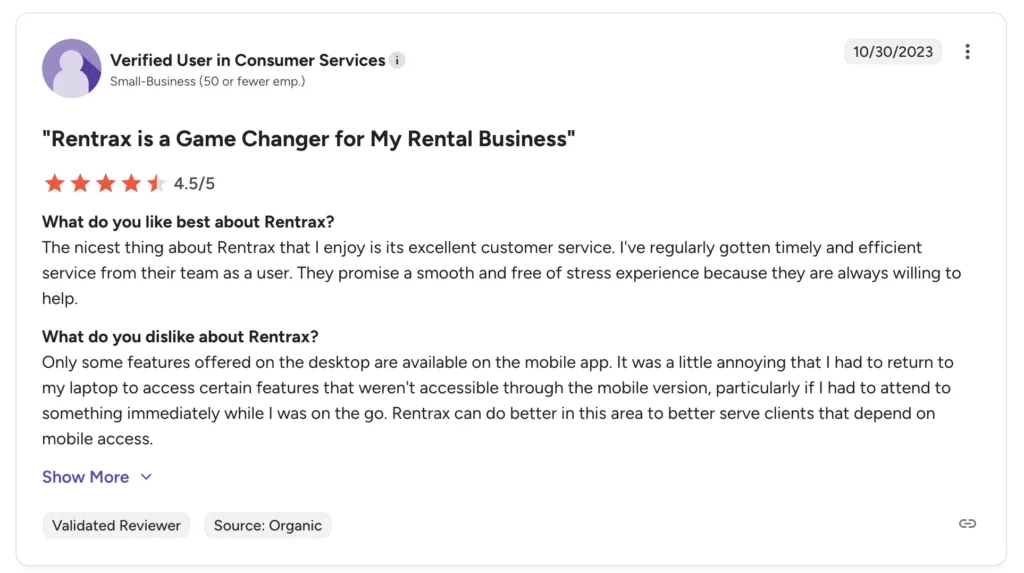
Source: G2
3. Booqable: Simple rentals, anytime, anywhere
Booqable is designed to support small- to medium-sized heavy equipment rental businesses that need an easy-to-use system to manage rentals and streamline equipment workflows. Its core appeal lies in simplifying reservations, inventory visibility, and online store creation so that customers can browse and book equipment directly from a digital storefront.
Booqable focuses on seamless online bookings and e‑commerce‑ready rental stores, making it ideal for businesses that want to combine inventory management with a branded customer‑facing rental site. It includes tools to manage orders through statuses like Draft, Booked, Picked Up, and Returned, with availability automatically updated as rentals progress.
Here are the features that Booqable has to offer:
- Order and rental management: Booqable enables rental businesses to view and manage open, upcoming, and past orders through an intuitive dashboard. An availability calendar shows which equipment is booked or free, helping teams plan without manual spreadsheets. Unlike more complex systems, once a rental duration is set, it cannot be changed after an order is placed, which simplifies scheduling but limits flexibility for mid‑rental changes.
- Tracking the order lifecycle: Booqable tracks basic order statuses, allowing staff to monitor each asset throughout its journey. Inventory counts update as items are picked up or returned, reducing errors and preventing double bookings.
- Service and maintenance: While Booqable lets you manually mark items as unavailable for maintenance or cleaning, it lacks a built‑in maintenance scheduler, service tickets, or history logs. You can create buffer time around rentals to allow for service, but there is no automated preventive maintenance scheduling or work order system within the platform.
- Mobile app and field support: Booqable offers a mobile app for iOS and Android that allows staff to browse catalogues, check availability, mark items as picked up or returned, and manage orders.
- Rental online store: One of Booqable’s strongest areas is its online rental storefront. You can create a visually appealing, branded store with detailed product images and descriptions that make it easy for customers to browse equipment and book online. It also integrates with popular payment gateways such as Stripe and PayPal and supports customizable invoices and offline payment options.
How Booqable wins over Point of Rental
Focus on a simple and intuitive interface
Booqable’s core focus lies on providing an accessible, intuitive inventory and order management experience designed for speed and ease of use, rather than deep enterprise complexity. While PoR is designed for complex workflows, Booqable is meant to save users time by eliminating the need to set up rules to manage rentals. Users can import items and onboard orders with minimal technical support.
The order creation process is straightforward, so orders can be processed quickly with the fewest steps. This simplicity is not “missing features,” it is an intentional UX approach that prioritizes operational speed and clarity over configurability.
Limitations
1. Support and customer service can be limited
Some users report that live technical support is minimal or unavailable, with no phone support and reliance on chat/AI responses. This can be frustrating when mission‑critical issues arise, and you need quick help.
2. Not built for large‑scale or complex operations
Booqable’s simplicity is great for smaller teams, but reviewers note that it is geared more toward beginners and heavy equipment rental businesses that are not looking to scale extensively. Reviewers have said it may fall short for businesses with complex rental workflows or large fleets.
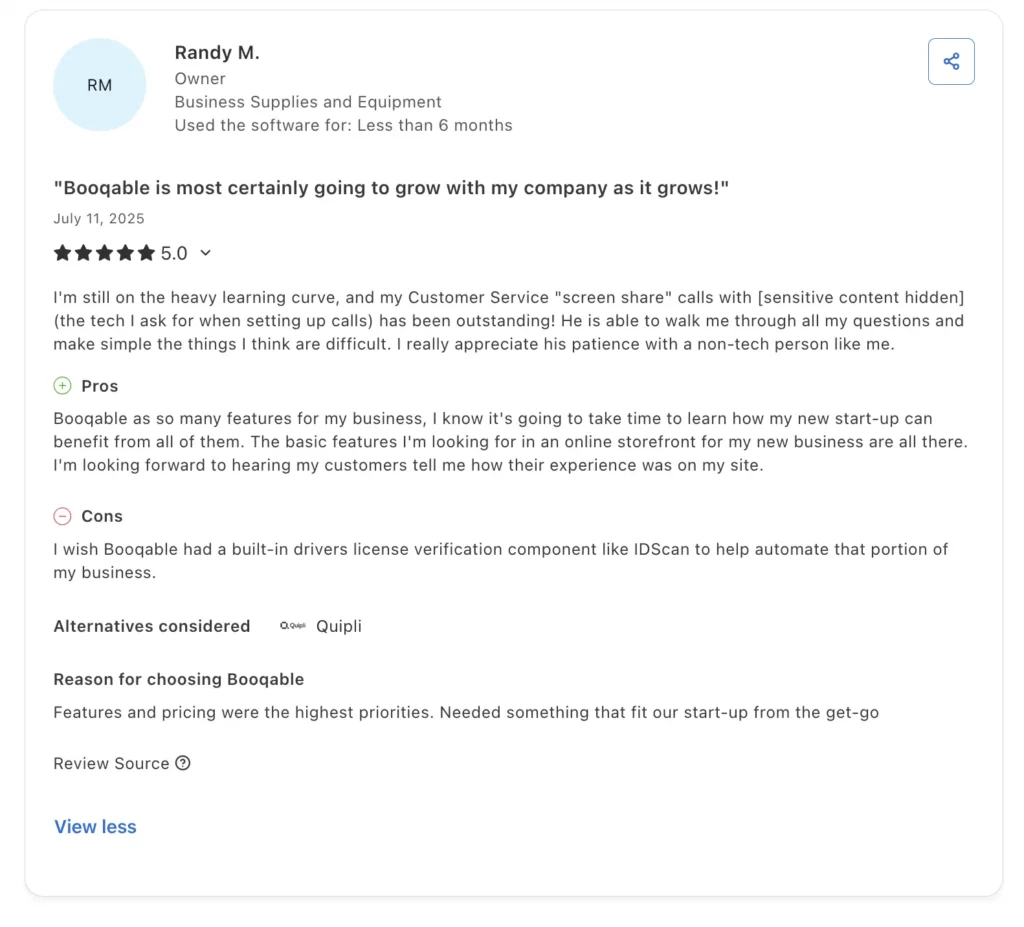
Source: Capterra
4. RentMan: Managing rentals, from projects to the end user
Rentman is a cloud-based rental platform designed to manage not just equipment bookings but the full rental lifecycle within projects and operations. Unlike traditional rental software, Rentman treats equipment as part of project workflows, linking gear to job sites, crew assignments, and logistics. This makes it ideal for heavy equipment businesses that operate across multiple construction sites and need to coordinate operators or schedule deliveries alongside machinery.
- Project-based scheduling: Rentman allows rental teams to assign heavy equipment directly to specific projects or job sites, complete with start and end dates. Its visual drag-and-drop project timelines let managers coordinate multiple assets across different projects while tracking dependencies to ensure the right machinery is on site at the right time.
- Logistics and transport planning: Rentman supports detailed planning for heavy equipment pickups, deliveries, and routes. Teams can schedule drop-offs and returns across multiple job sites while monitoring transit timelines to reduce delays.
- Integrated quoting and invoicing: Rentman simplifies the financial workflow by linking quotes directly to projects. Teams can generate professional quotes, convert them into confirmed rentals without re-entering information, and automatically generate invoices while tracking payment status. Integration with accounting software such as QuickBooks or Xero further streamlines the process, making it easier to maintain financial accuracy while planning operations.
- Inventory and equipment tracking: With Rentman, teams can track heavy equipment availability across all projects. QR code and barcode scanning speed up check-ins and check-outs, while bundling equipment into kits ensures that project-specific sets of machines are deployed efficiently. Every asset’s usage history is logged per project, providing accountability and helping managers monitor equipment performance over time.
What RentMan offers better than Point of Rental
Project-centric workflow
Most of RentMan’s key features center on managing projects, bringing equipment management, order processing, and crew scheduling into one place. Users can plan across multiple sites by ensuring equipment and operators are where they need to be. You can check which equipment is booked for each project to gain clear visibility into which client has access to which equipment. This includes determining which construction projects are coming to an end and keeping buffer time in mind, i.e., the duration during which the equipment is returned from the last rental, serviced, and prepared for the next project.
By renting equipment project-wise, you can be sure which heavy equipment operators are regular customers.
Limitations:
1. Not fully built to handle heavy equipment
Its workflows focus primarily on scheduling equipment for projects, so it lacks deep preventive maintenance capabilities, such as automated service schedules, alerts, and repair workflows for large machinery. Additionally, Rentman does not offer telematics, so tracking engine hours, fuel usage, or remote diagnostics requires external solutions. Equipment utilization outside of project assignments is also limited, making it challenging to optimize idle machinery or manage internal fleet movements without manual monitoring.
2. Limited equipment utilization tracking
Rentman tracks equipment primarily within projects, so internal operations or non-project-related usage are not fully visible. Fleet optimization for idle machines, cross-site reallocation, or internal asset planning requires manual monitoring or third-party tools.
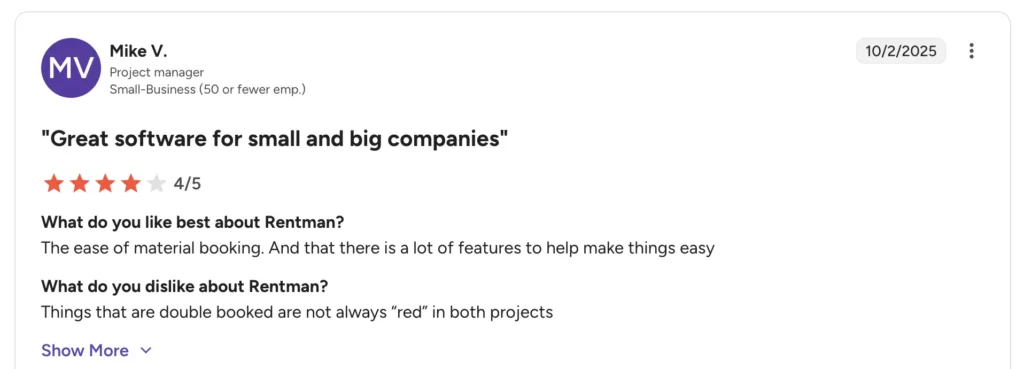
Source: G2
5. InTempo Software: Streamlining rentals, powering enterprise operations
InTempo Software (including InTempo Enterprise and InTempo Core) is a comprehensive rental management and ERP platform purpose‑built for equipment rental businesses, including construction and heavy-machinery fleets. Unlike lightweight rental tools, InTempo provides deep operational, financial, and asset lifecycle capabilities that help heavy equipment rental companies manage everything from reservations to accounting and maintenance in one system.
Core features
- End‑to‑End rental and business management: InTempo lets heavy equipment rental teams create quotes, contracts, and reservations, manage customer accounts, and handle billing workflows from the same dashboard. Its tools are designed to support both rental and sales processes, meaning equipment can be rented, sold, or serviced without switching systems.
- Deep equipment lifecycle support: InTempo supports comprehensive heavy equipment tracking and lifecycle management, meaning every piece of heavy equipment, from generators to excavators, can be monitored through acquisition, service, depreciation, and retirement. Inventory tracking helps rental coordinators see what’s available or in service across all locations, reducing idle time.
- Enterprise‑grade financials and accounting: One of InTempo’s core strengths is its integrated accounting capabilities. InTempo Core integrates with external tools such as QuickBooks, providing flexibility for businesses of all sizes.
- Business intelligence and dashboards: InTempo includes powerful reporting and BI tools with drag‑and‑drop dashboard builders that can be customized for different roles, from yard staff to executives. Dashboards can show fleet utilization, upcoming reservations, maintenance schedules, and financial KPIs in real time.
- Dispatch, routing, and mobile operations: InTempo provides tools to connect drivers, delivery operations, and customers, which is a key capability for heavy equipment rentals where logistics drive profitability. The system supports route optimization and turn‑by‑turn directions to drivers.
Why you should go for InTempo rather than Point of Rental
Rental operations management at the enterprise level
InTempo combines business operations with enterprise-level rental features to provide a holistic solution to your rental challenges. This is critical for heavy equipment businesses because it combines advanced features, including operations management, accounting, maintenance, and analytical workflows.
InTempo offers operational workflows that turn heavy equipment machinery into revenue-driving resources. Here’s what it offers to its users:
- Asset lifecycle control: InTempo not only simplifies equipment management but also ensures your equipment is maintained from the time it is procured through its disposal. The system records equipment procurement, maintenance, delivery, and return, so the complete lifecycle is tracked.
- Inventory and multi-location tracking: Track every piece of machinery and equipment across multiple yards or depots. You can run cycle counts without shutting down operations, set reorder thresholds for parts, and see equipment status instantly, improving utilization and reducing stockouts.
- Comprehensive maintenance and work orders: Create and manage preventive maintenance and repair work orders, assign tasks to mechanics, track labor and parts usage, and view maintenance reports. You can base service schedules on calendar days, miles, hours rented, or meter units to account for heavy machinery health.
- Dispatch and delivery optimization: Plan and optimize routes for equipment delivery and pickup while tracking vehicles in real time. You can manage time windows, equipment restrictions, and send customers updates via email or SMS, improving logistics and customer experience.
- Flexible billing options: Choose from daily, weekly, monthly, or custom billing cycles, and keep cards on file for recurring rentals. InTempo supports complex rate structures to fit heavy equipment pricing models.
InTempo as a comprehensive solution with complete financial control over equipment
InTempo is a comprehensive platform that goes beyond simple rental equipment management. It offers solutions that cover each stage of the asset lifecycle and ties all processes together. You can track financial metrics for each stage using built-in accounting features, including general ledger, fixed asset depreciation, and tax management.
You do not need to invest in an external tool to forecast revenue per asset, plan replacements, and understand the total cost of ownership for every asset. Rental transactions, billing details, reports, and maintenance history can be saved in one location. InTempo breaks down the data silos that most heavy equipment rental companies face when using separate systems for accounting, maintenance, logistics, and rentals.
Limitations:
1. High cost for small-to-medium-sized businesses
InTempo could be expensive for smaller heavy equipment businesses that do not need extensive financial tools. It has built-in ERP and financial tools that raise the overall acquisition cost as the per-seat cost rises. Implementation, configuration, and training can also add to the upfront investment, especially for heavy equipment businesses with complex financial and operational requirements.
2. A lack of online booking features
InTempo is designed to enhance internal operations and improve enterprise asset management, so customer-facing solutions are not the priority. Unlike modern cloud-first rental platforms that offer native online booking portals, self-service customer dashboards, and instant availability views, InTempo relies more heavily on staff-driven workflows for quote creation, reservations, and contract management.
6. Texada: Heavy equipment rentals, optimized end to end
Texada is purpose-built to handle heavy equipment and manage the entire rental lifecycle. It enables users to scale easily as their operations grow. It offers a variety of advanced features, specifically tailored to the needs of heavy equipment businesses. Some industry-specific features include:
- Instant quote generation with accurate pricing and availability
- Drag-and-drop dispatch scheduling for pickups and deliveries
- Instant and paperless contract creation and management
- Updated fleet status and availability visibility
- Automated missed-booking alerts and more time to handle critical situations
Here are some solution areas that Texada targets for smooth rental asset management:
- Centralized workflow management system: Texada helps manage complex rental contracts, asset information, orders, and fleet utilization while automating rental processes. This helps ensure that teams spend more time making the equipment available to the customers than on paperwork.
- Proactive maintenance and asset uptime: Texada tackles maintenance issues with automated maintenance tracking and preventive servicing tools that help extend equipment life and reduce breakdowns. You can schedule routine maintenance tasks, track service history, and receive alerts for upcoming repairs
- Financials, billing, and accounting integration: Texada integrates rental operations with financial workflows, reducing manual entry and improving billing accuracy. The platform supports automated invoicing, recurring payments, and integration with platforms like QuickBooks to get accurate visibility into invoices.
- Mobile app for remote fleet management: With Texada’s mobile-friendly platform, field teams, technicians, and drivers can update work orders and delivery status, capture digital signatures, collect inspection data, and access rental and maintenance instantly when online. This ensures the accuracy of field data and connects yard operations with office workflows.
The core reason to choose Texada over Point of Rental
Workflows tailored to the heavy equipment industry
One area where Texada outperforms PoR is its ability to offer customized workflows that reflect the needs of the heavy equipment industry. Rentals are treated as part of the rental process, and all stages are well-connected. Texada connects key business functions, inventory, maintenance, billing, dispatch, and customer experience into one platform built for large, mobile fleets. Since the workflows are centralized, users can manage all rentals and related processes from a single location without switching between systems. PoR was designed as a general platform, and its workflows are not specifically focused on heavy equipment.
Limitations:
1. Limited customization
Texada offers limited on-site customization, so users need extensive vendor support for any account adjustments. This can make it harder to adapt the software to specific contract terms, reporting needs, or specialized operational rules.
2. Lack of options for reporting capabilities
Users do not have access to advanced reporting features, which limits their ability to customize reports as per specific use cases. It does not provide in-depth analytics for heavy equipment businesses and may be a deciding factor for businesses that rely heavily on the reporting functionality.
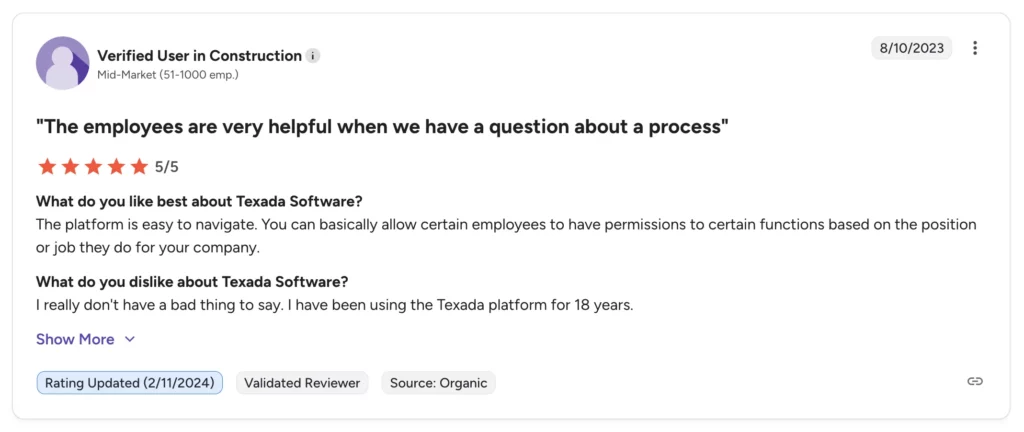
Source: G2
A side-by-side comparison of Point of Rental alternatives
The following table compares Point of Rental in terms of functionality, uses, and solutions with the top heavy equipment software providers in the rental market currently:
| Criteria | Point of Rental (PoR) | EZRentOut + EZO | Rentrax | Booqable | Rentman | InTempo | Texada |
| Primary Focus | End-to-end rental lifecycle | Rental + asset-first operations | Booking & reservations | Simple rentals + online store | Project-centric rentals | Enterprise rental ERP | Heavy equipment rental workflows |
| Deployment Model | Desktop-first, cloud add-on (RentalForce) | Fully cloud-based, mobile-first | Cloud-based | Cloud-based | Cloud-based | Hybrid/enterprise cloud | Cloud + legacy modules |
| Best For | Large rental businesses managing complex contracts | Growing heavy equipment fleets needing field + ops visibility | Fast booking-driven rental businesses | Small to mid-size rental businesses | Project-based construction rentals | Enterprise-scale rental companies | Large multi-site heavy equipment operations |
| Rental Lifecycle Coverage | Strong (quote → invoice) | Strong + extended via asset ops | Strong bookings, moderate ops | Basic lifecycle | Strong within projects | Very strong | Very strong |
| Asset-Level Visibility | Rental status only (limited condition insight) | Deep asset tracking (location, condition, availability) | Moderate | Basic | Project-based only | Deep lifecycle tracking | Strong |
| Maintenance Management | Preventive maintenance scheduling | Recurring, condition-based + inspection workflows | Basic scheduling | Manual only | Limited | Advanced work orders | Preventive maintenance |
| Maintenance Analytics | Limited | Utilization-driven insights | Basic | ❌ | ❌ | Advanced | Moderate |
| Fleet Utilization Reporting | Standard utilization reports | Asset, location, revenue-based utilization | Moderate | Basic | Project-only | Advanced | Moderate |
| Multi-Location Support | Strong | Strong + asset movement tracking | Moderate | Limited | Moderate | Strong | Strong |
| Field & Mobile Use | Limited (desktop-centric) | Mobile-first with real-time updates | Mobile app available | Mobile app (basic) | Mobile app | Limited mobile usability | Mobile-friendly |
| Project-Based Rentals | Supported | Supported | Limited | ❌ | Core strength | Supported | Supported |
| Online Booking | Limited | Optional | Core strength | Core strength | Limited | ❌ | Limited |
| Accounting & Financial Depth | Strong billing, accounting integrations | Standard integrations | Standard | Basic | Standard | Built-in ERP & accounting | Strong |
| Reporting Flexibility | Limited customization | Configurable operational reports | Moderate | Limited | Moderate | Advanced BI | Limited |
| Scalability | High | High (modular growth) | Moderate | Low–moderate | Moderate |
Conclusion: Why heavy equipment businesses need asset-first software
For heavy equipment businesses, rental management is not enough. You need software that can help manage assets while also ensuring quality rental management. As fleets grow, operations become increasingly complex, requiring a tailored system to manage rentals and track equipment across locations.
With the EZO and EZRentOut combo, you can do much more than just rental asset management. Track equipment across locations, schedule maintenance proactively, prevent downtime, and maximize equipment utilization in just a few steps.

![[How-to] Integrate QuickBooks Desktop with EZRentOut](https://cdn.ezo.io/wp-content/uploads/2015/11/Support-Blog-Header-6.png)