

Heavy equipment rental operations are highly complex. The value of every piece of equipment is tied to its use and ROI.
A fleet cannot be operated based on assumptions. Real numbers on accurate utilization rates, equipment uptime, maintenance costs, and revenue per unit are essential for determining whether the operations are yielding benefits and your fleet is optimized. And that’s what Heavy Equipment Rental General Managers are responsible for!
Heavy Equipment GMs manage high-end operations that involve strategic decision-making with direct impact on ROI.
Today’s Heavy Equipment Rental GMs need to be proactive rather than reactive when it comes to strategy building. They need to combine strategy with implementation so that every operational decision has a direct, measurable impact on profitability.
So, choosing rental asset management software that gives them visibility into their daily operations lays the foundation for sustainable operations. When GMs have access to reliable, centralized data, they move from firefighting daily issues to optimizing long-term fleet strategy. They can identify underperforming assets, forecast maintenance budgets, improve turnaround times, and ensure that every unit in the fleet contributes to revenue rather than drains it.
They need to ensure they can develop the clarity and control needed to generate measurable ROI.
Let’s help you create a checklist that you, as a Heavy Equipment General Manager, can use while choosing a rental asset management software that can help you manage your fleet and maintenance operations in the best way possible.
Reasons Heavy Equipment GMs need a rental equipment management software for fleet optimization
Heavy equipment GMs operate in a high-stakes environment where managing hundreds of valuable and expensive pieces of equipment demands precision and accountability. They cannot just rely on manual spreadsheets and paper logs to account for the equipment moving in and out of a warehouse or a construction jobsite. And that’s why several GMs are pushing their rental companies to move toward automated systems. We found in our State of the Equipment Rental Industry Report that 58% of rental owners and managers plan to adopt integrated fleet management systems, such as rental equipment management software.
Dominick Perez, Owner of DomCo Direct, says,“The more thinking the software can do for me, the better,” highlighting further that such a system can help increase equipment utilization through data-driven insights. Such data serves as the anchor for high-level decision-making, for instance, changing rental rates as equipment utilization changes or devising season-driven marketing strategies to increase the number of your rentals.
The following are some reasons why you should consider a rental software for fleet management:
1. Maximizing equipment utilization
Idle equipment is equal to stranded capital. You cannot derive revenue from it if you are unaware of your current utilization rates or are unable to identify which equipment is not being used. Rental software helps GMs:
- Track utilization rates by asset and location
- Identify underperforming equipment
- Reallocate idle units across branches
- Make informed buy vs. sell decisions
Equipment utilization helps determine how well your equipment is performing and whether you are using it the right way. If certain equipment is not performing well or is sitting idle, you can reallocate it.
Imagine you operate a fleet of 20 mid-size excavators and 15 boom lifts across three branches.
Your downtown branch shows 92% utilization for 20-ton excavators due to ongoing infrastructure and roadwork projects. Meanwhile, a suburban branch shows only 48% utilization for the same excavator category over the past quarter. Two machines have been sitting idle for over 45 days. Without rental management software, this imbalance might go unnoticed.
With rental equipment management software, the GM can immediately see:
- Revenue per excavator by branch
- Idle days per unit
- Maintenance costs incurred while idle
- Upcoming project demand in high-performing locations
Instead of purchasing additional excavators for the downtown branch, the GM can transfer the two underutilized units from the suburban yard. That single decision avoids a six-figure capital expense while immediately increasing revenue-generating capacity.
2. Reduce unplanned downtime
Equipment that is not operating well or is experiencing downtime will only add to your costs. Consider this: If you are renting out equipment for short-term, downtime can drastically change your rental game. Contractors may rent an excavator for three days to complete trenching or a boom lift for a week to finish facade work, only to have it break in the middle of the operation. This would mean a loss of the remaining rental period, increased costs due to operational constraints, and a damaged reputation, impacting repeat rentals.
Unlike long-term leases, where there’s more buffer, short-term rentals demand near-perfect uptime.
With rental software, you can leverage utilization reports or even create custom reports to assess what equipment needs special attention. You can assess maintenance requirements by checking what equipment is due for maintenance or has been recently maintained. With rental equipment management software, GMs can:
- Automate preventive maintenance scheduling
- Track meter-based usage (hours, mileage, cycles)
- Flag equipment due for service before it is assigned to a short-term job
- Monitor service history and recurring issues
- Analyze maintenance cost trends
- Block high-risk equipment from being dispatched
For example, if a skid steer is due for service in 8 engine hours and is about to be assigned to a 5-day short-term rental, the system can alert the team to service it first, preventing a mid-rental breakdown.
3. To improve rental revenue accuracy
Revenue leakage is a silent profit killer in the heavy equipment rental industry. Without a single source of truth to consolidate your rental data, it can be difficult to store the vital rental information that guides decision-making and determines profits. Even a small error can add up to costs, especially with short-term rentals, where equipment moves between projects and clients.
A robust rental asset management system logs every hour of equipment use, helping translate equipment into revenue. For Heavy Equipment GMs, rental software serves the following purposes:
- Track short-term and long-term rentals: The system logs each rental contract, including start/end times, asset type, and project location. For short-term rentals, where equipment may be rented for just a few days or hours, this prevents underbilling and lost revenue due to overlaps.
- Link revenue to individual pieces of equipment: Since GMs are responsible for maximizing revenue from equipment, they need to first track each piece of equipment individually. For example, if a rented excavator consistently logs overtime hours in short-term contracts, the GM can recognize its high value and adjust pricing or fleet allocation accordingly.
- Automate billing for late returns or extra usage: When a contractor keeps a boom lift for an extra day, the software can automatically calculate additional charges. Similarly, for rentals spanning multiple jobs, the system ensures that the usage beyond contracted hours is accurately invoiced.
Manual tracking often results in missed rentals and complete access to information on revenue per unit, preventing Heavy Equipment GMs from deciding which equipment needs maintenance so the performance goals can be achieved.
4. To strengthen dispatch and operational control
Heavy equipment rental businesses need sufficient operational control to ensure their fleet operates optimally. Dispatch management is another aspect that can give rental GMs a tough time, leading to lost equipment, delayed deliveries, and dissatisfied customers. With the right system, GMs can:
- View the built-in availability calendar to see the most recent status of each piece of equipment and refer to it when making a booking.
- Check the most recent equipment status to stay updated on whether it’s ready for dispatch or has been dispatched.
- Prevent double-bookings by checking the exact quantity of available equipment and confirming which machines are available, reserved, in transit, or under maintenance. GMs and dispatchers can see all reservations on a single dashboard along with revenue statistics, so they know whether certain equipment is converting into profit.
- Receive alerts every time a piece of equipment is rented out or dispatched. This keeps them updated on which equipment is going out, so they know the frequency of checkouts of certain equipment.
Dispatch management is critical for smooth and fast rental operations. For heavy equipment companies operating across multiple branches, knowing your repeat customers and the types of equipment they rent helps devise strategies to maximize equipment use.
5. Enhanced compliance and risk management
The heavy equipment market is highly regulated, requiring compliance with safety standards. Employee protection on the worksite and accident prevention are major reasons equipment needs to be maintained at all times. Heavy Equipment Rental GMs need to ensure that the equipment being rented out is inspected, serviced, and maintained on time.
To ensure this, multiple layers of accountability — from safety inspections and operator certifications to emissions compliance and insurance documentation — can be attached to every asset in your fleet. A centralized system helps GMs keep track of these documents, ensure that their teams attach safety manuals to each document, and stay on top of the upcoming services.
Ignoring this creates serious risks like:
- Missed inspection deadlines
- Expired certifications
- Incomplete service documentation
- Equipment is dispatched without proper safety checks
- Limited traceability during disputes or accidents
Rental equipment management software transforms compliance from reactive damage control into proactive risk prevention.
Checklist for Heavy Equipment Rental General Managers while choosing a rental asset management software
When choosing heavy equipment rental software, GMs should not only assess the system’s features but also evaluate how well it fits their workflows and enhances them. According to research, the heavy construction equipment rental market was estimated at USD 98.77 billion in 2025 and will reach USD 146.37 billion by 2035, with a CAGR of 4.01%. Given the construction industry’s growth, we can infer that GMs in this industry must seek integrated solutions that simplify their jobs and improve fleet efficiency.
Let’s look at the factors driving a rental GM’s decision to invest in a rental asset management software:
1. Fleet visibility and utilization
Why it matters: You cannot optimize what you cannot measure.
Fleet visibility serves as the foundation of fleet optimization and profitability. If GMs do not have precise insight into how often each unit is rented, how long it sits idle, and how much revenue it generates, their decision-making will be prone to errors. A rental GM needs to be on top of their equipment numbers and condition. They need to know where the equipment is and in what condition, the number of units available, its custodians, and whether it has been rented out.
However, fleet visibility involves a lot more than just knowing where equipment is. It involves knowing how well the equipment is performing and its current utilization. Keeping the location and utilization aspects in mind, a rental GM must look for the following features in a system while choosing to go for one:
- Be able to assess the equipment’s utilization at multiple levels, including what the equipment type is, whether the utilization is low or high based on its type, and the performance of the equipment in different branches.
- The system must highlight the equipment as under maintenance, on-rent, reserved, or available clearly so the booking team knows what’s available to be rented out.
- Provide metrics and charts to paint an accurate picture of the equipment usage. These charts can be displayed on the dashboard location-wise, so GMs know which equipment in each location is underperforming.
- Identify underperforming assets automatically. This helps the system flag equipment below a utilization threshold (e.g., under 50%), with high maintenance costs but low rental frequency, and categories that are oversupplied.
With this data readily available to the GMs, they can make strategic decisions about reallocating equipment and retiring certain pieces. This data also informs pricing strategies and fleet expansion decisions, as utilization and equipment availability influence equipment value.
2. Short-term and long-term rental management
Why it matters: Rental businesses do not operate on a solo model; they manage both short-term and long-term rental equipment, each with its own operational and financial challenges. The GMs need to assess if the system they opt for supports their business model, including both short-term and long-term rental management.
Short-term and long-term rentals both impact utilization rates, revenue forecasting, and customer retention. Without visibility into both, the chances of the operations falling apart quickly increase.
Short-term rentals typically range from a single day to a few weeks and are common for roadwork projects, landscaping jobs, emergency construction needs, and seasonal demand spikes. These rentals involve high asset turnover, frequent dispatch and returns, rapid inspections, and constant contract modifications or extensions. A single excavator might be rented multiple times within the same week. In such a fast-moving environment, manual tracking leads to double bookings, missed overtime charges, overlooked extensions, and scheduling errors. Rental software must provide availability tracking, prevent booking overlaps, automate billing for late returns or extra usage, and enable digital check-in and check-out inspections.
Similarly, long-term rentals span several months and require strong contract management and proactive maintenance. Orders need to be renewed automatically to avoid wasting time on generating invoices for equipment rented for longer periods. The software must also indicate the equipment’s current condition, so it can be scheduled for maintenance. For Heavy Equipment GMs, this visibility is essential because long-term rentals can sometimes mask underperformance. An asset may be continuously on rent, but rising maintenance costs or untracked service obligations can erode profitability over time. Without proper reporting, it becomes difficult to evaluate the true return on that unit.
3. Maintenance management
Why it matters: Maintenance determines the longevity of equipment and helps improve its functionality. GMs need to ensure that the equipment is functioning properly to avoid customer disappointment and encourage repeat rentals.
Equipment maintenance in the heavy equipment market is critical to repeat rentals and long-term equipment usage. Heavy equipment is expensive, so ensuring that it stays well-maintained determines how long it will last. Given the size, complexity, and cost of machinery like excavators, loaders, cranes, and telehandlers, every maintenance activity must follow a structured, traceable workflow.
Integrated maintenance workflows in your system ensure that your maintenance is conducted on time and as per the usage of each piece of equipment. Your rental software must have built-in maintenance workflows for smoother maintenance management. This includes updates on the current maintenance status of your equipment, a service workshop that provides maintenance features to categorize service types, and work orders to process a maintenance request while keeping a record of consumables needed for maintenance.
At its core, rental software can be used to service equipment when:
- Equipment maintenance thresholds are reached (engine hours, mileage, cycles)
- An inspection identifies a fault
- A breakdown is reported from the field
- A return inspection flags damage
- A compliance requirement is due
Without structured work order management, workshops fall into “firefighting mode,” responding only when machines break down. This leads to rushed repairs, emergency parts orders, overtime labor, and frequent dispatch disruptions. With integrated work order workflows, maintenance becomes predictable. Equipment downtime is planned, technician workload is balanced, and fleet availability improves.
4. Live location data
Why it matters: Staying up to date with the latest location data helps make strategic decisions, including which equipment is available for immediate use, which equipment needs to be reallocated from a specific location, and how far along the route the equipment is in transit.
GPS tracking is no longer a “nice-to-have” for heavy equipment rental businesses; it’s a strategic control tool. Heavy equipment frequently moves between job sites, branches, and customer locations. Without GPS tracking, GMs often rely on phone calls, manual updates, or assumptions about equipment locations.
GPS tracking provides:
- Live location data for every tagged asset
- Visibility into equipment in transit
- Confirmation of delivery and pickup
- Accurate branch-level inventory positioning
For example, if a 20-ton excavator is scheduled for pickup but has not arrived at the yard, GPS tracking immediately shows whether it’s still on-site, in transit, or at another location. This eliminates guesswork and reduces dispatch delays. For GMs managing multiple yards, this centralized visibility prevents equipment from being “lost in the system.”
A rental asset management system with GPS tracking capabilities pinpoints the exact location of equipment through GPS coordinates and a map. It may also integrate with third-party GPS providers like Samsara for enhanced tracking capabilities; through the integration, the data is immediately reflected in your rental system, eliminating the hassle of maintaining data in two disparate locations.
Additionally, as a Heavy Equipment Rental GM, you must ensure your system accurately reflects the location of your equipment so that, when you receive a customer query, your booking team can provide the exact location information. You also have to ensure that your equipment is well-protected on-site from theft or unexpected loss. GPS alerts allow you to ensure just that by sending notifications if equipment moves beyond the marked boundaries in the system.
5. Billing accuracy and accurate revenue calculation
Why it matters: Accurate billing ensures that every rental dollar is captured, minimizes revenue leakage, and enables precise measurement of asset profitability. In heavy equipment rental, missed charges, overlooked extensions, or manual calculation errors can quickly add up, impacting ROI. For GMs, staying on top of billing accuracy is essential not only for revenue but also for operational efficiency, customer trust, and strategic decision-making.
Make sure you look for a rental asset management system that integrates with third-party accounting software, such as QuickBooks, Xero, and Sage. These systems, once integrated, help rental businesses accurately calculate rental charges and generate invoices based on rental duration, terms, and pricing rules. You can ensure that your system does not have duplicate entries for the same invoice, which could distort your revenue calculation.
Additionally, your rental system should be able to calculate the total rental cost by factoring in damage charges, late fees, delivery fees, and any other associated costs with a rental order. You should be able to set rental rates (per minute, hourly, daily, weekly, monthly, and yearly) in your system to automate invoice calculations. This way, you can ensure that revenue is accurately captured for each rental, track asset performance, and make informed decisions about fleet utilization, maintenance, or expansion.
6. Quick check-ins and checkouts
Why it matters: Accurate check-in and check-out procedures ensure that equipment is handed over safely, damage is documented, and compliance requirements are met. For Heavy Equipment Rental GMs, this process is critical because errors or omissions during equipment delivery and handovers can lead to disputes, lost revenue, or untracked maintenance needs.
One of the most basic features any rental asset management system must offer is automated and quick check-ins and checkouts. When a piece of equipment is checked in, your team can take photographs and log them so the before-and-after condition of the equipment can be matched to charge for damages. Comments and notes can also be added to each piece of equipment to notify the booking team of any anomalies, preventing the booking team from promising a faulty piece to the customer. Your team can also quickly check in and check out equipment, as required, by using advanced features in the rental system they use. They will not need to switch between multiple systems and equipment logs to rent the equipment.
Mobile app functionality further enhances these capabilities by enabling technicians, yard staff, and field personnel to perform inspections directly on smartphones or tablets. QR or barcode scanning allows instant identification of equipment, eliminating the need for manual data entry. The Offline Mobile App functionality ensures that inspections can still be logged in remote or low-connectivity job sites, with data automatically syncing once connectivity is restored.
For example, if a skid steer is returned from a short-term rental, a technician can scan the asset using the mobile app, note a minor hydraulic leak, and attach a photo. Once updated, the system automatically updates the equipment’s condition, you can trigger a maintenance work order, and the machine will be marked unavailable for future rentals until the repair is completed. This workflow prevents delays, protects the business from disputes, and ensures that all equipment is accurately tracked and maintained.
7. Online equipment booking
Why it matters: The heavy equipment rental industry is rapidly growing, with rental businesses no longer relying solely on word of mouth or physical shops to rent equipment. An online rental webstore makes it convenient and quick for rental clients to go through rental catalogs and choose the equipment that best suits their needs.
Make sure you go for a rental system that enables you to rent equipment online through a rental website. Modern equipment rental systems like EZRentOut, Quipli, and Booqable enable their clients to set up sleek websites with pre-built, customized themes to match their business type. For instance, if you are in the construction industry, EZRentOut offers several construction themes so you can set up industry appropriate website.
An online platform will allow you to categorize equipment, set rental rates, attach pictures, and even provide discount coupons to repeat customers to increase equipment rentals. Additionally, modern rental software like EZRentOut allows webstore integration with payment gateways like Square, Stripe, and PayPal that help automate invoicing and make the payment experience easier for clients.
Mobile compatibility further extends this capability, allowing field teams to confirm online bookings, prepare assets for pickup, and track rental status. Web orders are automatically tagged and marked in the system, making them easier to identify as needed. As a GM, you can have complete visibility into which channels are generating more rental revenue, so you can adjust your rental strategies accordingly.
Ensure that you are able to SEO-optimize your website so your website can show up on Google for better visibility. This is especially important for rental businesses that face a lot of competition and need to be omnipresent across channels to drive up their sales.

8. Reporting and analytics
Why it matters: Access to reports and up-to-date analytics helps Heavy Equipment GMs evaluate the worth of every piece of equipment, analyze what contributes the maximum to revenue, and calculate equipment utilization to make accurate decisions.
Rental software with robust reporting capabilities provides GMs with insights into fleet performance, allowing them to identify underperforming equipment, monitor branch-level productivity, and optimize utilization across locations. Analytics tools can highlight trends such as seasonal demand fluctuations, peak rental periods, and high-maintenance assets, enabling proactive decision-making regarding fleet expansion, retirement, or redistribution.
For example, if a specific category of excavators consistently generates higher revenue than others, you can prioritize allocating these machines to high-demand branches or consider acquiring additional units.
Furthermore, you can create customized dashboards and display reports to improve data analysis and have quick access to data. GMs can track key performance indicators (KPIs) such as revenue per asset, utilization rates, maintenance costs, and downtime in a single view. You can also draft Custom Reports to calculate revenue per equipment by location or order, so every type of metric or data can be obtained by simply generating specific reports.
Conclusion: Heavy Equipment Rental GM software selection checklist
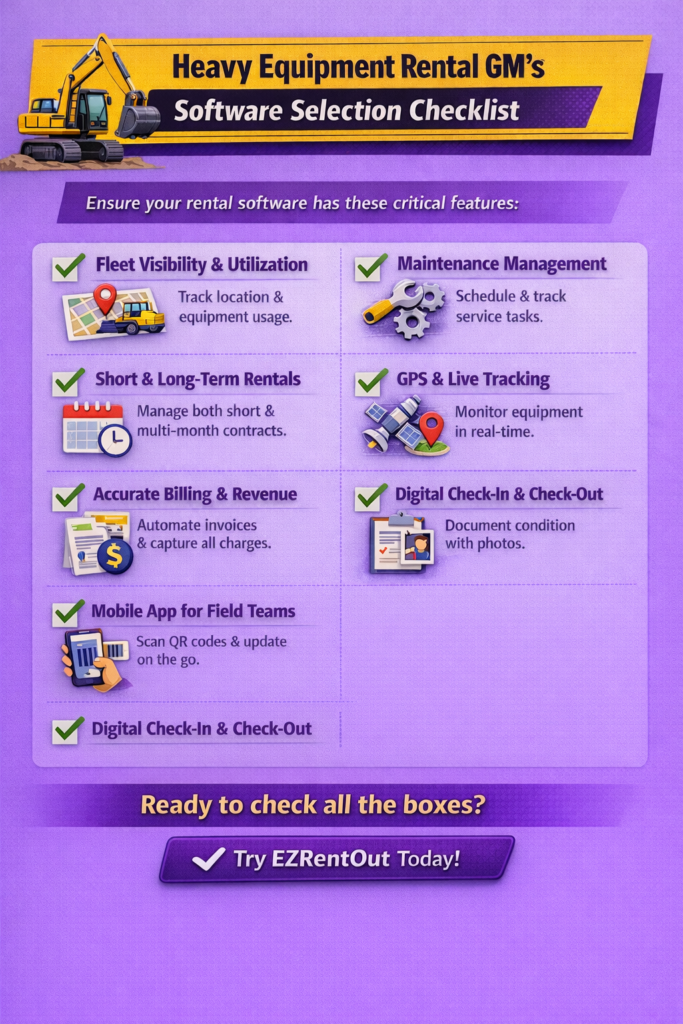
Here’s a summary of the checklist every Heavy Equipment Rental GM must use to optimize their equipment management:
- Fleet visibility and utilization: Track updated location, utilization rates, idle assets, and performance across branches.
- Short-term and long-term rental management: Support high-turnover rentals and multi-month rentals with accurate billing and availability tracking.
- Maintenance management: Automate preventive maintenance, monitor service history, generate work orders, and reduce unplanned downtime.
- GPS and live location tracking: Monitor equipment in transit, confirm delivery/pickup, and protect assets from theft or loss.
- Billing accuracy and revenue Capture: Auto-generate invoices, track revenue per asset, manage late fees, and integrate with accounting systems.
- Digital check-in and check-out: Perform inspections, document damages, attach photos/notes, and maintain compliance records.
- Mobile app functionality: Enable field teams to check assets in/out, scan QR/barcodes, and log inspections in real time, even offline.
- Online equipment booking: Allow customers to browse, reserve, and pay for equipment online; integrate with payment gateways; track online orders.
- Dispatch and operational control: Centralized dashboards for bookings, availability, and alerts to prevent double-booking and optimize fleet allocation.
- Compliance and risk management: Track safety inspections, operator certifications, and regulatory documentation to reduce liability.
- Reporting and analytics: Generate actionable insights on utilization, revenue, maintenance costs, downtime, and KPI dashboards for strategic decision-making.
Choosing the right rental asset management software is a strategic decision that determines the quality of your rental operations. With in-depth visibility into your rental landscape, you can make proactive decisions that help turn operations into revenue. So, intelligently invest in a system that can improve the current state of your heavy equipment rental operations and support maintenance and equipment optimization decisions.

![[How-to] Get Started with the New EZRentOut Mobile App](https://cdn.ezo.io/wp-content/uploads/2020/04/How-to-Get-Started-with-the-New-EZRentOut-Mobile-App.png)