At some point, every IT team outgrows the way they’ve been managing assets.
What used to work, including spreadsheets, manual updates, or separate tools, starts to break as the company grows.
You start noticing problems like:
- Devices that don’t show up in your system
- SaaS tools that people are using without approval
- Surprise license renewal alerts from Finance
- Assets with no clear owner or status
This isn’t just because of bad tools. It’s because your environment has become too big and complex to effectively manage.
As your company expands—more employees, more locations, more cloud tools—your IT systems stop communicating with each other properly.
So your IT team ends up doing a lot of manual work just to keep data in sync across tools like:
And even though it looks like you have visibility, the data isn’t fully reliable. That’s where cloud ITAM tools come in. They don’t just track assets; they help you in different ways, such as:
- Keeping data accurate and up to date
- Managing IT assets across their full lifecycle
- Connecting different systems so everything stays aligned
In this guide, we’ll look at five cloud ITAM tools that are built to scale with your growing infrastructure.
What makes a cloud ITAM tool truly scalable
Not every asset tool can handle a growing company. A scalable ITAM tool doesn’t just list assets; it helps you manage, trust, and act on your data as things get more complex.
Here’s what actually matters:
1. Continuous asset discovery
In a modern IT environment, things don’t stay still. New devices are added, employees install software, cloud instances spin up, and others disappear just as quickly. If your system depends on manual updates, it will fall out of sync almost immediately.
A scalable ITAM tool continuously discovers assets in the background, so your inventory stays accurate without constant effort.
For example, imagine a new employee joins an organization and sets up their laptop. A few days later, they installed an unapproved design tool. Instead of relying on someone to log this manually, an ITAM tool automatically detects both the device and the installed software. This ensures IT always has a current view of what exists in the environment, without chasing updates.
2. Lifecycle governance
Knowing what assets you have is only the starting point. The real value comes from managing what happens to those assets over time.
Every asset follows a lifecycle, from procurement to deployment, usage, reassignment, and eventually retirement. Without a system to manage these transitions, assets often get lost in the process.
Take a common situation: an employee leaves the company and returns their laptop. If there’s no lifecycle tracking in place, that device may sit unused while IT unknowingly purchases a replacement for someone else. A scalable ITAM system avoids this by marking the device as available, notifying the right team, and enabling reassignment. This turns IT from reactive (fixing gaps) to proactive (optimizing resources).
3. Data normalization and trust
As systems grow, so does the risk of messy data. You may end up with duplicate records, inconsistent naming, or devices that are still marked active even though they’re no longer in use.
The problem isn’t just cosmetic; bad data leads to bad decisions.
Imagine being asked by finance how many laptops your organization owns. Your system shows 1,200 devices, but in reality, a significant portion are duplicates or outdated entries. Without clean, standardized data, you can’t trust your own reports.
Scalable ITAM tools solve this by normalizing and reconciling data across systems, ensuring that what you see reflects reality. This is what turns visibility into confidence, not guesswork.
4. SaaS and software visibility
IT environments today are no longer centered only around hardware. They are increasingly driven by SaaS applications, many of which employees can adopt without IT involvement.
This creates a new challenge: you might be paying for software you don’t fully understand or control.
For instance, your company may have 100 licenses for a SaaS tool, but only 60 employees actively use it. Without visibility, you continue paying for unused licenses. An ITAM solution helps uncover this by showing exactly who is using each application and how often. This allows IT and finance to reduce waste, manage renewals more effectively, and regain control over software spend.
5. Integrations across the IT stack
A scalable ITAM tool cannot operate in isolation. It needs to connect with the rest of your IT ecosystem so that data flows automatically between systems.
Without integrations, IT teams spend a significant amount of time manually reconciling differences between tools, updating records, fixing mismatches, and chasing inconsistencies.
Consider what happens when an employee leaves. If your systems aren’t connected, their laptop might still appear active, their SaaS access may remain enabled, and licenses may continue renewing. With proper integrations in place, the identity system marks the user inactive, the ITAM system updates asset ownership, and SaaS access is revoked automatically. Everything stays aligned without manual intervention.
5 cloud ITAM tools that scale with growing infrastructure
1. AssetSonar
Overview
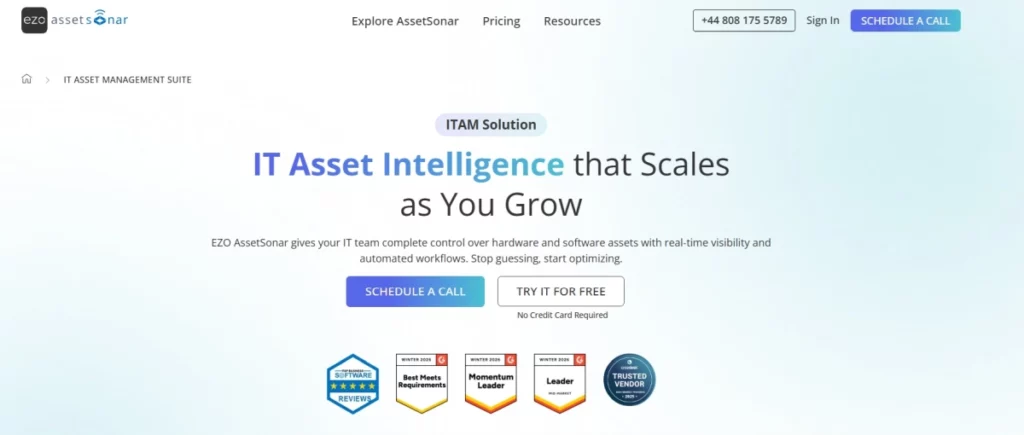
AssetSonar is a cloud-based IT asset management platform built for mid-market to enterprise IT teams managing distributed and growing infrastructure.
It acts as a centralized system where IT teams can track and manage hardware, software, and SaaS assets across their entire lifecycle, from procurement to retirement. More importantly, it connects asset data across systems, helping organizations move from fragmented tracking to a more unified and reliable view of their IT environment.
Key capabilities
- Automated asset discovery across endpoints and systems
AssetSonar automatically detects hardware, software, and SaaS assets using agents and integrations, reducing the need for manual data entry and keeping inventory up to date. - Hardware and software lifecycle tracking
It manages assets from procurement to retirement, including ownership, status changes, warranties, and usage history, ensuring nothing falls through the cracks. - SaaS license management and visibility
The platform tracks software usage and license allocation, helping identify unused licenses and reduce unnecessary spending. - Asset-to-user and asset-to-ticket relationships
Assets can be linked to employees and support tickets, giving IT teams better context when troubleshooting issues or managing requests. - Custom reporting and audit-ready insights
AssetSonar provides real-time reporting and audit logs, helping organizations stay compliant and prepared for audits without manual effort. - Integrations with identity, MDM, and ITSM tools
It integrates with systems like Jamf, Intune, Zendesk, and others, allowing asset data to stay aligned across the IT ecosystem.
Why it scales well
AssetSonar scales effectively because it goes beyond simple asset tracking and focuses on operational control and data reliability.
As organizations grow, the main challenge isn’t just knowing what assets exist; it’s keeping data accurate and ensuring different systems stay aligned. AssetSonar addresses this by creating a single source of truth for all asset data, reducing the need for manual reconciliation across tools as headcount grows.
For example, if a device stops reporting or software goes unused, AssetSonar can surface these issues through real-time visibility and usage tracking. IT teams can then take action, whether that’s reclaiming licenses, investigating inactive assets, or planning replacements, before problems escalate.
It also improves operational efficiency by automating workflows and consolidating data from multiple systems. This allows IT teams to spend less time fixing inconsistencies and more time making informed decisions about procurement, cost optimization, and compliance.
In growing environments, this shift, from manual tracking to connected, lifecycle-driven asset management, is what makes AssetSonar a scalable solution.
2. Lansweeper
Overview
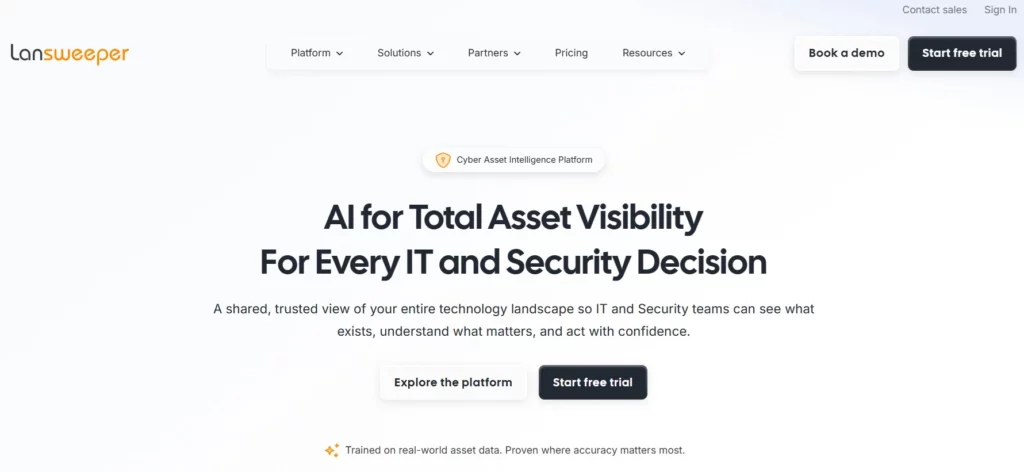
Lansweeper is a cloud-enabled IT asset discovery and inventory platform known for its strong visibility across complex environments.
It is widely used by IT teams that struggle with incomplete or outdated asset records, especially in environments with a mix of on-premise infrastructure, remote devices, and cloud resources.
Rather than focusing heavily on lifecycle workflows, Lansweeper’s core strength lies in helping organizations know exactly what exists in their environment at any given time.
Key capabilities
- Agentless and agent-based asset discovery
Lansweeper can scan networks without requiring software installation (agentless), while also supporting agents for deeper visibility on remote devices. - Comprehensive hardware and software inventory
It collects detailed information about devices, operating systems, installed applications, and configurations, creating a centralized inventory. - Network and cloud asset scanning
The platform continuously scans networks and integrates with cloud environments to identify new or changed assets automatically. - Asset classification and normalization
It organizes discovered data into structured formats, helping reduce inconsistencies and making reporting more reliable. - Vulnerability and lifecycle insights
Lansweeper maps assets against known vulnerabilities and provides insights into outdated systems or unsupported software.
Why it scales well
Lansweeper scales effectively because it solves one of the hardest problems in growing IT environments: visibility.
As organizations expand, assets often fall outside traditional management systems. Devices may not report correctly, shadow IT grows, and inventories quickly become outdated. Lansweeper continuously scans and updates asset data, ensuring IT teams always have a near real-time view of their environment.
For example, if a new device connects to the network or a previously unknown application is installed, Lansweeper can detect it automatically. This reduces blind spots and helps IT teams regain control over their infrastructure.
However, many organizations pair Lansweeper with a lifecycle-focused ITAM tool when they need deeper governance beyond discovery.
3. InvGate
Overview
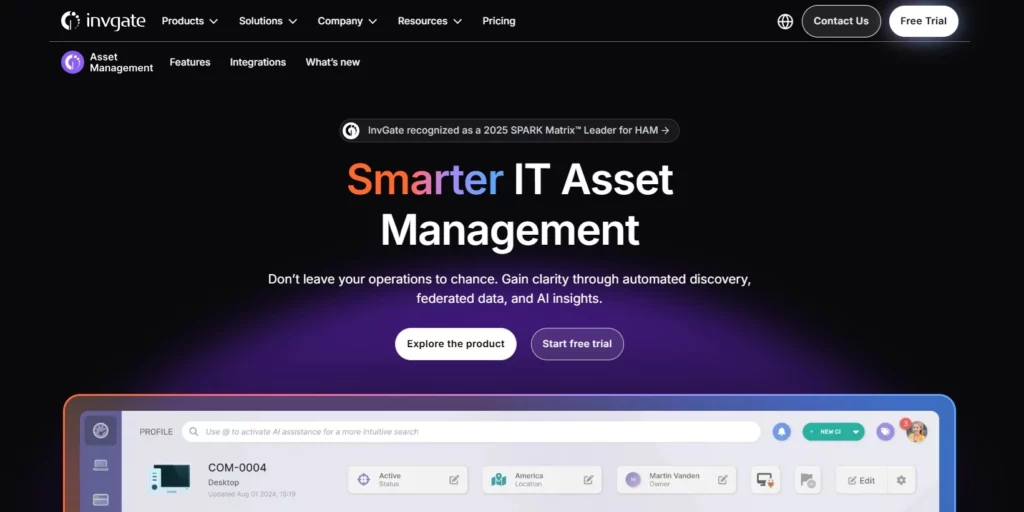
InvGate is a cloud ITAM platform designed to help IT teams move from basic tracking to structured asset lifecycle management and operational efficiency.
It is often used by organizations that want to align asset management with service management processes, making it easier to connect assets with real operational workflows.
Key capabilities
- Unified asset inventory across environments
InvGate tracks physical, virtual, and cloud assets in a centralized system, giving teams a complete view of their infrastructure. - End-to-end lifecycle management
Assets are managed from procurement through deployment, usage, maintenance, and retirement, ensuring nothing is left unmanaged. - Software license and compliance tracking
The platform monitors software usage and licensing to help organizations stay compliant and avoid unnecessary costs. - IT financial and vendor management
It provides visibility into asset costs, contracts, and vendor relationships, supporting better financial planning. - Automation and AI-driven insights
InvGate uses automation to reduce manual work, such as triggering alerts for renewals or identifying optimization opportunities.
Why it scales well
InvGate is built for organizations that are transitioning from reactive IT operations to more process-driven and automated environments.
As infrastructure grows, managing assets manually becomes unsustainable. InvGate addresses this by standardizing lifecycle processes and automating repetitive tasks, which reduces operational overhead.
For example, instead of manually tracking warranty expirations, the system can automatically flag upcoming renewals and notify the relevant teams. This ensures assets are managed proactively rather than reactively.
Its ability to connect asset data with service workflows also helps IT teams make better decisions, especially when resolving incidents or planning upgrades.
4. Device42
Overview
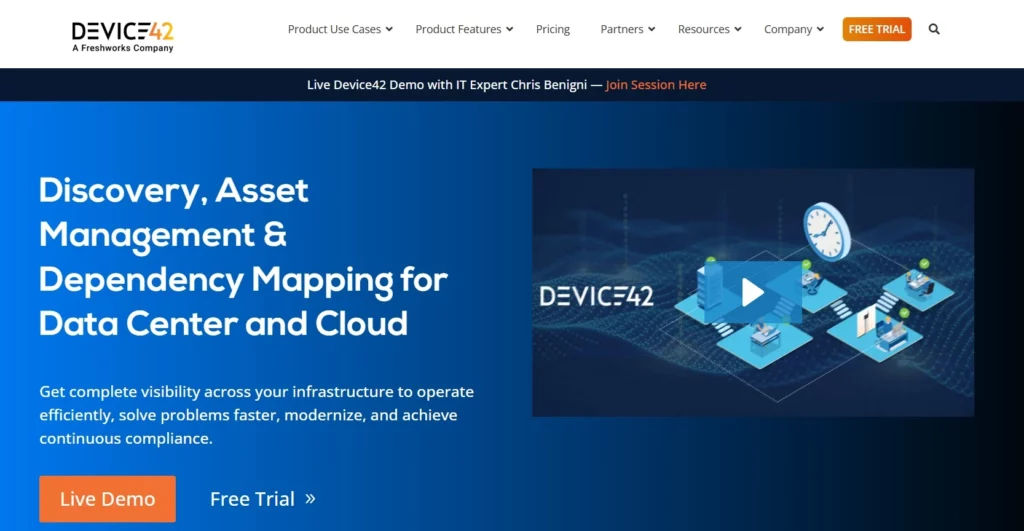
Device42 is an ITAM and CMDB platform designed for organizations managing complex, infrastructure-heavy environments such as data centers and hybrid cloud systems.
It goes beyond simple asset tracking by providing deep visibility into how assets are connected and dependent on each other.
Key capabilities
- Agent-based and agentless discovery
Device42 automatically discovers assets across physical, virtual, and cloud environments, ensuring accurate and up-to-date records. - Dependency mapping and relationship visualization
It shows how different assets are connected, such as which applications run on which servers or how systems depend on each other. - Custom asset types and flexible data models
Organizations can define and track different types of assets based on their infrastructure needs. - CMDB functionality with detailed configuration data
Device42 acts as a configuration management database, storing deep technical details about each asset. - Infrastructure and data center asset management
It is particularly strong in tracking racks, servers, IPs, and other infrastructure components.
Why it scales well
Device42 is designed for environments where the challenge is not just scale, but complexity.
As infrastructure grows, understanding how systems interact becomes critical. Without this, even small changes can create unexpected issues.
For example, if a server fails, Device42 can show which applications and services depend on it. This allows IT teams to assess impact quickly and respond more effectively.
This level of visibility makes Device42 especially valuable for organizations managing hybrid infrastructure or large data center environments.
5. Zluri
Overview
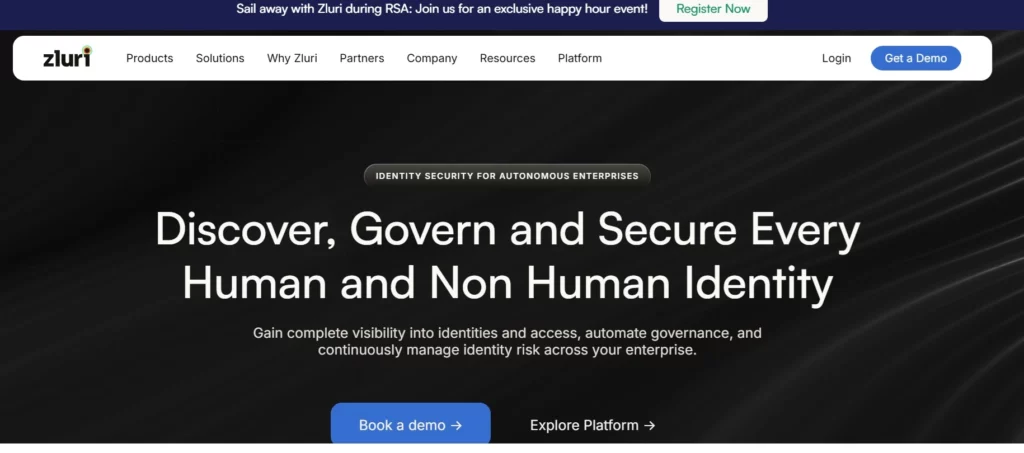
Zluri is a cloud platform focused on SaaS management and software asset visibility, helping organizations control and optimize their growing software ecosystem.
As SaaS adoption accelerates, many IT teams struggle to track what applications are being used, who is using them, and how much they cost. Zluri is designed to solve exactly this problem.
Key capabilities
- SaaS discovery across the organization
Zluri identifies all SaaS applications in use, including those adopted without IT approval (shadow IT). - License usage and optimization insights
It shows how frequently each application is used, helping teams identify unused or underutilized licenses. - Renewal and contract management
The platform tracks renewal dates and contract details, preventing surprise costs. - User access and permission visibility
IT teams can see who has access to which tools, improving governance and security. - Spend and cost management
Zluri provides insights into SaaS spending, helping organizations reduce unnecessary expenses.
Why it scales well
Zluri scales effectively because it focuses on one of the fastest-growing challenges in IT: SaaS sprawl.
As organizations adopt more cloud applications, it becomes increasingly difficult to manage licenses, control costs, and maintain security.
For example, different teams may independently subscribe to similar tools, leading to duplicate spend. Zluri helps identify these overlaps and provides insights to consolidate applications and optimize usage.
By bringing visibility and control to SaaS environments, it complements traditional ITAM tools and ensures organizations can scale their software ecosystem without losing control.
Detailed comparison: Where each ITAM tool fits
| Tool | Core Strength | Primary Focus Area | What It Does Best | Where It Falls Short | Best Fit Use Case | Ideal Organization Type |
| AssetSonar | Full lifecycle ITAM | End-to-end asset operations | Connects asset data across hardware, software, and SaaS with lifecycle workflows and integrations | Not as deep in pure network discovery as discovery-first tools | Managing assets from procurement → usage → retirement with full visibility and control | Mid-market to enterprise teams with distributed infrastructure |
| Lansweeper | Discovery & visibility | Asset inventory accuracy | Automatically discovers and catalogs devices, software, and network assets with high accuracy | Limited lifecycle governance and workflow management | Building a reliable, real-time inventory of all IT assets | Organizations struggling with unknown or unmanaged assets |
| InvGate | Lifecycle + automation | Process-driven ITAM | Adds structure to asset management through automation, lifecycle tracking, and ITSM alignment | Less specialized in deep infrastructure mapping or SaaS optimization | Standardizing asset workflows and reducing manual operational work | IT teams moving toward process maturity and automation |
| Device42 | Infrastructure mapping | Dependency and CMDB visibility | Maps relationships between assets (apps, servers, systems) and provides deep infrastructure insights | Can be complex to implement; less focused on SaaS and financial optimization | Understanding dependencies and managing complex hybrid or data center environments | Enterprises with complex infrastructure and interdependent systems |
| Zluri | SaaS management | Software visibility & cost control | Tracks SaaS usage, identifies unused licenses, and optimizes software spend | Limited hardware lifecycle and infrastructure asset management | Controlling SaaS sprawl, reducing license waste, managing renewals | SaaS-heavy organizations with growing subscription costs |
How to choose the right cloud ITAM tool
Choosing the right ITAM tool isn’t about picking the “best” product overall. In fact, it’s about understanding what problem you’re trying to solve right now.
Most IT teams don’t start with a fully mature setup. Instead, they’re dealing with one major pain point at a time. The right tool depends on where you are on that journey.
If your biggest problem is visibility
If you’re not confident about what assets exist in your environment, that’s the first issue to solve.
This usually shows up as:
- devices that aren’t tracked
- unknown software running in your environment
- incomplete or outdated asset records
In this case, tools like AssetSonar are a strong starting point. It focuses on discovery, automatically finding devices, applications, and systems so you can build a reliable inventory.
Think of this as answering the basic question: “What do we actually have?”
If your focus is lifecycle and operations
Once you know what assets exist, the next challenge is managing them properly.
This includes:
- tracking ownership
- managing asset status
- handling reassignment and retirement
- planning renewals and replacements
If your current process feels manual or inconsistent, tools like AssetSonar or InvGate Assets help bring structure and control.
They allow you to move from: “We have a list of assets” → “We actively manage how those assets are used and maintained.”
If SaaS is your biggest cost driver
In many organizations today, the biggest issue isn’t hardware; it’s software.
Teams sign up for tools independently, licenses go unused, and costs keep increasing without clear visibility.
If this sounds familiar, a tool like Zluri can help you:
- see what SaaS tools are being used
- understand who is actually using them
- reduce unnecessary licenses
This helps answer the question: “What are we paying for, and do we really need it?”
If you need a unified system
As organizations grow further, they often realize that solving one problem at a time isn’t enough.
You don’t just need:
- visibility
- or lifecycle tracking
- or SaaS control
You need all of them working together.
At this stage, it’s important to choose a platform that connects everything, so discovery, lifecycle management, reporting, and integrations all work as part of one system.
This is what turns ITAM from a set of tools into an operational foundation.
Why cloud ITAM is becoming a core IT system
Modern IT environments are no longer stable or easy to manage. They are distributed, constantly changing, and heavily driven by SaaS and cloud tools. As a result, traditional ways of tracking assets are no longer enough.
ITAM is no longer just about keeping a list of devices. It has evolved into a system that helps organizations understand what’s actually happening in their environment and what actions to take.
- It acts as a system of verification, ensuring asset data is accurate and not based on assumptions.
- It also becomes a system of intelligence, highlighting issues like unused licenses, inactive devices, or upcoming renewals so teams can act early.
- At the same time, it works as a system of coordination, keeping IT, finance, and security aligned without constant manual effort.
Organizations that use ITAM this way move away from reactive firefighting and toward more proactive, controlled operations, where decisions are based on reliable data, not guesswork.
Conclusion: Scaling IT requires scaling asset intelligence
As your infrastructure grows, complexity doesn’t just increase; it multiplies.
Without the right systems in place, IT teams often become bottlenecks, spending more time fixing data gaps and reconciling systems than actually driving meaningful outcomes.
Cloud ITAM tools like AssetSonar, Lansweeper, InvGate Assets, Device42, and Zluri each bring different strengths. But at their core, they all aim to solve the same problem: turning scattered, unreliable asset data into clear, actionable insight.
The real question isn’t whether you need ITAM.
It’s whether your current approach can keep up with the scale and complexity of the infrastructure you’re building.