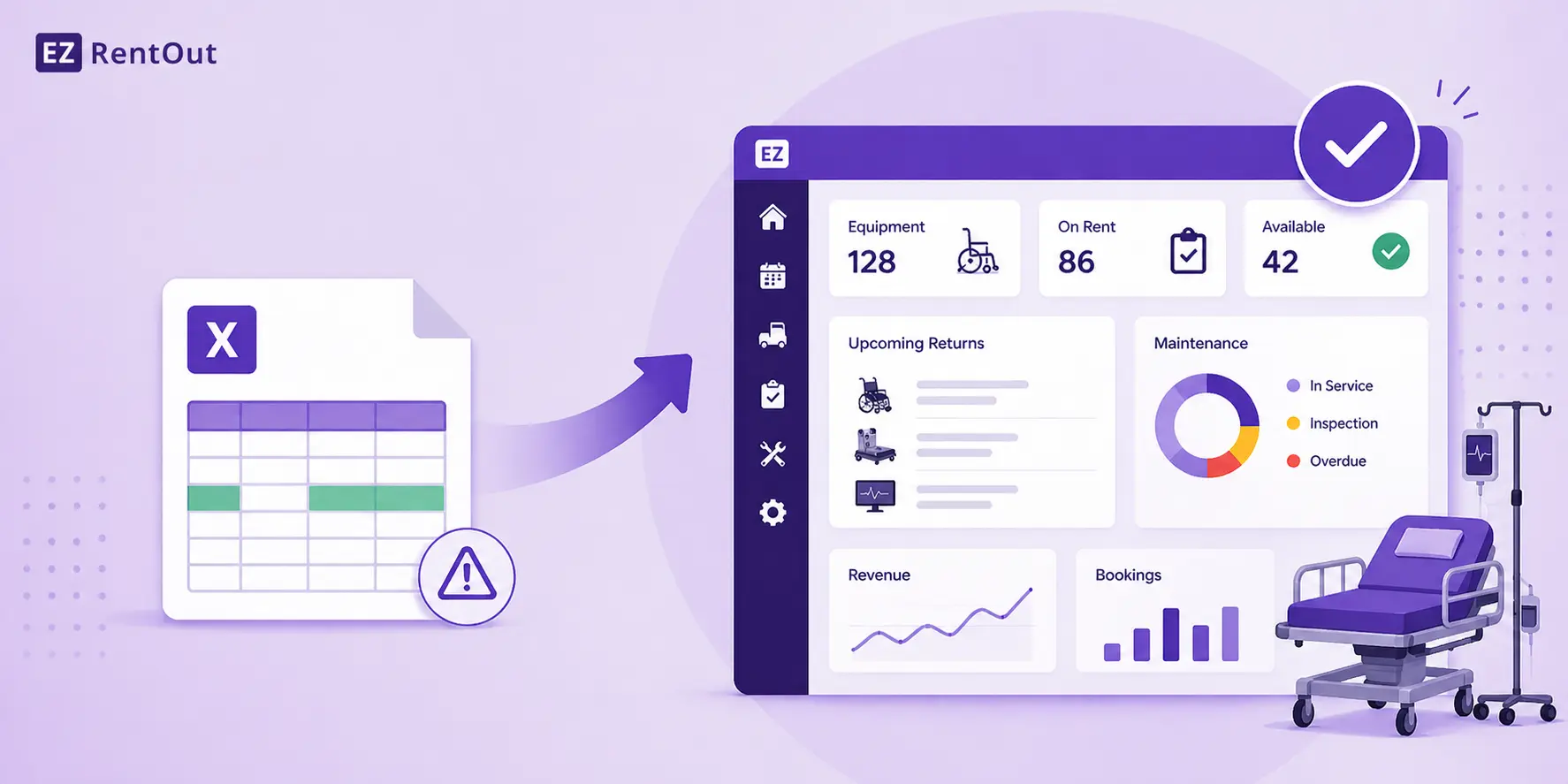
DME tracking doesn’t fail because of volume; it fails because of fragmented workflows.
If you’re a General Manager running a medical equipment rental business, you’re not struggling because you have too many assets to manage. You’re struggling because every part of your operation, including inventory, orders, dispatch, maintenance, and billing, lives in a different place.
And when those pieces don’t connect, DME tracking breaks. This isn’t an isolated issue; it shows up in everyday operations.
Equipment goes out, but its status isn’t updated in time. A pickup gets delayed, but billing doesn’t reflect it. A unit sits unused at one location while another site is short on stock. These aren’t separate problems; they’re connected gaps that keep repeating across your workflow.
At the same time, demand for DME rentals continues to increase. The global medical equipment rental market alone is projected to grow from $58.5 billion in 2023 to nearly $97.7 billion by 2032, reflecting a steady rise in reliance on rental-based healthcare models. More orders, faster turnaround expectations, and higher compliance requirements mean your operations have less room for error than ever before.
But without real-time visibility and coordination across your processes, even small gaps start turning into lost revenue, delayed deliveries, and frustrated customers.
In this article, you’ll find out where and why DME tracking breaks in rental businesses like yours, and what those breakdowns actually look like in day-to-day operations.
What DME tracking means for GMs in medical equipment rental operations
When you’re running a DME rental business, tracking is about knowing what your medical equipment is doing at any given moment.
Durable Medical Equipment (DME) includes items such as wheelchairs, oxygen concentrators, hospital beds, CPAP machines, etc. These aren’t static assets sitting in a warehouse. They’re constantly moving, out for delivery, in use at a patient’s home, coming back for inspection, or waiting to be redeployed.
That’s where tracking gets more complex and critical.
1. Availability: Can you actually fulfill the next medical equipment rental order?
It’s not enough to know you have 20 wheelchairs in your system. You need to know how many are:
- ready to go
- already rented
- reserved for upcoming orders
For example, a clinic calls needing three wheelchairs urgently. Your system shows five available, but two are already reserved for tomorrow, and one is still awaiting cleaning. In reality, you can only fulfill two.
Without accurate availability tracking, you either overpromise or miss the opportunity altogether.
2. Location: Where is the medical equipment right now?
Your equipment isn’t just in one place. It’s spread across:
- warehouses
- delivery vans
- patient homes
- partner facilities
Think about an oxygen concentrator that was scheduled for pickup yesterday but hasn’t been returned yet. If your system still shows it in circulation without a precise location, your team ends up making calls, checking with drivers, or worse, assuming it’s lost.
Real tracking means knowing exactly where each medical unit is, without having to chase down information.
3. Status: What condition is it in?
Location alone isn’t enough. You also need to know if the medical equipment is actually usable.
A hospital bed that has been returned isn’t immediately ready for the next rental. It might be:
- waiting for cleaning
- under maintenance
- approved and ready to deploy
Now imagine dispatch assigns that bed to a new order, only to realize it hasn’t been sanitized yet. That delay could have been avoided with clear status tracking.
4. Rental lifecycle: What stage is the medical equipment in?
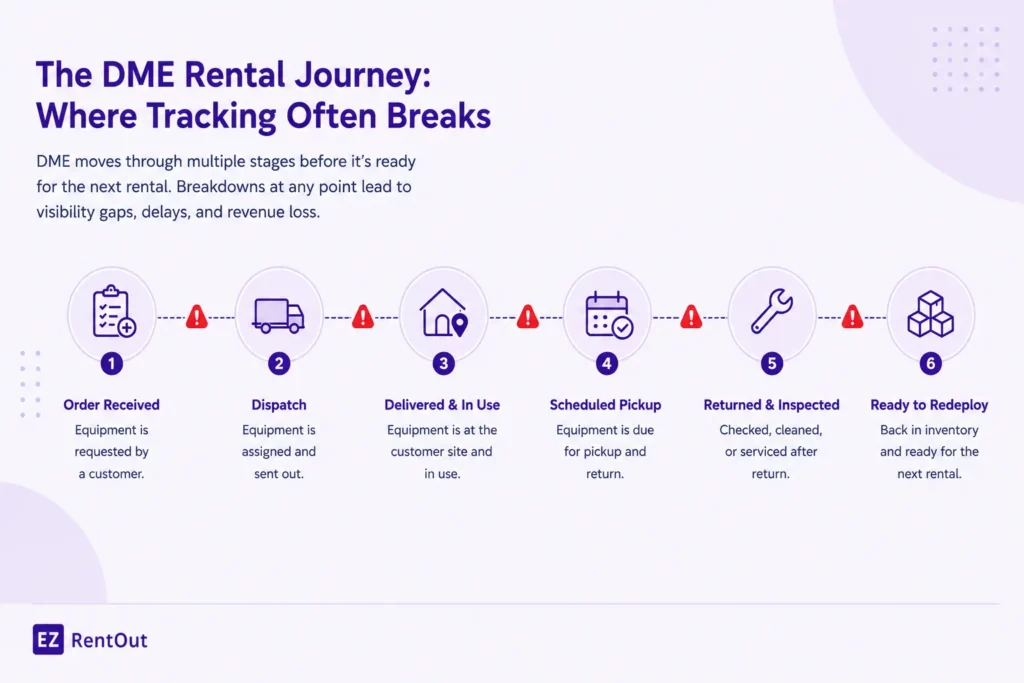
Every piece of DME moves through a lifecycle:
delivery → usage → billing → return → inspection → redeploy
Tracking breaks when you lose visibility between these steps.
For instance, a CPAP machine gets delivered, but the system isn’t updated. Billing doesn’t start on time. Or a wheelchair gets returned, but no one marks it as available again, so it sits idle while new orders go unfulfilled.
Tracking the lifecycle means you’re not just logging movement, you’re managing transitions.
5. Billing linkage: Is the rental equipment generating revenue?
In medical equipment rental businesses, tracking and billing are tightly connected.
If you don’t know:
- When the equipment was delivered
- How long has it been used
- When it was picked up
…you can’t bill accurately.
Take a simple case: a recovery center rents a hospital bed for short-term patient care. It was supposed to be picked up on the 10th but remained on-site until the 15th. If that extra usage isn’t captured in your tracking system, those five days of revenue are lost.
The reality: Why DME tracking breaks
In short, DME rental tracking is about operational clarity.
You’re not just asking:
- Do we have this equipment?
You’re asking:
- Where is it?
- Is it usable?
- What stage is it in?
- Is it earning revenue right now?
But here’s where things start to fall apart.
Even when all this information exists, it doesn’t live in one place. Orders move forward without the dispatch being fully aligned. Deliveries happen, but billing doesn’t always reflect them in time. Pickups get delayed, but the system doesn’t catch up fast enough. Each step moves, but not always together.
So instead of one clear picture, you’re working with fragments. Some updates happen manually. Some happen late. Some never make it back into the system at all.
That’s the real reason why DME tracking breaks. Not because you lack data, but because your workflows aren’t connected, and your updates aren’t happening in real time.
When you can answer all of those questions in real time, tracking works. When you can’t, that’s when it starts to break.
10 DME tracking challenges medical equipment rental GMs face daily
The 10 tracking challenges listed below are everyday breakdowns that directly impact fulfillment, utilization, and revenue in DME rental operations.
1. Lack of visibility into medical rental equipment availability
The problem isn’t that you don’t have a certain medical equipment to rent, it’s that you can’t confidently commit to it.
At any given moment, your team is making decisions based on partial or outdated availability. What looks available in the system may already be reserved, out for delivery, or stuck in a return backlog that hasn’t been processed yet.
For example, you might see 12 oxygen concentrators listed as available. But when you break it down:
- 4 are already reserved for upcoming orders
- 3 are still awaiting cleaning or inspection
- 2 are out for delivery but not yet marked as dispatched
In reality, you only have 3 units you can actually deploy immediately.
Now multiply that across multiple product categories and locations.
Let’s say your team receives 15 incoming wheelchair rental requests in a day across three branches. Without visibility:
- One location overcommits by 5 units
- Another sits on 8 idle units that no one knows are available
- Result: missed orders + underutilized inventory at the same time
This is where availability tracking breaks, not in counting medical assets, but in understanding their true state in real time. When your team can’t trust availability, every order becomes a risk.
2. Medical equipment lost between delivery and pickup
This isn’t about medical rental equipment going missing overnight; it’s about losing track of it in motion.
Once equipment leaves your warehouse, visibility drops sharply. It’s no longer in inventory, but it’s not fully accounted for in operations either. And without tight order tracking, that gap becomes a blind spot.
Think about a typical day. You dispatch 8 hospital beds and 12 mobility aids across clinics, rehab centers, and patient homes. By the end of the day:
- 3 deliveries are completed but not marked in the system
- 2 items are delivered to the wrong department or treatment room at a facility
- 4 pickups are delayed, but no one updates the order status
Now your system shows everything as “in use,” but in reality:
- Some equipment is already idle at a clinic or rehab center
- Some items are ready for pickup, but haven’t been scheduled
- Some equipment is simply unaccounted for
This is where order management directly impacts DME tracking.
If your orders don’t reflect real-world movement, delivery confirmed, pickup scheduled, or pickup completed, you lose control over where your medical equipment actually is.
Home healthcare scenarios
The risk is even higher in home healthcare scenarios. For example:
- A CPAP machine delivered to a patient might stay in use 5–7 days longer than planned because pickup wasn’t triggered
- A wheelchair returned informally (via driver or third party) might sit unlogged for 24–48 hours before anyone updates the system
That’s not just a tracking issue, it’s:
- Delayed availability for the next order
- Lost billing days
- Higher chances of permanent loss or damage
When DME order tracking isn’t tightly linked to equipment movement, assets don’t disappear; they drift outside your system.
3. Disconnected order, inventory, and dispatch systems
This is where your medical equipment rental operation looks connected on the surface, but might be breaking underneath.
Orders get created. Inventory exists. Dispatch moves medical equipment. But each of these functions runs on its own track, without a shared system tying them together in real time.
A rental order might be logged correctly, but it doesn’t automatically reflect what’s actually available in inventory. So your team ends up committing equipment based on assumptions rather than the current state.
Then dispatch steps in.
Instead of working from a live, system-driven queue, dispatch teams are often stuck navigating a clunky legacy system that doesn’t reflect updated changes. So they end up relying on:
- calls to confirm what needs to go out
- WhatsApp messages to clarify changes
- manual notes to track what’s been loaded
For example, you receive 20 rental orders in a day across different medical rental product types. Out of those:
- 6 require last-minute changes (address updates, item swaps, timing shifts)
- 4 orders get partially fulfilled because the originally assigned medical equipment isn’t actually ready
- 3 deliveries go out with incorrect items due to miscommunication between order entry and dispatch
None of this happens because your team isn’t capable; it happens because the current system doesn’t connect the dots.
For GMs in a DME rental business, this gap is especially critical. Equipment isn’t just picked and shipped; it’s assigned, scheduled, delivered, installed, and eventually retrieved. Every step depends on tight coordination between order data, inventory state, and dispatch execution.
When those systems don’t operate as one, your team fills the gaps manually, and that’s where errors start compounding. This is a major gap in DME rentals.
4. Manual DME tracking and its operational gaps
A lot of your DME rental tracking still depends on people remembering to update things at the right time.
Not because you want it that way, but because your current system doesn’t capture changes instantly. So updates get passed along via quick calls or messages, or logged later when someone has time.
For example, a driver completes 10 deliveries in a day.
- 7 deliveries are marked complete right away
- 2 are confirmed over a quick message, but not updated in the system
- 1 isn’t logged until the next day
By the end of the day, your system doesn’t reflect what actually happened.
- Some equipment still appears to be out for delivery
- Some isn’t marked as an active rental yet
- Billing for a few items hasn’t started
Now extend that to pickups.
Let’s say your team has 30 active rentals scheduled for return this week. If even 20% of pickups are logged late, that’s 6 units where:
- medical equipment appears unavailable longer than it actually is
- the next rental gets delayed
- or billing continues incorrectly
Individually, these seem like small delays. But together, they create a system your team can’t fully rely on. This is how DME tracking breaks, not through a single failure, but through repeated, manual gaps.
When updates depend on people instead of being captured automatically, your data slowly drifts away from reality. And once that happens, every decision built on that data becomes harder to trust for your rental operations.
5. Slow turnaround between DME rentals
In DME rentals, revenue doesn’t just depend on how much equipment you own. It also depends on how quickly you can turn it around for the next order.
The gap usually appears after the medical equipment is returned. You know it’s returned. But you don’t have clear visibility into:
- what has actually been received
- what’s still waiting for cleaning or inspection
- what is fully ready to go back out
So instead of moving smoothly from return to ready to next rental, the equipment gets stuck in between. For example, let’s say 15 wheelchairs are returned in a day.
- 10 are physically back in the warehouse
- 5 are still in transit or pending check-in
Out of the 10 in the warehouse:
- 6 are cleaned and ready
- 4 are still waiting to be processed
But if your system doesn’t clearly reflect this breakdown, your team sees all 15 as unavailable.
Now imagine you receive 8 new rental requests the same day.
- You could have fulfilled 6 immediately
- Instead, those orders get delayed, or worse, declined
That’s not a supply problem. It’s a turnaround visibility problem. Over time, this adds up. If even 5–10 units per day are stuck in this in-between state, that’s:
- fewer rentals fulfilled
- longer idle time per asset
- and lower revenue per unit
The impact is simple: equipment isn’t earning when it should be.
6. Inaccurate billing due to missing DME usage data
Billing starts to break when usage isn’t captured at the exact moments that matter: delivery and pickup. If those timestamps aren’t recorded, your billing is always slightly off.
For example, a CPAP machine is delivered on the 5th, but the system is updated on the 7th. That’s 2 days of usage that never gets billed.
On the return side, a wheelchair scheduled for pickup on the 12th is actually picked up on the 15th. If that delay isn’t reflected, you lose 3 additional billable days.
Now scale this.
If you’re managing 60 active DME rentals, and even 20% of them have a 2-day mismatch:
- that’s 12 rentals affected
- resulting in 24 billable days either missed or inaccurately recorded
And these gaps don’t show up as obvious errors; rather, they quietly reduce revenue over time.
Missed pickups are where this gets worse.
If pickups aren’t triggered or logged on time, medical rental equipment continues to be used without being tied to billing. The asset is out, the service is ongoing, but the revenue stops being captured.
For GMs in DME rental businesses, this isn’t a minor issue. Billing accuracy depends entirely on how precisely you track actual usage.
7. Rental vs. owned medical equipment confusion
Not every piece of equipment in your system belongs to you, and that distinction needs to be clear at all times. In DME rental operations, you’re often handling a mix of medical equipment you own and equipment currently rented out. When these aren’t clearly separated, small mistakes start showing up in everyday work.
For example, you send a driver to pick up 10 oxygen concentrators from a facility. When they arrive:
- only 6 are actually yours
- the remaining 4 belong to the facility
The pickup is delayed, your team has to double-check records, and the driver leaves without completing the job.
Now let’s look at the billing side.
Those 6 rented units were supposed to be picked up and rented on the same day, but the confusion has delayed the process by 1–2 days. During that time:
- you can’t rent them out again
- billing may not reflect the extra usage
- and your team spends time fixing something that should’ve been clear
This leads to either lost revenue or billing disputes. Even a few of these mix-ups each week can result in repeated pickup delays, confusion during audits, and unnecessary back-and-forth with customers.
When rental and owned medical equipment aren’t clearly defined, simple tasks become harder than they should be.
8. DME maintenance and compliance gaps
When there’s no structured way to track inspections and servicing, medical rental equipment can return to circulation without being properly checked.
For example, an oxygen concentrator is returned after a 20-day rental.
- It gets placed back in storage
- No inspection is logged
- No one confirms whether it was cleaned or tested
A new order comes in the next day, and the same unit is sent out again. On the surface, everything looks fine. But:
- the equipment hasn’t been verified for performance
- there’s no record of its last inspection
- and no confirmation if it meets compliance standards
Now imagine this happens with just 3–4 units in a week. That’s multiple instances where medical equipment is being used without proper checks, and there’s no audit trail to fall back on.
This isn’t just an operational gap. It directly impacts patient safety and puts your DME rental business at risk during audits or compliance checks. So, DME rental software with preventive maintenance becomes a necessity to avoid such issues.
9. Poor DME utilization tracking across locations
When you’re operating across multiple locations, having a clear, centralized view of your medical rental equipment is essential.
One site might have more medical equipment than it needs, while another is struggling to fulfill orders. The issue isn’t inventory, it’s visibility across locations.
For example, you have two branches:
- Location A has 20 oxygen concentrators, but only 8 are currently rented out
- Location B has 15 units, and all 15 are in use, with new requests coming in
Without a centralized view, your team at Location B assumes there’s no availability and delays or declines new orders. Meanwhile, Location A has 12 units sitting idle. No one connects the dots.
Over time, this leads to unnecessary purchases of medical equipment at one location, idle inventory at another, and missed revenue opportunities overall.
When you can’t see how your equipment is being used across locations, you’re not managing a fleet; you’re just managing isolated pockets of inventory.
10. Lack of standardized DME data and reporting
When your data isn’t consistent, your decisions start relying on guesswork. Information exists, but it’s scattered, incomplete, or recorded differently across teams. There’s no single version you can trust when you need answers.
For example, you want to understand the demand for oxygen concentrators last month.
- Your inventory records show 40 units in circulation
- Your order records show 52 rentals completed
- Your billing data reflects 47 billed rentals
None of these numbers match exactly. Now you’re left asking:
- Which number is correct?
- How many units were actually used?
- Do you need more inventory or not?
Without a clear audit trail, default, and custom reports, you can’t trace what happened. Without consistent data, you can’t forecast what’s coming next. So decisions get made based on assumptions like ordering more medical equipment just in case, delaying purchases because the numbers don’t look urgent, or missing demand because it wasn’t visible in time.
Over time, this creates a cycle where reporting doesn’t reflect reality, planning becomes reactive, and growth decisions feel uncertain.
This is usually the point where medical equipment rental GMs realize the issue isn’t just tracking; it’s how everything connects behind it.
What high-performing DME rental GMs do differently
High-performing DME rental GMs run their operations on systems where everything updates in one place. Inventory, orders, dispatch, and billing are not handled separately. They are part of the same workflow, so when something changes in one step, it automatically reflects everywhere else.
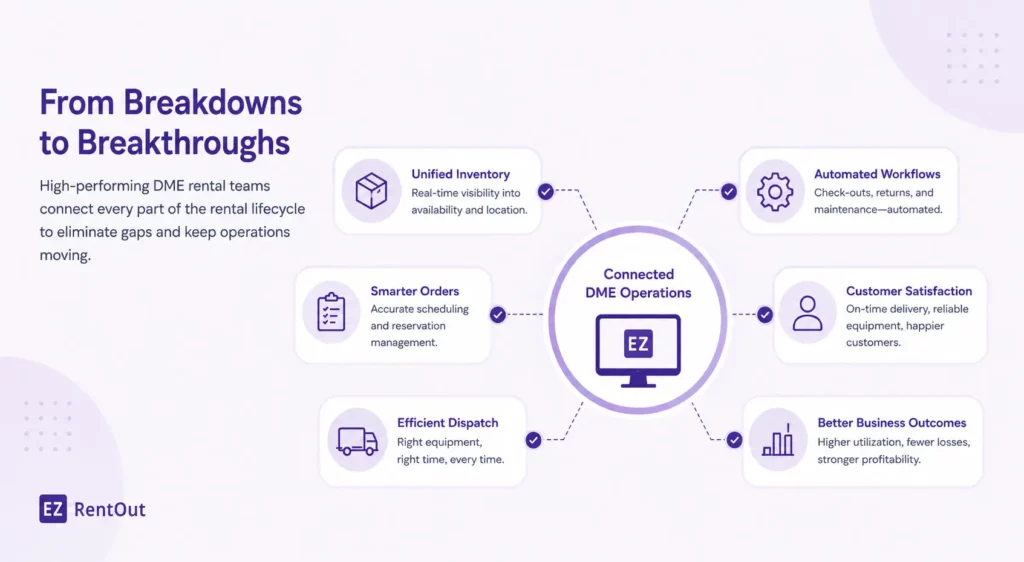
For instance, a clinic places a recurring weekly order for 10 portable exam tables for an outreach program.
The system reserves only the units that are actually available, blocks them from being assigned elsewhere, and gives dispatch the exact pickup, delivery, and return schedule. Once the tables are delivered, the rental period starts from the confirmed delivery time. When the program ends, and the tables come back, they’re marked for inspection before becoming available again.
The same workflow applies across routine operations: reservations prevent double-booking, returns update availability instantly, and maintenance steps are triggered before equipment goes back into circulation.
This reduces the need for follow-ups and removes gaps between steps. Across locations, data is handled in a consistent way:
- The same status labels are used everywhere
- Updates follow the same process
- Reports pulled from the same dataset
So when you review utilization or demand, the numbers make sense.
And platforms like EZRentOut support this approach by consolidating inventory, orders, reports, and billing into a single system. Equipment movement, rental duration, and availability are all tracked within the same workflow.
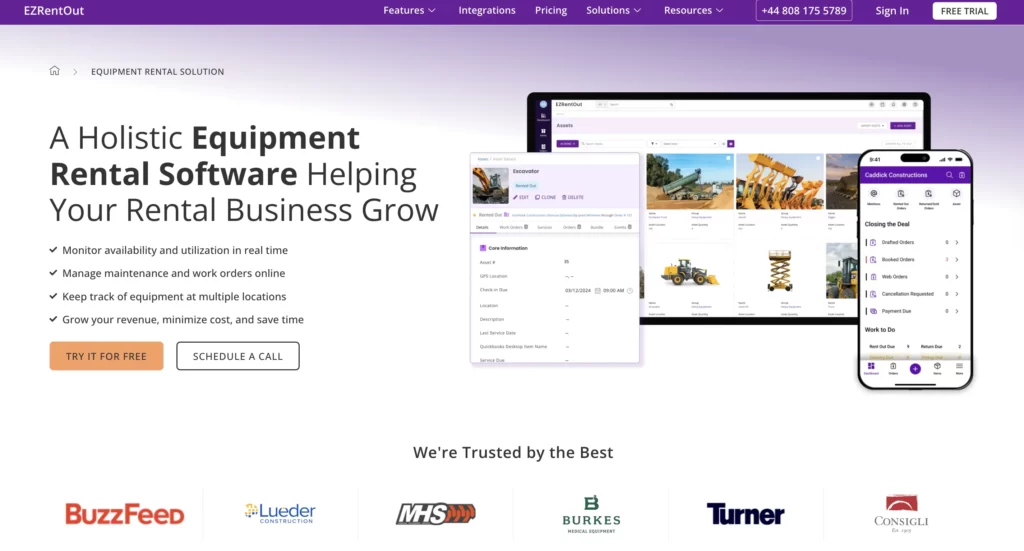
This allows you to know what’s available without checking multiple sources, track medical equipment across its full rental lifecycle, and rely on data that reflects actual operations.
When everything updates in one place, the breakdowns that slow teams down stop occurring.
Wrap up
Most of the issues discussed don’t stem from a single major failure. They come from everyday gaps like late updates, systems that don’t reflect real activity, and teams working without a shared view of what’s actually going on.
These gaps affect how quickly you can fulfill DME rental orders, how accurately you bill, and how well you utilize your equipment. Over time, they make operations harder to manage and harder to scale.
The teams that operate smoothly have one thing in common: their systems reflect real-world activity as it happens. Equipment movement, order updates, and billing are all tied together, so nothing gets lost between steps.
That’s what removes the need for constant follow-ups, manual checks, and corrections.
Because at its core, why DME tracking breaks comes down to whether your system can keep up with your day-to-day operations.