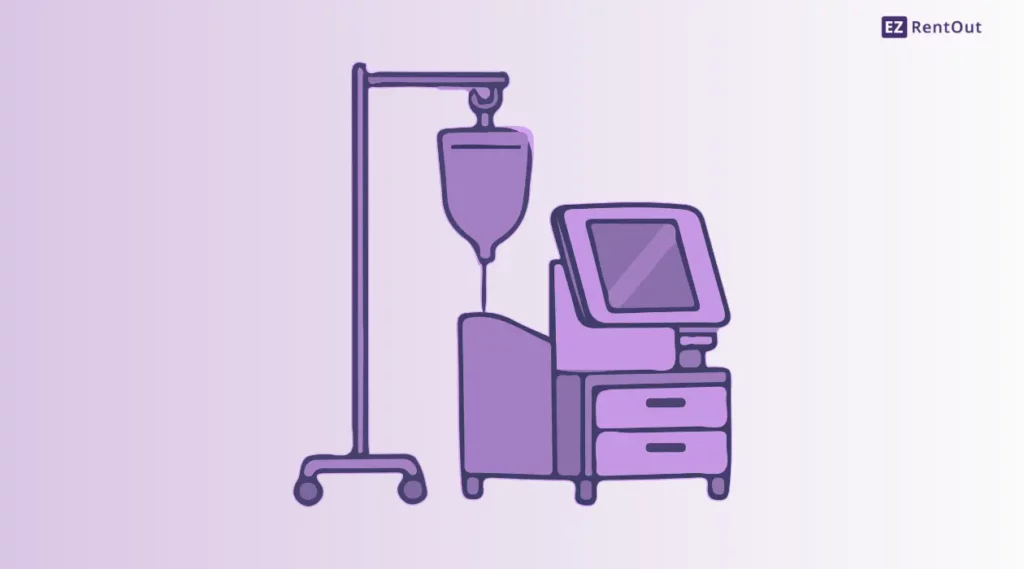
Running medical equipment rentals isn’t just about tracking equipment; it’s about maintaining control over high-risk, regulated equipment in environments where failure has real consequences.
Medical Equipment General Managers are the ones juggling many responsibilities in healthcare settings, from coordinating inventory to balancing compliance requirements, maintenance schedules, and equipment availability across departments and locations.
Without the right systems in place, even minor gaps, like missing calibration records or unclear asset ownership, can lead to audit risks, operational delays, or compromised patient care.
In this blog, we will unpack how leading healthcare equipment rental organizations are moving from fragmented spreadsheets and reactive workflows to centralized, system-driven operations that combine rentals, maintenance, and compliance in a single platform.
We’ll also walk you through the key capabilities Medical Equipment GMs should look for, from end-to-end rental lifecycle management to audit-ready compliance tracking and multi-site visibility. You’ll also find a practical evaluation framework to help assess the right solution for your organization.
Finally, we will present a curated list of top platforms, complete with features, strengths, limitations, ideal use cases, and a side-by-side comparison table to support confident decision-making.
How Leading Healthcare Equipment Rental Teams Are Evolving Their Operations
If you’re running a medical equipment rental operation, you’ve likely seen the pressure build over time.
What starts as manageable, tracking assets in spreadsheets, coordinating manually across teams, quickly becomes difficult to control as your inventory grows, customers increase, and compliance expectations tighten.
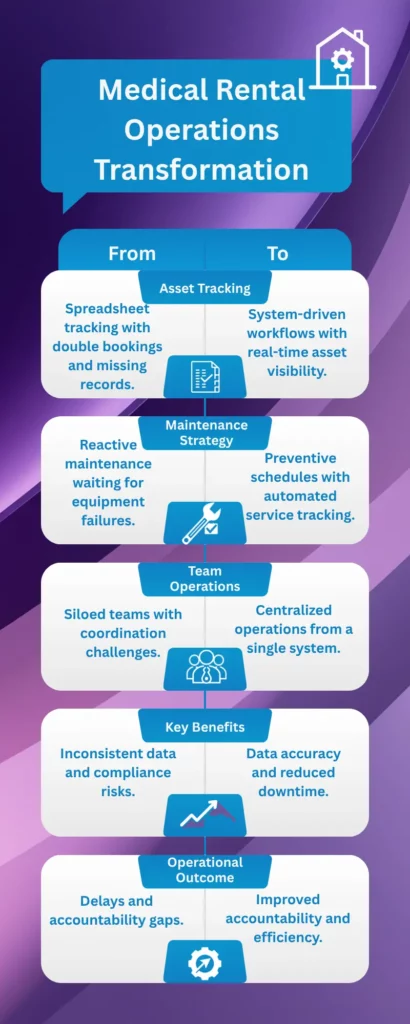
Moving from disconnected workflows
1. Spreadsheet tracking to system-driven workflows
You may still be relying on spreadsheets or disconnected tools to track rentals, availability, and asset status. But as your operation scales, gaps start to show in the form of double bookings, missing records, and inconsistent data.
Leading medical equipment rental teams are moving to systems that standardize workflows, enforce data accuracy, and give you real-time asset visibility.
2. Reactive maintenance to preventive and predictive approaches
When equipment is constantly moving between customers, waiting for failures isn’t an option. You need to ensure every asset is serviced, calibrated, and ready before it goes out again.
That’s why leading teams are shifting toward preventive maintenance schedules and automated service tracking to reduce downtime and avoid compliance risks.
3. Siloed teams to centralized rental operations
If your rental, maintenance, and compliance processes are handled separately, coordination becomes your biggest challenge.
High-performing medical equipment rental businesses are centralizing operations, so your team can manage bookings, servicing, and compliance from a single system, reducing delays and improving accountability.
The emergence of unified rental systems
1. Asset operations as a strategic function
You’re no longer just fulfilling rental requests; you’re running a high-stakes operation where efficiency, compliance, and asset utilization directly impact profitability. Asset operations is becoming a core function that drives both service quality and business performance.
2. Data-backed utilization decisions
Instead of relying on assumptions, you now have the data to understand which equipment is overbooked, underutilized, or driving the most revenue. Leading teams use these insights to optimize their medical equipment inventory, reduce unnecessary purchases, and improve overall utilization.
Evaluation Criteria: How to Choose the Right Medical Equipment Rental Software
Once you start evaluating tools, the challenge isn’t finding options; it’s knowing what actually matters for your operation. Not every platform built for rentals is designed for the level of control, traceability, and coordination your business requires.
Here’s how you can think about it when narrowing down the right fit.
Core capabilities medical equipment rental software should have
1. Complete rental lifecycle management
You need visibility and control from the moment equipment is reserved through to its return and readiness for the next booking. This includes scheduling, dispatch coordination, returns, invoicing, and status updates, all within a single continuous flow.
2. Maintenance tracking with full service history
Every medical asset should carry its own history, what was serviced, when, and by whom. This ensures you’re not relying on memory or scattered records when preparing medical equipment for the next rental.
3. Built-in compliance documentation
Whether it’s calibration records, inspection logs, or certifications, your system should store and organize everything in one place. So, you’re always prepared when audits or checks come up.
4. Readiness-based availability
It’s not enough to know if something is in stock. You need to know if it’s actually ready to go out, serviced, compliant, and cleared for use. This is what prevents last-minute delays or risky deployments.
5. Visibility across locations
If you’re managing inventory across warehouses, hospitals, or regions, you should be able to see where everything is and move assets efficiently without guesswork.
6. Billing and utilization insights
You should be able to track how often a certain medical equipment is rented, how it contributes to revenue, and where inefficiencies exist, so that you can make better decisions around pricing, inventory, and demand. Plus, the invoicing and payment should also be handled within the medical rental equipment software you’re using.
Advanced capabilities for growing operations
1. Controlled access across teams and sites
As your team expands, you’ll need to define who can view, edit, or manage different parts of the system, without compromising data integrity.
2. Audit-ready reporting
Instead of scrambling for records, your system should make it easy to generate reports that clearly show asset history, usage, and compliance status when needed.
3. Integration with your existing systems
Your rental platform shouldn’t operate in isolation. It should connect with your billing tools, ERP, payment gateways, or healthcare systems so data flows seamlessly across your operations.
4. Mobile workflows for on-the-ground teams
Whether it’s checking equipment in and out, updating status, or logging service activity, your team should be able to do it in real time, without being tied to a desk with data available on the go.
Top 7 Medical Equipment Rental Software Solutions Helping General Managers Streamline Rentals & Compliance
Below are seven tools that support efficient rental management and compliance tracking for medical equipment operations.
1. EZRentOut
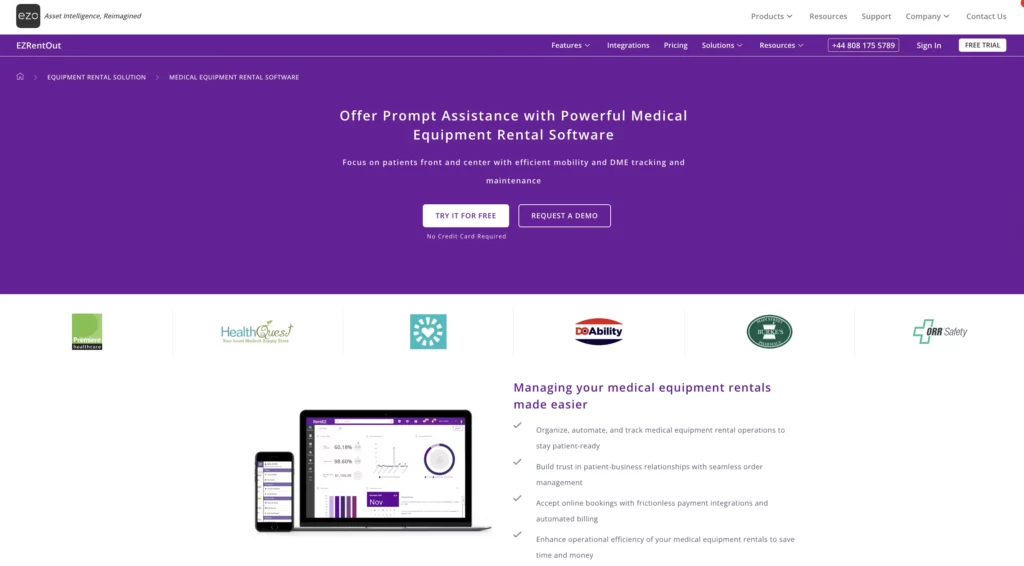
EZRentOut is a cloud-based rental management platform designed for equipment rental businesses, including those managing medical and durable medical equipment (DME). It brings rentals, inventory tracking, maintenance, and billing into a single system, helping you manage the full lifecycle of your equipment without relying on multiple tools.
For medical equipment rental companies, it’s particularly useful when you need to balance availability, servicing, and compliance readiness while handling growing order volumes.
Key features
- Asset tracking: Real-time location tracking to keep track of your medical equipment
- Order management: Smooth order management with comprehensive booking details
- Rental lifecycle: End-to-end rental lifecycle management (quotes, reservations, dispatch, returns)
- Inventory management: Real-time inventory tracking with availability-based scheduling
- Maintenance management: Preventive maintenance scheduling with full service history logs
- Check-in/check-out: Barcode and QR code scanning for faster check-in/check-out
- Billing & payments: Consolidated billing, invoicing, and online payment gateway integrations
- Mobile operations: Mobile app for field operations and on-the-go updates
- Reporting and analytics: For utilization and performance tracking, with the option to create custom reports
- Bundling: Bundle or package equipment with accessories or extras to rent similar items together
- Sub-renting: Sub-rent medical equipment from other providers and easily assess your profit on each rental
Strengths
- Combines rental workflows and maintenance tracking in one platform, reducing the need for separate systems
- Strong visibility into asset availability, helping prevent double bookings and scheduling conflicts
- Set up an online rental store with customizable URLs and a multi-store listings option
- Easy to deploy and use, especially for small to mid-sized rental operations
- Mobile-first capabilities improve coordination for field teams
Limitations
- May lack deeper enterprise features like advanced dispatch optimization or complex inter-branch workflows compared to more specialized systems
- Compliance workflows (e.g., healthcare-specific audit frameworks) may require configuration rather than being fully out-of-the-box
Ideal use case
EZRentOut is a strong fit if you’re running a mid-sized to enterprise-level medical equipment rental operation and want to:
- Replace spreadsheets with a centralized system
- Improve visibility into rentals, maintenance, and inventory
- Ensure equipment is serviced and ready before each rental
- Streamline billing and day-to-day operations without heavy implementation overhead
EZRentOut review
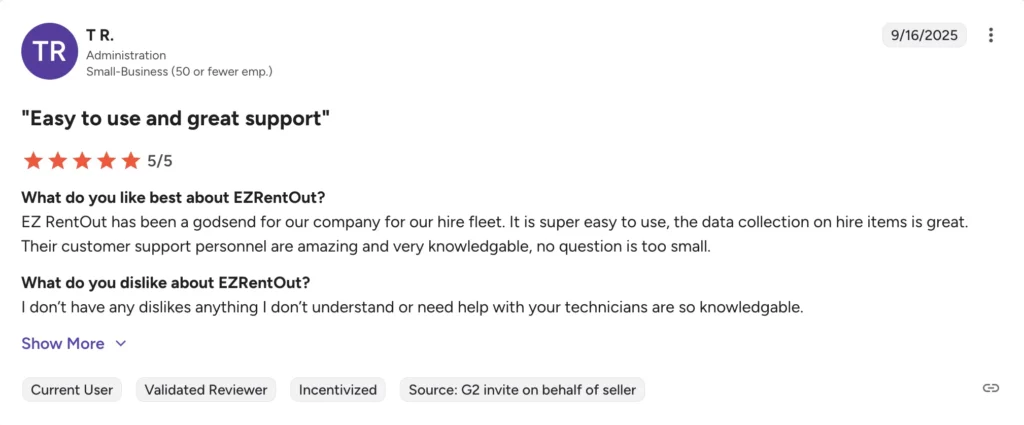
Source: G2
Pricing
- Essential ($89/month): Covers core rental operations including bookings, mobile access, unlimited assets, and QR/barcode scanning. Well-suited for smaller fleets.
- Growth ($399/month): Expands capabilities with an availability calendar, webstore, custom reporting, and payment integrations. Ideal for scaling operations.
- Premium ($499/month): Includes all Growth features plus maintenance tracking, sub-rentals, recurring orders, customer management, and accounting integrations. Designed for larger, more complex fleets.
- Enterprise (Custom pricing): Tailored for multi-location operations with advanced integrations, customization, and priority support.
Quick snapshot
| Category | Details |
| Best For | Mid-sized to enterprise-level operations |
| Deployment | Cloud |
| Pricing Model | Tiered |
| Key Strength | Rental + maintenance in one system |
| Limitation | Compliance workflows |
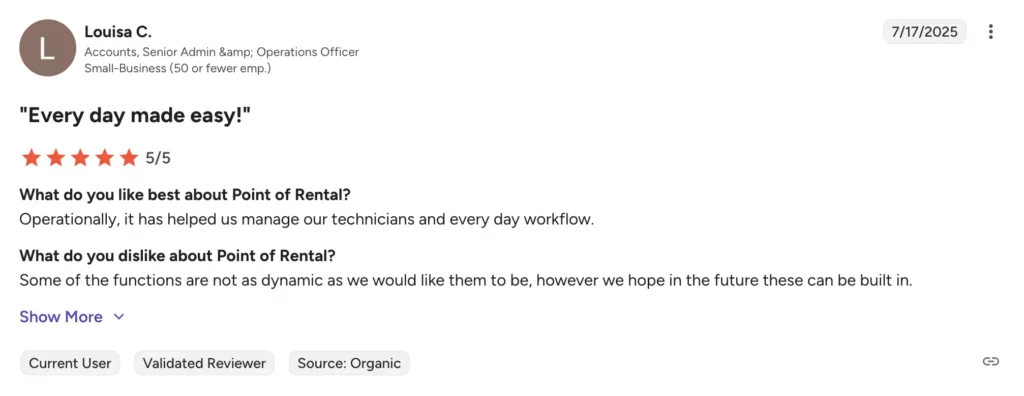
2. Point of Rental
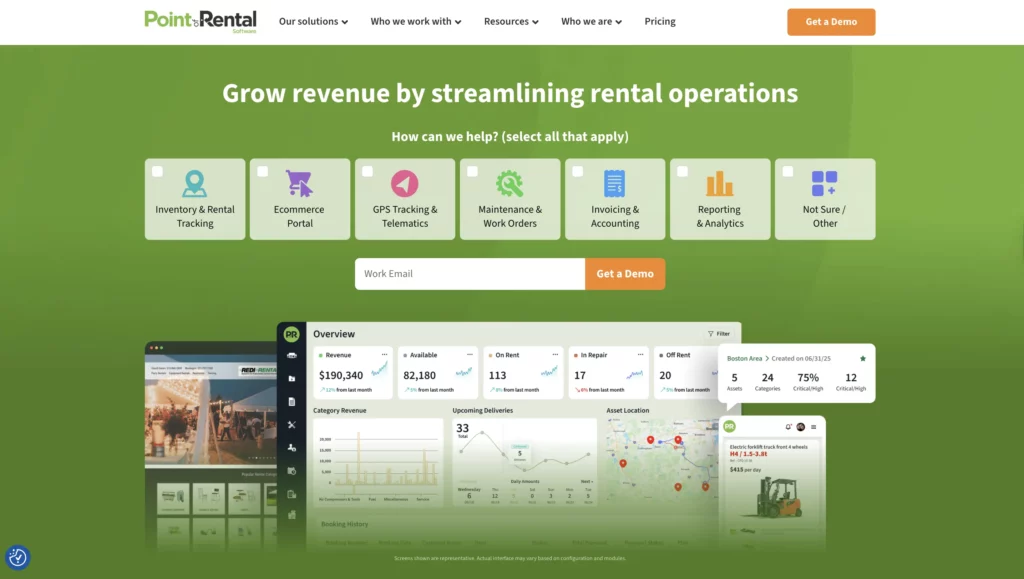
Point of Rental is an enterprise-grade rental management platform built to handle complex, high-volume medical equipment rental operations. It’s designed for businesses that need deeper control over inventory, contracts, logistics, and financials, especially when operating across multiple locations or departments.
For medical equipment rental companies, it’s best suited when your focus is on scaling operations, managing large inventories, and standardizing workflows across branches.
Key features
- Rental management: Centralized rental management covering contracts, scheduling, and inventory tracking
- Inventory visibility: Real-time inventory availability with reduced risk of double bookings
- Maintenance tracking: Preventive maintenance tracking with service logs and inspection workflows
- Billing & accounting: Integrated billing, invoicing, and accounting tools
- Mobile operations: Mobile app for delivery, pickup, barcode scanning, and field updates
- Customer experience: Customer portal and e-commerce capabilities for online bookings and payments
- Multi-location management: Multi-location support with logistics and inventory transfers
Strengths
- Built for complex and multi-branch rental operations, making it highly scalable
- Strong coverage across rental workflows, finance, CRM, and customer experience in one system
- Flexible deployment options (cloud and on-premise) to fit different operational needs
- Robust feature set for managing high volumes of equipment and transactions
Limitations
- Can be feature-heavy and require training, especially for teams transitioning from simpler tools
- Not specifically designed for healthcare, so compliance workflows may need configuration
- Interface and reporting may feel less intuitive and clunky compared to newer, more modern tools
Ideal use case
Point of Rental is a strong fit if you’re running a large or growing medical equipment rental business and need to:
- Manage operations across multiple locations or divisions
- Handle high volumes of rentals, contracts, and logistics
- Standardize workflows across teams
- Integrate rental operations with finance and customer management
Point of Rental review
Source: G2
Pricing
- Custom pricing (quote-based): Point of Rental does not offer fixed pricing tiers. Costs are tailored based on your business size, number of users, features required, and deployment type (cloud or on-premise).
- Product-based pricing: Pricing varies depending on the product you choose, each designed for different levels of operational complexity and scale.
- Add-ons and modules: Additional costs may apply for advanced features such as CRM, e-commerce integrations, mobile apps, and reporting tools.
Quick snapshot
| Category | Details |
| Best For | Large, multi-location operations |
| Deployment | Cloud / On-premise |
| Pricing Model | Custom |
| Key Strength | Scalability across branches |
| Limitation | Complex setup |
3. RentalMan by Wynne Systems
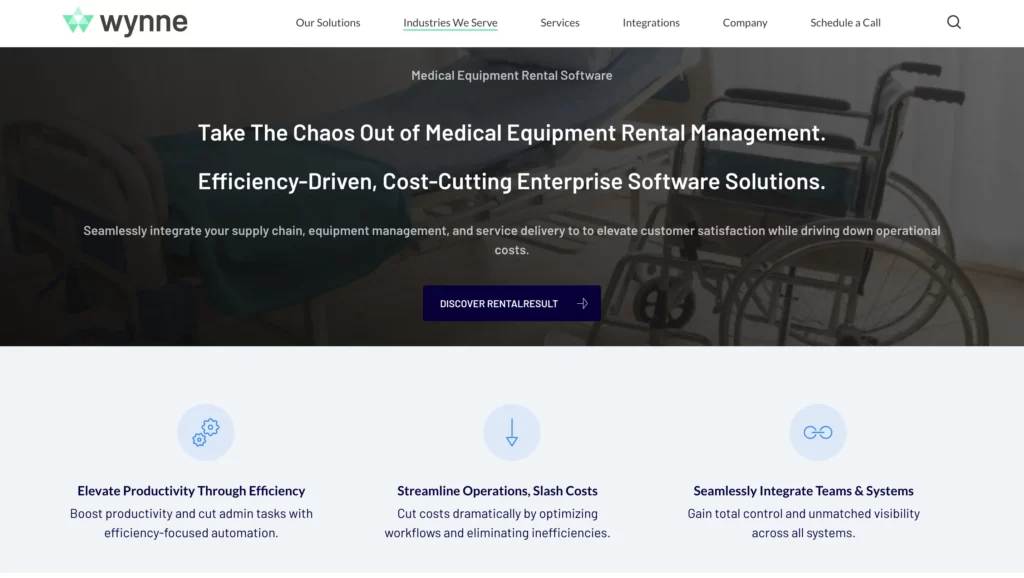
RentalMan by Wynne Systems is an enterprise-grade rental ERP platform built for large, complex equipment rental operations. It’s designed to unify everything from rental workflows and inventory to finance and logistics within a single system, making it particularly suited for businesses operating at scale.
For medical equipment rental companies, RentalMan is best suited when you’re managing high volumes, multiple branches, and tightly integrated financial and operational workflows.
Key features
- Order management: With in-app messaging, alerts, and notifications to keep teams aligned
- Inventory management: With real-time tracking from purchase order to delivery
- Asset tracking: For live visibility into equipment status, availability, and utilization
- Maintenance scheduling: To ensure timely servicing and reduce the risk of unexpected failures
- Logistics coordination: To manage deliveries, pickups, and field operations efficiently
- Document management: To attach and access images, PDFs, and records for assets and orders
- Operational visibility: Single-pane interface providing centralized visibility across operations
- Reporting and analytics: For performance tracking and operational insights
- Patient records: Patient record management to link equipment usage with customer or patient data
- System configuration: Configurable, cloud-based system with flexibility for enterprise environments
- Mobile access: For teams working across locations and in the field
Strengths
- Designed as a comprehensive rental ERP, combining operations, logistics, and financial workflows
- Strong fit for multi-location and high-volume environments requiring centralized control
- Deep visibility across inventory, orders, and asset utilization
- Configurable to support complex business processes and integrations
Limitations
- Implementation can be resource-intensive and time-consuming, especially for smaller teams
- Requires training due to the depth and breadth of features
Ideal use case
RentalMan is a strong fit if you’re running a large-scale medical equipment rental operation and need to:
- Manage multiple locations, fleets, and high transaction volumes
- Integrate rental operations with finance and accounting systems
- Standardize workflows across departments and regions
- Gain deeper control over utilization, logistics, and financial performance
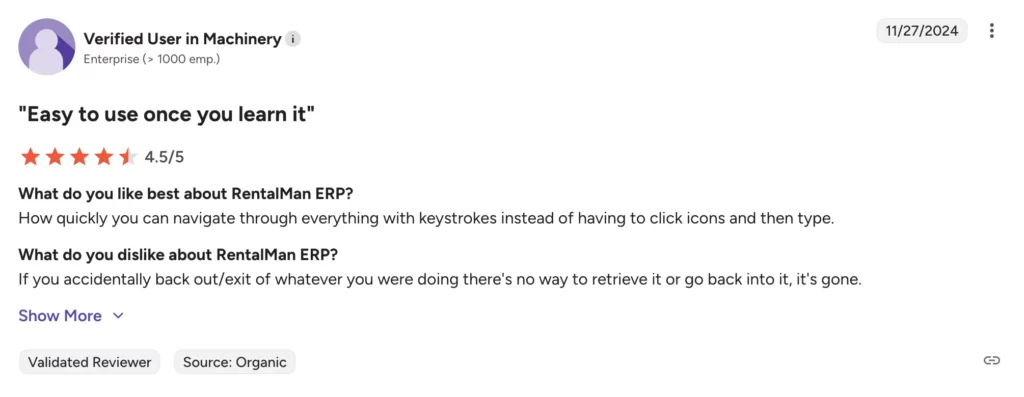
RentalMan review
Source: G2
Pricing
- Custom pricing (enterprise quote-based): RentalMan does not publish fixed pricing tiers. Costs are tailored based on your business size, number of users, operational complexity, and required modules.
- Industry-specific configuration: Additional costs may apply for customization to support medical equipment workflows, integrations, and compliance requirements.
Quick snapshot
| Category | Details |
| Best For | Enterprise rental operations |
| Deployment | Cloud |
| Pricing Model | Custom ERP |
| Key Strength | Full rental ERP |
| Limitation | Heavy implementation |
4. Booqable
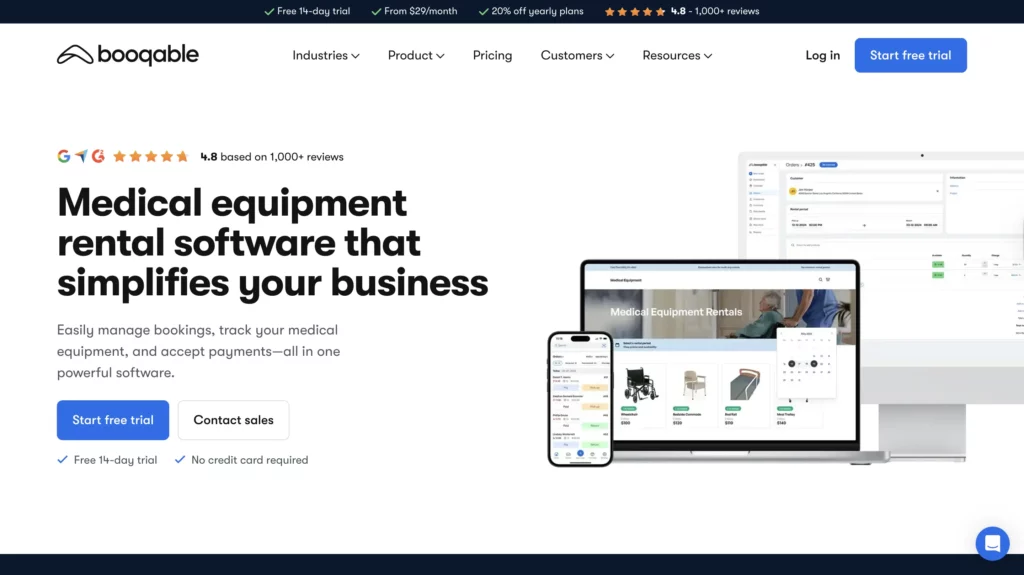
Booqable is a cloud-based rental management platform designed for small to mid-sized equipment rental businesses. It focuses on simplifying day-to-day operations by combining inventory tracking, online bookings, and payments into a single, easy-to-use system.
For medical equipment rental companies, Booqable is best suited when you need a lightweight, fast-to-deploy solution to manage bookings, track availability, and reduce manual coordination, without the complexity of enterprise systems.
Key features
- Inventory management: Real-time inventory tracking with automatic availability updates as bookings change
- Online booking system: With website builder or integrations (e.g., Shopify, WordPress)
- Order and reservation management: To create, manage, and fulfill rental bookings in one place
- Billing & contracts: Quotes, contracts, and invoicing generated automatically for each rental
- Check-in/check-out: Barcode and QR-based tracking for faster check-ins and reduced manual errors
- Payments: Accept payments and security deposits directly within the booking flow
- Customer management: Communication tools centralized within the system
- Maintenance scheduling: Maintenance downtime scheduling to block equipment during servicing or repairs
- Reporting & insights: To track revenue, bookings, and equipment performance
Strengths
- Strong online booking and e-commerce capabilities, helping you capture demand without manual coordination
- Real-time availability reduces scheduling conflicts and overbooking
- Combines customer-facing and operational workflows in a single system
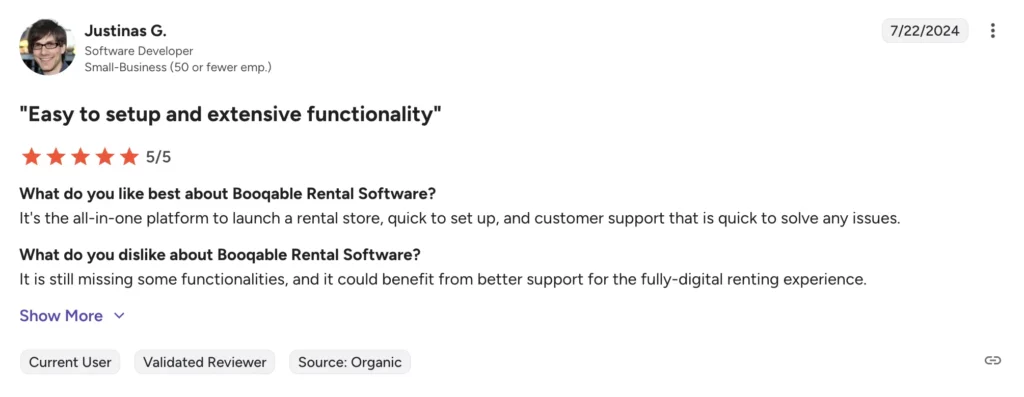
- Quick to implement and easy for teams to adopt
Limitations
- Basic reporting capabilities often deemed insufficient by larger equipment rentals needing deep insights
- Clunky mobile application and view compared to its desktop version
Ideal use case
Booqable is a strong fit if you’re running a small to mid-sized medical equipment rental business and want to:
- Enable online bookings and reduce manual order handling
- Improve booking accuracy with real-time availability
- Standardize customer-facing workflows (quotes, contracts, payments)
- Digitize operations quickly without heavy setup
Booqable review
Source: G2
Pricing
- Starter ($29/month): Designed for small teams, this plan includes core features like order and inventory management, quotes, contracts, invoices, and real-time availability tracking.
- Grow ($69/month): Builds on the Starter plan with added capabilities like website booking integration, user permissions, additional team members, and more advanced reporting.
- Scale ($149/month): Includes all Grow features plus multi-location support, API access, activity logs, and higher user limits, suited for larger, more complex operations.
Quick snapshot
| Category | Details |
| Best For | Small teams |
| Deployment | Cloud |
| Pricing Model | Tiered |
| Key Strength | Online booking |
| Limitation | Limited reporting depth |
5. Brightree
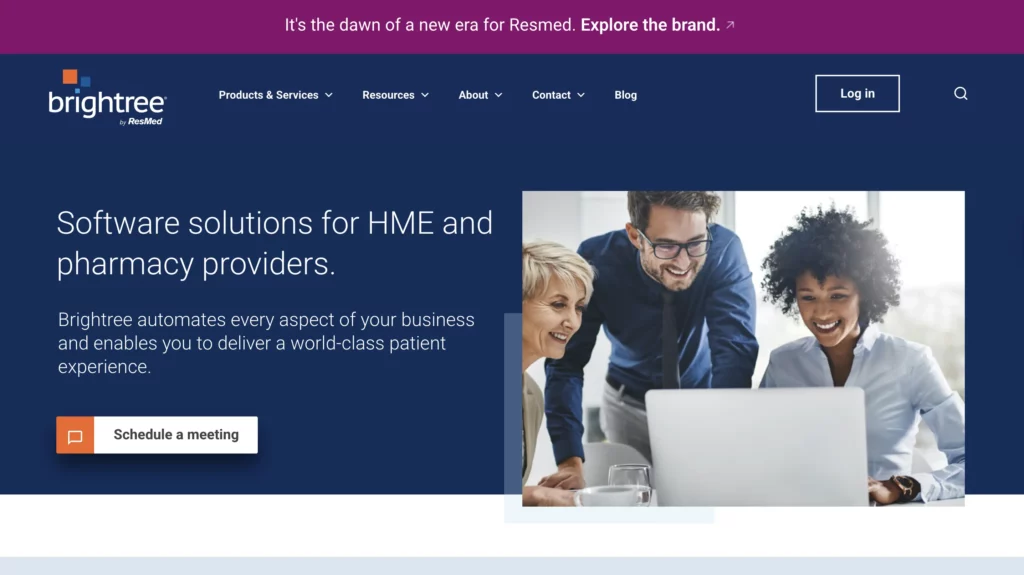
Brightree is a cloud-based business management platform purpose-built for home medical equipment (HME) and durable medical equipment (DME) providers.
Unlike general rental tools, it’s designed around healthcare-specific workflows, especially billing, compliance, and patient management, making it highly relevant for medical equipment rental companies operating in regulated environments.
If your operations are closely tied to insurance reimbursements, patient documentation, and regulatory compliance, Brightree positions itself as more than a rental tool; it’s a system for managing the full healthcare delivery and revenue cycle.
Key features
- Workflow automation: End-to-end workflow automation from referral intake to billing and collections
- Billing & RCM: DME billing and revenue cycle management to streamline claims, reduce denials, and accelerate reimbursements
- Inventory tracking: Inventory and equipment tracking to manage medical assets and ensure availability
- Compliance management: Compliance and documentation management aligned with healthcare regulations and audit requirements
- Patient management: Track patient intake, communication, and records
- Delivery management: Mobile delivery and logistics tools with real-time visibility into deliveries and route coordination
- System integrations: Interoperability and integrations with referral sources, payers, and healthcare systems
- Reporting: Analytics and reporting for operational performance and financial insights
Strengths
- Built specifically for HME/DME providers, not adapted from generic rental software
- Strong billing and reimbursement capabilities, which are critical in healthcare environments
- Deep compliance support, including documentation tracking and audit readiness
- Connects clinical, operational, and financial workflows in one system
Limitations
- Less focused on traditional rental workflows like dynamic pricing, bundling, or flexible reservations
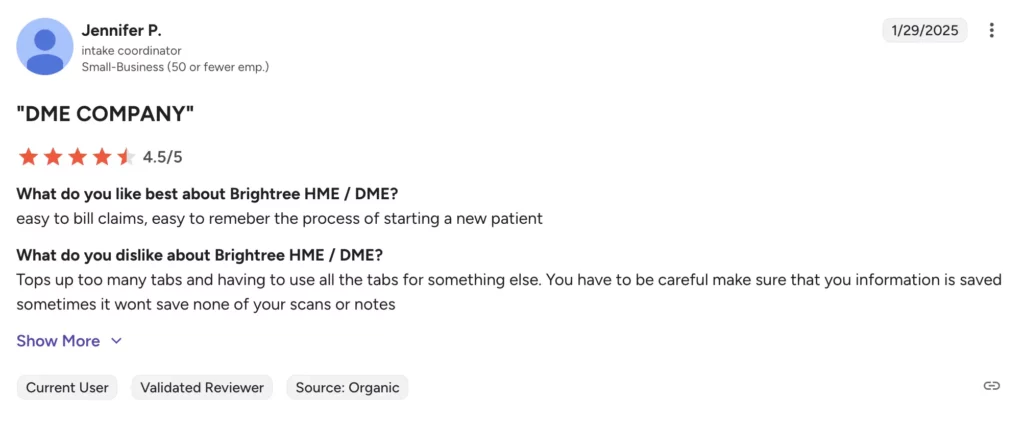
- Can be complex to implement and manage, especially for smaller teams
- Best suited for U.S.-based healthcare models due to heavy alignment with insurance and Medicare processes
Ideal use case
Brightree is a strong fit if you’re operating a medical equipment rental business within a healthcare delivery model and need to:
- Manage insurance billing, claims, and reimbursements
- Maintain strict compliance with healthcare regulations
- Track patient-related documentation alongside equipment usage
- Integrate operations with referral networks and healthcare systems
Brightree review
Source: G2
Pricing
- Custom pricing (quote-based): Brightree does not publish fixed pricing tiers. Costs are tailored based on your organization’s size, workflows, and modules required (e.g., billing, inventory, delivery, and patient management).
Quick snapshot
| Category | Details |
| Best For | Healthcare-driven operations |
| Deployment | Cloud |
| Pricing Model | Custom |
| Key Strength | Billing + compliance |
| Limitation | Less rental-focused |
6. Bonafide by WellSky
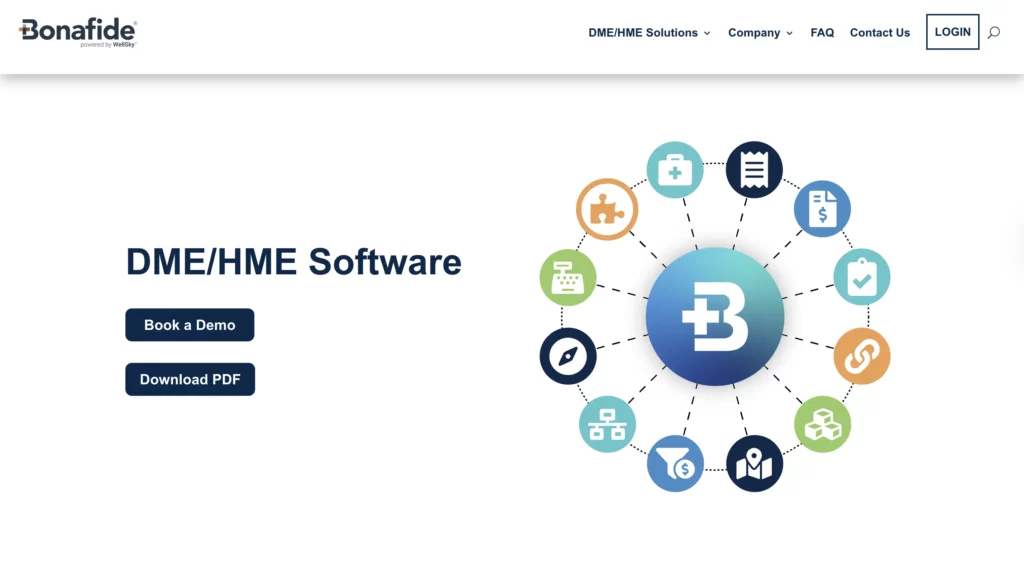
Bonafide by WellSky is an enterprise-grade ERP platform purpose-built for DME and HME providers, designed to manage the full spectrum of healthcare equipment operations, from patient intake to billing and delivery.
Unlike traditional medical equipment rental systems, it focuses heavily on revenue cycle management, compliance, and healthcare-specific workflows, making it well-suited for organizations operating within payer-driven environments.
If you’re a general manager and your medical equipment rental business is closely tied to insurance reimbursements, documentation accuracy, and operational efficiency at scale, Bonafide functions as a centralized system for both clinical and financial workflows.
Key features
- Patient intake: For eligibility verification with guided workflows and real-time payer authorizations
- Billing management: Billing and accounts receivable management with claim validation, denial tracking, and automated payment posting
- Revenue cycle management (RCM): To track claims, improve collections, and optimize reimbursement performance
- Documentation management: With centralized storage, OCR support, and compliance tracking
- Inventory & supply chain management: With demand planning, purchase orders, and asset traceability
- Order-to-cash workflows: For connecting orders, delivery, billing, and payments in a single process
- Delivery coordination: Mobile delivery and logistics tools for coordinating field operations and equipment distribution
- Partner portals: Facility and hospice portals enabling partners to place and manage orders directly
- Reporting & operational dashboards: for tracking KPIs, claims performance, and business health
- Integrations: Third-party integrations with clearinghouses, payers, and external systems
Strengths
- Built specifically for DME/HME workflows, not adapted from generic rental software
- Strong billing and revenue cycle capabilities, critical for reimbursement-driven operations
- Deep integration between orders, inventory, delivery, and financial workflows
- Enables high levels of process control and compliance tracking across the organization
Limitations
- Less focused on flexible rental workflows like dynamic reservations or bundling
- Can be complex to implement and manage, especially without dedicated operational resources
- Best aligned with U.S. healthcare reimbursement models, limiting applicability in other regions
Ideal use case
Bonafide is a strong fit if you’re running an enterprise and compliance-heavy medical equipment rental business and need to:
- Manage billing, claims, and reimbursement processes at scale
- Maintain strict documentation and audit readiness
- Coordinate patient-related workflows alongside equipment delivery
- Integrate financial, operational, and clinical processes into a single system
Pricing
- Custom pricing (quote-based): Bonafide does not publicly list specific pricing as it is a tailored enterprise resource planning (ERP) solution for DME/HME providers. It is typically quote-based, customized to the organization’s size and needs.
Quick snapshot
| Category | Details |
| Best For | Compliance-heavy enterprises |
| Deployment | Cloud |
| Pricing Model | Custom ERP |
| Key Strength | Revenue cycle control |
| Limitation | Complex implementation |
7. NikoHealth
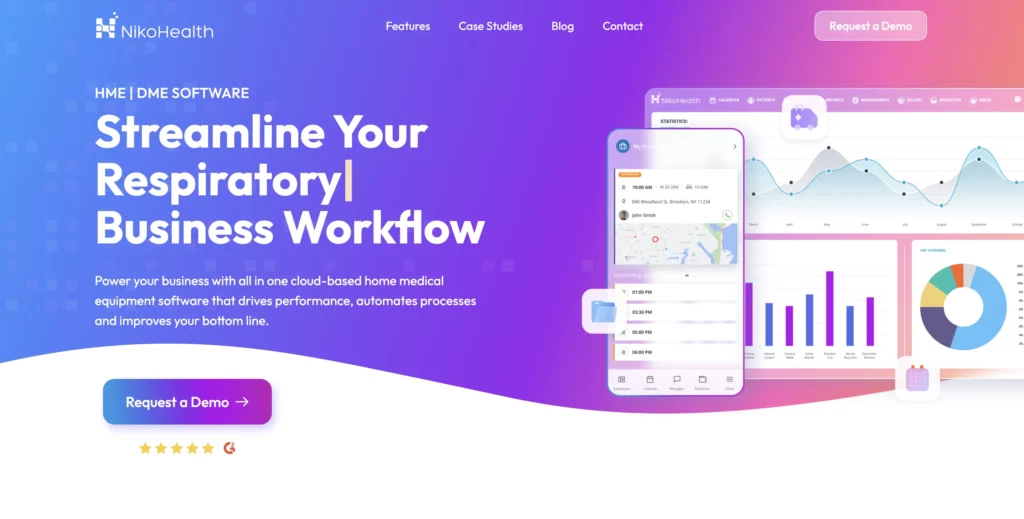
NikoHealth is a modern, cloud-based platform built specifically for HME and DME providers, designed to connect operational workflows with billing, delivery, and patient management in a single system.
It focuses heavily on automation, real-time visibility, and reducing manual handoffs across teams, making it particularly effective for organizations looking to modernize and scale their operations.
For medical equipment rental companies, NikoHealth stands out when your priority is improving order flow efficiency, accelerating cash cycles, and eliminating process gaps between teams.
Key features
- Billing automation: End-to-end billing and claims management with automated invoicing, remittance posting, and denial tracking
- Order management: With real-time status visibility across billing, operations, and delivery teams
- Patient EMR: Integrated patient EMR connecting intake, documentation, and billing workflows without re-entry
- Inventory tracking: Inventory and asset tracking with live visibility across locations and field teams
- Delivery management: With mobile capabilities, including real-time tracking and e-signature capture
- Resupply automation: Automated resupply workflows to generate recurring orders and reduce missed revenue opportunities
- Document management: With centralized, searchable records tied to orders and patient data
- Scheduling & coordination tools: For deliveries, follow-ups, and resource allocation
- Analytics & reporting: For operational performance and revenue insights
- Integrations: API integrations and ecosystem connectivity to streamline data flow across systems
Strengths
- Strong focus on automation across the entire workflow, reducing manual effort and delays
- Connects billing, delivery, and operations into a single system of record
- Real-time visibility eliminates the need for cross-team follow-ups or status checks
- Modern, intuitive interface that reduces onboarding time for new staff
Limitations
- Primarily optimized for U.S. DME/HME workflows, especially payer-driven models
- May require process alignment to fully leverage automation capabilities
- Less focused on traditional rental features like flexible pricing models or bundling
Ideal use case
NikoHealth is a strong fit if you’re running a growth-focused medical equipment rental business and need to:
- Improve coordination between billing, operations, and delivery teams
- Reduce claim errors and accelerate reimbursement cycles
- Automate recurring orders and resupply workflows
- Gain real-time visibility into order status and operational performance
NikoHealth review
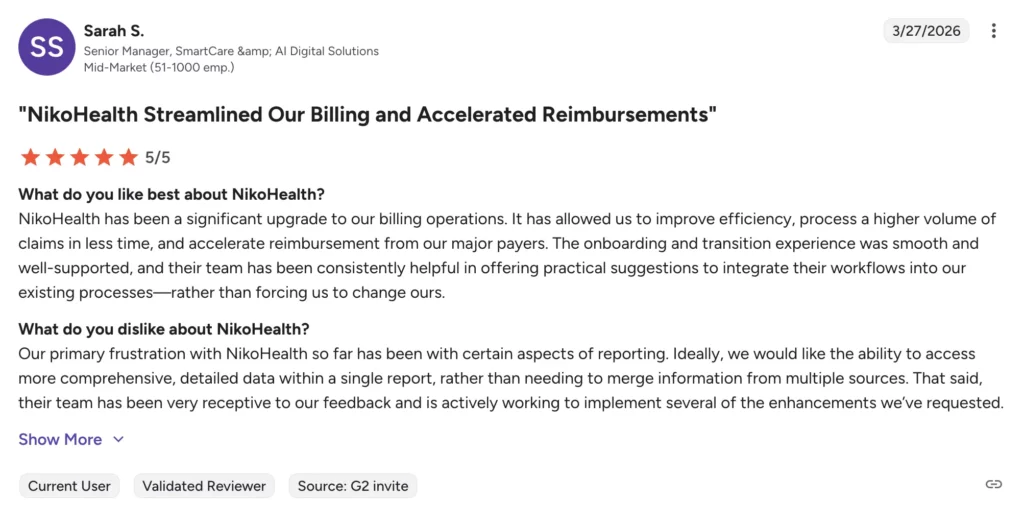
Source: G2
Pricing
- Quote-based pricing: Interested users must request a demo or proposal directly from NikoHealth.
Quick snapshot
| Category | Details |
| Best For | Growth-focused operations |
| Deployment | Cloud |
| Pricing Model | Custom |
| Key Strength | Automation |
| Limitation | US-centric workflows |
Comparison Table: A Brief Overview of 7 Medical Equipment Rental Software
| Software | Best For | Rental Management | Maintenance Tracking | Compliance & Billing | Multi-Location Support | Ease of Use |
| 1. EZRentOut | Mid-sized to enterprise-level operations | ✔️ End-to-end lifecycle | ✔️ Preventive + history | ⚠️ Configurable compliance | ✔️ Supported | ⭐⭐⭐⭐☆ Easy |
| 2. Point of Rental | Large, multi-branch operations | ✔️ Advanced workflows | ✔️ Service + inspections | ⚠️ Not healthcare-specific | ✔️ Strong | ⭐⭐⭐☆☆ Moderate |
| 3. RentalMan (Wynne) | Enterprise-scale operations | ✔️ ERP-level control | ✔️ Scheduled maintenance | ⚠️ Requires setup | ✔️ Strong | ⭐⭐☆☆☆ Complex |
| 4. Booqable | Small, fast-growing teams | ✔️ Booking-focused | ⚠️ Basic (downtime only) | ❌ Limited | ⚠️ Limited | ⭐⭐⭐⭐⭐ Very easy |
| 5. Brightree | Healthcare billing-heavy operations | ⚠️ Limited rental focus | ✔️ Asset tracking | ✔️ Strong (RCM + compliance) | ✔️ Supported | ⭐⭐⭐☆☆ Moderate |
| 6. Bonafide | Enterprise, compliance-driven | ⚠️ Limited rental focus | ✔️ Supply + tracking | ✔️ Strong (RCM + audits) | ✔️ Strong | ⭐⭐☆☆☆ Complex |
| 7. NikoHealth | Growth-focused, automated operations | ⚠️ Workflow-driven | ✔️ Asset visibility | ✔️ Strong (billing + EMR) | ✔️ Supported | ⭐⭐⭐⭐☆ Modern |
Conclusion
Choosing the right software isn’t about finding the most feature-rich platform. It all boils down to finding the one that fits how your operation actually runs.
Whether you’re focused on scaling medical equipment rental volumes, tightening compliance, improving billing accuracy, or coordinating deliveries across locations, the right system should remove friction, not add to it.
What becomes clear across these tools is that there’s no one-size-fits-all solution. Some platforms are built for operational control and rental workflows, while others are designed around healthcare billing and compliance.
Your decision ultimately comes down to where your biggest bottlenecks lie today, and what you need to standardize as you grow.
As your operation evolves, the expectation shifts from simply managing medical equipment to running a reliable, accountable, and data-driven system. That’s where investing in the right medical equipment rental software for general managers makes the difference, giving you the visibility and control needed to scale without losing oversight.