
Picture walking into a warehouse and knowing exactly where an item is located. Sounds simple and futuristic, right? This convenience is possible through RFID technology. Businesses using RFID tags can scan, track and monitor items from a distance– saving time and effort. Primarily RFID tags are used to collect mass information in a short span of time, making them a popular choice for large businesses.
In enterprise environments, this capability enables real-time visibility across large, distributed asset networks, reducing operational blind spots and improving decision-making.
To delve deeper into how RFID tags can be used, this blog will cover the basics of RFID tags, examples, use cases, and implementation.
For enterprise asset operations, understanding RFID is key to building scalable, automated tracking systems that integrate with broader operational workflows.
What is an RFID tag
An RFID (Radio Frequency Identification), also known as an RFID chip, is a tracking technology that identifies objects using intelligent barcodes. It consists of a microchip and an antenna and transmits the data to an RFID reader using radio waves.
At enterprise scale, RFID tags serve as a foundational layer for automating asset tracking and minimizing reliance on manual processes.
Some of the common uses of RFID tags include inventory tracking and heavy machinery management. These tags can easily store a wide range of data, making them a popular choice among high-level organizations. Moreover, RFID tags consist of cryptographic security features that require a high level of verification and authentication, making them a secure tracking option for businesses.
This makes RFID particularly valuable for enterprise organizations that require secure, compliant, and high-integrity asset tracking systems.
Common types of RFID and their use cases
There are quite a few different types of RFID tags designed for unique purposes. In enterprise environments, selecting the right RFID type is critical to aligning tracking capabilities with asset value, operational complexity, and environmental conditions.
Let’s look at a brief description of each tag and its use case:
1. Active RFID tags
When a company needs to track real-time locations of various items, they use active RFID tags. These are typically larger than passive RFID tags and can’t easily be torn off. Companies need to train their employees to use complex software programs associated with them.
These are especially suited for enterprise use cases involving high-value assets, large facilities, or real-time operational monitoring.
There are two main types of active RFID tags:
- Beacons send out information every few seconds and can be detected hundreds of feet away. Their battery runs out faster since they are transmitting data so regularly. They are preferred to track high-value goods.
- Transponders need a reader to transmit data. A reader initially signals the transponder when they are in close proximity to one another, and the transponder responds by pinging back the necessary data. These are commonly used in vehicle tracking and toll collection.
2. Passive RFID tags
As compared to active RFID tags, these are less expensive and commonly used by companies for inventory management in retail. They are smaller in size and a preferred choice for small-scale items.
Enterprise teams often deploy passive RFID at scale for high-volume asset tracking where cost-efficiency is a priority.
There are two types of passive RFID tags:
- Inlays are thin and easy to stick on different materials.
- Hard tags are made out of more durable materials like plastic or metal.
One of the downsides of passive RFID tags is that they don’t have a power source of their own and draw power from the RFID reader before data is transmitted.
3. Semi-passive RFID tags
Also known as battery-assisted RFID tags, semi-passive RFID tags contain a battery, but they do not transmit a signal like active RFID tags. To enable full reflection of the reader’s signal, the tag is only powered by the battery when a signal is received. A good example of semi-passive RFID tags is cold chain monitoring.
These are commonly used in enterprise scenarios requiring environmental monitoring, such as cold chain logistics or sensitive equipment tracking.
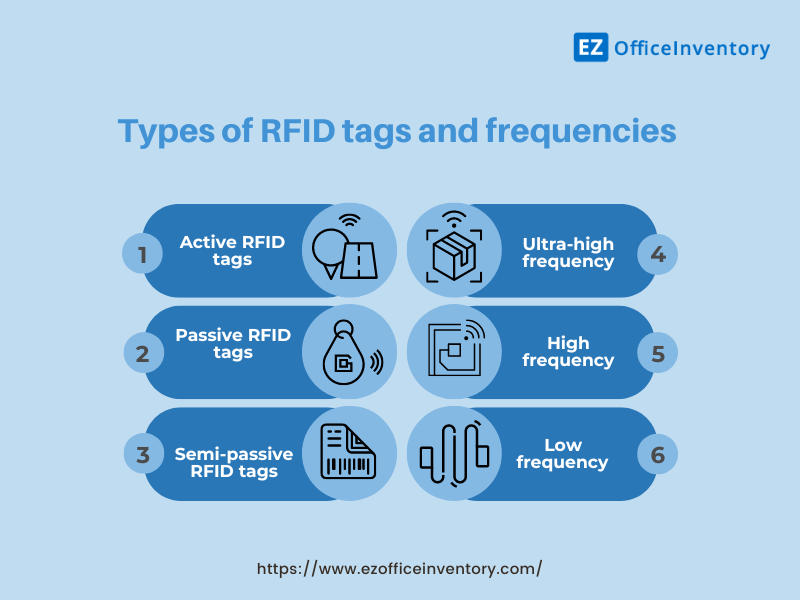
4. Ultra-high frequency (UHF)
These are most commonly considered as the supply chain frequency because of lower prices while still providing a good range, 300 MHz to 3 GHz, for item-level tracking and retail inventory control.
UHF RFID is widely adopted in enterprise supply chains due to its ability to support bulk scanning and high-throughput operations.
Retailers mandate that their suppliers provide the UHF RFID tags for every product and pallet. It reduces the need for manual inventory, as hundreds of tags can be read at once.
5. High frequency (HF)
High-frequency RFID is most commonly used for ticketing, payments, and data transfer applications. The frequencies vary from 3 to 30 MHz, which is why these tags have a longer read range and higher memory capability. They are also used in tracking bracelets for theme parks.
In enterprise contexts, HF RFID supports secure transactions and identity-based tracking across systems.
6. Low frequency (LF)
As the name suggests, RFID tags with a lower frequency, 30 KHz to 300 KHz, have slower read rates and shorter read ranges. Liquids and metals interfere with them due to the lack of longer wavelengths. LF RFID tags are commonly used in applications where an RFID label is affixed, such as on automobiles. They are also typically used for RFID access control systems.
LF RFID is often used in enterprise environments where proximity-based authentication and controlled access are required.
RFID applications for your business
There are countless areas where RFID is useful. Applications can range from general operations like supply chain management and inventory tracking to more specialized ones based on the business sector.
For enterprise organizations, RFID applications extend beyond basic tracking to enable end-to-end operational visibility and automation.
RFID tags can be used across industries to track items, control access, and manage warehouses. Here is a list of popular ways businesses can use RFID tags:
1. Inventory management
RFID tags are widely used for inventory management, offering real-time tracking of stock levels. It can be easily used from a distance to manage larger inventories conveniently. With its help, businesses can avoid stock shortages and streamline their warehouse operations, saving time and improving efficiency.
In enterprise environments, this enables real-time inventory accuracy across multiple warehouses and reduces stock discrepancies at scale.
2. Asset tracking
Tracking and monitoring fixed assets such as machinery, vehicles, or equipment is easier with RFID tags. These can be attached to assets to automate location tracking. You can manage maintenance schedules, usage, and reduce the chances of theft or inventory loss.
This is critical for enterprise asset lifecycle management, where visibility into usage, location, and maintenance directly impacts ROI and uptime.
3. Access control
Businesses looking to manage employee access can also use RFID tags to enhance security. For instance, embedding RFID chips in ID badges can help control access to restricted areas in the company. RFID tags in ID cards automatically identify and authenticate the employees, ensuring only authorized personnel have access.
Enterprise organizations rely on such systems to enforce security policies and ensure compliance across facilities.
4. Healthcare counterfeit protection
In the healthcare industry, RFID tags are commonly used to track counterfeit medications. Pharmaceutical products are tagged so that suppliers track medication to eliminate the risk of counterfeit drugs in the supply chain. Plus, RFID tags also help hospitals track and manage inventory to ensure the timely availability of important supplies.
This highlights RFID’s role in enterprise-grade compliance and risk mitigation in highly regulated industries.
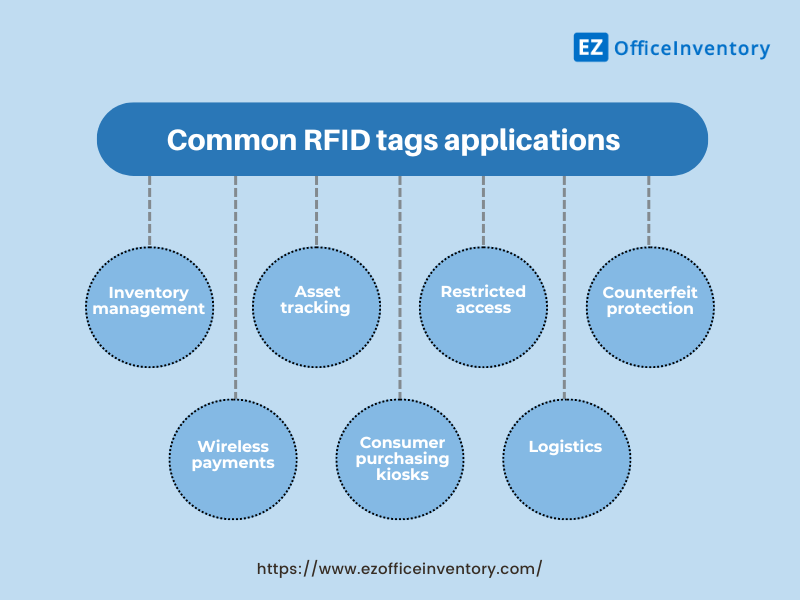
5. Electronic Wireless payments
Contactless payments are widely popular because of their speed and convenience. RFID technology forms the key component of wireless payments, such as credit cards, enabling consumers to make secure transactions without needing to swipe their cards.
At enterprise scale, RFID enables secure, high-volume transaction processing with minimal friction.
6. Consumer purchasing kiosks
Self-service kiosks powered by RFID technology allow consumers to place goods on a counter and automatically generate the total bill. This not only improves the shopping experience but also speeds up the checkout process, minimizing the need for any assistance.
These systems are often deployed in enterprise retail environments to streamline operations and reduce dependency on manual staff intervention.
7. Logistics
The RFID system is used in the supply chain to automate processes. This ultimately leads to a decrease in manual errors and an increase in efficiency and quality.
For enterprise supply chains, this level of automation is essential to maintain efficiency, accuracy, and traceability across global operations.
Can you picture the consequences if large food corporations were unable to instantly and continuously manage the inventory they carry? When you shop at the supermarket, you are not aware of how much the product has traveled, but thanks to RFID technology, there is a trace of its movements.
By labeling products and pallets, you can quickly ascertain what products you have, how many of them you have, and how much room they take up in your back store or warehouse as they are brought in.
How to use RFID technology
In order to derive maximum benefits from RFID, it is important to implement it in the right manner. For enterprise implementations, this process must align with broader IT architecture, data governance, and operational workflows.
There are 3 main stages that can help you to plan, use, and analyze RFID for your business:
Planning
In this planning phase, you can identify the use case, select a suitable RFID type, and decide on positioning. Enterprise teams must evaluate scalability, integration requirements, and cross-functional dependencies during this stage.
Identifying the need: Shortlist where RFID will be used. There can be various contenders, such as asset management, inventory tracking, or access control.
RFID selection: Pick a suitable RFID tag for the task you have shortlisted. In case you want to manage assets, then a durable RFID tag will be an appropriate choice.
Decide reader positions: An important step in setting up RFID is to locate the readers at an optimal position. For inventory tracking, RFID readers can be placed at the entrance and exit of the warehouse.
Integrate with a software: RFID is a tagging mechanism that needs to be integrated with software to convey all stored data. This can be done by integrating the RFID technology with a relevant software, such as an asset tracking system or ERP.
Tagging
While tagging items, ensure that tags are placed in such a way that they won’t be damaged or destroyed by external conditions. Next, scan the unique identifiers into the software you will be using. This way, all your tagged items will be accounted for in the system.
Standardized tagging practices are essential in enterprise environments to ensure consistency across large asset bases.
Using RFID
RFID tags can be used in three main ways. The first one is automatic reading, and it scans items as they pass through the zone. Second is manual reading, which requires the items to be in close vicinity of the reader. The third option is to set up a read distance according to the tag type. Items within the reading range will be identified by the RFID scanner.
Enterprise operations often combine these methods to balance automation, accuracy, and operational control.
Benefits of using RFID tags
RFID technologies and systems offer benefits for all businesses, helping them to:
1. Increased efficiency
The RFID technology helps businesses to stay productive and efficient, reducing manual labor. Mass inventory and assets can be easily scanned and updated in the system without much physical effort. For enterprise teams, this translates into reduced operational overhead and faster processing across large asset volumes.
2. Improved customer experience
Customers can receive accurate information about product availability and estimated delivery times using RFID tags. In addition, customers do not need to spend time in long queues behind the counter, especially at the time of sales, leading to a better experience. Positive customer experience shapes the revenue of businesses that rely heavily on sales. Enterprise organizations benefit from improved service delivery and customer satisfaction driven by accurate, real-time data.
3. Better security
Security is crucial for businesses, especially when they invest in a new technology. RFID tags enhance the security protocol by tracking valuable assets and preventing theft. The access control system also enables companies to give restricted access to sensitive information and areas for user-authenticated control. In enterprise environments, enhanced security controls are essential for protecting high-value assets and sensitive operations.
4. Real-time tracking
The majority of businesses find it challenging to track inventory and risk losing critical items due to a lack of management. RFID tags enable real-time tracking of assets, allowing you to monitor exact movements. Enterprise teams rely on real-time tracking to maintain visibility across distributed operations and minimize asset loss.
5. Durability and automation
RFID applications can automatically track the movement of items and submit data to the financial management system, or ERP. As a result, they can replace obsolete spreadsheets and eliminate manual form-filling. Using stationary readers at strategic locations saves time and eliminates the need for manual intervention on a production line, for instance. This level of automation is critical for enterprise-scale operations where manual processes are not sustainable.
Manage your inventory better using RFID tags
RFID technology is a powerful tool for supply chain management, manufacturing, and the retail industry. The technology may be complex in comparison to barcodes or QR codes, but the advantages are worth it. RFID tags allow organizations to track asset locations at all times, thereby improving visibility with real-time data. They also enable you to drastically speed up equipment processing with the ability of an RFID system for mass data collection.
For enterprise asset operations, RFID acts as a key enabler of automation, real-time visibility, and scalable asset tracking across complex environments.
Using RFID asset tracking software enables you to track, maintain, and report the necessary details whenever you need, anytime, anywhere.
When integrated with enterprise asset management systems, RFID data becomes a critical input for analytics, compliance reporting, and operational optimization.