
Key Takeaways:
- OEM data directly influences equipment reliability, warranty decisions, repair costs, maintenance planning, and lifecycle management.
- Enterprises should link OEM equipment, parts, manuals, warranties, and service information directly to asset records instead of storing them separately.
- OEM maintenance recommendations should become asset-linked schedules and work orders that account for actual operating conditions, such as harsh environments and heavy use.
- OEM parts are not automatically the best choice; enterprises should weigh compatibility, warranty, safety, availability, cost, and asset criticality when selecting replacements.
- Centralizing OEM details such as model numbers, warranties, approved parts, service intervals, manuals, and repair history improves consistency across maintenance and lifecycle decisions.
- Disconnected OEM data can create inconsistent maintenance, repair, and lifecycle decisions across teams and sites.
- EAM software can operationalize OEM information by connecting manufacturer data with asset records, maintenance workflows, repair history, warranties, and lifecycle management.
OEMs, or Original Equipment Manufacturers, make equipment, parts, or components used in another company’s final product or operation. For asset-heavy enterprises, OEMs matter because manufacturer details influence maintenance schedules, warranty coverage, approved parts, repair decisions, asset reliability, and lifecycle planning.
A maintenance manager gets an early-morning call.
A critical asset is down, the replacement part may not align with OEM guidance, and no one is sure whether the repair affects warranty coverage.
Approved parts information is hard to find, and the service history is incomplete.
That is why enterprise teams need reliable OEM information. They are not just looking for a definition. They need to understand how OEM data affects real decisions: which parts to buy, which maintenance instructions to follow, which warranties still apply, and how to keep critical equipment available.
Asset-heavy organizations manage thousands of assets across warehouses, facilities, job sites, fleets, labs, plants, offices, and field teams. When technicians cannot access complete OEM context during daily work, maintenance decisions become inconsistent across teams and locations.
A strong enterprise asset management system links OEM data to each asset record, making manufacturer guidance part of daily workflows.
What does OEM mean in asset management?
In asset management, OEM usually refers to the original manufacturer of the equipment an organization owns and operates. In some supply chains, OEM can also refer to a company that manufactures components or parts used in another company’s product or system.
This article focuses primarily on OEMs as the original manufacturers of equipment managed by asset-heavy enterprises. For example, the company that manufactures a generator, medical device, fleet vehicle, or industrial machine may be the OEM for that asset.
In maintenance and repair contexts, a genuine OEM part is supplied under the original equipment manufacturer’s brand and part number. The OEM may manufacture the part itself or contract a supplier to produce it on its behalf.
Teams often choose genuine OEM parts when compatibility, reliability, warranty requirements, or asset criticality make the manufacturer’s specified part essential.
For example, a facilities team managing HVAC systems across multiple office buildings may rely on OEM guidance to determine filter replacements, inspection intervals, approved components, and warranty conditions. If a technician installs an unapproved replacement part, the organization may face compatibility issues or a warranty claim may be affected, depending on the warranty terms and whether the part contributed to the failure or damage.
The meaning of OEM can vary across industries such as automotive, IT, facilities, manufacturing, electronics, and industrial operations. For example, a construction company may operate generators from one OEM, lifts from another, and HVAC systems from a third, each with its own manuals, maintenance schedules, warranty terms, and approved replacement parts.
Why do OEMs matter to asset-heavy enterprises?
OEMs matter to asset-heavy enterprises because their specifications, manuals, approved parts, warranties, and service recommendations directly affect asset reliability, downtime, repair costs, compliance, and lifecycle planning.
For asset-heavy enterprises, OEM data is not just reference information. It shapes how equipment is operated, maintained, repaired, and eventually replaced.
Enterprise asset management involves managing physical assets throughout the full lifecycle, from planning and procurement through maintenance, compliance, risk management, and disposal.
OEMs influence three major operational outcomes:
1. Reliability
OEM recommendations help teams understand how equipment should be inspected, serviced, calibrated, and operated. Following OEM guidance helps reduce unexpected failures, improve uptime, and keep assets performing consistently across locations and teams.
2. Warranty control
Using a replacement part that doesn’t meet warranty requirements, or failing to follow required maintenance terms, may affect a warranty claim. OEM documentation helps teams verify applicable requirements before approving repairs or replacements.
3. Lifecycle decisions
OEM data helps organizations decide when to repair, replace, reallocate, or retire equipment. Maintenance history, approved parts, expected lifespan, and service recommendations all support better long-term asset planning.
For example, a facilities team managing HVAC systems across 30 buildings needs the OEM model, serial number, warranty terms, filter type, inspection interval, and service history for each unit. Without that information, maintenance becomes inconsistent, replacement planning becomes reactive, and downtime becomes more likely.
What is the difference between OEM equipment, OEM parts, and OEM data?
Many enterprises track the equipment itself but fail to track the OEM context around it. That gap creates problems during maintenance, repairs, audits, warranty claims, and lifecycle planning.
| Term | What it means | Why it matters in EAM |
| OEM equipment | Equipment produced and sold under the original manufacturer’s brand | Helps teams identify the manufacturer, model, warranty, and lifecycle requirements |
| Genuine OEM parts | Parts supplied under the original manufacturer’s brand and part number | Helps teams maintain specified compatibility and document parts used in repairs |
| OEM-approved third-party parts | Parts made by an independent supplier that meet or are approved to the OEM’s specifications | Gives teams a distinct category for approved alternatives to genuine OEM parts |
| OEM data | Manuals, specifications, serial numbers, service intervals, warranty details, and approved parts information | Helps teams standardize maintenance, repairs, and lifecycle decisions |
How should teams track OEM data for assets with multiple components?
Not every asset has a single OEM. Complex equipment such as generators, vehicles, pumps, and production machinery can contain components from several manufacturers. Use parent-child asset or component records to preserve those relationships.
The parent asset record can hold the OEM information for the complete equipment, including its manufacturer, model, serial number, and warranty details. Installed components can have their own manufacturer, model, serial number, warranty, parts, and service information. This lets teams trace component-level maintenance and replacement history while keeping each component connected to the larger asset.
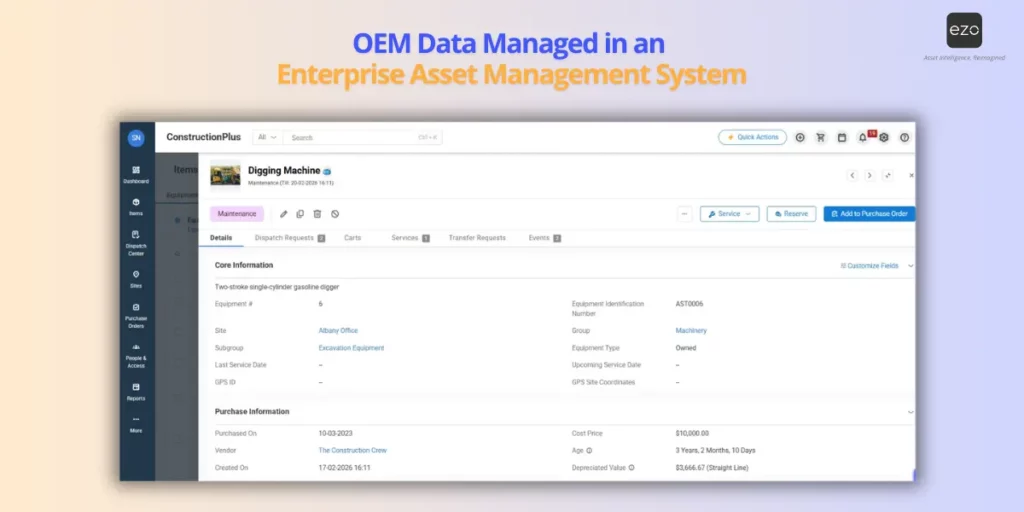
In enterprise asset management, OEM information should be connected to the asset or component it applies to. OEM data should be attached directly to the asset register so teams can quickly access manuals, warranties, service intervals, and approved parts during daily operations.
OEM parts should also be linked to maintenance and repair history. This helps teams understand which components were installed, how assets have been serviced over time, and whether repairs align with warranty requirements. OEM manuals and service schedules should also guide preventive maintenance workflows instead of remaining buried in PDFs or binders.
For example, if a technician replaces a failed component but does not record whether the replacement was OEM or aftermarket, the organization may lose visibility into whether future failures are tied to part quality, installation practices, asset age, or operating conditions.
How do OEMs, suppliers, and service providers differ?
OEMs, suppliers, and authorized service providers can all appear in an asset’s records, but they play different roles. The same company can sometimes serve more than one role.
| Party | Typical role | Information relevant to asset management |
| OEM | Original manufacturer of the equipment or component | Model and specifications, manuals, warranty terms, service intervals, approved parts, and end-of-life guidance |
| Supplier or vendor | Company that sells or supplies the equipment, parts, or related goods | Purchase details, pricing, invoices, delivery information, and commercial terms |
| Authorized service provider | OEM-authorized or otherwise qualified company that services the equipment | Service dates, work performed, parts installed, inspection results, and repair documentation |
Why it matters: Keeping these relationships distinct helps teams know whether to contact the manufacturer for technical or warranty requirements, the supplier for purchasing matters, or the service provider for repair history and service records.
How do OEMs affect maintenance planning?
OEMs affect maintenance planning by defining recommended service intervals, inspection tasks, approved parts, operating conditions, and safety requirements for equipment.
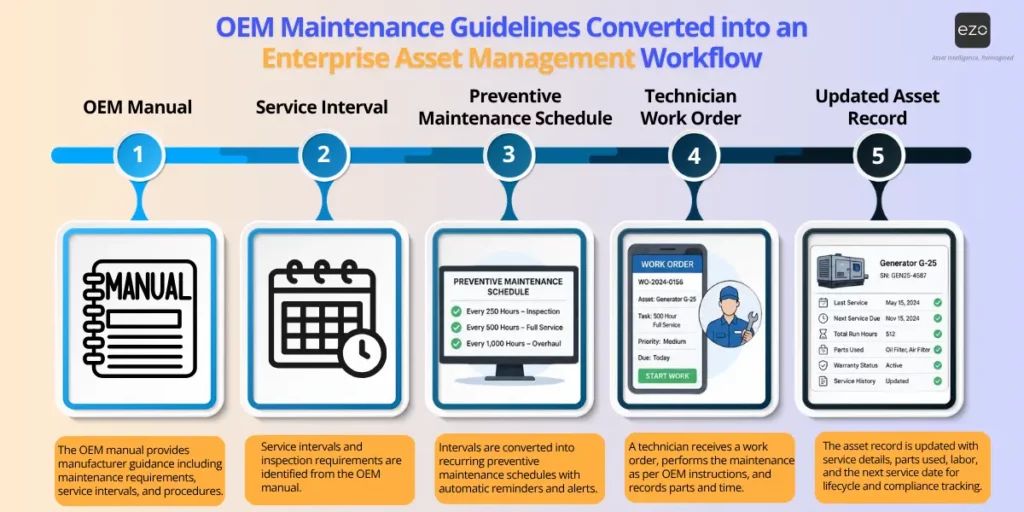
Manufacturer manuals often include detailed inspection and maintenance guidance that helps teams understand how assets should be serviced throughout their lifecycle. OEM recommendations may follow time-based, usage-based, or condition-based maintenance models depending on the type of equipment and operating environment.
Maintenance teams should translate OEM guidance into recurring schedules tied directly to asset records, work orders, and maintenance history. Maintenance teams should translate OEM guidance into recurring schedules that are directly tied to asset records, work orders, and maintenance history.
Maintenance planning should also reflect real operating conditions, not just generic service intervals. Equipment used in harsh environments, high temperatures, or heavy-duty operations may require more frequent servicing than standard OEM recommendations.
Strong maintenance schedules coordinate time-based, usage-based, and condition-based activities to help prevent failures and sustain operational performance across the organization.
For example, a generator OEM may recommend inspection after every 250 hours of operation and full servicing after every 500 hours. Instead of leaving that guidance inside a manual, enterprise teams should convert it into automated maintenance schedules connected to the generator’s usage history, work orders, and service records.
What is OEM vs aftermarket, and why does the decision matter?
Genuine OEM parts carry the original manufacturer’s brand and part number. Aftermarket parts are made by third-party manufacturers, but aftermarket doesn’t necessarily mean unapproved: some third-party parts may be OEM-approved or manufactured to OEM specifications, while others aren’t. Quality, compatibility, certification, and warranty implications can therefore vary by supplier and part.
The decision matters because it can affect compatibility, cost, warranty coverage, downtime risk, and long-term asset reliability.
| Factor | Genuine OEM parts | Third-party parts |
| Source | Supplied under the original manufacturer’s brand and part number | Supplied by an independent manufacturer |
| Compatibility | Specified for the original equipment | Depends on the supplier, specification, and application |
| Cost | Often higher | Often lower |
| Warranty alignment | May align directly with OEM requirements | Check warranty terms and whether the part or resulting damage is excluded |
| Availability | May depend on OEM supply chain | May provide additional sourcing options |
| Risk | Generally lower uncertainty around specified fit | Quality and fit can vary by supplier |
| Best fit | Critical, warranty-covered, regulated, or high-risk assets | Situations where cost, availability, or an approved alternative matters |
For example, if a hospital replaces a component in a diagnostic machine, it may choose an OEM part because compatibility, safety, and warranty coverage are critical. But if a warehouse needs replacement wheels for non-critical carts, an aftermarket part may be acceptable because the risk is lower and the cost savings matter.
For enterprise teams, the decision is rarely just about price. Teams may prefer genuine OEM parts when reliability, warranty requirements, regulatory needs, or operational continuity are critical. Third-party parts, including OEM-approved alternatives, may offer cost or availability advantages depending on the asset and applicable requirements.
In enterprise asset management, the key is not to always choose OEM or always choose aftermarket. The key is to record which part was used, whether it was genuine OEM or third-party, why it was selected, and how it affected asset performance and maintenance outcomes over time.
What OEM information should enterprises track in an asset management system?
Enterprises should track OEM information that helps teams maintain, repair, verify, and replace assets consistently throughout their lifecycle.
| Category | OEM information to track |
| Identity | OEM name, manufacturer model, serial number |
| Warranty | Warranty start and end dates, warranty terms |
| Maintenance and service | OEM manuals, maintenance intervals, safety instructions, service bulletins, inspection requirements, repair history, end-of-life or replacement guidance |
| Parts | Approved replacement parts, parts used in each repair |
| Procurement context | Purchase date, vendor or supplier |
This information should be directly connected to the asset record so teams can access it while planning maintenance, approving repairs, conducting audits, troubleshooting failures, or deciding whether to repair or replace equipment.
A centralized asset record helps standardize maintenance decisions across locations, technicians, and operational teams. It also improves accountability by ensuring service history, warranties, approved parts, and manufacturer guidance remain visible throughout the asset lifecycle.
For example, a hospital managing diagnostic equipment needs fast access to OEM manuals, calibration schedules, service history, warranty status, and approved replacement parts. If that information is fragmented across departments or documents, teams may delay repairs, miss required inspections, or install components that create compliance, reliability, or patient safety risks.
How does OEM data improve asset lifecycle management?
OEM data improves asset lifecycle management by providing teams with the manufacturer context they need at every stage, from procurement and usage to maintenance, repair, reallocation, and retirement.
| Lifecycle stage | How OEM data helps |
| Procurement | Compare equipment specifications, warranties, and expected lifespan |
| Receiving | Capture serial number, model, and warranty details |
| Assignment | Match assets to the right use case and operating environment |
| Usage | Follow operating guidelines and safety requirements |
| Maintenance | Schedule service based on OEM recommendations |
| Repair | Choose approved parts and document work performed |
| Reallocation | Check the condition and remaining useful life before transfer |
| Retirement | Use repair history and OEM end-of-life guidance to justify disposal |
Enterprise asset management depends on making informed decisions throughout the full lifecycle of an asset. OEM data helps teams standardize those decisions by giving them consistent manufacturer guidance alongside the asset’s service and lifecycle history.
For example, two identical assets may appear similar in inventory, but if one has missed maintenance intervals, has expired warranty coverage, and has undergone repeated repairs with non-OEM parts, it should not be treated the same as an asset with a complete OEM service history. OEM context helps teams make better repair-versus-replace decisions based on the asset’s actual condition and lifecycle risk.
When OEM data is not managed properly, enterprise teams make maintenance, repair, and replacement decisions with incomplete context. Without proper OEM data management, teams make maintenance, repair, and replacement decisions without complete asset context.
Poor OEM data management can lead to:
- Warranty and parts problems: Missed warranty claims or use of incompatible or unapproved parts.
- Maintenance delays: Slower troubleshooting, missed inspections, and inconsistent service intervals.
- Higher downtime risk: Reactive maintenance and delayed repairs can increase equipment downtime.
- Poor lifecycle decisions: Incomplete history can lead to unnecessary purchases or weak repair-versus-replace decisions.
- Documentation and knowledge gaps: Incomplete records make audits harder and increase reliance on individual technicians’ knowledge.
In many organizations, OEM information exists but isn’t connected to the asset. The problem is not missing OEM data. The problem is disconnected OEM data.
For example, one maintenance team may replace a motor without realizing the equipment is still under warranty. Another team may install a cheaper aftermarket part without understanding its impact on reliability. A third team may miss a required inspection because the OEM schedule exists only inside a manual that no one references during daily operations.
The problem is not missing OEM data. The problem is disconnected OEM data.
How EAM software helps enterprises manage OEM data at scale
Enterprise asset management software connects manufacturer information to asset records and maintenance workflows used to manage equipment throughout its lifecycle.
With EZO EAM, teams can keep OEM information connected to the asset record, including:
- OEM and asset details: Record the manufacturer, model, serial number, warranty information, and other identifying details alongside the asset.
- OEM documentation: Attach manuals and service instructions to the relevant asset so teams can access supporting information when maintaining or troubleshooting equipment.
- Maintenance planning: Record OEM service intervals and maintenance requirements to support recurring maintenance schedules.
- Service history: Keep repair and maintenance records associated with the asset so teams can review what work has been performed and which parts were used.
- Lifecycle decisions: Use maintenance history, warranty information, and manufacturer guidance when deciding whether to repair, reallocate, or replace equipment.
For example, an organization can keep an OEM manual and warranty information with an asset record, use the manufacturer’s service guidance when planning maintenance, and retain the resulting repair history against that asset. Technicians can then access supporting documents, review service history, and update work-order information from a mobile device while servicing equipment.
This gives maintenance and asset teams the context they need to apply manufacturer guidance during day-to-day service and lifecycle decisions.