Introduction: OSHA 30 is only useful when safety awareness becomes a daily action
OSHA 30 certification commonly refers to completing a 30-hour OSHA Outreach Training course and receiving an OSHA 30-hour course completion card. OSHA itself describes these as course completion cards, not formal certifications or licenses, but the phrase “OSHA 30 certification” is widely used by employers, contractors, and jobsites.
For asset-heavy teams, OSHA 30 matters because safety risks often show up in equipment. A damaged guard, overdue inspection, unsafe ladder, faulty forklift, missing PPE, or unresolved repair can quickly become a workplace hazard, operational delay, or compliance concern.
Training helps supervisors and safety-responsible workers recognize these risks. But training alone does not inspect assets, assign corrective work, update equipment status, or retain maintenance history. Asset-heavy teams need a way to turn safety awareness into documented follow-through.
That is where enterprise asset management software becomes relevant. It helps teams connect asset records, inspections, preventive maintenance, work orders, equipment status, and lifecycle history, making safety issues easier to track, act on, and review.
What is OSHA 30 certification?
OSHA 30 certification is the common term for completing a 30-hour OSHA Outreach Training course and receiving an OSHA student course completion card.
OSHA’s Outreach Training Program includes 10-hour and 30-hour classes delivered by OSHA-authorized trainers. The 30-hour course is generally intended for supervisors and workers with safety and health responsibilities.
The distinction between “certification” and “course completion card” matters. OSHA 30 shows that a person has completed Outreach Training, but it does not replace an employer’s responsibility to provide training required under specific OSHA standards. It also does not prove that a worksite, company, or equipment program is fully compliant.
For asset-heavy teams, OSHA 30 should be treated as a foundation for safety awareness, not the end of the process. The real operational question is: once someone identifies a risk, can the team document what happened next?
What does OSHA 30 training cover?
OSHA 30 training focuses on workplace safety and health awareness. Topics vary by course type, such as Construction, General Industry, Maritime, or Disaster Site Worker, but the training generally covers:
- Hazard recognition
- Hazard avoidance and prevention
- Worker rights
- Employer responsibilities
- How to file a complaint
- Industry-specific safety concerns
- Safe work practices for hazardous environments
For asset-heavy teams, these topics connect directly to equipment condition, inspection routines, maintenance practices, PPE availability, machine guarding, vehicle readiness, facility systems, and how people work around physical assets.
A supervisor may learn to recognize an unsafe machine, but the organization still needs a process to inspect it, report the issue, assign corrective work, update the status, and maintain a record.
OSHA 10 vs OSHA 30: What is the difference?
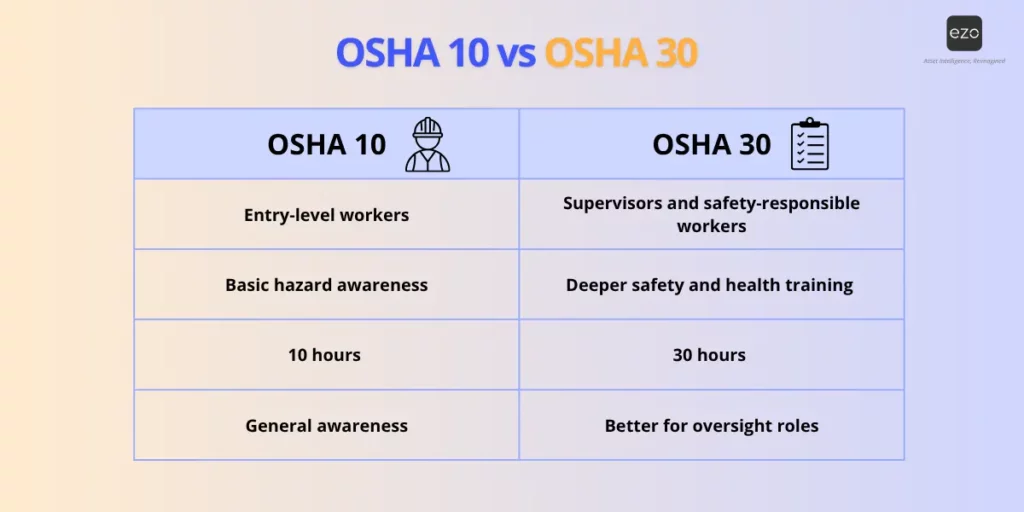
OSHA 10 is typically used for entry-level safety awareness. OSHA 30 is longer, more detailed, and better suited for supervisors or workers with safety responsibilities.
| Area | OSHA 10 | OSHA 30 |
| Training length | 10 hours | 30 hours |
| Typical audience | Entry-level workers | Supervisors, leads, and safety-responsible workers |
| Depth | Basic safety awareness | More detailed, industry-specific safety training |
| Outcome | OSHA 10-hour course completion card | OSHA 30-hour course completion card |
| Best fit | General hazard awareness | Oversight and safety responsibility |
In asset-heavy environments, OSHA 10 may help frontline workers understand common hazards, while OSHA 30 is more useful for people who oversee equipment-heavy work, coordinate maintenance, supervise crews, or influence safety procedures.
Who needs OSHA 30 in asset-heavy teams?
OSHA 30 is most useful for people who supervise work, manage equipment-heavy environments, or make decisions that affect safety-critical operations.
This can include:
- Site supervisors
- Construction forepersons
- Maintenance managers
- Facilities managers
- EHS managers
- Equipment managers
- Warehouse leads
- Plant supervisors
- Operations managers
- Fleet managers
- Field service leads
A construction supervisor may oversee lifts, scaffolding, cranes, temporary site equipment, power tools, and PPE. A facilities manager may coordinate HVAC systems, electrical assets, generators, emergency lighting, elevators, and outside contractors. A fleet manager may be responsible for vehicle inspections, maintenance schedules, and operator safety.
In each case, OSHA 30 helps the person recognize risk. Asset and maintenance workflows help the team manage what happens after the risk is found.
Is OSHA 30 legally required?
OSHA 30 is not required by OSHA for all workers. However, it may be required by employers, states, municipalities, unions, contractors, project owners, or specific jobsites.
Requirements can vary based on:
- Employer policy
- Contract terms
- State or municipal rules
- Union requirements
- Jobsite access rules
- Project owner requirements
- Industry expectations
This article is for general information only. OSHA-related training requirements can vary by jurisdiction, employer policy, contract terms, and worksite conditions. Teams should confirm requirements with qualified safety, compliance, or legal advisors.
Why OSHA 30 matters for asset-heavy teams
OSHA 30 matters because asset-heavy work environments carry risks that are tied to equipment condition, maintenance quality, and daily operating practices.
Safety is not separate from operations. It depends on whether the equipment is inspected, maintained, repaired, removed from service when unsafe, and documented properly.
1. It helps supervisors spot equipment-related hazards
Asset-heavy teams work around machinery, vehicles, tools, lifts, electrical systems, HVAC units, production lines, generators, chemicals, and heavy equipment.
Supervisors may need to identify:
- Damaged guards
- Faulty ladders
- Unsafe forklifts
- Uninspected lifts
- Poorly maintained machinery
- Missing PPE
- Electrical hazards
- Incomplete inspection records
OSHA 30 helps safety-responsible workers think more systematically about these risks, especially when they supervise people, equipment, or multiple worksites.
2. It supports safer maintenance decisions
Maintenance is where safety awareness often becomes action. A team may know that equipment should be safe before use, but the real control point is whether inspections, repairs, and service work are properly managed.
That includes:
- Pre-use inspections
- Preventive maintenance schedules
- Work order documentation
- Hazard reporting
- Corrective action tracking
- Equipment status updates
- Maintenance history
When these processes are inconsistent, known safety issues can remain unresolved even after someone notices them.
3. It improves accountability across departments
Safety does not sit with one team. Operations, maintenance, facilities, fleet, procurement, finance, and equipment teams all influence whether assets remain safe and available.
Operations teams know how equipment is being used. Maintenance teams know what has been repaired. Facilities teams know which systems support the work environment. Equipment teams know where assets are assigned. Procurement and finance influence whether aging or unsafe equipment is replaced on time.
OSHA 30 helps build awareness across these roles. Strong asset records help teams assign ownership and close the loop.
4. It helps reduce avoidable disruption
Unsafe or poorly maintained equipment can lead to downtime, failed inspections, emergency repairs, delayed work, and preventable risk.
For example, a forklift with overdue maintenance may be pulled from service during a busy warehouse shift. A generator with an incomplete inspection history may create issues during a site review. A production machine with recurring safety problems may cause unplanned downtime.
OSHA 30 helps teams recognize these situations earlier. The operational benefit comes when teams can act on them before they escalate.
Why OSHA 30 training alone is not enough
OSHA 30 improves safety awareness, but it does not automatically make equipment safe, inspected, maintained, repaired, or retired.
Many teams complete training but still rely on paper checklists, spreadsheets, email threads, disconnected maintenance logs, or informal conversations to manage follow-up work. That creates gaps such as:
- Inspections completed but not recorded
- Failed checks not linked to work orders
- Unsafe assets are still marked as active
- Maintenance history missing from the asset record
- No clear owner for corrective action
- Reports were built manually before audits
- Safety-critical assets tracked across multiple systems
- Different inspection templates used across locations
The issue is rarely a lack of intent. The problem is that safety processes break when asset data is scattered, outdated, or hard to act on.
How EZO’s enterprise asset management software supports OSHA 30-trained teams
EZO helps asset-heavy teams connect safety awareness to the asset and maintenance workflows that support daily operations.
Instead of treating safety issues as isolated notes, teams can connect them to the asset record, inspection results, work orders, maintenance schedules, equipment status, and lifecycle history.
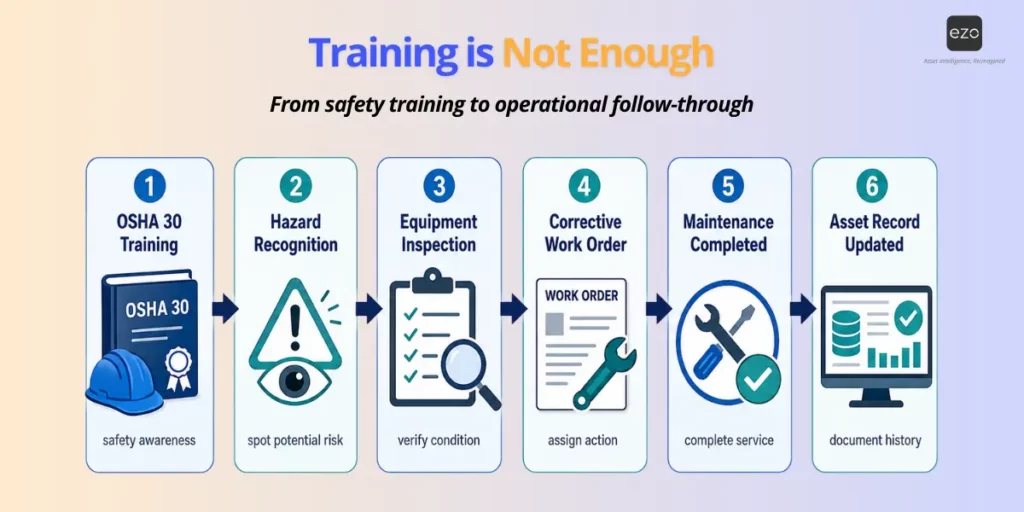
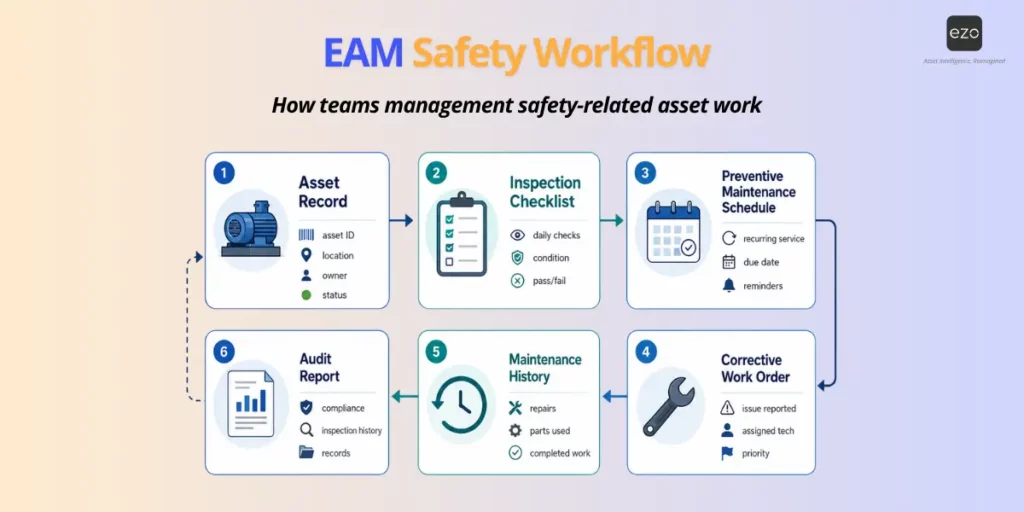
A practical safety follow-through workflow can look like this:
- A supervisor identifies an equipment-related hazard.
- The asset is inspected.
- The failed check is recorded.
- A corrective work order is assigned.
- Maintenance is completed.
- Equipment status is updated.
- The asset history is retained for future reference.
This matters because safety issues rarely stop at identification. Someone needs to own the follow-up, complete the work, and keep the record.
Centralized asset records
Centralized records help teams track equipment type, location, custodian, condition, status, documents, and lifecycle history.
For safety and maintenance teams, this makes it easier to answer:
- Where is the asset?
- Who is responsible for it?
- Is it active, unavailable, under repair, or retired?
- What condition is it in?
- What documents or manuals are attached?
- What work has been done on it?
Inspection checklists
Inspection checklists help standardize how teams inspect equipment, tools, PPE, vehicles, machinery, and facility assets.
Instead of relying on inconsistent paper forms, teams can document what was checked, who checked it, when it was checked, what failed, and what follow-up was required.
Preventive maintenance schedules
Preventive maintenance helps teams service safety-critical assets before failure.
For equipment such as forklifts, lifts, HVAC units, generators, pumps, fire safety systems, production machinery, and facility systems, recurring schedules reduce reliance on memory and manual reminders.
This does not guarantee compliance, but it helps teams manage maintenance work more consistently.
Corrective work orders
A failed inspection should not sit in a spreadsheet or email thread.
With corrective work orders, teams can assign the issue, set priorities, track completion, and retain a record of the fix. This helps close the gap between identifying a hazard and resolving it.
Equipment status updates
If equipment is unsafe, under repair, retired, or unavailable, that status needs to be visible before someone checks it out, dispatches it, assigns it, or returns it to service.
Accurate status tracking helps operations, maintenance, facilities, and field teams work from the same information.
Maintenance and lifecycle history
Maintenance history helps teams understand what has happened to an asset over time, including inspections, repairs, parts used, labor, downtime, service notes, recurring issues, and follow-up actions.
That history supports repair-or-replace decisions, audit preparation, warranty claims, and leadership reporting.
What should teams track after OSHA 30 training?
After OSHA 30 training, asset-heavy teams should track operational data demonstrating that safety processes are being followed.
| What to track | Why it matters |
| Equipment inspection dates | Shows whether assets are checked on schedule |
| Preventive maintenance schedules | Reduces missed service and unexpected failures |
| Failed inspection items | Helps prioritize corrective action |
| Open safety-related work orders | Shows unresolved risk |
| Asset condition | Helps identify unsafe or aging equipment |
| Equipment location | Helps teams find and verify assets |
| Custodian or responsible team | Improves accountability |
| Service history | Supports audits, warranty claims, and replacement planning |
| PPE availability | Helps confirm the required protective equipment is ready |
| Retired or unavailable assets | Helps prevent unsafe equipment from being used |
Training improves awareness. Tracking shows whether the team acted on it.
How OSHA 30 connects to different asset-heavy industries
OSHA 30 becomes more valuable when it is connected to the equipment and environments teams manage every day.
Construction
Construction teams manage heavy equipment, ladders, scaffolding, lifts, power tools, PPE, vehicles, and temporary site assets. OSHA 30 can help supervisors recognize hazards, while the EZO helps track assignments, inspections, conditions, maintenance readiness, and work orders.
Manufacturing
Manufacturing teams rely on production machinery, conveyors, compressors, pumps, electrical systems, machine guards, and maintenance logs. If safety issues are not documented or service is overdue, risk can spread across the production floor.
Facilities
Facilities teams manage HVAC systems, fire safety equipment, electrical assets, elevators, generators, emergency lighting, and building systems. These assets often need recurring inspections, service records, and reliable maintenance history.
Fleet and field service
Fleet and field service teams manage vehicles, mobile equipment, tools, safety gear, inspection kits, and service documentation. Mobile access to asset and maintenance records helps teams working across locations verify equipment status before work begins.
How to connect OSHA 30 training with daily asset workflows
The best way to make OSHA 30 useful after training is to turn safety awareness into repeatable workflows.
A practical process includes:
- Identify safety-critical assets across sites, fleets, facilities, and departments.
- Attach manuals, safety documents, inspection requirements, and maintenance instructions to asset records.
- Create preventive maintenance schedules for assets that need recurring service.
- Build inspection checklists for equipment, tools, PPE, vehicles, machinery, and facility systems.
- Assign ownership by role, team, location, or asset category.
- Convert failed checks into corrective work orders.
- Track completion, notes, parts, labor, downtime, and follow-up action.
- Update asset status when equipment is unavailable, under repair, or retired.
- Review reports with safety, maintenance, facilities, and operations teams.
This helps teams move from training completion to daily operational control.
Common mistakes teams make after OSHA 30 training
Many teams complete OSHA 30 training but fail to build the asset and maintenance processes needed to sustain safer operations.
Common mistakes include:
- Treating the OSHA 30 card as the end goal
- Keeping inspection checklists on paper
- Not linking failed inspections to corrective work orders
- Tracking maintenance in spreadsheets only
- Not assigning ownership for follow-up action
- Not recording retired or unsafe assets
- Not connecting safety data with asset history
- Reviewing records only before audits
- Using different inspection templates across locations
- Assuming training completion equals operational readiness
The card matters, but the stronger question is: once a worker or supervisor recognizes a hazard, can the organization prove what happened next?
How EZO helps improve safety follow-through
EZO helps asset-heavy teams connect asset records, inspections, preventive maintenance, corrective work orders, equipment status, and lifecycle history in one platform. After an OSHA-related inspection or internal safety review, this connected system helps teams move from identifying issues to assigning action, tracking completion, and maintaining a clear record of what was done.
For teams managing facilities, fleets, tools, machinery, vehicles, and safety-critical equipment, this matters because many inspection findings are tied to physical assets. A supervisor may identify a damaged machine guard, an overdue forklift inspection, an unsafe ladder, a leaking compressor, a vehicle defect, or equipment that should be taken out of service. EZO gives teams a structured way to document the issue, assign ownership, complete corrective work, and keep the asset record updated.
Asset records help teams start with a complete view of the affected equipment. After an inspection, the team can open the asset profile to see the asset’s location, assigned user, service history, warranty details, documents, and previous issues before deciding what action is needed.
Location and custody tracking helps teams confirm where the asset is and who is responsible for it. This is useful when an inspection finding involves equipment that moves between job sites, departments, vehicles, warehouses, or field teams. Instead of searching manually, teams can quickly identify the current location and custodian.
Equipment condition tracking helps teams flag whether an asset is safe to use, needs repair, or should be removed from service. For example, if a ladder, forklift, vehicle, or production machine fails inspection, its condition can be updated so teams do not continue using unsafe equipment.
Inspection checklists help standardize what teams review after training. Supervisors and technicians can use checklists to document safety checks, capture findings, note failed items, and create a repeatable inspection process across locations and asset types.
Preventive maintenance schedules help teams address recurring safety requirements before they become inspection findings. If equipment needs monthly checks, quarterly servicing, annual certification, or routine parts replacement, EZO helps schedule that work and reduce reliance on memory or spreadsheets.
Corrective work orders help teams turn inspection findings into assigned action. When a defect or safety issue is found, teams can create a work order, assign it to the right technician, add notes or images, set priority, track parts and labor, and monitor progress until the issue is resolved.
Maintenance history gives teams a record of what was done, when it was completed, who performed the work, and what the outcome was. This is especially useful when teams need to show that an inspection finding was addressed and that the asset was repaired, serviced, or cleared for use.
Equipment status helps prevent unsafe assets from staying in circulation. Teams can mark equipment as under maintenance, unavailable, retired, or ready for use, so operations teams know whether an asset can be safely assigned or deployed.
Alerts and reminders help teams stay ahead of overdue inspections, recurring maintenance, certification checks, and follow-up work. After OSHA 30 training, teams may know what needs attention, but reminders help make sure those tasks are completed on time.
Lifecycle tracking helps teams identify when an asset is becoming too risky or costly to keep in service. If a machine, vehicle, tool, or facility asset repeatedly fails inspections or requires frequent corrective work, lifecycle data can support repair, replacement, or retirement decisions.
Reporting helps managers review inspection outcomes, overdue work, recurring issues, downtime, maintenance completion, and asset condition across teams or locations. This gives leadership a clearer view of where safety follow-through is working and where gaps remain.
Mobile access for field teams helps supervisors and technicians record findings from the field instead of waiting to update records later. Teams can complete inspections, update asset status, add photos, create work orders, and close tasks from the job site, facility floor, warehouse, or field location.
The goal is not to replace OSHA 30 training, safety expertise, or legal compliance guidance. It is to give asset-heavy teams a practical system for acting on the risks their trained employees identify. OSHA 30 helps teams recognize hazards. EZO helps teams document, assign, track, and prove the follow-through.
Final takeaway
OSHA 30 helps supervisors and safety-responsible workers recognize workplace hazards. For asset-heavy teams, that awareness is most useful when it connects to inspections, maintenance work, equipment status, and asset history.
OSHA 30 is commonly referred to as a certification, but OSHA treats it as a course completion card, not a formal certification or license. It can support better safety awareness, but it does not automatically make equipment safe or prove that follow-up happened.
Asset-heavy teams still need a system that shows what was inspected, what failed, who owned the work, what was completed, and whether the asset was safe to use.
EZO helps make that follow-through visible by connecting asset visibility, inspections, maintenance work, corrective actions, and lifecycle history into a single system of record.