Starting a construction equipment rental business is not just about buying machines and waiting for contractors to call. The businesses that last are built around three things: equipment people actually need; pricing that protects margin; and operating systems that keep every asset, booking, invoice, service record, and customer agreement under control.
Many new rental owners get the order wrong. They spend most of their capital on the fleet, then try to build processes around problems that show up later: double bookings, missing attachments, late invoices, unclear damage responsibility, idle equipment, and service delays.
That is where rental businesses lose control. Not because they bought the wrong excavator or priced a rental incorrectly, but because they did not establish the operating rhythm needed to manage equipment movement, maintenance, billing, and customer expectations from day one.
This guide walks through the right sequence for starting a construction equipment rental business:
- Understand the construction equipment rental market.
- Build the legal, insurance, pricing, and agreement foundation.
- Plan a focused fleet.
- Set up operations before the first rental goes out.
- Choose rental management software that supports rental workflows.
- Market your business locally.
- Scale based on utilization, revenue, and service capacity.
Whether you are still validating the idea or preparing to launch, the goal is the same: build the system before you build too much fleet.
1. Understand the construction equipment rental market
Before you buy a skid steer, excavator, scissor lift, generator, or compactor, you need to know who you are renting to and what kind of work is happening around you.
Construction equipment rental demand usually comes from:
- Independent contractors who need equipment for a short project but cannot justify owning it.
- Small and mid-sized construction companies that want to avoid tying up capital in depreciating equipment.
- Landscaping, site development, roadwork, concrete, demolition, and utility crews that need equipment for specific jobs or seasons.
- Contractors who need backup equipment when owned units are unavailable, down for maintenance, or already assigned to another job.
The key question is not, “What equipment can I afford to buy?”
It is, “What equipment do local contractors repeatedly need, and where are current rental providers failing them?”
1.1 The market itself is worth paying attention to
The numbers tell a clear story. According to Mordor Intelligence, the global construction equipment rental market is projected to reach $141.42 billion in 2026 and grow to $179.21 billion by 2031, at a CAGR of 4.85%.
That growth reflects a larger shift in how contractors think about equipment ownership. Contractors do not always want to bear the costs of storage, maintenance, insurance, and depreciation for equipment they only need for specific jobs. Renting gives them more flexibility, especially when project timelines, labor availability, and capital budgets are uncertain.
Equipment World also reported that 72% of contractors rented equipment in the past 12 months, up from 69% in 2024, with cost and flexibility as the main reasons contractors continue to rent rather than buy.
For a new rental business, that demand is not just a market trend. It is a signal to build the business around contractors’ realities: equipment availability, fast turnaround, clear pricing, reliable maintenance, and the ability to confirm availability before a customer commits to a job.
1.2 Find your niche before you expand
Trying to rent every type of construction equipment from day one can stretch your capital, service capacity, and team too thin. A focused rental catalog is easier to manage, maintain, and market.
Start by identifying the category where demand, budget, and service capability overlap.
| Category | Common equipment | Why it may be worth considering |
| Earthmoving | Excavators, skid steers, compact track loaders, bulldozers | High demand across site prep, grading, landscaping, and demolition |
| Lifting and access | Scissor lifts, boom lifts, telehandlers | Useful for contractors working at height; may require stricter safety checks |
| Compaction | Plate compactors, trench rollers, ride-on rollers | Lower entry cost and steady demand across paving, trenching, and site work |
| General construction | Generators, light towers, concrete mixers, compressors | Broad use across many job sites, and often easier to start with |
| Attachments | Buckets, augers, forks, breakers | Good add-on revenue, but must be tracked carefully with parent equipment |
Starting narrow does not limit growth. It gives you cleaner utilization data, simpler maintenance routines, and a clearer message for your first customers.
A business known for reliable compact equipment in one region is easier to position than a business with a scattered catalog, unclear availability, and no operational focus.
1.3 Validate local and regional demand
Your market research does not need to be complicated, but it does need to be honest.
Review construction permits, infrastructure projects, residential development, commercial builds, roadwork, municipal projects, and seasonal activity in your area. Then talk to contractors, project managers, landscapers, site developers, and subcontractors.
Ask:
- What equipment do you rent most often?
- How far are you willing to travel for pickup?
- Do you prefer pickup or delivery?
- What rental providers do you currently use?
- What frustrates you about them?
- What equipment is hardest to find when you need it?
- What causes delays on your jobsites?
- How much notice do you usually have before you need equipment?
Pay attention to service gaps as much as supply gaps. A market may already have rental companies but still have room for a provider that offers faster response times, clearer availability, better-maintained equipment, easier booking, or more transparent billing.
2. Build your business foundation first
Most people starting a construction equipment rental business want to jump straight to the fleet. That is understandable. Equipment is the visible part of the business.
But the legal, insurance, pricing, and agreement foundation is what protects the business once equipment starts moving.
Construction equipment rental carries real risk. A customer can damage equipment, injure someone on a jobsite, return equipment late, dispute charges, lose an attachment, or claim a machine was already damaged before it left your yard.
Before the first rental goes out, your business needs clear rules for ownership, liability, billing, and customer responsibility.
2.1 Choose the right legal structure
Most equipment rental businesses operate as an LLC or a corporation rather than as a sole proprietorship because the work carries financial and liability exposure. A formal structure helps separate business and personal liability, although the right setup depends on your location, tax situation, and risk profile.
You may also need local business licenses, sales tax registration, reseller permits, commercial vehicle permits, or transportation-related approvals if you deliver heavy equipment. Requirements vary by city, state, and country, so confirm local rules before accepting orders.
A legal or tax advisor can help you decide:
- Which business structure fits your risk and tax situation?
- Whether you need sales tax registration
- What permits are required for heavy equipment transport?
- What language should appear in your rental agreements?
- How to treat deposits, damage waivers, and late fees
This is not the place to rely on a copied template or verbal advice from another operator. A small mistake in the foundation can become expensive once equipment, customers, and invoices are involved.
2.2 Get the right insurance coverage
Insurance is non-negotiable in equipment rental. At a minimum, discuss these policies with your insurance provider:
- General liability insurance for third-party bodily injury or property damage.
- Inland marine insurance for equipment while it is transported or used away from your premises.
- Commercial auto insurance if your business delivers or picks up equipment.
- Property coverage for your yard, office, tools, and owned assets.
- Workers’ compensation if you hire employees.
- Customer insurance requirements or damage waivers for high-value rentals.
Some rental businesses require renters to provide proof of insurance before equipment is released from the yard. Others use damage waivers for specific rental categories. The right approach depends on the equipment’s value, the customer type, and local legal requirements.
Do not rely on verbal agreements about who pays for damage. Your insurance requirements, waiver terms, and customer responsibilities should be written into the rental agreement.
2.3 Create pricing that protects margin
Most construction equipment rental businesses use daily, weekly, and monthly rates. Weekly and monthly rates usually offer a lower effective daily rate because longer rentals provide more predictable revenue.
When setting rates, account for:
- Acquisition cost or financing payments
- Maintenance and repair cost
- Insurance
- Storage and yard overhead
- Delivery and pickup cost
- Depreciation
- Expected utilization
- Cleaning, inspection, and turnaround time
- Attachments and accessories
- Late fees, damage fees, and fuel charges
A common mistake is pricing based solely on competitors. Competitive research helps you understand the market range, but your rates still need to align with your cost structure.
A low price that keeps equipment busy but does not cover maintenance, depreciation, delivery, insurance, and downtime will weaken the business even when bookings look strong.
You do not need to undercut every competitor. You need to understand the local price range and choose a rate that supports both demand and profitability.
2.4 Build a rental agreement before accepting orders
Every rental should have a signed agreement before the equipment leaves your possession.
Your rental agreement should clearly define:
- Rental dates and return time
- Rental rate and billing cycle
- Deposit or payment terms
- Delivery and pickup responsibility
- Fuel, cleaning, and consumable charges
- Damage, theft, and loss of responsibility
- Inspection process before and after rental
- Permitted and prohibited uses
- Late return charges
- Customer insurance requirements
- What happens if equipment fails during the rental period
Clear language matters. A renter who does not understand the terms is a dispute waiting to happen. Have a lawyer review the template before using it.
The goal is not to make the agreement complicated. The goal is to make responsibilities clear before a problem arises.
3. Plan your construction equipment fleet strategically
Your fleet will likely be your largest upfront investment. It is also the easiest place to make an expensive mistake.
The temptation to buy more equipment than you need is real, especially when you want your business to look established from day one. But equipment that sits idle still costs money. It still needs storage, insurance, maintenance, security, and eventual replacement.
The early goal is not to own every type of machine. The goal is to own the right equipment so that you can serve customers well.
3.1 Start small and let demand guide the next purchase
A focused starting fleet gives you room to learn without overcommitting capital.
For many new rental businesses, that may mean starting with a practical mix such as:
- One or two skid steers or compact track loaders
- A compact excavator
- A few compactors
- Generators or light towers
- Common attachments that fit your core machines
- Safety accessories or jobsite add-ons that support repeat rentals
The right mix depends on your market. A landscaping-heavy area may need compact loaders, trenchers, and augers. A commercial construction market may need aerial lifts, generators, and light towers. A roadwork-heavy region may need rollers, compactors, and concrete equipment.
Start with equipment that has consistent local demand and manageable service requirements. Then use rental history, customer requests, and utilization data to decide what to add next.
If a piece of equipment sits idle more often than it goes out, one of three things is usually true:
- The equipment does not match your market.
- The price or positioning is wrong.
- You bought too many units too soon.
Utilization gives you a cleaner answer than instinct.
3.2 Prioritize equipment with broad use
If you are unsure where to start, choose equipment that serves a wide range of projects and customer types.
Common early categories include:
- Excavators and skid steers: used across site preparation, landscaping, demolition, and grading.
- Aerial lifts and boom lifts: useful for commercial contractors, maintenance crews, and jobs that require access at height.
- Plate compactors and rollers: steady demand, relatively lower acquisition cost, and frequent use in site prep and paving work.
- Generators and light towers are needed on many active job sites, especially for temporary power and extended working hours.
- Attachments: useful for increasing revenue per rental, but only if they are carefully tracked and returned with the correct parent equipment.
Attachments deserve special attention. They are easy to overlook because they may not be as expensive as machines, but they can create customer disputes and billing leakage if they are not tied to the correct order.
If an auger, bucket, fork, or breaker leaves with a machine, your team needs a clear record of where it went, who has it, what rate applies, and when it is due back.
3.3 Decide between new and used equipment
There is no universal answer to whether new or used equipment is better. The right choice depends on your budget, customer expectations, equipment category, and maintenance capability.
New equipment usually offers:
- Manufacturer warranty coverage
- Lower initial maintenance risk
- Longer useful life
- Easier financing
- Stronger customer perception
The tradeoff is a higher upfront cost and faster early depreciation.
Used equipment usually offers:
- Lower acquisition cost
- Faster fleet expansion with less capital
- More flexibility for secondary categories
The tradeoff is a higher inspection burden, greater maintenance risk, and a shorter remaining useful life.
A practical middle ground is to buy newer equipment in your primary category, where reliability matters most, and use carefully inspected used equipment for lower-risk secondary categories.
Before adding used equipment to the rental fleet, check:
- Service history
- Hours logged
- Hydraulic systems
- Engine condition
- Tires or tracks
- Safety features
- Attachment compatibility
- Parts availability
- Signs of structural wear
- Any recurring repair patterns
A used machine that looks affordable can become expensive if it is unavailable for too long.
3.4 Build maintenance into the fleet plan
Maintenance is not something to figure out once the fleet grows. It should be built into the business from the start.
Every piece of equipment should have a record showing:
- When it was purchased
- When it was last serviced
- What work was performed
- Which parts were replaced
- How many hours has it logged
- What inspection notes exist
- When the next service is due
- Whether it is safe and ready to rent
Equipment that breaks down mid-rental not only creates a repair bill but it can also delay a customer’s project, damage trust, require a replacement unit, and reduce future bookings.
Preventive maintenance protects equipment lifespan and the customer experience.
4. Set up your operations before the first rental goes out
You can have the right equipment, the right pricing, and interested customers, and still run into problems if your operations are not ready.
This is where many new rental businesses struggle. The issue is rarely one dramatic failure. It is usually a series of small operational gaps that become expensive as volume grows.
A customer books an excavator, but another team member already promised it to someone else. A skid steer comes back damaged, but there is no pre-rental inspection record. A generator misses its service interval because no one logged the hours. An invoice goes out late and leaves out delivery, fuel, or overtime charges. An attachment comes back missing, but no one can prove it was left with the original order.
These are not edge cases. They are predictable consequences of running a rental business on memory, paper, spreadsheets, and scattered messages.
4.1 What breaks without systems in place
Without clear systems, the same problems repeat:
- Double bookings: equipment is promised to more than one customer for the same period.
- Unclear availability: the team cannot confidently say what is ready, rented, reserved, overdue, or under maintenance.
- Missed billing: delivery fees, fuel charges, damage fees, overtime, or accessories are not captured.
- Late returns: overdue equipment is not flagged early enough to protect the next booking.
- Maintenance gaps: service intervals are missed because hours, usage, or inspection notes are not tracked consistently.
- Customer disputes: the team cannot quickly retrieve signed terms, inspection records, order history, or damage documentation.
- Idle equipment: assets sit unused because no one is tracking utilization by category or unit.
- Slow turnaround: returned equipment is not inspected, cleaned, serviced, and made available fast enough.
Each of these issues affects revenue. Some reduce cash flow. Some reduce customer trust. Some shorten equipment life. Some create legal or insurance exposure.
That is why operations need to be designed before the first rental goes out, not after problems appear.
4.2 Core systems every rental business needs
A construction equipment rental business needs a reliable process for each of the following areas.
Equipment availability
You need to know which equipment is available, reserved, rented, overdue, under service, or unavailable. This should be visible before a team member confirms a booking.
Availability is the center of the rental business. If the team cannot trust availability, every order becomes a risk.
Order and booking management
Every rental should be tied to a customer, a date range, a rate, delivery details, an equipment list, attachments, and terms.
A good order process should answer:
- What did the customer rent?
- What rate applies?
- When does the rental start and end?
- Is delivery included?
- What deposit or payment is required?
- Which attachments or accessories are included?
- What happens if the rental is extended?
When order details are scattered across email, messages, calls, and spreadsheets, mistakes become easier to make.
Check-out and check-in process
The check-out process should document what left the yard, who received it, when it left, where it went, and its condition.
The check-in process should document what came back, when it was returned, whether anything is missing, whether there is damage, and whether the asset is ready to rent again.
This protects your team in disputes and helps maintain equipment quality.
Maintenance and service records
Every inspection, repair, service interval, and downtime event should be tied to the specific asset.
A maintenance record should show:
- Service date
- Work performed
- Technician or vendor
- Parts used
- Cost
- Meter or hour reading
- Notes
- Next service date
Equipment should not go out if it is due for service or unsafe to rent.
Billing and payment workflow
Billing should reflect the actual rental period, rate, add-ons, delivery, fuel, late fees, damage charges, taxes, discounts, and extensions.
Missed billing directly reduces revenue. It is especially common when accessories, consumables, transport, or overtime are tracked separately from the order.
Customer records
Every customer record should include rental history, signed agreements, insurance documents, deposits, invoices, communication notes, and damage history.
This makes repeat rentals faster and makes disputes easier to resolve.
Reporting
Reporting helps you see what is working and what needs attention.
At minimum, track:
- Utilization by asset
- Utilization by category
- Revenue by asset
- Maintenance cost by asset
- Overdue returns
- Downtime
- Missed or disputed charges
- Repeat customers
- Average turnaround time
According to EZRentOut’s own rental industry survey, rental businesses reported issues such as missed billing, downtime-related revenue loss, and underutilized equipment. These are operational problems, not just administrative ones. They are exactly the kinds of issues a rental business needs to track early.
5. Choose the right construction equipment rental management software
Spreadsheets may work when you have a few units and a handful of customers. They break down when equipment is moved between job sites, service bays, customer locations, and your yard every day.
The problem is not only manual updating. The bigger issue is that rental work connects many records: customer, order, equipment, attachment, availability, invoice, inspection, service history, delivery, and payment.
If those records live in separate places, your team spends time reconciling information instead of running the business.
5.1 The problem with spreadsheets and disconnected tools
When a rental business is small, a spreadsheet can feel manageable. But as the fleet grows, the spreadsheet becomes a liability.
Common problems include:
- A unit is marked available even though it is already reserved.
- A return date changes, but the availability calendar is not updated.
- A maintenance note is stored separately from the asset record.
- A customer is invoiced without delivery, fuel, or damage charges.
- A team member forgets to include an attachment on the order.
- A machine is rented before the inspection is complete.
- A manager cannot see which assets are profitable and which are sitting idle.
Disconnected tools create a different version of the same problem. Booking lives in one place, invoices in another, maintenance records somewhere else, and customer communication across email or text.
The result is operational fragmentation. The business may look busy, but the team does not have a reliable view of what is available, what is earning, what is overdue, and what needs attention.
5.2 What to look for in rental management software
Not all construction equipment rental software is built for how rental businesses actually operate. A construction equipment rental business needs more than a basic inventory list. It needs a system that integrates availability, orders, assets, customers, billing, maintenance, and reporting into a single workflow.
Look for software that supports:
- Availability Calendar: so your team can see which equipment is available, reserved, rented, overdue, or unavailable for maintenance before confirming a booking.
- Order management: so quotes, reservations, rentals, returns, extensions, deposits, and charges are tied to the same customer record.
- Asset tracking: so each serialized asset has its own record, status, location, rental history, and service history.
- Asset Stock: for bulk rental items that need quantity-level tracking rather than individual serial tracking.
- Bundles: for renting equipment, attachments, accessories, or kits that are commonly paired together.
- Services and Maintenance: so inspections, repairs, service schedules, and downtime are connected to the equipment record.
- Rental Webstore: if you want customers to browse equipment and place rental requests online.
- Sub Renting: if you occasionally source equipment from another provider to fulfill customer demand.
- Reporting: so you can track utilization, revenue by asset, downtime, overdue returns, and maintenance cost.
- GPS Sync Source: if you use supported telematics data and need GPS information connected to equipment records.
The right software should reduce the number of manual handoffs between booking, dispatch, billing, service, and reporting.
5.3 Where EZRentOut fits in
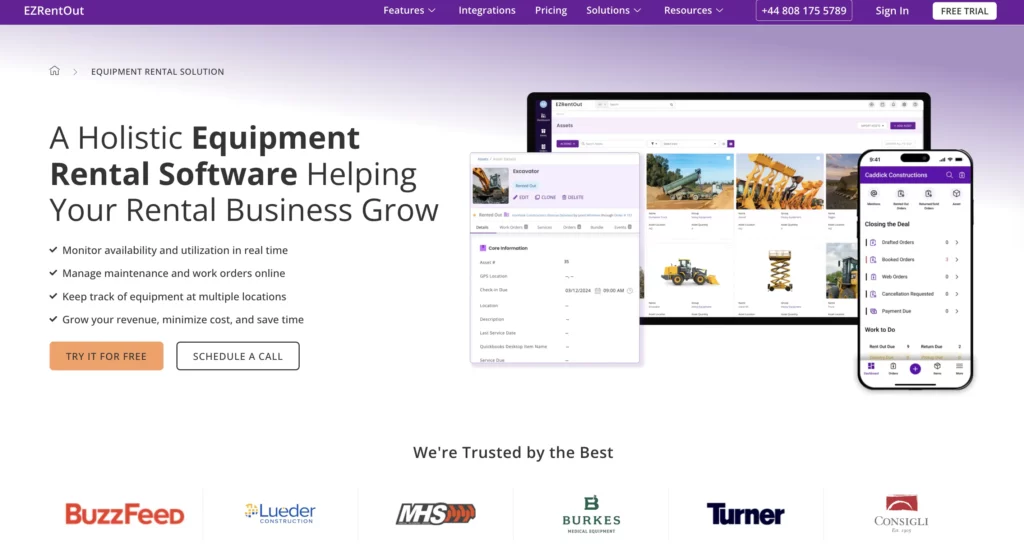
EZRentOut is rental management software for businesses that rent equipment, tools, vehicles, AV gear, medical equipment, event items, and other assets. For construction equipment rental teams, it brings orders, availability, assets, customers, invoices, maintenance, and reports into a single operating system.
With EZRentOut, construction rental teams can:
Track equipment availability
Use the Availability Calendar to see what is available, reserved, rented, or due back before confirming a booking. This helps prevent double bookings and gives the team a clearer answer when a customer asks what is available.
Create and manage rental orders
Build quotes, reservations, and rental orders without manually re-entering the same information.
Manage Asset Stock and Bundles
Track bulk rental items as Asset Stock and rent commonly paired equipment, accessories, or kits together as Bundles. This is useful when accessories, attachments, or grouped items need to move with the main rental order.
Support online rental requests
Use the Rental Webstore to let customers browse equipment and place rental requests online. This helps make the rental catalog easier to access and reduces the need to handle every request manually.
Connect service work to equipment records
Use Services and Maintenance to track repairs, service schedules, inspections, and maintenance history against equipment records. This helps teams see whether an asset is ready to rent or should stay unavailable until service is complete.
Track utilization and revenue
Use reporting to understand which equipment earns revenue, which categories are underused, and which assets cost too much to maintain.
Support sub-rentals when needed
Use Sub Renting when customer demand exceeds your owned fleet, and you need to fulfill a rental through another provider.
The value is not software for software’s sake. The value is having one place to answer the operational questions that affect revenue:
- What is available?
- Where is it?
- Who has it?
- When is it due back?
- Has it been serviced?
- Has the customer been billed?
- Is this asset worth keeping in the fleet?
6. Market your construction equipment rental business locally
Once your fleet and operations are in place, your next job is to make yourself visible to contractors who need equipment nearby.
Most early customers will not come from broad brand awareness. They will come from local search, referrals, repeat relationships, and a fast response when a contractor needs equipment for a job.
6.1 Build your local search presence
Start with a complete Google Business Profile. Include:
- Business hours
- Service area
- Phone number
- Equipment categories
- Delivery and pickup options
- Photos of your fleet
- Customer reviews
- Website link
- Quote request option
Contractors often search with urgent intent. They may need a skid steer tomorrow, a generator this week, or a compactor before a concrete pour. Make it easy for them to call, request availability, or ask for a quote.
Your website should clearly show:
- Equipment categories
- Service area
- Rental terms
- Delivery and pickup options
- Contact information
- Request-a-quote form
- Photos of actual equipment
- Safety or insurance requirements
- FAQs for first-time renters
For SEO, build pages around the equipment and locations your customers search for, such as:
- Skid steer rental in [city]
- Excavator rental near [service area]
- Construction equipment rental in [city]
- Generator rental for construction sites
- Compactor rental near me
Local search works best when your website, Google Business Profile, reviews, and service pages all tell the same story.
6.2 Build relationships with contractors
Local relationships matter in construction. Visit jobsites, attend contractor events, talk to general contractors, connect with landscapers and project managers, and introduce your business to builders, municipalities, facilities teams, and subcontractors.
Your first customers may come more from direct outreach than from paid advertising.
Make the offer specific:
- What equipment do you carry
- Where you deliver
- How quickly can you confirm availability
- What rental terms do you offer
- How customers can request quotes
- What makes your service easier to work with
A contractor does not need a long brand story. They need to know whether you have the equipment, whether it works, whether it can arrive on time, and whether the bill will match the agreement.
6.3 Compete on service, not only price
Large rental companies may have deeper fleets. Independent rental businesses can compete through responsiveness, local knowledge, flexible service, transparent billing, and better follow-through.
Avoid building your entire strategy around being the cheapest provider. Competing only on price makes it harder to fund maintenance, delivery, insurance, replacement equipment, and customer support.
- Reliable equipment
- Clear availability
- Fast answers
- Transparent pricing
- Accurate billing
- Well-documented rental terms
- Responsive delivery and pickup
- Fewer surprises for the customer
Contractors remember the rental provider who saves them time when a job is under pressure.
6.4 Use reviews and repeat rentals as growth levers
Ask satisfied customers for reviews after successful rentals. Reviews help local search performance and reduce buyer hesitation.
A contractor choosing between two rental providers will often trust the company with better evidence of responsiveness and reliability.
Repeat rentals are equally important. A customer who rents from you once and has a smooth experience is easier to win back than a brand-new customer. Keep records of what they rented, which projects they typically support, their delivery preferences, and which equipment they often ask about.
That history can help you serve them faster the next time they call.
7. Scale without the growing pains
Growth creates a new set of problems. More equipment means more maintenance. More bookings mean more scheduling conflicts. More customers mean more invoices, disputes, returns, and special terms. More locations mean more movement to track.
The safest way to scale is to use data from your rental operation rather than instinct alone.
7.1 Know when to expand your fleet
Consider buying more equipment when:
- A category has consistently high utilization.
- Customers repeatedly ask for an item you do not carry.
- You are turning away profitable rentals because units are unavailable.
- Maintenance downtime is reducing availability too often.
- Revenue per asset justifies another purchase.
- You can support the added delivery, service, storage, and insurance costs.
Avoid buying equipment only because it appears popular in the market. Your own booking and utilization data should guide expansion.
If a machine is rented often, billed correctly, maintained efficiently, and still has unmet demand, that is a strong signal. If a machine is popular in theory but idle in your yard, that is not a reason to buy more.
7.2 Decide when to hire
Hiring should follow operational pressure.
You may need additional staff when:
- Returns and inspections are delayed.
- Maintenance work is falling behind.
- Customers wait too long for quotes or confirmations.
- Delivery and pickup demand exceeds your capacity.
- Billing errors are increasing.
- Equipment is moving without accurate records.
- The owner is spending too much time on admin instead of sales or operations.
Software can reduce manual work, but it does not replace every role. Use systems to remove repetitive admin work so people can focus on service, maintenance, customer communication, and growth.
7.3 Expand by category or geography carefully
Expansion can happen in two ways: adding more equipment categories or serving a wider area. Both create complexity.
Adding categories means new maintenance requirements, new parts, different customer expectations, and possibly new safety requirements.
Expanding geography means longer delivery routes, higher fuel costs, greater scheduling pressure, and more demanding field support.
Before expanding, ask:
- Do we have enough utilization in our current fleet?
- Can we properly service the new equipment?
- Can we deliver and recover equipment without hurting response time?
- Do we have the right insurance and rental terms?
- Will this expansion improve the margin or only increase volume?
- Can our systems handle more assets, customers, orders, and invoices?
Controlled growth is better than fast growth that weakens service.
7.4 Use utilization reports to guide decisions
Utilization reports help you see which assets are earning, which are underused, and which are costing too much to maintain.
Use reporting to decide:
- Which equipment to buy more of
- Which equipment to retire or sell
- Which categories need better marketing
- Which assets have too much downtime
- Which customers rent most often
- Which rental periods generate the best margin
- Which machines have recurring service issues
This is where rental management software becomes a strategic tool, not just an administrative system. Better data helps you scale with fewer blind spots.
Conclusion: Build the system before you build too much fleet
A construction equipment rental business can be a strong, recurring revenue opportunity, but only if the operation is disciplined from the start.
The sequence matters.
First, understand local demand. Then set up the legal, insurance, pricing, and agreement foundation. Build a focused fleet. Create processes for availability, orders, maintenance, billing, and customer records. Choose rental software that supports the workflow. Market locally. Then scale using utilization and revenue data.
The businesses that struggle are usually not short on equipment. They are short on operational control.
Build that control early, and every rental after that becomes easier to manage, measure, and improve.