
Disclosure: EZO publishes this guide, and EZO EAM is one of the seven platforms reviewed.
Key Takeaways:
- RFID delivers operational value when tag reads connect to accurate asset records and defined workflows.
RFID platforms are not interchangeable because EAM, location intelligence, manufacturing, IoT, and returnable-asset systems serve different needs.
Large asset counts, multi-site coverage, and high-volume fixed-reader processing require separate validation.
Industrial RFID performance depends on asset materials, tag placement, reader configuration, read zones, and environmental conditions.
EZO EAM suits RFID-assisted equipment audits, custody, reservations, and lifecycle workflows rather than continuous factory location tracking.
A successful RFID pilot should test real assets, workflows, exceptions, and operating conditions before scaling.
RFID total cost includes tags, readers, antennas, software, integration, installation, tagging labor, training, and ongoing support.
RFID can make physical asset tracking a lot faster. But choosing an RFID asset tracking system takes more than buying tags and readers.
If you run a large manufacturing plant, warehouse, maintenance operation, or distributed industrial business, the bigger question is what happens after a tag gets detected. Does the system link that read to the right asset record? Can it support audits, transfers, check-in and checkout, inventory, maintenance, or production workflows? Will it connect with your ERP, EAM, CMMS, WMS, or other business systems? And will it keep up once you move beyond a small pilot?
This guide compares seven RFID-enabled asset tracking platforms worth considering in 2026. They don’t all operate at the same layer of the technology stack: some focus on asset operations, some on location intelligence, and others on manufacturing, IoT visibility, returnable assets, or RFID-centered asset management. We’ve therefore organized them by best-fit scenario rather than ranking them from best to worst.
7 RFID-enabled asset tracking platforms at a glance
These platforms serve different operational layers, so the comparison is not strictly one-to-one. EZO EAM and Wasp Asset focus on asset-management workflows, Zebra MotionWorks Enterprise focuses on location intelligence, Xemelgo on manufacturing operations, Visi-Trac on broader IoT asset visibility, Datacor TrackAbout on returnable-asset lifecycle management, and SATO ASETRA on RFID-centered asset management.
The table below shows where each platform fits and how RFID is used within that architecture.
| Platform | System category | Best fit | RFID role | Published pricing signal |
| EZO EAM | EAM / asset operations | Equipment and asset operations | RFID-assisted asset tracking | RFID available from Advanced; pricing varies by tracked-item count and billing term. Enterprise pricing is custom. |
| Zebra MotionWorks Enterprise | Location and tracking platform | Enterprise location intelligence | RFID + location technologies | No public price found |
| Wasp Asset (AssetCloud) | Fixed asset management | RFID-enabled audits | RFID + barcode | Complete Cloud from $250/month, billed annually; RFID add-on $3,995/year |
| Xemelgo | Asset and operations platform | Manufacturing visibility | RFID + sensors | Monthly subscription; amount not publicly listed |
| Visi-Trac | Asset visibility / IoT | Enterprise asset visibility | RFID + IoT | No public price found |
| Datacor TrackAbout | Returnable asset tracking | Industrial containers | RFID + barcode | No public price found |
| SATO ASETRA | RFID asset management | Tools and spare parts | RFID + barcode/2D codes | No public price found |
Important: Large asset counts, multi-site support, and high-volume fixed-reader processing are separate capabilities. Inclusion in this list does not mean that every platform supports all three. Buyers should validate their specific asset types, reader architecture, locations, integrations, and workflow requirements with each vendor.
Pricing note: Published prices are shown in USD and were checked on October 20, 2026. Pricing structures are not directly comparable because vendors use different billing models, asset or user limits, add-ons, and quote-based packaging. Confirm current pricing and the full RFID deployment cost with each vendor before purchasing.
What does “large-scale” mean for RFID?
For this guide, large-scale does not refer to a single asset-count threshold. It describes RFID deployments where the combination of asset population, number of locations, read or transaction volume, and operational complexity makes manual identification or tracking difficult to manage.
Scale can therefore mean different things for different operations. A manufacturer may need to track thousands of tools and spare parts across multiple plants, while a logistics operation may manage millions of returnable containers across a distribution network. A location-intelligence deployment may instead be defined by the number of readers, monitored zones, or volume of location events.
These measures are not directly interchangeable. A vendor’s stated software capacity does not necessarily demonstrate equivalent reader throughput or a proven deployment at that scale. Buyers should validate asset volume, site count, reader architecture, read-event volume, integration load, and documented deployment experience against their own requirements.
What is an RFID asset tracking system?
An RFID asset tracking system uses RFID tags, readers, and software to identify tagged assets and record detections, movements inferred from reader events, or asset status.
A typical RFID workflow looks like this:
RFID tag → reader → captured event → edge or middleware processing, where used → business application → asset record → workflow
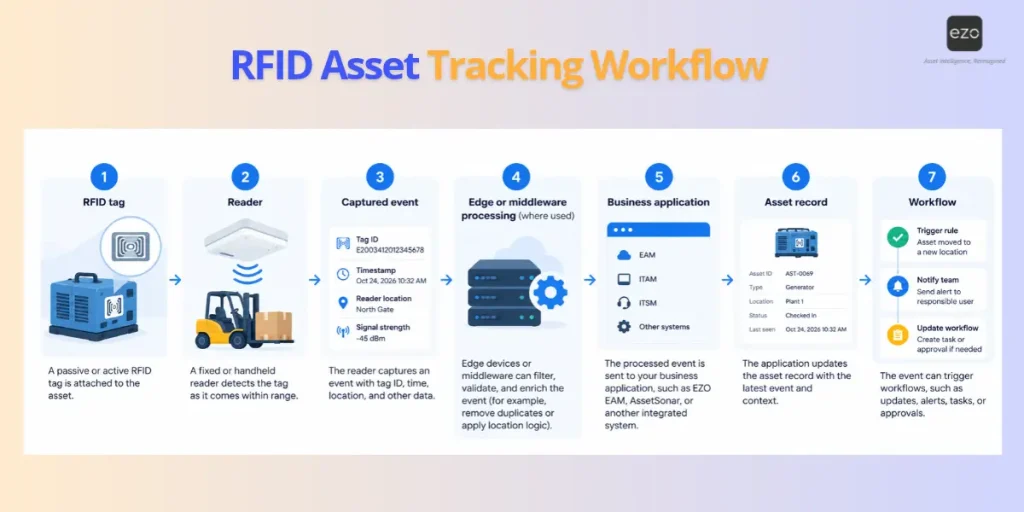
The reader captures the RFID signal. Depending on the deployment, the reader, edge, or middleware may filter, deduplicate, or otherwise process read events before they reach the business application.
The software layer provides business context and determines how the workflow stores and uses captured data.
Say your team detects a tagged tool. In one setting, that might help verify an inventory count. In another, the same scan could kick off a checkout, return, transfer, receiving, or maintenance workflow.
Distinguish RFID hardware from the software that interprets and reads tags and supports asset workflows. A reader can identify a tag, but the surrounding software decides how it stores, interprets, and uses that information.
Large industrial deployments often pair RFID with other technologies too. Zebra MotionWorks Enterprise, for example, supports multiple location technologies, while Visi-Trac combines RFID with RTLS, Bluetooth, sensors, mesh technologies, and GPS.
How we evaluated these RFID asset tracking systems
An RFID system that works well for a small tool room may not suit a multi-site manufacturing operation.
We checked product capabilities against available first-party documentation. This comparison is based on public documentation and customer stories, not hands-on testing or independent performance benchmarking. “Best fit” descriptions identify a specific use case rather than a universal winner.
For this comparison, we evaluated each platform against seven criteria:
1. RFID capabilities
Which RFID workflows does the platform support? Does it work with handheld readers, fixed readers, gates, or other RFID infrastructure?
2. Asset management
Can it keep track of asset identity, location, status, history, ownership, custody, or condition?
3. Industrial fit
Does it handle manufacturing equipment, production tooling, spare parts, returnable containers, warehouse inventory, or other industrial assets?
4. Operational workflows
Can RFID data feed audits, transfers, receiving, check-in and check-out, maintenance, inventory, or production workflows?
5. Integrations
Can RFID data flow into ERP, EAM, CMMS, WMS, MES, procurement, or other enterprise applications?
6. Scale
Can the platform support the required asset population, number of locations, read or transaction volume, and operating complexity?
7. Implementation
What hardware, tagging, configuration, integration, and deployment work should you plan for?
We weren’t looking for the platform with the longest feature list. The goal is to help you choose the RFID system that best fits your operating environment.
1. EZO EAM: Best fit for RFID-assisted asset operations
EZO EAM brings enterprise asset management, RFID-assisted asset tracking, and broader equipment workflows together in one platform.
With its RFID capabilities, teams can use compatible external RFID readers to scan groups of tagged assets and then act on them through workflows such as check-in, checkout, possession verification, reservations, and service-related tasks. The broader EZO EAM platform also covers asset lifecycle management, availability, reservations, inventory, audits, and multi-location operations.
The key distinction is how EZO EAM uses RFID data: it connects RFID scans to asset operations and records rather than serving as a continuous factory-location platform.
Platform snapshot
| Field | EZO EAM |
| System category | EAM / asset operations |
| RFID role/reader model | RFID-assisted asset tracking; TSL 1128 UHF RFID scanner documented |
| Asset & workflow coverage | Asset records, check-in and checkout, custody audits, reservations, inventory, service records, and lifecycle workflows |
| Integrations | API access from Advanced; additional named integrations depend on plan |
| Scale evidence | Multi-location asset management is documented; the reviewed sources do not establish a public asset count or RFID reader-throughput figure. |
| Deployment & implementation | Compatible external RFID hardware and mobile RFID scanning; fixed-reader or RFID-gate support is not established in the reviewed sources |
| Pricing basis | Item-based asset management pricing; RFID scanning Advanced+; CMMS separately packaged |
| Consider another option if… | You need continuous location intelligence or automated fixed-reader tracking across production areas |
EZO EAM’s documented plan structure is important when evaluating these capabilities. RFID scanning requires Advanced or above; asset check-in and checkout are available across plans. Custody audits and transfer of custody start at Advanced+, location audits start at Premium+, and full CMMS workflows require the separately priced CMMS add-on on Premium or are available through Enterprise.
EZO EAM’s hardware documentation lists the TSL 1128 RFID scanner and UHF RFID support. Confirm compatibility with the current reader, mobile operating system, and app version before purchasing hardware. The reviewed documentation does not establish support for fixed RFID readers or RFID gates, so organizations that require automated fixed-reader workflows should confirm the supported hardware architecture before deployment.
Pricing checked October 20, 2026: EZO EAM uses item-based pricing. The pricing page currently displays $63.55/month for Essential, $85.51/month for Advanced, and $100.88/month for Premium based on 300 tracked items, with Custom Enterprise pricing for larger or more complex requirements.
Note: Advanced is the starting plan for RFID. The listed asset-management plans include unlimited users subject to EZO EAM’s fair-use policy. CMMS capabilities are packaged separately and priced by admin user, so organizations requiring preventive maintenance or work-order functionality should include that cost in their evaluation.
Best fit: Organizations that want RFID-assisted asset identification connected to equipment records, custody, reservations, inventory, service history, and broader asset lifecycle workflows.
2. Zebra MotionWorks Enterprise: Best fit for enterprise location intelligence
Zebra MotionWorks Enterprise sits in a different category from a typical EAM application. It is a location and tracking platform that uses data from location sensors and tagged resources to support location intelligence and tracking use cases.
Zebra also offers MotionWorks Enterprise RFID Reader Management, a focused module for deploying, configuring, and monitoring Zebra fixed RFID readers from a consolidated application. The distinction matters when evaluating the overall architecture: reader management addresses the reader fleet and read-data flow, while tracking and location intelligence sit in the broader MotionWorks Enterprise platform or the receiving business application.
Zebra documents support for technologies such as passive RFID, Bluetooth Low Energy, and ultra-wideband (UWB) within its broader location and tracking offering.
Platform snapshot
| Field | Zebra MotionWorks Enterprise |
| System category | Location and tracking platform |
| RFID role/reader model | RFID plus other location technologies; RFID Reader Management supports Zebra fixed RFID readers |
| Asset & workflow coverage | Location intelligence, automated movement tracking, manufacturing visibility, and warehouse and logistics tracking |
| Integrations | Existing business applications; ServiceNow Hardware Asset Management integration documented |
| Scale evidence | Distributed reader environments and enterprise deployments are documented; the reviewed sources do not provide a public asset-count figure. |
| Deployment & implementation | Broader location architecture using RFID and other technologies; reader-management capabilities are focused on Zebra fixed RFID readers |
| Pricing basis | Not publicly listed in the reviewed sources |
| Consider another option if… | You need a general-purpose EAM for broader asset records, custody, maintenance, and operational workflows |
Zebra’s Toyota Material Handling customer story shows how MotionWorks Enterprise improves visibility across manufacturing and distribution processes.
Zebra also documents an integration between MotionWorks Enterprise and ServiceNow Hardware Asset Management, showing how location data can connect to another enterprise application.
Best fit: Large organizations where RFID and other location technologies form part of a broader enterprise location-intelligence architecture.
3. Wasp Asset (AssetCloud): Best fit for RFID-enabled fixed asset audits
Wasp now brands its product as Wasp Asset, although older documentation and product materials still refer to AssetCloud. For consistency, this article uses Wasp Asset (AssetCloud).
Wasp Asset is a fixed asset management platform covering asset records, audits, check-in and checkout, transfers, maintenance, reporting, mobile workflows, and lifecycle management. Its RFID functionality extends these workflows to bulk RFID transactions.
The current Wasp Asset mobile application supports RFID-tagged assets using the Wasp DR6 Smart Scanner and DR6 RFID Gun Grip with an RFID license. Wasp specifically documents the ability to locate, audit, move, check in, and check out RFID-tagged assets in bulk.
Platform snapshot
| Field | Wasp Asset (AssetCloud) |
| System category | Fixed asset management |
| RFID role/reader model | RFID-enabled bulk transactions; DR6 Smart Scanner and DR6 RFID Gun Grip documented |
| Asset & workflow coverage | Asset records, audits, check-in and checkout, transfers, maintenance, reporting, and lifecycle management |
| Integrations | REST API access listed for Complete and Enterprise; confirm specific connectors |
| Scale evidence | Bulk RFID transactions are documented; the reviewed sources do not provide a public asset count or reader-throughput figure. |
| Deployment & implementation | Cloud-hosted and self-hosted options; confirm RFID hardware, mobile OS, and offline support for the proposed configuration. |
| Pricing basis | Published cloud pricing with a separately listed RFID add-on |
| Consider another option if… | You need continuous location intelligence rather than RFID-enabled fixed asset management |
Wasp’s RFID capability is particularly relevant when an organization wants to replace one-at-a-time barcode scanning with bulk RFID scanning during audits or asset movements.
Pricing checked October 20, 2026: Wasp Complete Cloud starts at $250/month for five included users, billed annually. The published feature matrix lists RFID under Complete and Enterprise, rather than Basic. Enterprise pricing is available by quote. Wasp separately lists an RFID add-on at $3,995/year. Additional user charges apply, and organizations should also account for compatible RFID hardware, tags, implementation, and other deployment costs.
Best fit: Organizations looking for fixed asset management with RFID-enabled bulk audits, transfers, check-ins, and checkouts.
4. Xemelgo: Best fit for manufacturing tooling and equipment visibility
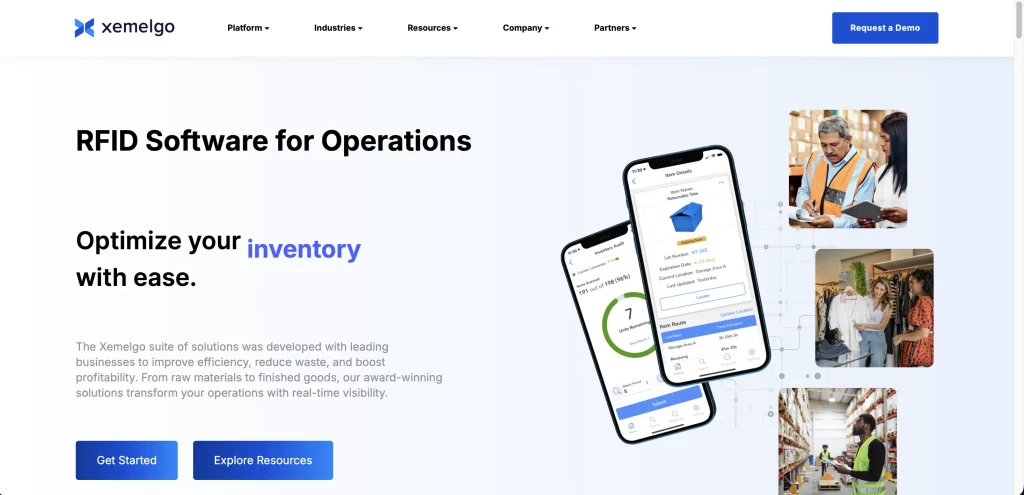
Xemelgo is particularly relevant for manufacturers that need visibility across production tooling, equipment, calibrated assets, inventory, and shop-floor resources.
Its asset tracking solution supports production tooling, calibrated inspection equipment, lab equipment, maintenance tools, IT assets, blueprints, and bins.
RFID is one of several tracking technologies Xemelgo supports. The company works with RFID hardware manufacturers and systems integrators and offers RFID-based asset tracking with handheld scanners. Its manufacturing platform also includes applications for calibrated asset tracking, production equipment, work-in-process, inventory, and performance monitoring.
Platform snapshot
| Field | Xemelgo |
| System category | Asset and manufacturing operations platform |
| RFID role/reader model | RFID-based asset tracking with handheld scanners; hardware-agnostic |
| Asset & workflow coverage | Production tooling, calibrated equipment, maintenance tools, inventory, WIP, and shop-floor resources |
| Integrations | Open APIs and ERP/MRP/WMS integration capabilities documented |
| Scale evidence | Confirm supported asset volumes, site counts, and reader architecture with Xemelgo. |
| Deployment & implementation | Works with RFID hardware manufacturers and systems-integration partners; hardware architecture requires evaluation |
| Pricing basis | Asset Tracking subscription advertised with unlimited assets and users; confirm application scope and deployment charges. Standard dollar amount not publicly listed on the reviewed asset tracking page |
| Consider another option if… | You need returnable-container lifecycle management or a broader general-purpose EAM rather than manufacturing-focused asset visibility |
The company also shares a customer example from TestEquity, where RFID and Xemelgo helped teams find assets faster and support same-day shipment workflows.
Xemelgo describes itself as hardware-agnostic and works with RFID tags, hardware, and systems-integration partners. This gives organizations flexibility when designing an RFID deployment, but buyers should evaluate the hardware and implementation architecture as part of the overall project.
Best fit: Manufacturers that need RFID-connected visibility across tooling, equipment, calibrated assets, inventory, and shop-floor operations.
5. RFID Global Solution Visi-Trac: Best fit for enterprise asset visibility
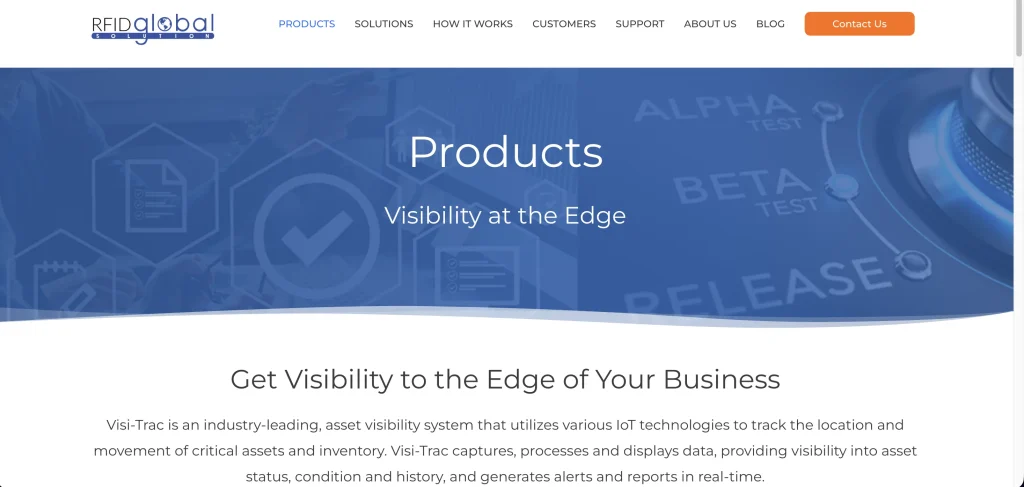
Visi-Trac takes a broader IoT approach to asset visibility. Its data-capture layer can use RFID, RTLS, Bluetooth, sensors, mesh nodes, and GPS.
Visi-Trac processes that data through filters, business rules, event processing, and workflow logic before presenting it through asset-management, mobile, analytics, and reporting applications. RFID is therefore one component of a broader asset-visibility architecture.
Platform snapshot
| Field | Visi-Trac |
| System category | Asset visibility / IoT |
| RFID role/reader model | RFID combined with RTLS, Bluetooth, sensors, mesh, and GPS; handheld readers documented in the GE use case |
| Asset & workflow coverage | Location, status, condition, movement history, warranty, service history, and physical inventory reconciliation |
| Integrations | EAM, financial, and procurement systems |
| Scale evidence | Enterprise deployments and industrial customer examples are documented; the reviewed sources do not provide a public asset-count or reader-throughput figure. |
| Deployment & implementation | Multi-technology data-capture architecture with RFID as one component of the broader visibility stack |
| Pricing basis | Not publicly listed in the reviewed sources |
| Consider another option if… | You only need RFID-assisted fixed asset audits without a broader IoT asset-visibility architecture |
Visi-Trac Asset Manager maintains information such as an asset’s last-seen location, status, condition, movement history, warranty, and service history. Its mobile application compares physical inventory with expected records and classifies items as Found, Missing, Misplaced, or New.
RFID Global Solution documents applications across manufacturing, aerospace, energy, healthcare, technology, supply chain, and other industries. Its customer examples include GE tool tracking, Flex supply-chain automation, Cisco fixed asset lifecycle management, and Boeing asset monitoring.
The GE example is particularly relevant to industrial operations. RFID-enabled carts and handheld readers tracked tools in a turbine maintenance facility, with Visi-Trac comparing tool usage against expected inventory.
Best fit: Enterprise organizations that need RFID alongside other IoT technologies to track asset location, status, condition, and movement.
6. Datacor TrackAbout: Best fit for returnable industrial containers
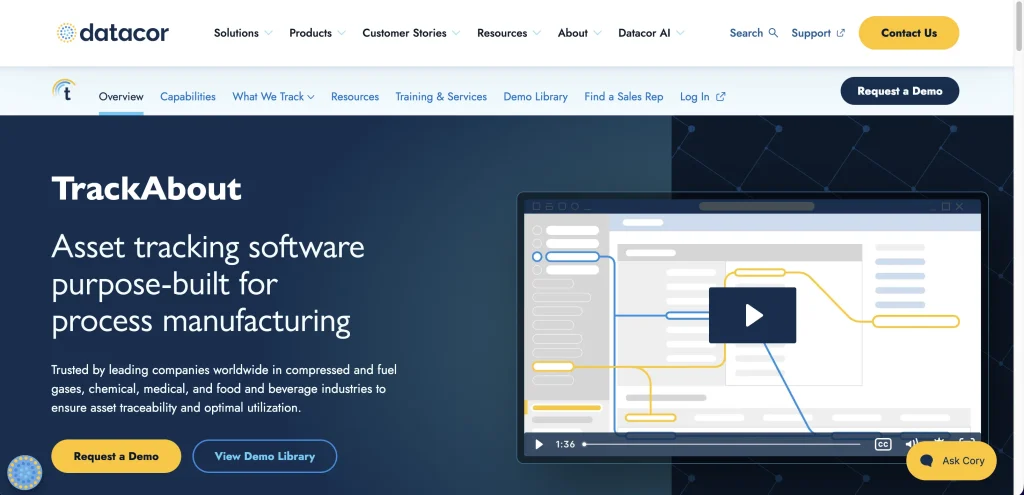
TrackAbout is a specialist platform, not a general-purpose RFID asset management system.
Now operated by Datacor, TrackAbout is purpose-built to track returnable containers and serialized assets, particularly in process industries. Its documented markets include industrial gases, LPG and fuel gases, chemicals, medical, and food and beverage.
TrackAbout’s Core Tracking module supports individual serialized assets identified by barcodes or RFID tags. Its workflows cover asset management, production, distribution, and supply chain operations.
Platform snapshot
| Field | Datacor TrackAbout |
| System category | Returnable asset tracking |
| RFID role/reader model | RFID and barcode identification of serialized assets; specific reader model not established in the reviewed sources |
| Asset & workflow coverage | Returnable containers, serialized assets, production, distribution, delivery, maintenance, returns, and chain of custody |
| Integrations | ERP, dispatch, rental, and logistics systems; APIs |
| Scale evidence | Datacor says the platform can manage millions of returnable containers; this refers to serialized asset management capacity, not equivalent RFID read volume. |
| Deployment & implementation | Supports serialized asset tracking across plant, distribution, and supply-chain workflows; specific RFID deployment architecture not established in the reviewed sources |
| Pricing basis | Not publicly listed in the reviewed sources |
| Consider another option if… | You need general-purpose asset management or RFID location infrastructure rather than returnable-asset lifecycle management |
TrackAbout is a natural fit for assets such as gas cylinders, chemical containers, returnable plastic containers, kegs, medical equipment, and other returnable industrial assets.
The platform supports workflows around delivery, returns, maintenance, plant operations, compliance, and chain of custody. Datacor says the platform can manage millions of returnable containers.
TrackAbout also integrates with ERP, dispatch, rental, and logistics systems and offers APIs for broader integrations.
Its strongest differentiation is managing the returnable-asset lifecycle rather than providing generic RFID infrastructure. Organizations should therefore evaluate it against their specific container, distribution, return, maintenance, and billing processes.
Best fit: Process manufacturers and distributors managing returnable industrial containers or serialized assets across delivery, use, maintenance, and return workflows.
7. SATO ASETRA: Best fit for manufacturing tools and spare parts
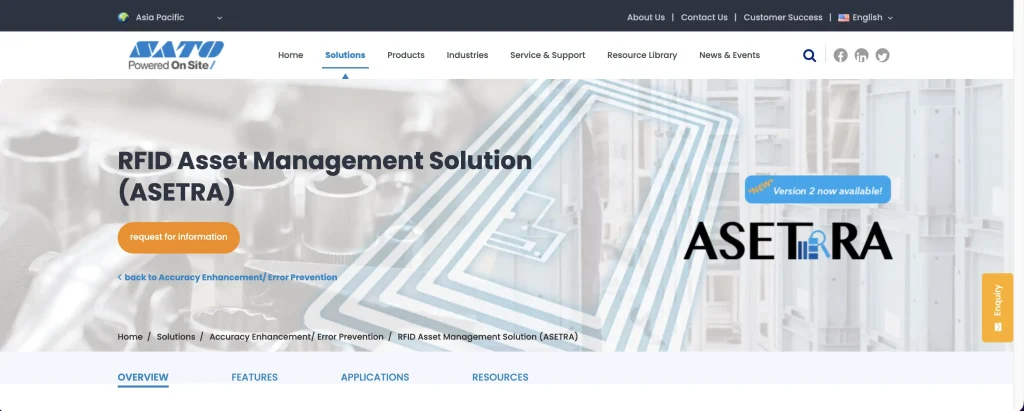
SATO ASETRA is an RFID asset management solution designed around equipment, tools, spare parts, and returnable transport items.
SATO describes ASETRA as a solution for assets such as equipment, tools, pallets, racks, and other returnable transport items. Its capabilities include RFID-based stocktaking, asset tracking, searching, movement management, and multi-site asset visibility.
Confirm current multi-site licensing; SATO’s older brochure describes multi-worksite access as an optional licensed feature. SATO also provides RFID readers, gates, tags, and related infrastructure. SATO documents CSV-based exchange with existing asset management databases and assignment of RFID identifiers to existing asset numbers. Confirm the required integration method.
Platform snapshot
| Field | SATO ASETRA |
| System category | RFID asset management |
| RFID role/reader model | RFID-centered asset tracking; handheld terminals, readers, gates, and tags documented |
| Asset & workflow coverage | Tools, molds, equipment, spare parts, RTIs, stocktaking, searches, movement, loans, and returns |
| Integrations | Existing asset-management database; CMMS integration documented in the Suntory example |
| Scale evidence | Suntory deployment spans 10 factories; one plant manages approximately 24,000 equipment spare parts. |
| Deployment & implementation | RFID handheld terminals across remote worksites; SATO supplies readers, gates, tags, and related infrastructure |
| Pricing basis | Not publicly listed in the reviewed sources |
| Consider another option if… | You need broader EAM or CMMS functionality rather than RFID-centered asset management |
2026 customer example: Suntory Products
In September 2026, SATO announced that Suntory Products had deployed ASETRA across all 10 of its factories. At the Suntory Natural Water Kita Alps Shinano-no-Mori plant, ASETRA manages about 24,000 spare parts for equipment.
According to SATO, stocktaking that previously required 20 people for a combined 57 hours now takes one person about two hours, representing a reported reduction of more than 95% in stocktaking labor hours. SATO also reports that ASETRA integrates with the site’s existing CMMS and can automatically register inbound, outbound, and stocktaking records from RFID reads.
For manufacturers evaluating RFID for large spare-parts populations, the deployment provides a concrete example of connecting RFID-based identification with an existing maintenance and inventory environment.
Best fit: Manufacturers and logistics organizations that need RFID-based management for tools, molds, equipment, spare parts, and returnable transport items.
How these RFID systems differ
The differences become clearer when you look at what RFID actually does within each platform. The same RFID read can support an asset-management workflow in one system, location intelligence in another, or returnable-asset tracking in another.
| Platform | Layer | What RFID does here |
| EZO EAM | Asset operations layer | RFID identifies equipment and links scans to asset workflows such as custody, checkout, reservations, and maintenance. |
| Zebra MotionWorks Enterprise | Location intelligence layer | RFID is part of a broader location and sensor architecture that collects and distributes location data. |
| Wasp Asset | Fixed asset management layer | RFID extends asset management workflows to bulk audits, movements, check-ins, and checkouts. |
| Xemelgo | Manufacturing operations layer | RFID works alongside other technologies to support manufacturing assets, tooling, inventory, and shop-floor workflows. |
| Visi-Trac | IoT asset visibility layer | RFID is one of several technologies used to capture location, status, condition, and movement information. |
| TrackAbout | Returnable asset lifecycle layer | RFID supports serialized asset tracking across distribution, delivery, maintenance, and return processes. |
| SATO ASETRA | RFID asset management layer | RFID is central to stocktaking, asset searches, movement, loans, and managing tools, equipment, spare parts, and RTIs. |
Compare platforms against the same workflow and deployment requirements. A better question to ask is:
Which system operates at the layer your organization actually needs?
How to choose an RFID asset tracking system
Once you understand how the platforms differ, work through your requirements in this order.
1. Start with the asset
Pin down exactly what you want to track. For example:
- Production equipment
- Tools
- Spare parts
- Work-in-process
- Returnable containers
- Warehouse inventory
- Inspection equipment
- Maintenance equipment
The physical properties of these assets shape your RFID deployment. Metal surfaces, liquids, dense storage, temperature, chemicals, impact, and asset orientation can all affect tag and reader performance.
Choose tags based on the asset and its environment, including material, required read range, mounting method, durability, environmental exposure, frequency requirements, and expected lifespan.
2. Decide how assets need to be identified
Determine whether your workflow requires:
- Handheld RFID scanning
- Fixed readers
- RFID gates or portals
- RFID plus barcode
- A combination of reader types
Don’t assume a platform that supports RFID supports every reader architecture.
A handheld reader may suit periodic audits, searches, returns, and transfers. A fixed reader may make more sense at controlled transition points such as receiving areas, warehouse entrances, shipping points, or production stations.
For fixed-reader deployments, also evaluate antenna placement and read-zone design. The goal isn’t simply to maximize the number of tags detected. It is to reliably detect the right assets at the right control point.
3. Define what happens after the read
This is one of the most important questions you’ll ask.
Picture an RFID reader detecting a tagged tool.
What should happen next?
Should the system:
- Update its location?
- Confirm that it was returned?
- Add it to an audit?
- Record a checkout?
- Update inventory?
- Trigger an exception?
- Start a maintenance workflow?
- Update a shipment?
- Confirm that it passed through a control point?
A system becomes more useful when an RFID event can directly support the next operational workflow.
In higher-volume deployments, also determine where event processing happens. The reader, edge layer, or middleware may filter, deduplicate, enrich, or route read events before they reach the business application. Not every deployment requires separate middleware, so confirm which component handles these functions.
4. Evaluate integrations
Large industrial operations rarely run on a single software system.
RFID information may need to connect with:
- ERP
- EAM
- CMMS
- WMS
- MES
- Procurement
- Inventory
- Logistics
- Analytics
Look past the “API available” checkbox.
Ask the vendor:
- What data can move through the integration?
- In which direction?
- How often?
- What happens when synchronization fails?
- Can asset IDs be mapped to existing identifiers?
- Can location changes flow into other systems?
- Who owns the master record?
For example, Visi-Trac documents interfaces with EAM, financial, and procurement systems, while Xemelgo describes open APIs and ERP/MRP/WMS integration capabilities. Zebra documents integrations that let MotionWorks Enterprise data feed existing business applications.
5. Test the physical environment
An RFID deployment that works well in an office can behave very differently on a factory floor.
Before you commit to a large rollout, test representative assets and the intended hardware for:
Metal: Metal surfaces can affect RFID performance and may require appropriate tags and positioning.
Liquids: Liquids can affect radio-frequency performance depending on the tag and application.
Asset density: A reader working around hundreds of tightly packed assets faces a different challenge than one scanning isolated equipment.
Reader placement: Fixed-reader systems need carefully designed read zones.
Tag placement: Where a tag sits and which way it faces can affect whether it is reliably detected.
Environmental conditions: Consider heat, moisture, chemicals, abrasion, vibration, outdoor exposure, and cleaning processes.
The five-layer RFID system test
A useful way to evaluate an RFID platform is to follow the process from identification to operational proof.
Layer 1: Identify
Can the system reliably identify the physical asset?
This starts with the RFID tag and its association with a unique asset record.
Layer 2: Capture
Can the system capture the tag where the work occurs?
Test the actual reader, tag, asset, and environment rather than relying solely on a vendor demonstration.
Layer 3: Interpret
Can the system understand what the RFID read means?
Detecting a tag doesn’t automatically mean an asset was transferred, returned, or checked out.
The system needs business context to determine what the read means and whether it should trigger or support an operational action.
Layer 4: Act
Can the read trigger or support an operational action?
That could include:
- Inventory verification
- Asset transfer
- Checkout
- Return
- Receiving
- Maintenance
- Audit exception
- Shipment verification
Layer 5: Prove
Can you retrieve the evidence afterward?
The system should help answer questions such as:
- When was the asset last detected, and what movement transaction was recorded?
- Was it present during the audit?
- What custody assignment or handoff was recorded?
- Was it returned?
- Was it sent to maintenance?
- Why does the physical count differ from the system?
This five-layer test helps separate an RFID reader from a complete RFID-enabled asset operation.
How to pilot RFID before scaling
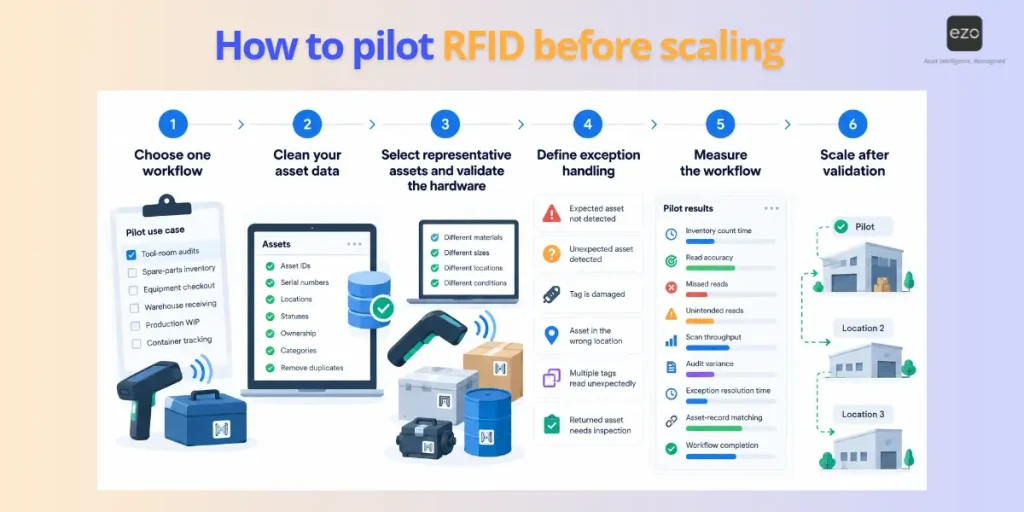
Don’t start by tagging every asset in every facility.
A controlled pilot can reveal problems before they become expensive.
Step 1: Choose one workflow
Start with a measurable use case such as:
- Tool-room audits
- Spare-parts inventory
- Equipment checkout
- Warehouse receiving
- Production WIP
- Returnable-container tracking
Step 2: Clean your asset data
Before tagging assets, verify:
- Asset IDs
- Serial numbers
- Locations
- Statuses
- Ownership
- Categories
- Duplicate asset records to identify and resolve
RFID can accelerate physical identification, but it won’t fix an inaccurate asset database.
Step 3: Select representative assets and validate the hardware
Don’t choose only easy-to-read assets. Include a range of materials, sizes, locations, and storage conditions, then validate the intended tags and readers against those assets in the actual operating environment.
Step 4: Define exception handling
Decide what happens when:
- An expected asset isn’t detected
- An unexpected asset is detected
- A tag is damaged
- An asset appears in the wrong location
- Multiple tags are read unexpectedly
- A returned asset needs inspection
Step 5: Measure the workflow
Track:
- Inventory count time
- Read accuracy
- Missed reads
- Unintended reads
- Scan throughput
- Audit variance
- Exception resolution time
- Asset-record matching
- Workflow completion
Set acceptance thresholds before testing. Define the percentage of expected tagged assets detected, unintended out-of-zone detections, correct asset record matches, completed transactions per minute, audit time reduction, and workflow completion rate. State the measurement period and denominator for each rate. These thresholds should reflect the specific use case requirements rather than a universal RFID benchmark.
Step 6: Scale after validation
If the pilot meets the predefined accuracy, workflow, and operational targets, expand to another workflow or location.
If it does not, identify whether the problem involves:
- Tag
- Reader
- Read zone
- Software
- Integration
- Asset data
- Operating procedure
Then correct it before expanding.
What does RFID asset tracking cost?
There is no universal price for RFID implementation.
The total cost depends on the size and complexity of the deployment.
A realistic cost model should include:
| Cost category | Examples |
| RFID tags | Labels, hard tags, specialized tags |
| Readers | Handheld, fixed, portal readers |
| Antennas | Fixed-reader infrastructure |
| Software | Asset management, RFID, analytics |
| Middleware | Event processing and device connectivity |
| Integration | ERP, EAM, CMMS, WMS, MES |
| Installation | Reader and antenna deployment |
| Tagging labor | Initial asset tagging |
| Training | Operations and maintenance teams |
| Support | Software and hardware support |
| Replacement | Damaged tags and hardware |
Published pricing at a glance
| Platform | Pricing basis | Published starting price | RFID/add-on cost | Billing/pricing note |
| EZO EAM | Tracked items | $63.55/month at 300 items | RFID included from Advanced. Pricing varies by tracked-item count | Monthly/yearly pricing views; Enterprise custom |
| Wasp Asset | Users/plan | Complete Cloud from $250/month, billed annually. | $3,995/year RFID add-on | Billed annually; 1 user on Basic, 5 on Complete |
| Xemelgo | Subscription | Not publicly listed | Not established | Monthly subscription |
| Zebra MotionWorks Enterprise | Quote-based / not publicly listed | Not publicly listed | Not established | Confirm with vendor |
| Visi-Trac | Not publicly listed | Not publicly listed | Not established | Confirm with vendor |
| Datacor TrackAbout | Not publicly listed | Not publicly listed | Not established | Confirm with vendor |
| SATO ASETRA | Not publicly listed | Not publicly listed | Not established | Confirm with vendor |
These figures are not apples-to-apples subscription comparisons. EZO EAM prices its core asset-management plans by tracked items, while Wasp’s published cloud pricing is user- and plan-based. RFID hardware, tags, readers, installation, implementation, integration, and other add-ons can materially change the total cost of an RFID deployment. Pricing checked October 20, 2026. Confirm current pricing and the complete deployment cost with each vendor before purchasing.
The software subscription is only one part of the total cost of ownership.
A lower software price can still lead to a more expensive deployment if it requires extensive integration, custom hardware, or manual tagging.
Which RFID asset tracking software is right for your operation?
Use these scenarios to build your RFID asset tracking shortlist:
Choose EZO EAM if you need RFID-assisted asset identification connected to equipment records, custody, checkouts, reservations, inventory, service history, and broader asset lifecycle workflows.
Choose Zebra MotionWorks Enterprise if your top priority is enterprise location intelligence, RFID infrastructure management, and bringing location data into your other business systems.
Choose Wasp Asset (AssetCloud) if you need fixed asset management with RFID-enabled bulk audits, asset movements, check-ins, and checkouts.
Choose Xemelgo if you’re a manufacturer looking for RFID-connected visibility across production tooling, equipment, calibrated assets, inventory, and shop-floor workflows.
Choose Visi-Trac if you need RFID combined with other IoT technologies such as RTLS, Bluetooth, sensors, mesh, or GPS.
Choose Datacor TrackAbout if your main job is tracking returnable industrial containers or serialized assets through delivery, use, maintenance, and return.
Choose SATO ASETRA if you need RFID-based management of manufacturing tools, molds, equipment, spare parts, or returnable transport items, especially across multiple worksites.
Where EZO EAM fits
RFID becomes much more useful when the data it captures becomes part of your operational record.
EZO EAM takes an asset-first approach. RFID scanning connects to asset records and workflows, including check-ins, checkouts, reservations, custody audits, inventory, and lifecycle management. RFID scanning is available starting with the Advanced plan. Basic service records are also available from Advanced, while deeper CMMS capabilities such as preventive maintenance and work orders require the separately priced CMMS add-on on Premium or are available through Enterprise.
That’s why EZO EAM is especially relevant when you’re not just asking:
“Was this RFID tag detected?”
but instead:
“What equipment is here, who has it, where should it be, what’s its status, and what should happen next?”
That distinction matters a lot for organizations managing shared equipment across plants, warehouses, job sites, maintenance areas, or multiple locations.
To be clear, EZO EAM isn’t meant to replace every possible RFID or RTLS architecture. If you need continuous location intelligence across production lines, look at dedicated location platforms like Zebra MotionWorks Enterprise alongside your EAM or asset management layer.
But if your main need is RFID-assisted equipment tracking tied to custody, availability, reservations, maintenance, and asset history, EZO EAM can give you that broader operational context.
Final takeaway
RFID can dramatically cut the effort it takes to identify and audit large physical asset populations. But the RFID reader alone isn’t a complete tracking system.
The right platform depends on where you need the intelligence to live.
If you need enterprise location intelligence and sensor management, a platform like Zebra MotionWorks Enterprise may be the right call. If fixed asset audits are your focus, Wasp Asset can connect RFID to established asset-management workflows. Manufacturers may find Xemelgo or SATO ASETRA a closer match for tooling, equipment, inventory, and spare-parts use cases. Visi-Trac is built for broader IoT asset visibility, while TrackAbout specializes in returnable and serialized industrial assets.