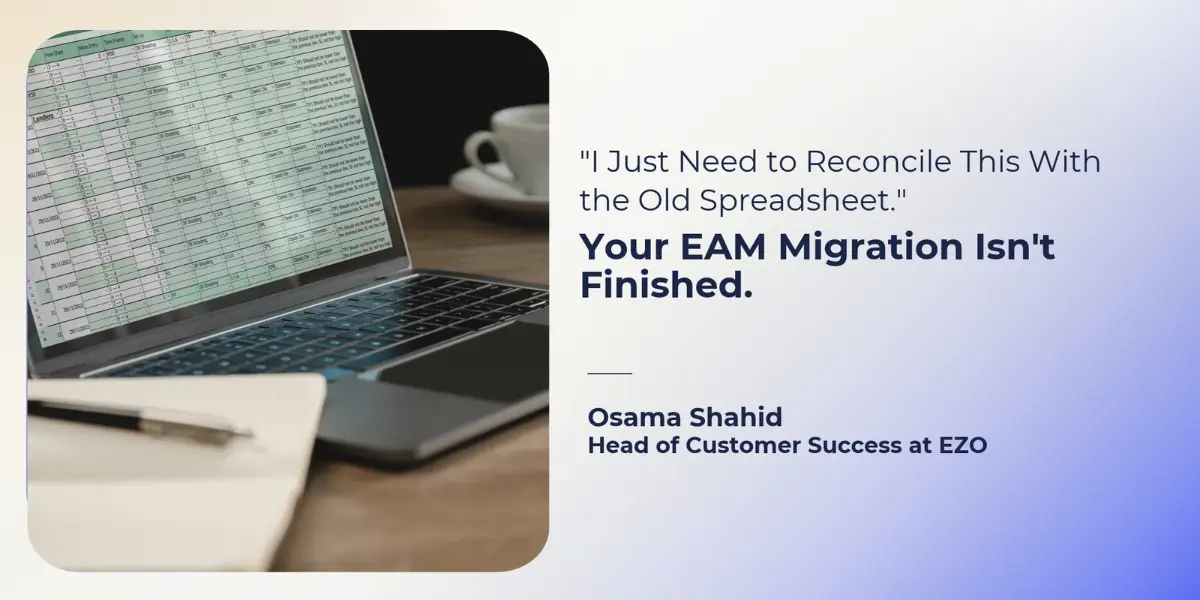
The project status says complete. Asset records are in the new enterprise asset management (EAM) system. Users have been trained. The ERP and HR integrations are live, and the implementation team has moved on to the next priority.
Then the first monthly asset report comes due, and someone says, “I just need to reconcile this with our old spreadsheet.”
That sentence rarely appears in an EAM implementation plan, yet it is one of the most useful things a Customer Success team can hear after go-live. Technically, the migration is done. Operationally, the old system has been rebuilt around the new one, and the spreadsheet points straight at the part of the implementation that never finished.
Here is the definition I’d ask every Procurement team to write into its acceptance criteria: an EAM migration is complete when the organization can run its asset operations from the new system without maintaining parallel spreadsheets for validation, reconciliation, or backup. Import accuracy is necessary, but it only covers the first of three migrations.
Moving the records is only the first migration
Every EAM implementation involves three separate migrations, each finishing at a different time.
Data migration asks whether the records moved. Asset IDs, locations, categories, vendors, purchase costs, and maintenance history are imported, validated, and mapped to the right fields.
Workflow migration asks whether the work moved. When an asset is transferred, checked out, sent for repair, or retired, the update now happens inside the EAM instead of in an email thread or a shared file.
Trust migration asks whether people stopped keeping a backup. Users answer routine questions from the EAM without checking a personal tracker first.
The third migration is usually the hardest because you can’t configure it. It comes from accurate records, clear ownership, and workflows that hold up during a busy week.
Put another way, adoption runs in a sequence: software deployed, process adopted, system trusted, workaround retired. Most go-live milestones stop at the first step, leaving Procurement to sign off on a project the people doing the work haven’t yet accepted.
Why do teams keep spreadsheets after an EAM implementation?
When a team keeps maintaining a spreadsheet after go-live, the easy assumption is that people resist change. A more useful assumption is that the spreadsheet still does a job the new process hasn’t replaced yet. That job usually traces back to one of five gaps.
They don’t fully trust the data. If a handful of imported records were wrong on day one, users reasonably double-check all of them. One bad location record can keep a spreadsheet alive for months.
Nobody owns conflicting records. When the EAM and the ERP show different costs for the same asset, someone has to decide which is right. If no one is named, whoever is closest to the report keeps a spreadsheet to settle it.
A critical workflow never moved into the EAM. The data was migrated, but the process for approving disposals or tracking loaner equipment still lives in a file because it was out of scope or configured late.
An integration creates exceptions nobody owns. Integrations move data on schedule. They don’t decide what happens when a record fails to sync, or two systems disagree. Unowned exceptions pile up, and a spreadsheet quietly becomes the exception queue.
A recurring report still needs manual rebuilding. If the quarterly asset report for Finance requires merging three exports and patching gaps by hand, the spreadsheet is the report’s real engine.
Each of these is rational behavior responding to incomplete process design. None of them is fixed by sending another reminder to “use the system.”
The spreadsheet is telling you what the implementation still needs
A reconciliation spreadsheet is a symptom. That is exactly what makes it useful. It is diagnostic evidence pointing to a specific gap in data trust, ownership, workflow, integration, or adoption.
So instead of asking why people still use it, ask: what would have to change for this spreadsheet to become unnecessary? The answer is usually narrow and fixable. A location hierarchy needs cleanup. A transfer workflow needs an approval step. A report needs one more custom field.
The Reconciliation Retirement Test
The Reconciliation Retirement Test is a five-part acceptance check for deciding whether an organization can stop maintaining a legacy asset spreadsheet after an EAM implementation. Procurement can add it to implementation acceptance criteria, vendor statements of work, migration plans, go-live governance, and post-implementation reviews.
Test 1: Can the team answer routine questions without the old file?
Where is the asset? Who has it? What condition is it in? Is maintenance due? What did it cost? Is anything missing? If the answer to any of these still starts with “Let me cross-check the spreadsheet,” the migration isn’t finished.
Test 2: Do users know where updates belong?
When an asset moves, changes hands, enters maintenance, changes status, or is retired, there should be one clear place to make that update. If people update both systems “just in case,” ownership is still unresolved.
Test 3: Is there a defined process for when systems disagree?
For every conflict, the team should know who owns the exception, which source takes precedence, how to correct the error, whether the fix reaches connected systems, and how to prevent the same disagreement from happening again.
Here is how that plays out. Say the ERP records a laptop’s purchase cost including sales tax and the EAM records it without. If the ownership model names the ERP as the source for cost, the EAM value is corrected, the integration mapping is fixed so the next sync carries the right figure, and the Procurement owner closes the exception. Without that rule, someone exports both systems into a spreadsheet to compare them, and the reconciliation file is back.
Test 4: Can recurring reports be produced without rebuilding the data first?
Exporting EAM data to model costs or prepare a board slide is ordinary analysis. The warning sign is when you need a spreadsheet to decide which record is correct, fill persistent gaps, merge conflicting sources, or recreate business logic the system should already hold. At that point, the spreadsheet is doing reconciliation, and the report depends on it.
Test 5: Can the old file become read-only?
Archive it, make it read-only, and watch what happens. If someone urgently needs to go back to it, you’ve found the exact process or trust gap that still needs work.
Don’t force retirement before the team trusts the replacement
Deleting the legacy file on go-live day doesn’t build trust. It just moves the spreadsheet to someone’s desktop. Retirement is the outcome, and a deliberate sequence gets you there:
- Preserve the migration baseline. Keep a frozen copy of the source data so you can trace any imported record back to its origin.
- Validate high-risk records first. Start with high-value assets, regulated equipment, and anything tied to audits or depreciation.
- Run both systems only for a defined period. Parallel tracking with an end date is a control. Without one, parallel tracking becomes the operating model.
- Assign an owner to every exception. Each mismatch found during the parallel period gets a named person and a resolution date.
- Freeze the legacy file once the five tests pass. Record the decision, date, and passed tests in go-live governance.
Who should own asset-data reconciliation after go-live?
Reconciliation ownership should be defined field by field, not system by system. For each important field, document the source system, data owner, update workflow, exception owner, and correction process. A typical model looks like this:
| Data | Source system | Owner |
| Asset identity and location | EAM | Asset management team |
| Employee and assignee information | HRIS | HR |
| Purchase order and cost | ERP or procurement system | Procurement |
| Maintenance status and history | EAM | Facilities |
| IT device telemetry | ITAM or MDM | IT |
The model needs one more entry that no single field covers: who has the authority to declare the legacy register retired. Without that role, the spreadsheet never officially ends.
What should “implementation complete” mean?
Most implementation milestones measure configuration. Procurement should measure operation.
| Weak milestone | Better milestone |
| Records imported | Records validated and exceptions resolved |
| Integration enabled | Source ownership and conflict handling tested |
| Users trained | Core work completed without the legacy tracker |
| Reports configured | Recurring reports produced without reconciliation |
| Go-live complete | Parallel tracking formally retired |
What should an EAM support after go-live?
After go-live, the capabilities that matter are those that take over the spreadsheet’s specific job. Corrections need a bulk path inside the system, or they drift back into Excel. Locations need a consistent structure, or one site shows up in reports under three names. Recurring reports need to come out of the system ready to use, or someone rebuilds them by hand every month.
In EZO EAM, the enterprise asset management platform from EZO, those jobs map to specific tools. The import wizard creates locations, groups, and vendors as assets are imported, carries custom fields across, and can nest locations under parent locations; its Update Existing mode corrects location and inventory records in bulk. The import data dictionary documents which fields each record type accepts. Custom reports export as PDF or CSV, a REST API connects other systems, and EZO offers guided post-launch support for adoption. None of these retires a spreadsheet by itself. That still depends on migration quality, clear ownership, and how consistently teams use the configured workflows.
When the spreadsheet comes back
Suppose someone creates Asset_Reconciliation_Final_v7.xlsx three months after launch. Don’t start with “Why aren’t they using the EAM?” Start with “What job is this spreadsheet doing?”
It might validate location data, track integration exceptions, fill a reporting gap, or simply give someone confidence nothing was lost. Each of those is a specific, solvable problem. Fix that problem, and the spreadsheet usually retires itself. A shadow spreadsheet is adoption feedback that someone took the time to build.
Five migration questions Procurement should ask an EAM vendor
Before approving an EAM implementation plan, ask:
- What happens to records that fail import validation, and how do you report them?
- How do we bulk-correct data after migration without creating another spreadsheet workflow?
- How do you identify and resolve conflicting records from integrated systems?
- How will we reproduce our current recurring asset reports without manual reconciliation?
- What criteria should we use before retiring our legacy asset register?
A vendor with a clear answer to the fifth question has thought through both adoption and deployment.
The question to ask three months after go-live
If Procurement asks only one question at the 90-day post-implementation review, make it this: “Which spreadsheets are people still maintaining, and what are they doing there that they can’t confidently do in the EAM?”
That question shifts the conversation from software implementation to operational adoption, where EAM value is realized.
Migration ends when the workaround stops being useful
A successful migration does more than move data into a new system. It removes the reason teams needed a parallel one. When Procurement can archive the reconciliation spreadsheet without anyone feeling anxious, the EAM has become the system people trust, not just the system the company bought.
See what it takes to retire your asset spreadsheet. Bring a current asset register or reconciliation workflow to an EZO EAM demo and see how the underlying process could move into a structured, shared asset workflow.