Disclosure: EZO EAM is developed by EZO, which publishes this comparison. It is assessed against the same criteria as every other platform and its limitations are stated explicitly; readers should weigh that relationship when evaluating our recommendations.
Last reviewed: August 2026. Vendor names, ownership and product scope were verified against official sources on this date. Naming in this category changes frequently, so re-confirm before issuing an RFP. Platforms are listed alphabetically, not ranked.
The seven enterprise asset management platforms for government worth evaluating in 2026 are Asset Essentials, AssetWorks, EZO EAM, IBM Maximo, Octave Attune EAM, OpenGov EAM, and Tyler EAM. There is no universal winner. Each one of them is built around a different government asset environment: shared equipment, fleet, facilities or public infrastructure. The right choice depends on which dominates your operations, not on which vendor lists the most features.
Introduction
Most government asset software comparisons rank products as if every agency is solving the same problem. They are not. A transit authority tracking signal assets, a public works department scheduling pavement inspections, and a facilities team routing work orders across twelve buildings all have different needs. A poor fit may not become obvious until long after the contract is signed.
This guide compares the seven platforms based on the operating environments agencies actually manage, along with the procurement questions that can determine whether a technically capable product makes it through review. These include security evidence, accessibility documentation, integration depth, and data-exit terms.
Government agencies need more than an asset register
Government agencies rarely have an asset problem. They have an asset visibility and accountability problem.
An agency may own vehicles, buildings, machinery, tools, IT equipment, roads, utilities, signs, parks and emergency-response equipment, managed by different departments, in different systems, under different processes. Knowing what the agency owns is the starting point, not the destination. The harder questions follow: Where is it now? Who is responsible? What condition is it in? What should happen to it next?
A spreadsheet can confirm that a generator exists and where it was assigned. It cannot tell you who approved its transfer, whether it failed its last inspection, or whether it can still be safely issued. Those histories scatter across emails, work orders and departmental databases, and when the person who remembers them leaves, part of the record leaves too.
This comparison covers platforms that manage physical government assets across at least two operational areas, including asset records, custody, maintenance, fleet, facilities, field work, infrastructure, and capital planning. It evaluates operational fit rather than feature-list length or certification counts.
Best government EAM software at a glance
| Platform | Best for | Strongest capability | Important consideration |
|---|---|---|---|
| Asset Essentials | Government buildings and facilities | Accessible maintenance and preventive-work management | Less enterprise-wide depth than broader EAM suites |
| AssetWorks | Fleet-heavy government operations | Fleet maintenance, fuel, parts and replacement planning | Breadth requires buying several separate products |
| EZO EAM | Shared equipment and distributed operations | Connects custody, availability, maintenance, inventory and field workflows | Assessed on documented capability, not a named government deployment |
| IBM Maximo | Complex, asset-intensive agencies | Deep EAM, reliability, hierarchy and asset-performance capabilities | Greater implementation and administration burden |
| Octave Attune EAM | Configurable enterprise environments | Enterprise maintenance, reliability, risk and complex assets | Ownership changed in May 2026; confirm roadmap and support |
| OpenGov EAM | Municipal infrastructure and public works | GIS-connected work, infrastructure and capital planning | May be most valuable inside the OpenGov ecosystem |
| Tyler EAM | Agencies using Tyler’s ecosystem | Government-specific workflows and ecosystem connectivity | Confirm whether Asset Maintenance, Asset Performance or both are quoted |
The table is a starting point, not a verdict. A fleet department and a facilities department hold different definitions of a good asset-management system, which is why this guide evaluates platforms by operating environment and workflow fit.
What is enterprise asset management software for the government?
Enterprise asset management software for the government helps agencies control the operational lifecycle of physical assets: acquisition, assignment, maintenance, inspection, cost tracking, transfer, replacement and disposal.
The operative word is lifecycle. An asset register is a snapshot; EAM is a living history. In government, accountability depends less on proving an asset exists than on reconstructing what happened to it.
How EAM differs from basic government asset tracking
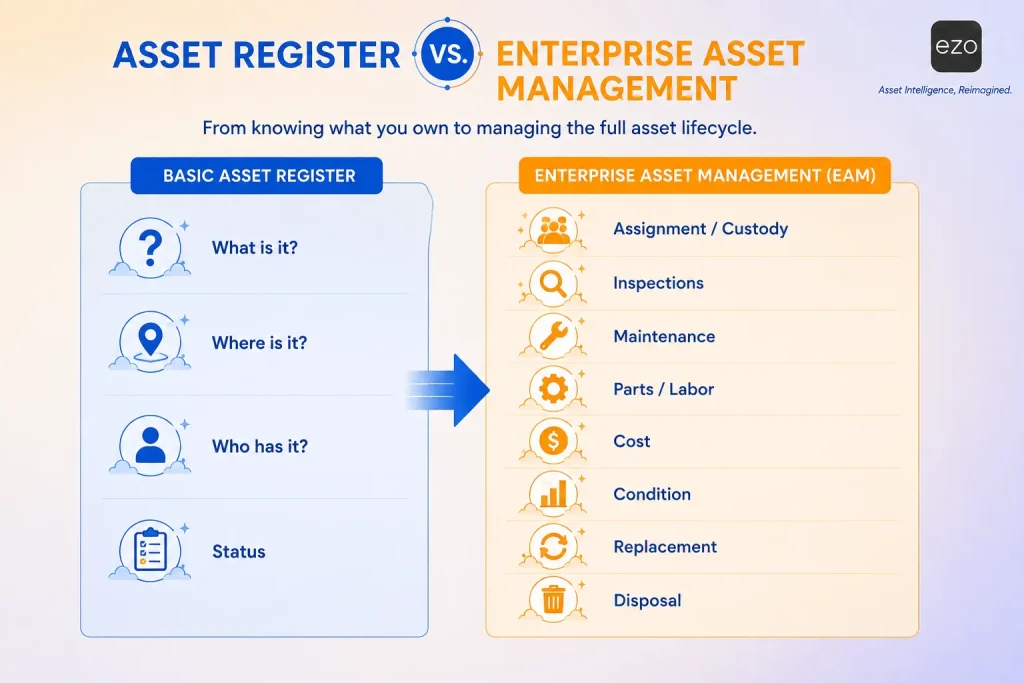
Government asset tracking answers four questions: what does the agency own, where is it, who has it and what is its status. EAM extends that to the operational record: what work was performed, when maintenance is due, what parts and labor were consumed, and when the asset should be repaired or replaced.
An asset register tells an organization what it owns. EAM helps it remember what happened to what it owns.
How EAM differs from CMMS software
A CMMS organizes maintenance work: preventive schedules, technicians, work orders, parts and service history. EAM covers a broader lifecycle including acquisition, custody, utilization, cost and replacement planning. The CMMS versus EAM distinction matters most at procurement, when scope is priced.
The boundary is not clean. A product labeled EAM may still need separate modules for a workflow your agency considers essential, and a maintenance-focused platform may be exactly what a facilities department needs. Buy on the workflows the system can execute, not the category name.
How EAM differs from fixed-asset accounting
Fixed-asset accounting focuses on capitalization, depreciation, book value and financial reporting. EAM focuses on condition, location, custody, maintenance, availability, operating cost and lifecycle decisions.
These systems work together rather than compete to be the single source for every asset question. An agency can hold accurate accounting records and still have poor operational visibility, and the reverse is common. Most agencies need EAM-to-ERP integration rather than one system fulfilling both roles.
Why government asset environments require different platforms
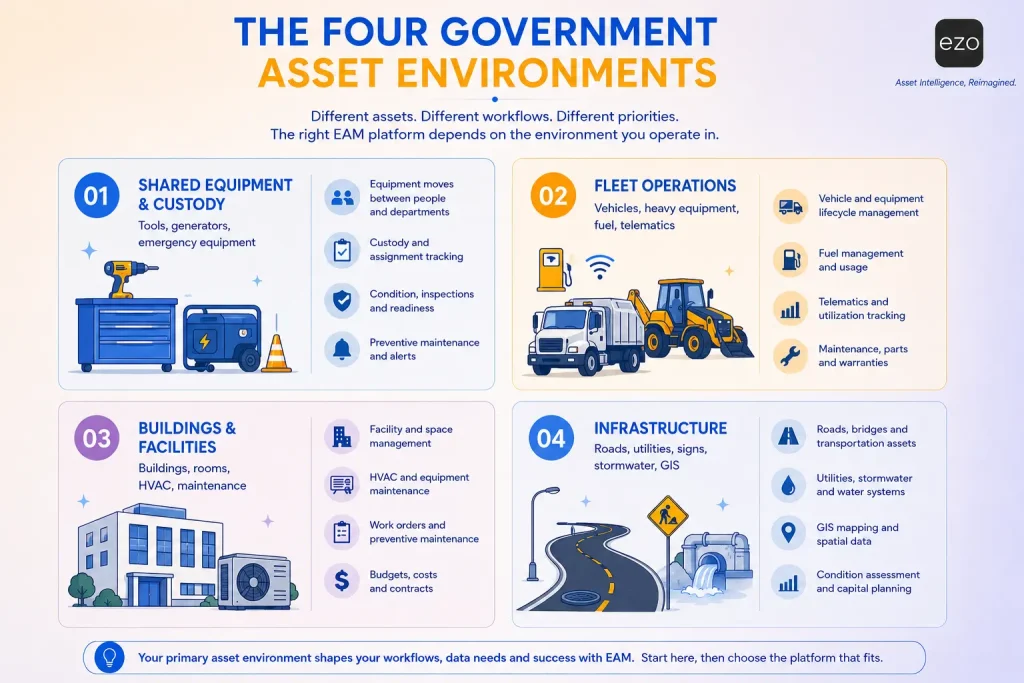
Government asset environments fall into four broad operating contexts, and this classification does more useful work than any feature count:
- Shared equipment and custody. Equipment moves between departments, employees and field teams. The priority is accountability: who holds the asset, whether the checkout was approved, and when it is due back.
- Fleet operations. Vehicles and heavy equipment dominate. Priorities shift to preventive maintenance, fuel, workshops, parts, utilization, telematics and replacement planning.
- Buildings and facilities. Work requests, preventive maintenance, inspections, technician scheduling and facilities reporting carry the most weight.
- Roads, utilities, and public infrastructure. Spatial complexity becomes central: GIS connectivity, field inspections, condition assessment, service requests and capital planning.
A platform built for municipal infrastructure may be exceptional for a roads department and unnecessarily complex for one controlling shared tools. Asset management is contextual, and these four environments are the lens used throughout.
How we selected and evaluated the platforms
Government EAM comparison has an evidence problem. Vendor websites communicate value; procurement requires more. A platform can advertise an audit trail without specifying which events are recorded, or list a capability needing another module or a custom integration.
Vendor claims below cite the source supporting them. Where a capability is asserted by a vendor but not independently confirmable, it is attributed rather than stated as fact.
Minimum inclusion requirements
Every platform required an active product offering as of the review date, physical-asset lifecycle capabilities, maintenance or work-management functionality, multi-location support, documented capability applicable to public-sector operations and an identifiable current product, not only a legacy name.
That bar is capability-based, not deployment-based. Some platforms also carry named government references; others are assessed on documented capability alone, and each profile states which applies.
Evidence standards
Evidence was prioritized in this order: official product documentation, security and compliance registries, vendor trust centers, named government case studies, procurement records, independent reviews and practitioner discussion as qualitative context.
The distinction between “not publicly verified” and “not available” matters. Where a capability could not be confirmed through public evidence, it is marked not publicly verified rather than assumed absent. Absence of evidence is not evidence of absence.
How platforms are evaluated and ordered
Each platform is assessed against seven dimensions: asset lifecycle and maintenance depth; public-sector fit; auditability and access controls; ERP, GIS and identity integration; mobile and field execution; implementation burden; and quality of public evidence.
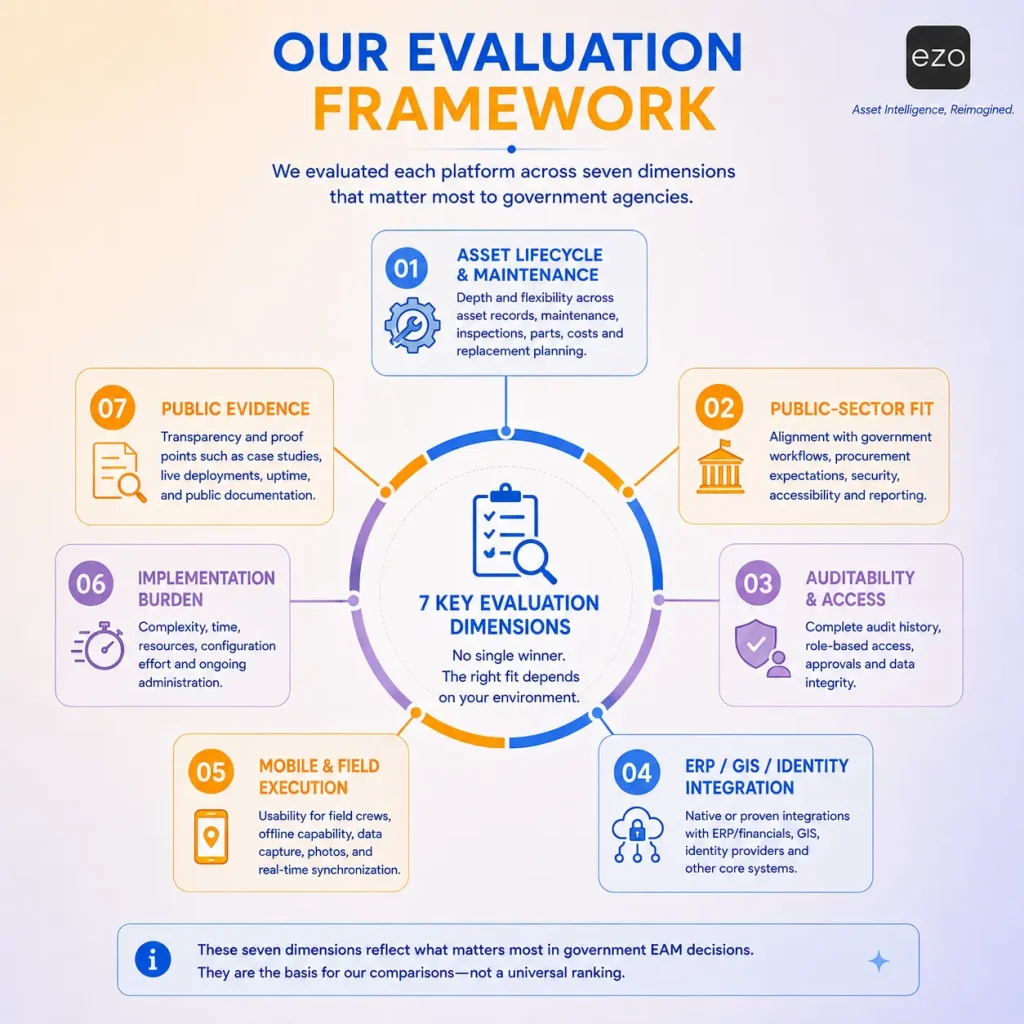
These are applied qualitatively in each profile rather than reduced to a composite score, because the weighting that matters is the reader’s own. A fleet department and a facilities department would weigh them differently, and a single ranked number would obscure that rather than resolve it.
Platforms are therefore listed alphabetically, not ranked. A specialized platform can outperform a broader suite for one department, and a platform ideal for a fleet may be wrong for facilities. A product strong on functionality can still fail procurement on security, accessibility, hosting or contract terms.
Feature lists tell you what exists. Workflows tell you what happens.
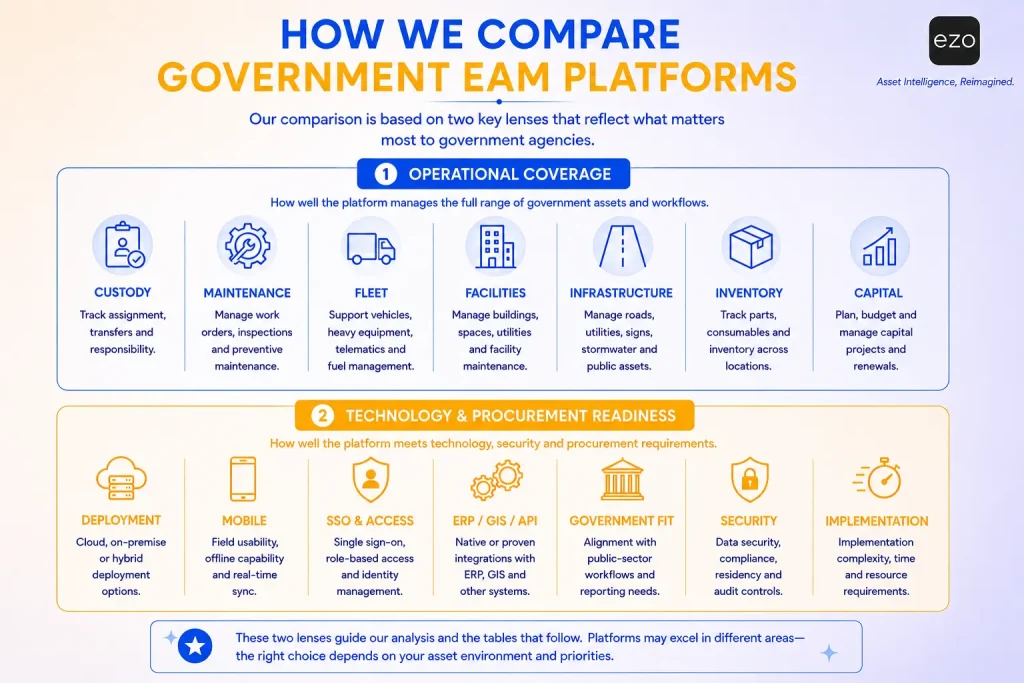
Government EAM software comparison
Each cell states what exists and under what condition. “Not publicly verified” means the claim could not be confirmed; “not available” means the capability is absent.
Asset and maintenance coverage compared
| Platform | Equipment and custody | Maintenance and work orders | Parts and inventory |
|---|---|---|---|
| Asset Essentials | Asset records with maintenance history; custody not publicly verified | Work orders, preventive maintenance, IoT-threshold predictive | Parts inventory and transactions |
| AssetWorks | Vehicle and equipment records; custody not publicly verified | Work orders, preventive maintenance, workshop management | Parts inventory in FleetFocus |
| EZO EAM | Checkout, reservation, transfer, return and approval workflows with custody history | Preventive schedules, inspections, work orders | Stockrooms, consumables, purchase orders |
| IBM Maximo | Asset hierarchies with location and ownership history | Work management, preventive maintenance, condition monitoring | Inventory and procurement |
| Octave Attune EAM | Asset hierarchies, linear assets, asset moves | Work orders, preventive maintenance, calibration, crews | Requisitions, purchase orders, stock levels |
| OpenGov EAM | Infrastructure records; custody not publicly verified | Work orders, service requests, field inspections | Materials and resource-usage tracking |
| Tyler EAM | Asset records with geo-location; custody not publicly verified | Work orders, maintenance programs, inspections | Not publicly verified |
Asset class coverage compared
| Platform | Fleet | Facilities | Infrastructure and GIS | Capital planning |
|---|---|---|---|---|
| Asset Essentials | Not publicly verified | Facilities and building maintenance | Separate Siemens product | Separate Siemens product |
| AssetWorks | FleetFocus: maintenance, parts, utilization | AssetWorks EAM: facilities, parks | AssetWorks EAM: public works infrastructure with GIS | Capital Asset Management (CAM) |
| EZO EAM | Vehicle records; fuel and workshop modules not available | Asset records by location | Through integration | Through ERP integration |
| IBM Maximo | Separate application | Separate application | Spatial asset management with Esri | Separate application |
| Octave Attune EAM | Vehicle asset moves; fuel management not publicly verified | Facilities and building assets | Esri GIS integration | Not publicly verified |
| OpenGov EAM | Through integration | Facilities asset and work management | Esri partner: pavement, signs, signals, stormwater, water | Capital improvement planning |
| Tyler EAM | Not publicly verified | Not publicly verified | Esri ArcGIS across public works assets | Capital improvement tracking via Asset Performance |
Deployment and technology compared
| Platform | Deployment | Mobile and offline work | Access controls and SSO |
|---|---|---|---|
| Asset Essentials | Cloud | Mobile capture in poor-connectivity areas | Not publicly verified |
| AssetWorks | Cloud and on-premises by product | MobileFocus for technicians | Not publicly verified |
| EZO EAM | Cloud | iOS, Android and Windows apps with barcode and QR scanning | Role-, location- and responsibility-based; SSO via Okta, OneLogin, PingIdentity, Entra ID |
| IBM Maximo | Cloud, on-premises, hybrid | Mobile field-execution apps | Enterprise identity and role-based access |
| Octave Attune EAM | Cloud and on-premises | Offline app runs disconnected after initial sync | Enterprise access controls |
| OpenGov EAM | Cloud | Mobile field apps for inspections and work | Platform roles; SSO not publicly verified |
| Tyler EAM | Cloud | Mobile and field apps; offline scope not publicly verified | Ecosystem roles; not publicly verified |
Integration and procurement fit compared
| Platform | ERP, GIS and API connectivity | Government specialization | Typical implementation profile |
|---|---|---|---|
| Asset Essentials | Open APIs; other Siemens products | Education, government facilities, local agencies | Lightest of the seven for facilities-only scope |
| AssetWorks | Open APIs; fuel, telematics, GIS | US state and local fleet and public works | Module-dependent; multi-product scope extends timelines |
| EZO EAM | REST API with ERP, identity, service-desk and accounting | General-purpose EAM applied to public-sector operations | Configuration-led; lighter than enterprise suites |
| IBM Maximo | Enterprise integration framework; Esri spatial | Transportation, utilities, federal agencies | Multi-month enterprise program, partner-led |
| Octave Attune EAM | REST API, enterprise connectors, Esri GIS | Utilities, transit, water and wastewater | Configuration-heavy; partner-led |
| OpenGov EAM | Esri partner solution; 311 and fuel integrations | Built exclusively for the public sector | GIS data quality drives effort |
| Tyler EAM | Tyler ERP and permitting; Esri ArcGIS; API toolkits | Built exclusively for the public sector | Shorter where Tyler is already in place |
Security evidence describes publicly verifiable attestations and documentation. It does not mean any deployment satisfies an agency’s requirements. Every platform here requires agency-specific verification of FedRAMP or StateRAMP status, hosting model, accessibility and contract terms.
Our wider review of enterprise asset management platforms covers how these products position outside government.
The 7 best enterprise asset management platforms for government
Asset Essentials: Best for government facilities maintenance
Verdict. Asset Essentials suits government facilities teams wanting accessible work-order and preventive-maintenance management without a large enterprise suite. Facilities work differs from infrastructure modeling: the goal is keeping buildings, equipment, rooms and systems operational.
Naming. The product name has not changed; the company brand has, twice. Dude Solutions renamed itself Brightly Software in March 2022, Siemens acquired Brightly later that year, and in July 2026 Brightly completed its transition to the Siemens brand as Siemens Asset Management Software. The product remained Asset Essentials throughout, and that is the current official name.
Best-fit environment. Government buildings, municipal facilities, libraries, recreation centers and administrative campuses.
What Asset Essentials manages.
- Asset records: asset and equipment history
- Workflows: work requests and work orders
- Maintenance: preventive maintenance, inspections, IoT-threshold predictive
- Inventory: parts inventory and transactions
- Access and automation: not publicly verified
- Integrations: open APIs; other Siemens products
Strength. Straightforward maintenance adoption for buildings. When the requester, the technician and the administrator reviewing the backlog can all navigate the workflow without excessive complexity, the system becomes part of daily operations. A capable system staff avoid creates less value than a simpler one they use.
Auditability and access controls. Not publicly verified. Confirm which maintenance and inspection events enter asset history, and what SSO options exist.
Integrations and field execution. Open APIs are documented, alongside integration with other Siemens asset products. The mobile app supports work capture in poor-connectivity areas; confirm how much of the workflow completes fully offline before relying on it.
Implementation and administration. Lighter than enterprise EAM suites, which is much of the appeal for facilities teams with limited administrative capacity.
Pricing and licensing. Confirm which Siemens or legacy Brightly products deliver the scoped workflows.
Important limitations. Asset Essentials may function more as a CMMS or facilities-maintenance system than a comprehensive EAM. It is a weaker fit where an agency needs deep fleet, infrastructure, custody and asset-performance management in one environment.
Questions buyers should verify. Does it cover non-facility assets? Which capital-planning capabilities exist? What offline support is provided? Which Siemens or legacy Brightly products are required?
AssetWorks: Best for government fleet operations
Verdict. AssetWorks suits public-sector organizations where vehicles, fuel, workshops, parts and fleet-replacement decisions dominate. For a fleet manager, a vehicle is a moving cost center: fuel, mileage, technician time, parts, utilization and replacement timing shape its lifecycle economics, which makes fleet a specialized problem rather than a subset of a general one.
Scope note. AssetWorks sells several distinct products that are not interchangeable. FleetFocus covers fleet maintenance, work orders and parts; FuelFocus covers fuel; AssetWorks EAM covers public works infrastructure, facilities and parks; Capital Asset Management (CAM) covers capital planning. Identify which are in scope before comparing quotes: a fleet-only quote and a fleet-plus-EAM quote are different purchases.
Best-fit environment. Municipal vehicle fleets, state transportation fleets, public-safety fleets, transit operations and government workshops.
What AssetWorks manages.
- Asset records: vehicle and equipment records, warranty tracking
- Workflows: work orders, workshop operations, technician and labor management
- Maintenance: preventive maintenance, replacement planning
- Inventory: parts in FleetFocus; fuel in FuelFocus
- Access and automation: not publicly verified
- Integrations: open APIs; fuel, telematics, GIS
Strength. Deep public-sector fleet specialization. Where vehicles and heavy equipment represent most of an agency’s assets, fleet depth creates more value than enterprise breadth.
Auditability and access controls. Not publicly verified. Confirm which fleet events are recorded and how access is scoped across departments and workshops.
Integrations and field execution. Open APIs with fuel, telematics and GIS integrations are documented, and MobileFocus supports technician workflows.
Implementation and administration. Scope depends on selected products and the state of existing fleet data, especially fuel and telematics history.
Pricing and licensing. Product- and module-dependent. Confirm which products deliver the scoped workflows.
Important limitations. Breadth here comes from buying several products rather than one. An agency needing fleet, facilities, infrastructure and capital planning is assembling a multi-product estate, with the licensing, integration and administration implications that follow.
Questions buyers should verify. Which products are included? How are non-vehicle assets handled? What telematics and fuel integrations exist? Can data consolidate across departments?
EZO EAM: best for connected equipment, custody and maintenance workflows
Verdict. EZO EAM suits agencies connecting equipment accountability with availability, reservations, inspections, maintenance, inventory and field operations without a heavily customized enterprise suite. Its strongest proposition is not that it maintains an asset record, but that the operational events surrounding an asset connect to that record.
Basis of assessment. This profile rests on documented product capability rather than a named public-sector deployment. Request reference customers at comparable scale.
Best-fit environment. Shared tools and equipment, distributed departments, municipal operations, field-service teams and public-safety equipment.
What EZO EAM manages.
- Asset records: lifecycle history; barcode, QR, RFID, GPS and telematics
- Workflows: checkouts, reservations, transfers, returns, approvals, chain-of-custody, requests and dispatch
- Maintenance: preventive maintenance, inspections with photos and signatures, work orders, service history
- Inventory: parts, consumables, stockrooms, purchase orders
- Access and automation: role-, location- and responsibility-based permissions; SSO via Okta, OneLogin, PingIdentity and Entra ID; automation for overdue returns
- Integrations: REST API with ERP, identity, service-desk and accounting
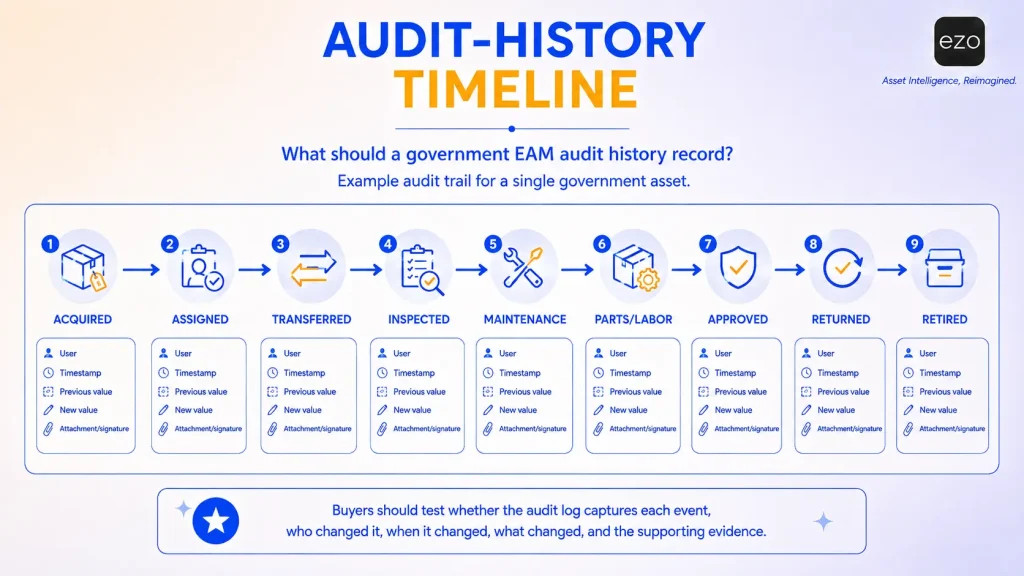
The differentiating workflow. A conventional register records that a generator exists and where it was assigned. A connected workflow follows it through assignment → transfer → inspection → maintenance → parts consumption → return to service. When those events live in separate systems, someone reconstructs the story later, by hand.
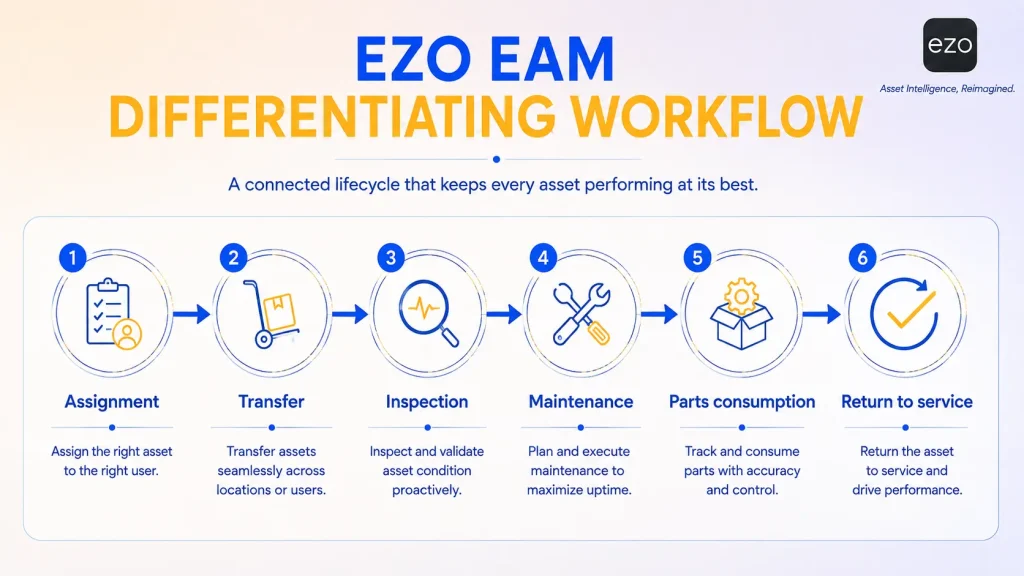
Auditability and access controls. Test what the platform records when an asset changes hands, location, condition or status: whether custody changes persist, whether approvals enter the asset’s history and whether permissions vary by role and location. The question is not whether an audit log exists, but whether it reconstructs the decision trail.
Integrations and field execution. REST API and integration workflows cover ERP, identity, service-desk and accounting environments, with iOS, Android and Windows apps supporting barcode and QR scanning, inspections and maintenance. Agencies with inconsistent connectivity should test offline behavior directly.
Implementation and administration. EZO EAM targets agencies wanting connected lifecycle workflows without a heavily customized deployment. Outcomes still depend on asset-data quality, department and location structures, permission design and user adoption.
Pricing and licensing. Request deployment-specific pricing rather than treating list pricing as a procurement estimate. Confirm what the base product includes, which capabilities require additional plans, how users are licensed, whether integrations are priced separately and what applies at termination.
Important limitations. EZO EAM is not a universal answer for every federal or highly regulated environment. Dedicated fuel-management and workshop modules are not available, and capital planning runs through ERP integration rather than a native module. Verify FedRAMP or StateRAMP requirements, hosting and data-location requirements, accessibility documentation and security attestations. Separate “the platform can technically support this workflow” from “the platform satisfies our procurement requirements.” It is a weaker fit where an agency needs deep enterprise reliability modeling.
Questions buyers should verify. Can unsafe or overdue equipment be blocked from issue? Which record changes appear in the audit history? What offline functionality exists? Which security and accessibility documents are available?
IBM Maximo: best for highly complex, asset-intensive agencies
Verdict. IBM Maximo Application Suite suits agencies managing complex, critical or deeply hierarchical assets that justify a significant enterprise implementation. Maximo’s strength is depth: assets that are components of larger systems governed by reliability requirements.
Best-fit environment. Transportation authorities, utilities, large state or federal departments, airports, ports and agencies with mature reliability programs.
What IBM Maximo manages.
- Asset records: complex hierarchies with location and ownership history
- Workflows: work management, mobile field execution
- Maintenance: preventive maintenance, condition monitoring, reliability and predictive capabilities
- Inventory: inventory and procurement
- Access and automation: enterprise identity and role-based access
- Integrations: enterprise integration framework; Esri spatial
Strength. Depth across maintenance, reliability, risk and asset performance. For a complex infrastructure operator, the useful question is rarely whether a maintenance task exists; it is whether maintenance history, condition, reliability and inventory inform one another.
Auditability and access controls. IBM Maximo provides enterprise identity and role-based access controls. Confirm which events are captured, how record-level changes are tracked and how audit data is exported.
Integrations and field execution. Extensive enterprise integration, including GIS-connected operations and mobile field execution. Confirm which integrations are native versus delivered through extra applications.
Implementation and administration. This is where Maximo demands most scrutiny: implementation complexity, specialist configuration, integration effort, administrative overhead and modular licensing. Complexity is valuable only when the problem is complex enough to justify it. Otherwise a sophisticated system becomes an expensive repository of unused functionality.
Pricing and licensing. Licensing is modular and application-based. Establish exactly which Maximo applications are in scope before comparing costs.
Important limitations. Maximo is likely excessive where requirements are relatively straightforward and the agency lacks appetite for substantial implementation and ongoing administration.
Questions buyers should verify. Which Maximo applications are required? What is in the licensing model? How much customization is necessary? Who administers the system after launch?
Octave Attune EAM: best for configurable enterprise asset management
Verdict. Octave Attune EAM suits asset-intensive organizations requiring configurable maintenance, asset hierarchy, risk, reliability and integration capabilities. Lineage matters more here than for any other platform in this comparison. The product ran as Infor EAM until Hexagon acquired it in October 2021 and renamed it HxGN EAM; in May 2026 Hexagon’s software division spun off as the independent company Octave, and the product became Octave Attune EAM. Vendors describe this as a naming and ownership change, not a technology change, but an owner change within the last year warrants direct questions about roadmap, support continuity and contract novation.
Best-fit environment. Utilities, transportation infrastructure, public works, complex facilities and large multi-department organizations.
What Octave Attune EAM manages.
- Asset records: asset hierarchies, linear assets, asset moves
- Workflows: work planning and scheduling, crews, routes, mobile work
- Maintenance: preventive maintenance, inspections, calibration, risk and reliability
- Inventory: requisitions, purchase orders, stock levels
- Access and automation: enterprise access controls
- Integrations: REST API, enterprise connectors, Esri GIS
Strength. Configurable enterprise depth for complex physical assets.
Auditability and access controls. Enterprise access controls are documented; confirm the specific event history captured and the export path for audit review.
Integrations and field execution. REST API, native enterprise connectors and Esri GIS integration are documented. The Attune EAM Offline app runs disconnected after an initial sync, covering work management, materials, inspections and checklists. Confirm required release levels.
Implementation and administration. Configuration depth is the product’s strength and its cost. Assess implementation effort and the availability of experienced partners, alongside migration considerations for former Infor or HxGN deployments.
Pricing and licensing. Verify which functionality falls inside Attune EAM versus adjacent products.
Important limitations. Public evidence of US government deployments is thinner than for AssetWorks, OpenGov or Tyler, concentrated in utilities, transit and water. Request government references, and raise the ownership change explicitly in contract review.
Questions buyers should verify. Which functionality is part of Attune EAM? How does the roadmap affect existing HxGN or Infor deployments? What government-specific evidence is documented?
OpenGov EAM: best for municipal infrastructure and public works
Verdict: OpenGov Enterprise Asset Management, formerly Cartegraph, suits municipalities connecting public works, field activities, GIS-based assets and capital planning. Geography carries analytic weight here: a road, stormwater system or signal is defined partly by where it is and what surrounds it.
Best-fit environment. Roads and streets, signs and signals, water and wastewater assets, parks infrastructure and stormwater systems.
What OpenGov EAM manages.
- Asset records: GIS-connected infrastructure records, condition assessment
- Workflows: work orders, service requests, mobile field work
- Maintenance: field inspections, maintenance programs
- Inventory: materials and resource usage
- Access and automation: platform roles; SSO not publicly verified
- Integrations: Esri partner solution; 311 and fuel systems
Strength. Documented coverage of pavement, signs, signals, stormwater, water distribution and parks assets, with capital improvement planning attached. An infrastructure system is not an EAM with a GIS layer added afterward: spatial context changes how work is prioritized. When ten assets need maintenance, the decision turns on location, condition, service impact and capital priorities.
Auditability and access controls. Not publicly verified. Confirm how inspection findings, condition ratings and work history are retained and exported.
Integrations and field execution. OpenGov EAM is listed as an Esri partner solution, and 311 and fuel-system integrations are documented. Establish the depth of the Esri integration in practice: whether location, condition, inspection and work history genuinely connect to the GIS record.
Implementation and administration. Driven by the quality of existing GIS data and the number of asset classes in the first phase.
Pricing and licensing. Confirm which capabilities are native to OpenGov EAM and which require other OpenGov products.
Important limitations. Determine whether the agency needs a standalone operational EAM, a public-works platform or the wider OpenGov financial and administrative ecosystem. That ecosystem may create real value for municipalities already inside it, but test the advantage against a specialized alternative. Movable equipment and custody deserve scrutiny.
Questions buyers should verify. Which capabilities are native and which require other OpenGov products? How deep is the Esri integration? Can it manage movable equipment and custody?
Tyler EAM: best for agencies using Tyler’s public-sector ecosystem
Verdict. Tyler Enterprise Asset Management suits agencies valuing government-specific workflows and connectivity with an established civic software ecosystem. Its strongest differentiator may not be an individual EAM feature but reduced fragmentation between asset management and the other systems a municipality already runs.
Product structure. Tyler EAM ships as two applications: Asset Maintenance, for tracking and maintaining physical assets in the field, and Asset Performance, an analytics layer for forecasting asset-related expenses. Establish which is in the quoted scope.
Best-fit environment. Municipal and county governments, public works departments, agencies already using Tyler products, and 311 environments.
What Tyler EAM manages.
- Asset records: asset creation and geo-location
- Workflows: work orders, service requests, 311 connections, mobile field work
- Maintenance: maintenance programs, inspections
- Inventory: not publicly verified
- Access and automation: ecosystem roles; not publicly verified
- Integrations: Tyler ERP and permitting; Esri ArcGIS; API toolkits
Strength. Alignment with government administrative and civic-service environments, particularly where service requests, 311 and public works already run on Tyler systems. The platform is GIS-centric, integrating with an agency’s existing Esri ArcGIS server. Several dimensions above remain not publicly verified; request documentation covering fleet, facilities, custody and parts directly.
Auditability and access controls. Not publicly verified. Confirm how asset and work history is captured and, critically, how it exports in full.
Integrations and field execution. Native integration across Tyler products with mobile and field workflows. Non-Tyler integration effort deserves specific testing.
Implementation and administration. Driven by the agency’s existing Tyler footprint and the degree of shared data across products.
Pricing and licensing. Ecosystem-dependent. Establish which workflows require additional Tyler applications.
Important limitations. Integration creates value when it reduces duplication; it becomes a constraint when an agency cannot realistically consider alternatives because too many surrounding systems depend on the incumbent. Verify that the ecosystem benefit outweighs a more specialized or product-agnostic platform.
Questions buyers should verify. Are both Asset Maintenance and Asset Performance in scope? Which workflows require other Tyler applications? How easily do non-Tyler systems integrate? How is full history exported?
Which platform fits your government asset environment?
The shortlist shrinks once an agency names its primary problem.
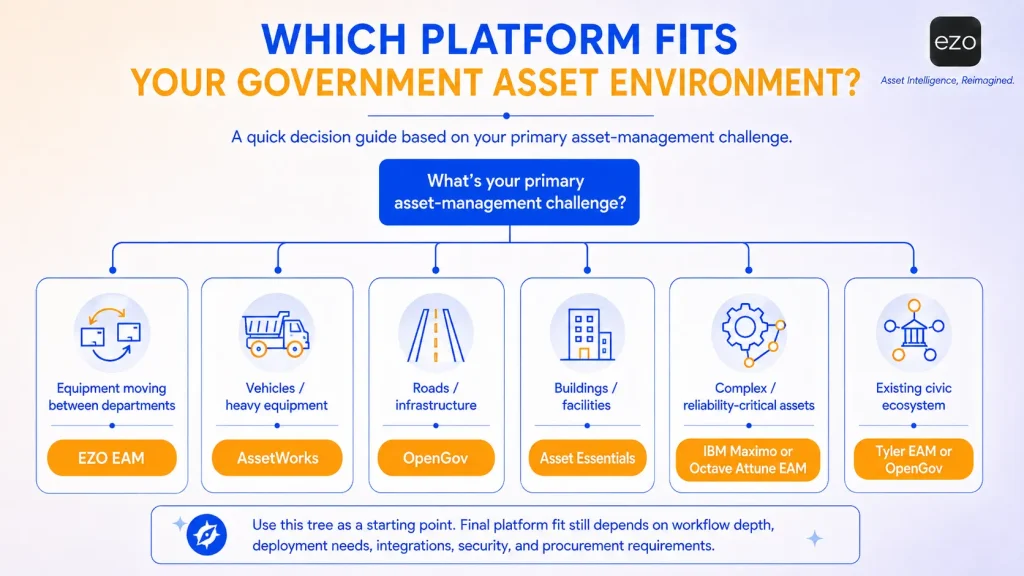
| If your primary challenge is… | Prioritize these capabilities | Evaluate first |
|---|---|---|
| Equipment moves between departments and must stay accountable | Custody, reservations, transfers, audit history | EZO EAM |
| Vehicles and heavy equipment dominate | Fuel, workshops, parts, telematics, replacement planning | AssetWorks |
| Roads and public infrastructure need coordinated work | GIS, inspections, service requests, condition and capital planning | OpenGov EAM |
| Government buildings need structured maintenance | Work requests, preventive maintenance, facilities reporting | Asset Essentials |
| Critical assets require reliability and complex hierarchies | Asset performance, risk, enterprise integration | IBM Maximo/Octave Attune EAM |
| The agency already relies on a civic software ecosystem | Shared data and connected government workflows | Tyler EAM/OpenGov EAM |
| One platform must span two or more asset environments | Breadth, integration layer, consistent audit history | Shortlist across categories and test the trade-off |
The warning inside this table: the best platform for a fleet department may be wrong for facilities. Decide first whether the agency needs one enterprise platform, specialized departmental systems or an integration layer, and make that decision before the shortlist becomes politically difficult to change.
Don’t watch the demo. Test the workflow.
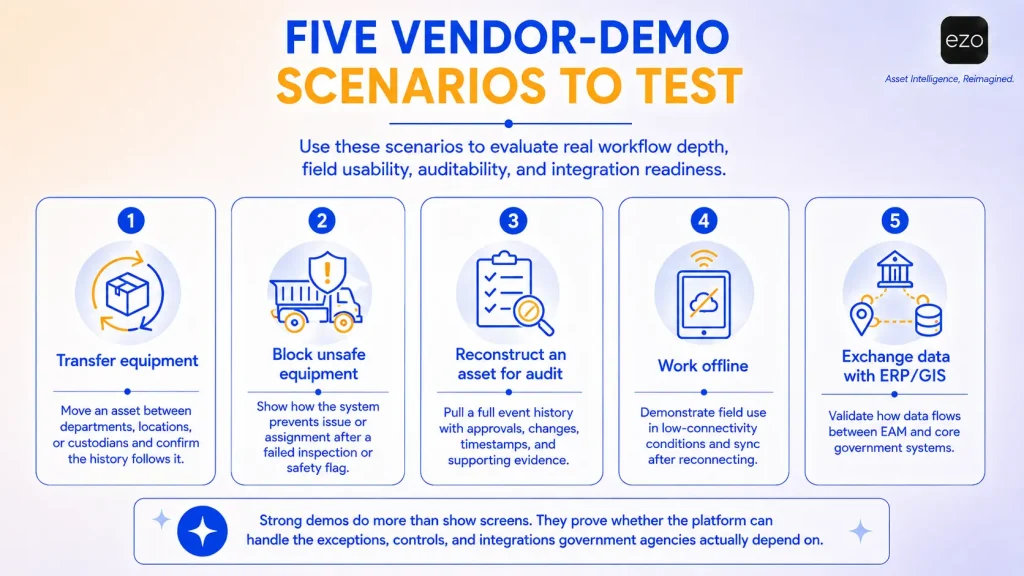
Vendor demonstrations are designed to persuade. A structured scenario test produces evidence. Give every shortlisted vendor the same five scenarios, the same data and the same criteria, and the question shifts from which demonstration did we like most to which system performed best under comparable conditions.
The unit of analysis is not the feature. It is the workflow.
Scenario 1: Transfer equipment between departments
Move a generator from public works to emergency management: transfer custody and location, preserve the previous owner, require approval, update availability and display the full transfer history. Watch for duplicate entry, manual handoffs, missing history and permission gaps.
Scenario 2: Prevent unsafe equipment from being issued
Ask what happens when preventive maintenance is overdue, an inspection fails or a safety hold is applied, then have a user attempt to reserve or issue the asset. The key question is whether the system merely records the problem or changes what users are allowed to do. That distinction separates an information system from a control system.
A system that asks employees to remember to record an inspection depends on memory and compliance. A system that makes the inspection a prerequisite for issuing the asset changes the decision environment itself.
Scenario 3: Reconstruct an asset for an audit
Retrieve acquisition details, assignment history, location changes, inspection results, maintenance records, costs and disposal records, with no advance preparation. This tests organizational memory under pressure, the condition auditors actually create.
Scenario 4: Complete field work without reliable connectivity
Have a technician locate the asset, complete an inspection, add photos and notes, record parts and labor, capture a signature and sync later. Do not accept a general claim that the platform is mobile. Test it under the connectivity your field teams have.
Scenario 5: Exchange data with ERP and GIS systems
Test whether the system sends costs and purchase data to the ERP, receives department and financial codes, syncs locations with GIS, prevents duplicates, flags failures and preserves source and last-updated data.
Integration demonstrations are usually optimistic. Every organization eventually hits a failed sync, duplicate record or incorrect mapping, so ask how the system tells you something went wrong. A successful integration is useful; a visibly failed one is arguably more useful, because the agency can correct it before the error institutionalizes.
Demo scorecard
Score each scenario across seven dimensions:
- Manual effort. Count clicks, screens, fields, handoffs and duplicate entries. This dimension predicts data quality later: as a workflow becomes longer and more fragmented, the risk of skipped fields, delayed updates and parallel spreadsheets rises, and compliance declines quietly. The feature still exists, but the organization stops receiving the data it expected.
- Configuration. Native workflow versus customization required.
- Evidence captured. History, attachments, timestamps, previous and new values.
- Permission enforcement. Whether controls apply automatically rather than by convention.
- Field usability. Mobile and offline practicality under real conditions.
- Integration dependency. Additional modules or middleware required.
- Export quality. Completeness and usability of extracted data.
Usability is not merely a UX consideration. For asset management, usability can directly affect data quality.
What should government buyers verify about security and compliance?
Security evidence is evidence. It is not automatic procurement approval. A platform can have exactly the workflows an agency needs and still fail on hosting model, security documentation, accessibility evidence or contract terms. Different frameworks answer different questions.
FedRAMP. May apply when a federal agency procures a cloud service; relevance depends on the agency, the data, impact level and acquisition terms. Verify status in the official FedRAMP Marketplace. A SOC 2 report is not a substitute for FedRAMP authorization.
StateRAMP. May apply to certain state and local procurements, with requirements varying by jurisdiction and contract. Verify status through the appropriate registry.
SOC 2 and ISO 27001. SOC 2 is an independent attestation about controls; ISO 27001 concerns an information-security management system. Neither makes a product automatically acceptable for a given procurement.
Accessibility. Request a VPAT, Section 508 documentation, WCAG conformance information, testing practices and the remediation process, for both administrative and mobile interfaces. Missing documentation can eliminate an otherwise suitable vendor late in review.
Data governance. Confirm data residency, encryption in transit and at rest, backup and disaster recovery, retention and deletion, public-record and legal-hold handling, SSO, role-based access and complete data export at termination.
What should a government EAM audit history record?
An audit trail is only as useful as the events it captures. Verify that the system records the event performed, the responsible user, timestamp, previous and new values, custody and location changes, approvals and rejections, inspections and findings, maintenance history, parts, labor and costs, attachments and signatures, deletions, administrative actions and export details.
Do not assume an audit log captures every event. Ask the vendor to reconstruct a real asset history during the demonstration, and check what standard asset reports pull without custom development.
Can EAM software support GASB reporting?
EAM supplies operational asset information that supports financial reporting, but it does not determine accounting compliance. GASB Statement 34 concerns financial reporting; accounting policy, capitalization rules, depreciation method and ERP configuration determine compliance.
An EAM system may supply asset identity, acquisition dates, condition, location, maintenance costs, retirement status, replacement estimates and inspection results. Capitalization, depreciation, book value, fund accounting and disclosures generally remain in the ERP.
Treat any “GASB 34 certified” claim with caution unless the vendor can support it precisely.
What integrations should government EAM software support?
ERP and financial systems. Purchase orders, vendors, cost centers, departments, project and funding codes, labor and parts costs and disposal records.
GIS platforms. Esri ArcGIS connectivity, spatial records, linear assets, field inspections and location sync.
Identity and access. SSO, SAML, SCIM, Microsoft Entra ID, Active Directory and automated provisioning.
Telematics and field technology. GPS location, engine hours, odometer readings, fault and condition data, maintenance triggers, and barcode, QR and RFID hardware.
APIs and exports. API coverage, rate limits, webhooks, bulk import and export, integration monitoring and exit-ready formats.
Build a government EAM RFP scorecard
Structure the RFP around five categories rather than a feature list, so procurement is not dominated by feature counting.
| Category | What to specify |
|---|---|
| Operational | Asset classes, locations, custody, reservations, work orders, preventive maintenance, inspections, fleet, facilities |
| Technical | Deployment, mobile and offline work, ERP and GIS integration, identity, API access, migration, reporting, export |
| Security and accessibility | Authorizations, attestations, encryption, residency, retention, disaster recovery, access controls, audit history, VPAT, Section 508, WCAG |
| Vendor and implementation | Implementation ownership, partners, training, support SLAs, upgrades, roadmap, references, procurement experience |
| Commercial | Licensing unit, required modules, implementation fees, integration and storage costs, annual increases, contract length, renewal, data export |
How much does government EAM software cost?
Public pricing for government EAM is inconsistent enough that a cheapest-to-most-expensive ranking would create false precision. Vendors may charge by named user, concurrent user, technician, asset, location, department, module, enterprise agreement or platform consumption, so two quotes can be structured differently enough that direct comparison is meaningless.
Costs beyond the subscription include implementation, data cleanup, migration, integrations, configuration, mobile devices, asset tags, training and added modules.
The better question is not how much does it cost but what will we actually pay to make this system operational. Ask each vendor: What is in the base product? Which capabilities require separate modules? Are requester or field-user accounts charged? Are integrations priced separately? Is offline functionality included? How are future asset or user increases priced? What costs arise when the contract ends?
How should agencies estimate implementation effort?
Inventory and data cleanup. Assess duplicate records, missing serial numbers, inconsistent names, obsolete assets and unknown ownership. Migrating poor records reproduces the old problem in a better interface.
Asset hierarchy and data model. Define departments, sites, facilities, parent-child relationships and custody before configuration.
Workflow and permissions. Define approval paths, maintenance escalation, inspection-failure handling and security roles.
Integrations and testing. Cover ERP, GIS, identity provider, telematics and reporting, including failure behavior rather than only successful sync.
Pilot and rollout. Pilot one department, one asset class and representative field and administrative users. Treat any universal timeline with skepticism.
How to build the business case for government EAM
Establish the baseline first. Measure missing or unassigned assets, preventive-maintenance completion, emergency-work percentage, work-order completion time and audit-preparation time. Without a baseline, improvement claims are unverifiable.
Trace the second-order effects. Better custody records reduce missing assets and the replacement purchases that follow. Better preventive maintenance and work order tracking reduce deferred work, emergency repairs and downtime. Better lifecycle data makes capital requests more defensible. Valuing this only through software cost savings understates the case, because much of the value sits in decisions otherwise made with incomplete information.
Separate financial from public-service value. Financial value covers lower purchasing and maintenance costs, reduced administrative effort and better use of existing assets. Public-service value covers more reliable equipment, faster response to service requests and safer field operations.
That distinction matters more in government than in commercial asset management. A private organization asks how to maximize the return on an asset. A government agency has a broader obligation: how to responsibly steward an asset that exists to serve the public. A road, a fire-service tool and a municipal facility are each part of a system through which public resources become public services. Avoid promising a standard ROI figure.
Know which level you are starting from. Agencies sit at one of five: visibility (registers, “what do we have”), control (assignments, transfers, approvals, custody history), maintenance (preventive work, work orders, inspections), intelligence (lifecycle cost, reliability, replacement planning), and integrated stewardship (ERP, GIS, identity and telematics connected across departments). An agency struggling with custody does not need what a mature infrastructure authority needs.
Common mistakes when selecting government EAM software
- One product for every asset class without testing fit. A fleet system, a facilities CMMS and an infrastructure platform solve different problems.
- Comparing feature counts instead of workflows. A feature may exist and still require multiple modules or manual steps.
- Treating security terms as interchangeable. FedRAMP, StateRAMP, SOC 2, ISO 27001, CJIS and FIPS address different requirements.
- Ignoring accessibility until procurement review. Missing documentation can eliminate a suitable vendor.
- Underestimating data cleanup. Poor records migrate faithfully.
- Overcustomizing before adoption. It increases implementation time and upgrade complexity.
- Ignoring data-exit provisions. Establish how the agency retrieves asset, work, attachment and audit data at contract end.
- Buying for management without testing field work. Technicians should test mobile under realistic connectivity.
Final recommendation
Start with the asset environment, not the vendor shortlist.
Choose EZO EAM when equipment moves between departments and custody, availability, maintenance and inventory must connect without heavy customization. Choose AssetWorks when vehicles, fuel, workshops and replacement planning dominate. Choose OpenGov EAM when roads, utilities and public infrastructure require GIS-connected work. Choose Asset Essentials when government buildings need structured preventive maintenance. Evaluate IBM Maximo or Octave Attune EAM when asset hierarchies, reliability and risk justify enterprise depth. Consider Tyler EAM where an existing civic ecosystem materially reduces fragmentation.
Define asset classes, workflows, evidence requirements, integrations and procurement constraints before comparing demonstrations.
Shortlist two or three platforms and require each vendor to complete the same five operational scenarios using representative agency data. Give vendors problems rather than demonstrations.
The underlying principle sits above every scorecard in this guide: do not buy EAM software to manage assets. Buy it to improve the decisions and behaviors surrounding those assets.