
Disclaimer: EZO publishes this guide. The methodology is vendor-neutral and works with any asset register, whether that is an asset management system, a spreadsheet, or another controlled record-keeping system. A separate section near the end explains how EZO EAM supports parts of the process.
What is an equipment inventory audit?
An equipment inventory audit compares physical equipment with equipment records to verify that the equipment exists and that the recorded information is accurate, including identity, location, custody, condition, and status. A reliable audit runs in both directions. Checking the register against physical equipment tests existence, while checking physical equipment against the register tests completeness. Physical verification ends fieldwork, but reconciliation ends the audit. Reconciliation is complete only once discrepancies have been investigated, approved corrections have been applied, and unresolved exceptions have been given accountable owners and due dates.
This guide describes operational physical verification and reconciliation carried out by internal staff as part of routine asset management. It is not a substitute for an independent assurance engagement performed under a professional auditing standard. Where an audit result has regulatory, grant, or contractual implications, confirm what your obligation requires before relying on this process.
Key takeaways
- Equipment inventory audits verify existence, identity, location, custody, condition, and status, not just quantities.
- A defensible audit starts with a defined scope, a preserved baseline snapshot, a documented exclusion log, and a controlled movement tracking process.
- Two-direction verification exposes completeness gaps because a register-led check cannot find equipment that was never recorded in the register.
- Preserve evidence before correcting records, then investigate using movement, custody, maintenance, procurement, and disposal history.
- “Not found” does not mean lost. Equipment may have been moved, checked out, sent for repair, or taken offsite.
- Completing fieldwork does not mean the audit is closed. Reconciliation requires approved corrections, documented exceptions, owners, due dates, and sign-off.
- Audit frequency should be based on equipment risk, and recurring discrepancies should trigger fixes to the workflows that cause record drift.
Why do equipment records drift
Your equipment register may say that a generator is sitting at Site A, that a camera kit is assigned to Department B, or that 14 tools are available for use. When was the last time anyone verified whether those records still match physical reality?
Records rarely become inaccurate all at once. Drift happens one transaction at a time. Someone transfers equipment to another site. An employee returns an item to the wrong location. A machine enters repair. A replacement arrives before anyone updates the old record. A team disposes of an asset, but its record remains active. These ordinary events are why asset tracking degrades quietly rather than visibly.
Individually, they look minor. Together, they leave an equipment register that looks complete but no longer describes the equipment an organization actually has. An equipment inventory audit closes that gap. It tests record reliability, documents discrepancies, identifies their causes, and establishes an accountable path to correct them.
What this guide covers
The primary methodology applies to individually tracked equipment: assets with their own identity, record, and history, such as machinery, tools, vehicles, IT hardware, and test equipment.
Bulk inventory, supplies, and consumables are managed by quantity rather than by identity and require their own inventory procedures. They are outside the main methodology here. Grouped stock still appears at two points because auditors encounter it inside equipment areas, but both points are labeled as adaptations rather than part of the core method.
Regulatory examples are US-specific, but the asset auditing principles behind them are not. The methodology itself is not bound by jurisdiction, though workplace photography rules, employee data handling, and where audit records may be hosted all vary by country. Confirm those locally before fieldwork.
Key terms used in this guide
Professional practice treats these terms as distinct, and this guide does the same.
| Term | Meaning in this guide |
|---|---|
| Equipment | An individually tracked operational item with its own identity and record |
| Equipment register | The system of record used to track equipment, sometimes called the asset register |
| Fixed asset | An item is capitalized on the balance sheet. Some equipment is a fixed asset, and some fixed assets are not operational equipment |
| Capital equipment | Equipment that meets the organization’s applicable capitalization policy |
| Property | Used where government or institutional sources use that term |
| Custody | Who is accountable for an item, which is not necessarily the same as where it physically sits |
| Register for the floor | Working from a record to the physical item, which tests existence. Also called a book-to-floor test |
| Floor to register | Working from a physical item back to the record, which tests completeness |
| ITAM | IT asset management, the equivalent discipline for IT hardware |
“Floor” means the physical areas in scope, including warehouses, yards, plant rooms, and sites. The two directional terms above are used consistently throughout, including in the metric names later on.
Three audit states that should not be confused
- Fieldwork complete. Planned physical verification has finished.
- Reconciliation complete. Discrepancies have been investigated, approved corrections have been applied, the report has been issued, and remaining exceptions have been given owners and due dates.
- Corrective action closed. All accepted exceptions have been resolved.
A report can be issued at reconciliation, complete with open exceptions still outstanding. Those exceptions stay tracked until corrective action is closed.
What an equipment inventory audit verifies
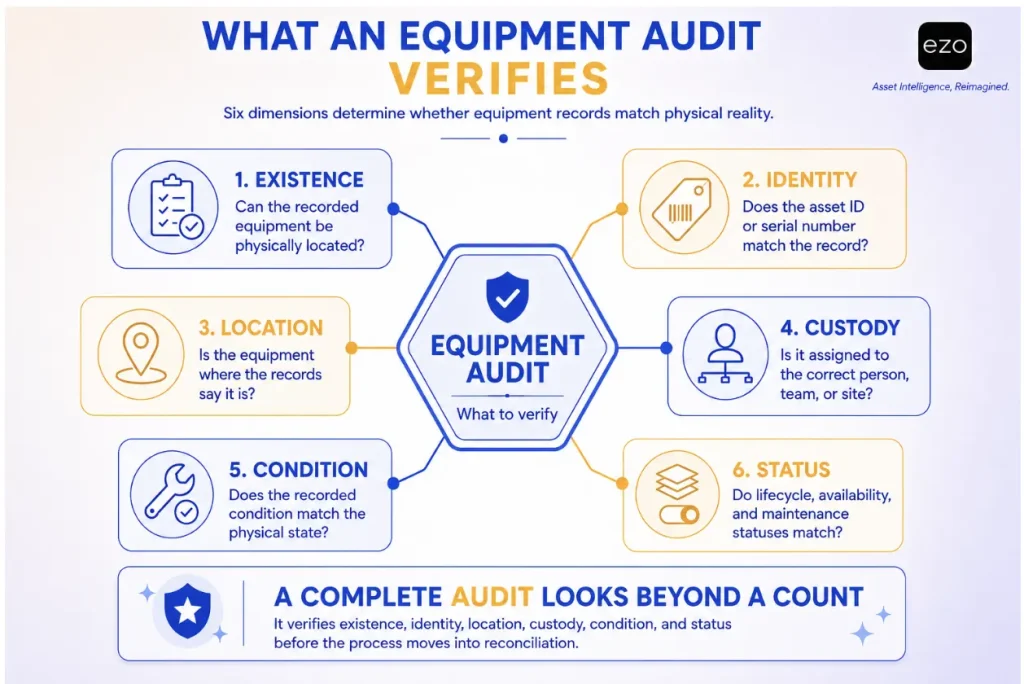
An equipment inventory audit verifies that equipment physically exists and that the recorded information is accurate.
US Department of State property procedures offer a useful control model. Under 14 FAH-1 H-611, physical inventory and reconciliation require a minimum of four actions: an actual count of the property; a comparison of that count with the balances recorded in the property records; the resolution of discrepancies, including management approval for record adjustments; and inventory adjustment and posting to the records. The same section expects the exercise to establish physical existence, location, condition, and use. That is one agency’s handbook rather than a universal rule, but the sequence is a sound model for any organization.
Those four actions cover most of what matters. The six dimensions below constitute EZO’s operational synthesis, extending the federal model with identity and custody, which matter more in environments where equipment is checked out and moved between people rather than stored in fixed locations.
1. Existence
Can the recorded item be physically located or otherwise verified using the evidence standard set for the audit? Failure to locate equipment during fieldwork is a discrepancy. It is not, by itself, proof of loss.
2. Identity
Is the item you found actually the item represented by the record? Finding a generator is not the same as finding the generator in the register.
Establish identity through a documented identifier hierarchy, ranked before fieldwork rather than improvised in the aisle. The reasoning behind the ranking matters more than any universal default:
- Serial number. Manufacturer-assigned and travels with the item permanently, but it can be worn, obscured, or recorded incorrectly at intake.
- Asset tag or equipment ID. Organization-assigned and designed for scanning, but it can fall off, be damaged, or be reapplied to the wrong unit. Sound asset tagging practice reduces that risk without eliminating it.
- Manufacturer, model, and description. These identify a model, not a unit, so they support a match rather than establishing one.
Where a tag and a serial number conflict, record the conflict as an exception and investigate it. Do not resolve it through an auditor’s judgment in the field.
3. Location
Is the equipment where its record says it is? Location data quickly becomes stale after transfers between sites, departments, projects, rooms, storage areas, and repair facilities. Organizations operating equipment across multiple locations experience this more quickly than single-site operations.
4. Custody
Is the item assigned to the correct person, department, team, or project? Location and custody are different fields. Equipment may physically reside at one site while responsibility for it lies with someone elsewhere. That is why custody transfer needs its own record.
5. Condition
Does the recorded condition match what the auditor observes? Condition data is only trustworthy if the scale is defined before fieldwork and includes observable criteria for each value.
A scale might run from “good” through “serviceable with defect” to “unserviceable,” but these values are illustrative only. Define values that are mutually exclusive and observable, and avoid mixing dimensions. For example, “new” describes age or origin rather than serviceability. A scale that combines these dimensions will be applied inconsistently across auditors, and the resulting data cannot be trended.
6. Status
Avoid overloading a single status field with unrelated states. Many systems use a single field successfully, but the values in it must answer a single question. Depending on your asset lifecycle model, separate:
- Lifecycle: active, retired, disposed of
- Availability: available, unavailable
- Custody or assignment: unassigned, reserved, checked out
- Maintenance: operational, under repair, awaiting service
- Audit state: verified, verification pending, not located
An item can legitimately be active, checked out, and under repair at the same time. Define the fields and allowed values before the audit begins, and use the same values in your checklist and discrepancy reporting, or the audit criteria will not be reproducible.
What an equipment inventory audit is not
Getting the boundary wrong creates unnecessary work and sends the wrong team into the field with the wrong criteria.
An equipment inventory audit verifies whether physical equipment corresponds to equipment records. It is one form of asset auditing, not the whole category. It differs from:
- A safety inspection, which asks whether equipment is safe, compliant, and suitable for operation.
- A maintenance inspection, which examines condition and service requirements and feeds the maintenance log rather than the register.
- A fixed-asset financial audit, which examines capitalization, valuation, depreciation, impairment, and disposal. Those are financial accounting and reporting subjects governed by accounting standards. Systems used to manage fixed assets support the underlying records, but they do not own the accounting judgments.
- A stock or inventory audit, which counts materials and consumables by quantity.
- An ITAM audit, which applies similar physical verification principles and, depending on scope, may also cover device, configuration, software, and security-control records.
The question this guide answers is narrower: does the equipment we are accountable for correspond to the equipment we say we have, and are the records describing it accurate?
What to prepare before an equipment inventory audit
Preparation determines whether fieldwork produces useful answers or ambiguity. It is also where much of the asset management practice that makes an audit defensible is applied.
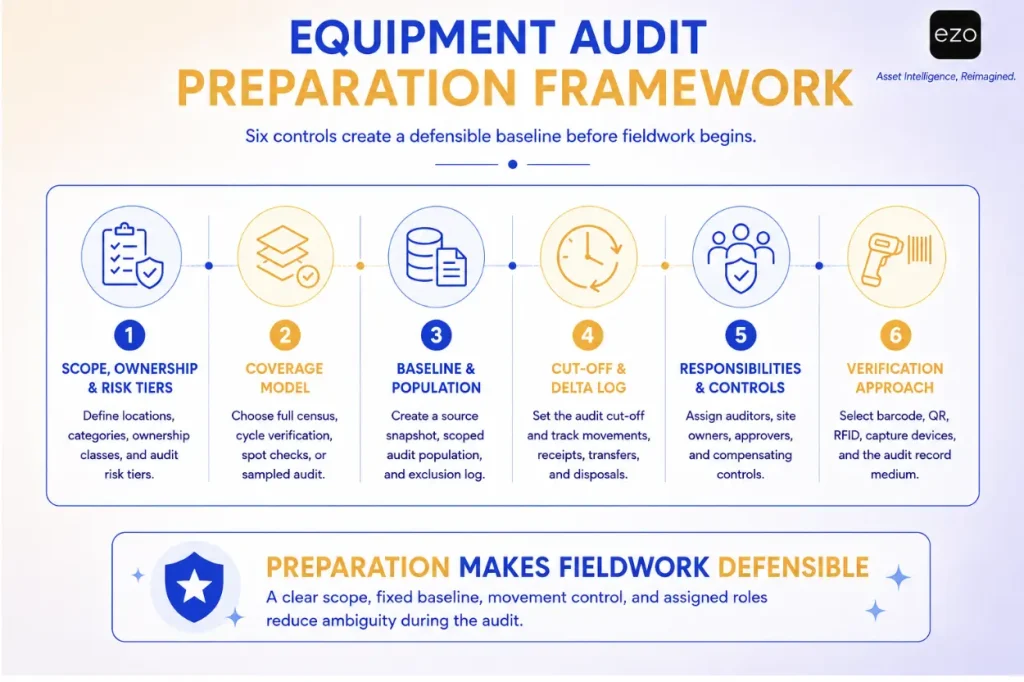
1. Define the objective, scope, and ownership classes
Document what the audit is intended to verify: locations and sites, departments, equipment categories, custodians, projects, the statuses in scope, the start and completion window, and any contractual, regulatory, insurance, or policy requirements that apply.
An audit may be organization-wide, site-specific, category-specific, or risk-based, and it may be triggered by an acquisition, a relocation, a suspected loss, a financial close, or a concern about record accuracy. “All equipment” sounds clear until you encounter items in transit, on loan, awaiting disposal, or temporarily in use elsewhere.
Ownership and possession classes. Not everything found at a site belongs in the equipment register. Decide now whether leased, rented, borrowed, customer-owned, consigned, demonstration, contractor-owned, and personally owned equipment should be included in the register, and record both inclusions and exclusions.
This step is necessary for Step 4. Without those classes, a floor-to-register sweep has no basis to distinguish third-party property from an unrecorded organizational asset. Both institutional sources cited in this guide handle it directly. State Department inventory preparation requires privately owned, demonstration, and leased property to be identified as such, and Florida Tech’s Asset Management Manual asks staff to mark personal property on campus so it is not inventoried by mistake.
Risk tiers. Rate equipment groups once and reuse the tiers, as they will drive audit coverage here and verification frequency later.
| Risk tier | Typical characteristics | Verification emphasis |
|---|---|---|
| High | Highly mobile, high value, security-sensitive, operationally critical, frequent custody changes, or a poor discrepancy history | More frequent verification, event-triggered checks, stronger review controls |
| Medium | Moves periodically, moderate operational or financial exposure, reasonably stable custody | Periodic full or cycle verification |
| Low | Stable location and custody, lower exposure, historically accurate records | Longer verification intervals with targeted checks |
Mandated cadence is an override, not a tier. Where a statute, contract, grant term, insurance condition, or internal policy sets a verification schedule, follow it regardless of where the equipment sits on the risk scale. Rate the equipment for risk as usual, then apply the mandate on top. Asset management compliance requirements should not be overridden by an internal risk score.
2. Choose a coverage model
Decide how much of the population will be verified before fieldwork begins.
- Full census. Every in-scope item and relevant physical area is verified, which is the model most often required for government and grant-funded populations.
- Cycle verification. Defined subsets are verified on a rolling schedule until the required population is covered, which better suits multi-site operations than a single annual count.
- Spot check. A targeted verification is used as a control or follow-up. It should not be presented as full coverage.
- Sampled audit. A defined subset is tested to draw conclusions about the whole population.
Sampling requires more care than it usually gets. ISO 19011:2018 Annex A distinguishes judgment-based sampling, which relies on the competence and experience of the audit team, from statistical sampling, which is based on probability theory. Judgment-based sampling is workable for operational monitoring, but the standard is explicit that it yields no statistical estimate of the uncertainty in the findings. If your result needs to support a formal conclusion about the population rather than a management view, you need statistical sampling, a documented population and sampling plan, and usually specialist or internal audit input. An informal percentage does not qualify.
3. Establish the source snapshot, audit population, and exclusion log
Keep these as three separate objects.
- Source snapshot. A timestamped, version-controlled export of the equipment register taken before fieldwork and preserved unchanged. No records are removed from it during the audit; eventual disposal is governed by your retention schedule.
- Scoped audit population. Derived from the snapshot by applying the documented scope rules.
- Exclusion log. Every source record excluded from the population, the reason, and the approver.
That separation preserves the audit trail, which is the whole point of a controlled asset register. If questionable records are removed from the baseline before verification, the audit can no longer demonstrate what the register contained at the start of fieldwork.
Depending on scope, relevant fields may include:
- Equipment ID and tag number
- Serial number
- Description, manufacturer, and model
- Location and department
- Custodian and access permissions
- Condition
- Lifecycle, availability, custody, and maintenance status
For a regulated reference point, 2 CFR 200.313(d)(1) requires property records for equipment acquired under a US federal award to include:
- A description of the property
- A serial number or other identification number
- The source of funding, including the Federal Award Identification Number (FAIN)
- The title holder
- The acquisition date and cost
- The percentage of the federal agency’s contribution toward the original purchase
- The location, use, and condition of the property
- Disposition data, including date of disposal and sale price
That list is stricter than most operational registers and the fixed-asset records that many organizations keep alongside them. The federal definition of equipment is also narrower than the operational meaning used here. Under 2 CFR 200.1, equipment means tangible personal property with a useful life of more than one year and a per-unit acquisition cost at or above the lesser of the recipient’s capitalization level or $10,000. That threshold rose from $5,000 in the 2024 revisions to the Uniform Guidance, which took effect for federal awards issued on or after 1 October 2024. Awards issued earlier generally continue under the previous threshold unless the agency applies or amends the revision, so many recipients are running both regimes simultaneously within a single equipment register. Check the terms of the specific award rather than assuming a single cut-off date, and remember that organizations routinely track many operational items below either threshold.
4. Set the cut-off and track post-baseline movement
Equipment does not stop moving because an audit begins. During fieldwork, items are checked out and returned, machines enter maintenance, equipment moves between sites, new equipment arrives, and assets are retired.
A complete operational freeze is rarely practical, but a controlled cut-off is more useful. State Department warehouse procedure sets a cut-off before the count, holds receiving documents until the inventory has been posted, keeps newly received property in a holding area so it is not counted as an overage, and records emergency transactions during the cut-off window so they carry into reconciliation.
In a digital system, the equivalent is a logged control. Timestamp the baseline and maintain a movement and transaction delta log from that point through reconciliation, recording checkouts, returns, custody changes, site transfers, maintenance movements, receipts, and disposals. Where asset management automation already captures these events, the log is a by-product rather than extra work.
The delta log lets you separate three outcomes that look identical in the field:
- Baseline discrepancy. The equipment was already inconsistent with the baseline when it was verified.
- Legitimate logged change. The item moved or changed status after the snapshot, and the change was properly authorized and recorded.
- Post-baseline control exception. The item moved after the snapshot, but the movement was unauthorized, recorded late, backdated, or lost to a synchronization failure.
The third case matters most because, without it, teams close genuine control failures as ordinary operational movement. If you are unsure which transactions your system already logs, check what its audit and verification settings capture before you rely on them.
5. Assign responsibilities and calibrate the audit team
Define who performs verification, owns each area, investigates discrepancies, approves corrections, owns unresolved exceptions, and certifies completion.
Where practical, separate physical verification from maintenance of the underlying records. State Department procedure uses that segregation as a control. Where total separation of duties is not possible, the accountable property officer must review and document the results instead. Small teams should follow the same logic and document a compensating review. Internal staff can perform an operational equipment audit with proper briefing. Where the result must satisfy an independent assurance or regulatory requirement, check whether that obligation calls for a qualified internal audit function or an external firm.
Naming an auditor is not the same as calibrating one. Access permissions do not replace calibration. Before fieldwork, brief the team on the identifier hierarchy, condition codes and their observable criteria, status definitions, exception categories, ownership classes, evidence requirements, cut-off rules, and what to do when a tag is missing or unreadable. Plan quality control at the same time: supervisor spot checks, rechecks of exceptions, and second verification for high-value or security-sensitive equipment. Teams running a tool crib or a controlled store often already have a second-person check they can reuse here.
Sizing the team is a local calculation, and generic ratios are unreliable because effort can vary by an order of magnitude across sites. The variables that drive it are item count per area, tag readability and condition, whether a condition assessment is required, connectivity, access restrictions, and the number of areas needing a second pass. Run a timed pilot on one representative area, ideally using the same scanning setup you plan to deploy, and extrapolate from that rather than from a published figure. Teams managing heavy equipment across yards will land in a very different place than an office IT count.
Plan an unaided completeness sweep. Where completeness matters, have at least one auditor sweep an area without the expected item list. A list-led sweep defines what auditors look for, so it cannot reliably surface equipment that was never recorded on the list.
6. Choose the verification approach
Three decisions are often conflated here, so make them separately.
| Layer | Options | Selection consideration |
|---|---|---|
| Identification method | 1D barcode, QR code, RFID, human-readable tag, serial number | 1D barcodes are well-suited for straightforward ID lookups on small labels. QR codes are 2D barcodes that can be scanned from more angles and tolerate partial damage better, which matters more in the field than raw data capacity, since most workflows encode only an ID or URL. RFID supports bulk reads, but performance degrades near metal and liquid without specialized tags |
| Capture device | Mobile device, handheld scanner, RFID reader, paper form | Match the device to the site, volume, connectivity, and equipment type |
| Audit record medium | Asset management system, controlled spreadsheet, printed working papers | The record must preserve observations, dates, and accountability. A spreadsheet does not maintain a tamper-evident trail on its own |
If you are weighing identification methods, the practical trade-offs between barcodes, QR codes, and RFID come down to label durability, scan distance, and cost per tag rather than theoretical capability. Whichever you choose, confirm your scanner setup works in the environment before fieldwork rather than on the day.
Rather than judging software by asset count, ask whether your current tool can do four things: capture observations while offline and sync without conflict, retain who changed what and when, prevent an auditor from overwriting a prior observation, and report by area and exception type. If it cannot, the gap will surface during reconciliation rather than fieldwork.
Plan for real field conditions. Audits happen in warehouses, basements, plant rooms, construction sites, yards, and remote facilities. Decide in advance what happens when connectivity fails, how offline records sync, what happens if two auditors verify the same item, what an auditor does with an unreadable label, how offsite items are verified, and what evidence is required before a record can be corrected.
The 7-step equipment inventory audit process
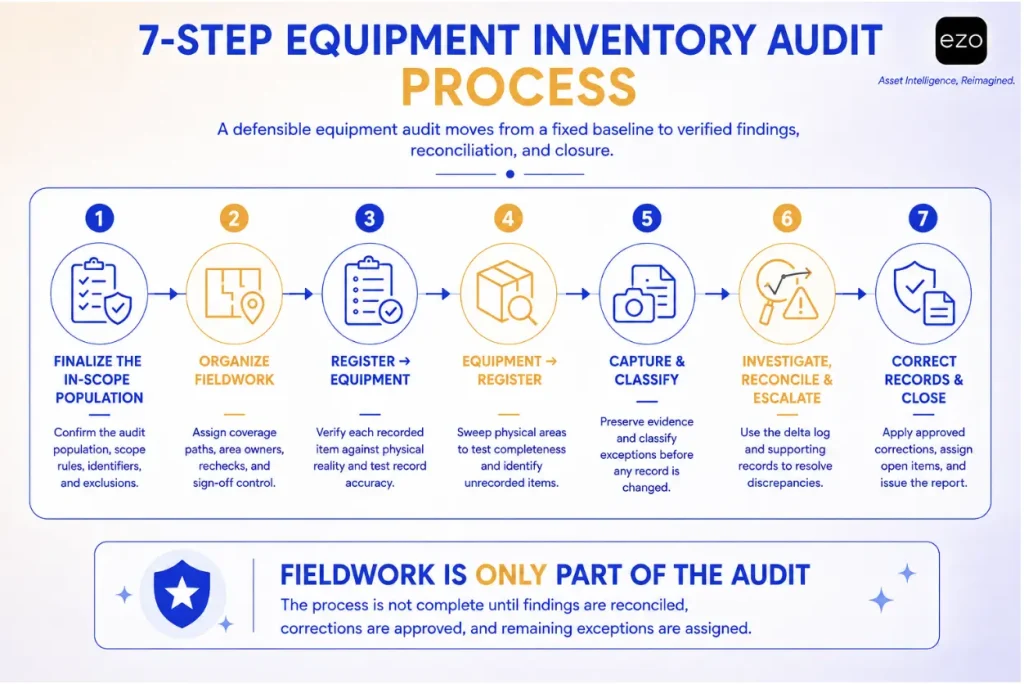
Treat each finding as evidence, not a checkbox, and keep the audit trail intact as you go. For every item or exception, the audit should be able to reconstruct what the register said, what the auditor observed, what differed, what the investigation established, and what was approved.
Step 1: Finalize the scoped audit population
Derive the final population from the source snapshot using the documented scope rules. Confirm locations, departments, equipment groups, ownership classes, custodians, and statuses, and record every exclusion with its reason and approval.
Flag equipment already known to be under repair, loaned out, temporarily offsite, in transit, awaiting disposal, or assigned to a temporary project location. These are not automatically discrepancies. An item at a repair vendor is consistent with the baseline if the baseline records it as under repair. It becomes a finding if the baseline says it is available at its normal location.
Do not clean up suspicious records before fieldwork, even if the register appears to need it. Preserve the baseline and let verification establish whether they are wrong. That is the difference between preparing a population and prejudging the result.
- Verify: Population, scope, ownership classes, identifiers, known locations, known exceptions.
- Document: Snapshot version and timestamp, scoped population, exclusion log.
- Watch for: Removing questionable records before testing them, which makes the audit look more accurate than the records were.
- Output: A documented population traceable to the original baseline.
Step 2: Organize fieldwork by physical area
Organize fieldwork so coverage can be demonstrated. Control becomes harder as the number of locations and items grows, and adding staff will not compensate for weak control over coverage. Give every area a named owner and a completion status, using a defined path such as building, floor, and room; warehouse, zone, and area; or plant, production area, site, and project. Location barcodes make area boundaries verifiable rather than assumed.
Sequencing by equipment category can work for standardized fleets, but it should not replace physical-area coverage where the audit needs to test completeness. A category list tells auditors what to expect and does not guarantee that every area is swept.
Build quality control in from the start: supervisor spot checks, rechecks of exceptions, second verification of selected high-risk equipment, and sign-off for completed areas.
- Verify: Every in-scope area has a defined path and an owner.
- Document: Areas completed, areas outstanding, rechecks performed, unusual field conditions.
- Watch for: Unstructured walkthroughs that make coverage impossible to prove.
- Output: Traceable physical coverage with a quality-control step.
Step 3: Verify the register against physical equipment
This is the register-to-floor direction. Work through the scoped population and locate each item.
Do not stop at found or not found. Where relevant, verify the equipment ID or tag, serial number, manufacturer and model, location, custodian, department, condition, and each applicable status. Establish identity through the identifier hierarchy before accepting a match.
Grade your evidence. For equipment that cannot be inspected in person, define acceptable evidence in advance and rank it, because these options are not equivalent:
- Independent physical observation by an auditor. This is the strongest evidence and the default.
- Supported remote verification, such as a recent documented mobile scan or timestamped image tied to the identifier.
- Third-party documentation, such as repair and service history from a vendor or shipping records.
- Custodian attestation. It establishes custody, not independent existence. It is useful, but weaker than the three above.
- Deferred verification with a named owner and due date. This is not evidence. It is an open exception with a deadline attached, and it should be counted as one.
Florida Tech’s guidance sits at the fourth level, requiring off-campus equipment to be accounted for in the physical inventory and physically verified by a custodian. Decide which levels your audit will accept before anyone leaves the office.
If an item cannot be located, record an exception and continue. Investigation belongs in Step 6, supported by the item’s transaction history.
- Verify: Existence, plus the relevant identity, location, custody, condition, and status fields.
- Document: What matched, what differed, the evidence used, and its level.
- Watch for: Treating “found” as sufficient verification, leaving every other record field untested.
- Output: Verified records and a documented exception list.
Step 4: Check physical equipment against the register
Now reverse the direction. Walk the area and ask whether every in-scope physical item that should be recorded is represented correctly in the register.
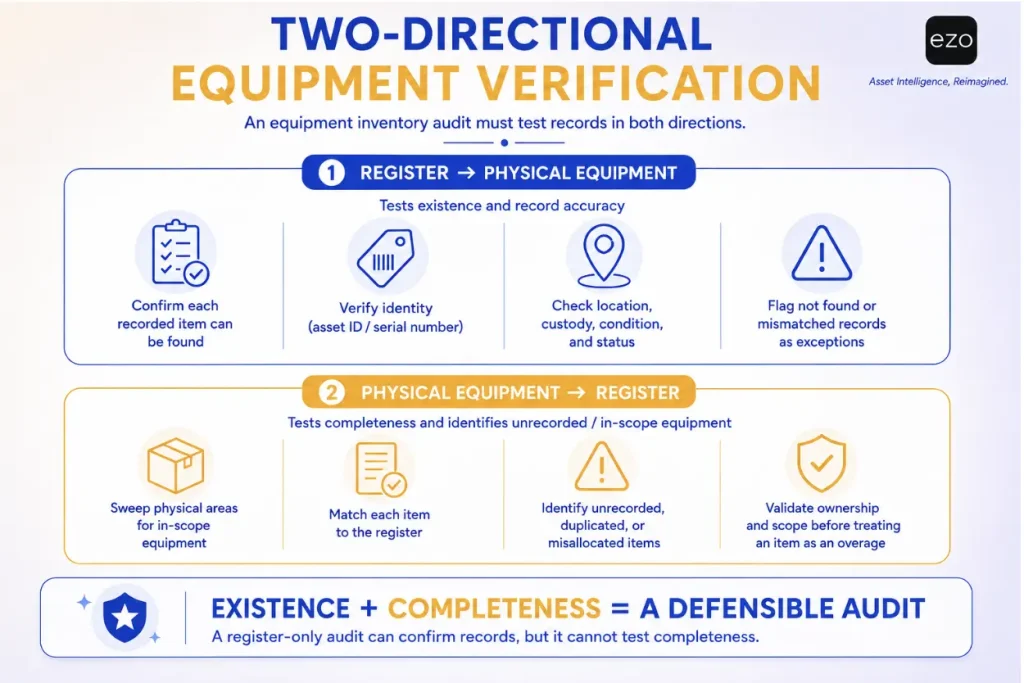
That qualifier is essential because not every object in a facility belongs in your register. This is where the ownership classes defined during preparation are applied. Without them, an auditor has no basis for deciding what an unmatched item actually is.
This floor-to-register direction tests completeness. A register-to-floor test can identify recorded equipment that could not be located during verification. It cannot find equipment that physically exists but was never recorded correctly. Those are different assertions, and testing one does not test the other.
Florida Tech’s reconciliation process gives a useful working list of what this direction surfaces: untagged assets found, tagged assets found with no record in the system, assets found that belong to another department, and assets in the system that were not located. Add to that duplicate records, identifier conflicts, replacements never reflected in the register, third-party equipment, and equipment received during the audit period.
Consider an example drawn from a typical multi-department count. The register contains 100 in-scope items, and auditors verify 96, leaving four recorded items to investigate. During the sweep, the team also found six pieces of equipment with no apparent matching record. Those are two separate findings, not one.
The six should not immediately be called unrecorded organizational assets, and creating asset tags for them on the spot would be the wrong reflex. They may be leased, borrowed, contractor-owned, personally owned, received after the baseline, below the tracking threshold, or duplicates. Validate each against the ownership classes before classifying it.
Grouped stock adaptation. Where an equipment area also holds grouped stock, quantity variance is reconciled against the group record rather than the individual identity chain. Treat it as a separate finding type and keep it out of your item-level exception rates.
- Verify: Physical equipment against the register and each unmatched item against scope and ownership rules.
- Document: Unmatched equipment, identifier problems, duplicates, third-party property, equipment belonging elsewhere.
- Watch for: Assuming every unmatched physical item belongs in the register.
- Output: A two-directional view of accuracy and completeness.
Step 5: Capture evidence and classify discrepancies
When physical reality and the register disagree, preserve the observation before changing the live record. This is a key control in the process, and everything downstream depends on it.
The rule is narrower than “never correct anything in the field.” Do not correct the live record until the original observation has been preserved. A version-controlled system can retain the observation while still allowing an authorized correction. A spreadsheet overwritten in the aisle cannot. Whatever system you use should maintain a tamper-evident trail of who changed which record, when, and on what authority. This allows the audit to separate four things: what the register said before the audit, what the auditor observed, what the investigation established, and what was eventually changed.
Useful evidence includes the equipment ID, serial number, a scan, location, custodian, condition, status, auditor notes, a timestamp, and auditor identity. Where site security and privacy rules allow photographs, the image should show the asset tag or serial number legibly, the item in its location, and any condition issue being recorded. A photograph that does not capture the identifier proves nothing about which item was seen.
Classify each exception as you record it, using the categories in the discrepancy table below. Consistency here makes the reporting usable later.
- Verify: Every discrepancy carries enough evidence for another reviewer to understand it.
- Document: Observation, identifiers, classification, circumstances, evidence.
- Watch for: Updating a record before preserving the auditor’s findings.
- Output: A classified exception list ready for investigation.
Step 6: Investigate, reconcile, and escalate
This is where physical verification becomes reconciliation. A discrepancy tells you that two sources disagree. It does not tell you which is wrong.
Start with the post-baseline movement log, then review the source snapshot, checkout history, transfer history, custody records, maintenance activity, procurement and receiving records, disposal records, and location history. Ask why the expected record and the observed reality diverged.
An item recorded at Site A and found at Site B might have been properly transferred after the baseline, transferred without updating the record, moved temporarily, sent for maintenance, or recorded incorrectly during an earlier transaction. The observation itself may need rechecking. Equipment that cannot be located may be under repair, on loan, stored elsewhere, or already disposed of.
Physical observation is important but not automatically authoritative. The conclusion should follow the corroborated evidence and your system-of-record policy.
Define materiality before you need it, and record it alongside your risk tiers. Instructions like “escalate material discrepancies” are useless without a definition, and writing one afterward invites hindsight. Set a financial threshold from acquisition cost or replacement value, then add non-financial triggers that escalate regardless of value:
- Operational criticality
- Security sensitivity
- Regulatory, contractual, or grant-funded status
- Repeated discrepancies involving the same item
- Suspected unauthorized transfer
- Suspected loss, theft, or fraud
Record the thresholds in the audit plan before fieldwork begins.
When an investigation supports loss or theft. A not-found result should not be treated as a loss prematurely, but there is a defined process once evidence supports it:
- Escalate to the accountable manager under organizational policy and to security where appropriate.
- Preserve the evidence and audit trail rather than adjusting the record first.
- Notify insurers and law enforcement where required by your policy terms, contract, grant conditions, or applicable law.
- Check regulatory and grant obligations. Under 2 CFR 200.313(d)(3), any loss, damage, or theft of equipment must be investigated, and the federal agency or pass-through entity must be notified if the event will impact the program.
- Obtain the required approval before writing off or deactivating the record.
For event-triggered audits following theft, fire, or flood, the same evidence-preservation and accountability principles apply, along with the organization’s incident-specific safety, continuity, and insurance procedures.
- Verify: The cause of the discrepancy and what the authoritative record should show.
- Document: Evidence reviewed, explanation, decision, approvals, remaining uncertainty.
- Watch for: Turning temporary operational circumstances into permanent record changes.
- Output: Reconciled findings with a defensible basis for correction or escalation.
Step 7: Correct records, report, and close
Fieldwork can end while the audit remains open.
Apply corrections only after the discrepancy has been investigated and the required approval obtained. Approval is not a formality. The federal control model treats management approval for record adjustment as one of the four required reconciliation actions. This creates an authorization trail before a consequential record change is posted.
Use stronger approval controls for actions that can rewrite history: deactivating equipment, merging duplicates, reassigning identifiers, writing off missing equipment, and changing ownership classification.
For unresolved exceptions, document what remains outstanding, who owns it, the required action, the due date, and the evidence of closure. Once the reconciliation criteria are met, issue the report and record the audit state as reconciliation complete, with open exceptions formally accepted and still tracked to closure.
What an equipment inventory audit report should contain
| Section | Contents |
|---|---|
| Scope | Population, locations, categories, ownership classes, exclusions with approvals |
| Baseline | Snapshot version and timestamp, cut-off, delta log reference |
| Method | Coverage model, identification method, capture process, evidence levels accepted |
| Execution | Audit dates, auditors, areas completed, rechecks, supervisory controls |
| Results | Equipment verified and discrepancies by category and risk tier |
| Resolution | Corrections applied, approvers, escalations, loss or theft referrals |
| Open items | Accepted exceptions with owners, actions, due dates, and closure criteria |
| Sign-off | Preparer, reviewer, approving role, date |
| Analysis | Recurring causes and recommended process improvements |
Set retention according to applicable law, grant terms, contracts, insurance requirements, or organizational policy rather than an arbitrary universal period. Custom reports are usually easier to maintain as repeatable audit outputs than hand-built documents.
Before closing the audit, ask why these discrepancies happened. Correcting 40 incorrect locations fixes today’s register. If the transfer process still allows equipment to move without updating the record, the same problem will recur next cycle.
- Verify: Every material or escalated finding is resolved, assigned, or formally accepted.
- Document: Approved corrections, open exceptions, owners, due dates, results, recurring weaknesses.
- Watch for: Calling the audit complete because fieldwork stopped.
- Output: Reconciled records, an issued report, and a defined path to corrective-action closure.
The process at a glance
- Finalize the scoped audit population
- Organize fieldwork by physical area
- Verify the register against physical equipment
- Check physical equipment against the register
- Capture evidence and classify discrepancies
- Investigate, reconcile, and escalate
- Correct records, report, and close
The seventh step is what changes the purpose of an audit. A good equipment audit does more than find which records are wrong. It helps explain why they were wrong and makes similar discrepancies less likely next time.
Custody changes are a common source of record drift. See how custody verification and location audits work in EZO EAM, or start a free trial and run one against a single site before committing to a full census.
Equipment inventory audit checklist
This is an execution aid for readers who have worked through the audit methodology above. Terms such as source snapshot, delta log, and accepted exception are defined earlier.
| Stage | Check |
|---|---|
| Before fieldwork | Define locations, departments, categories, custodians, and statuses in scope |
| Define ownership and possession classes, with inclusions and exclusions | |
| Assign risk tiers, then apply any mandated cadence as an override | |
| Choose full census, cycle verification, spot check, or sampling | |
| Take a timestamped, version-controlled source snapshot | |
| Derive the scoped audit population | |
| Record exclusions and their approvals | |
| Set the cut-off and open the movement and transaction delta log | |
| Assign auditors, area owners, investigators, approvers, and sign-off authority | |
| Confirm segregation of duties or document the compensating review | |
| Define condition codes and allowed status values | |
| Rank the identifier hierarchy and agree on accepted evidence levels | |
| Calibrate auditors on identifiers, evidence rules, and discrepancy categories | |
| Decide how offsite and inaccessible equipment will be verified | |
| Prepare scanners, devices, labels, and offline handling | |
| During fieldwork | Verify the equipment ID or tag |
| Verify the serial number and record identifier conflicts as exceptions | |
| Confirm the physical location | |
| Confirm the custodian or accountable department | |
| Record the condition using the defined criteria | |
| Verify each applicable lifecycle, availability, custody, and maintenance status | |
| Apply the agreed evidence levels for offsite or unavailable equipment | |
| Sweep each area for equipment with no matching record, unaided where completeness matters | |
| Validate unmatched items against ownership and scope rules | |
| Preserve evidence before changing any record | |
| Classify discrepancies consistently | |
| Complete supervisor rechecks and area sign-off | |
| After fieldwork | Reconcile findings against the baseline and delta log |
| Investigate equipment that could not be located | |
| Apply the escalation criteria set during planning | |
| Route confirmed loss, damage, or theft appropriately | |
| Obtain approval for corrections and for destructive changes | |
| Assign owners and due dates to unresolved exceptions | |
| Issue the report and obtain sign-off | |
| Record the audit state reached on the audit dashboard | |
| Calculate the metrics set out in “How to measure the quality of an equipment audit” below | |
| Identify recurring causes and validate them before changing a process |
A simple test for any equipment audit checklist is whether it covers both directions. Checking the register against the floor is the obvious half. Looking for equipment that is absent from the register or recorded incorrectly is the half most often skipped. Sector-specific versions of this exercise, such as a construction audit or a school audit, follow the same two-direction logic with different populations.
How to resolve equipment audit discrepancies
Classify what differs, investigate why the sources disagree, then apply the correction or escalation. The table is illustrative rather than exhaustive. It is grouped into three bands because these are not all the same kind of finding.
The typical starting priority column is a default, not a rating. Adjust it using the equipment risk tier: a wrong location on a security-sensitive item is not a medium-priority finding.
Band 1: Record discrepancies. These are genuine record failures and are the only findings that should feed the exception rates covered in the measurement section below.
| Audit finding | Typical starting priority | What to investigate | Typical controlled response |
|---|---|---|---|
| Recorded but not found | High | Delta log, checkout, transfer, repair, storage, disposal records | Investigate and locate where possible. Change status only after evidence and approval |
| Found with no matching record | High | Ownership class, procurement, receiving, transfer history | Validate ownership and scope, then create or restore a record with approval |
| Suspected unauthorized transfer | High | Approval history, transfer history, custody chain, access evidence | Escalate before adjusting the record |
| Serial or identifier mismatch | High | Primary identifiers, procurement records, service history | Re-establish identity before changing any identifier |
| Wrong location | Medium | Delta log, recent transfers, location history | Confirm the movement, correct the location, and address the missed update |
| Wrong custodian | Medium | Assignment and handoff history | Confirm custody and update under the required control |
| Wrong model or specification | Medium | Procurement, replacement, and service history | Confirm which unit is present and correct the record |
| Duplicate record | Medium | Asset IDs, serial numbers, and transactions on both records | Establish the authoritative record before merging or deactivating |
| Retired or disposed equipment is still active | Medium | Disposal records and approvals | Confirm disposal and update lifecycle status |
| Wrong status | Medium | Checkout, maintenance, retirement, and disposal records | Correct the applicable status field after verification |
| Wrong condition | Low to medium | Maintenance and inspection history | Update condition and route for maintenance where needed |
| Missing or unreadable tag | Low to medium | Serial number, secondary identifiers, acquisition records | Re-identify, then retag under the organization’s change process |
Band 2: Scope observations. Correctly classified third-party property is not a record failure. Report it separately so it does not inflate the discrepancy rate.
| Observation | Typical starting priority | What to investigate | Typical controlled response |
|---|---|---|---|
| Third-party property found | Medium | Lease, contract, loan, consignment, ownership evidence | Confirm the classification and record it outside the equipment register |
| Grouped stock quantity variance | Low to medium | Transaction history and other storage areas | Recount and reconcile against the group record, separately from item-level rates |
Band 3: Open verification states. These are workflow states, not findings. They close or convert.
| State | Typical starting priority | What to investigate | Typical controlled response |
|---|---|---|---|
| Item inaccessible | Low | Access constraints and scheduling | Reschedule with a named owner and due date |
| Verification pending | Low | The evidence levels agreed during planning | Obtain acceptable evidence, or carry as an accepted open exception |
Destructive or identity-changing actions, including merges, deactivations, and retagging, should require documented approval in accordance with the organization’s change-control policy. They can erase history before identity, ownership, authorization, and prior transactions have been established.
Start with the discrepancy, not the correction
The system says Room 204. You find the equipment in Room 205. Why not simply update the location?
Because the difference carries information. Location history often shows why it occurred. The item may have moved temporarily, been formally transferred after the baseline, been transferred without an update, or been recorded incorrectly earlier. Review the transaction history, establish what happened, then correct the authoritative record.
Investigate “not found” before declaring equipment lost
A not-found result can mean that the equipment is genuinely missing. It can also mean an active checkout, a recent transfer, maintenance, temporary storage, offsite project work, equipment in transit, an unrecorded disposal, or incorrect location data.
This is also why “ghost asset” should not be used for any item an auditor cannot immediately find. In an operational register, a ghost asset is an item that is still shown as active but no longer exists or is no longer owned or controlled by the organization. An idle spare or seasonal unit that still exists and is legitimately owned is not a ghost asset. It is a spare, and it belongs in your lifecycle records like any other item.
Treat unrecorded equipment as a control problem
When auditors find in-scope equipment with no valid record, creating a database row fixes the symptom. The underlying process may have failed at procurement, receiving, tagging, transfer, custody assignment, replacement, disposal, or system integration. These asset management challenges generate repeat findings
State Department procedure is instructive. When an item not listed on the property records is found during inventory, the procedure requires staff to locate the original acquisition document and add the property using its data, rather than simply logging what was found. Trace the item to its acquisition, transfer, or ownership evidence before reconstructing the record. The physical item tells you what exists. The procurement paperwork explains how it got there.
How often should you conduct an equipment inventory audit?
There is no universal interval. Frequency should reflect mobility, value, operational criticality, security sensitivity, exposure to loss, custody turnover, site movement, previous discrepancy rates, and any contractual or insurance requirements.
The risk tiers set during preparation drive the cadence:
| Risk tier | Typical verification approach |
|---|---|
| High | Shorter cycle verification intervals, event-triggered checks, plus a periodic full census where policy requires it |
| Medium | Periodic cycle verification with scheduled broader coverage |
| Low | Longer full verification intervals with targeted checks |
Apply any mandated cadence on top of this table rather than inside it. An annual audit suits some populations and is insufficient for others, so avoid presenting annual as a universal standard. An organization whose equipment changes hands weekly needs a different model from one running large stationary machinery, and both may need equipment KPIs between audits rather than a longer count.
Where a cadence is mandated
Where equipment is subject to a mandated schedule, follow that requirement in its own jurisdiction and context rather than generalizing it.
For recipients and subrecipients subject to 2 CFR 200.313(d)(2), a physical inventory must be conducted and reconciled with the property records at least once every two years. Under the same section at paragraph (b), a State must use, manage, and dispose of equipment acquired under a federal award in accordance with State laws and procedures. Indian Tribes follow tribal laws and procedures, with the federal section applying where such procedures do not exist. Public-sector teams managing this alongside operational counts often keep the two schedules separate in their asset-tracking system. Other recipients and subrecipients follow paragraphs (c) through (e).
These requirements do not set a cadence for equipment outside their scope, including most operational equipment. ISO 55000 and ISO 55001 set requirements and principles for an asset management system rather than a physical inventory procedure or interval, so organizations working toward that series should align this methodology with their own management system requirements. Nothing here claims conformance with any standard.
The real question is a risk question, and it is one that equipment KPIs between audits can help answer: how likely is this record to become inaccurate, and how costly would that inaccuracy be? That produces a more defensible cadence than choosing an interval, because annual sounds standard.
How to measure the quality of an equipment audit
This measurement model is EZO’s framework, not an external audit standard.
Do not use one accuracy percentage to answer several different questions. Separate how well the audit was executed, what it revealed about record integrity, and whether the findings were closed.
Audit execution: Did we run the audit well?
- Item coverage completion. In-scope items verified, divided by items scheduled.
- Area coverage completion. Physical areas swept, divided by areas in scope.
- Area sign-off rate. Areas formally signed off by a supervisor, divided by areas completed. Coverage and sign-off are different events, and the gap between them is informative.
- Supervisor rechecks the agreement. Rechecked items where the supervisor reached the same result, divided by items rechecked.
- Evidence completeness. Exceptions carrying the required evidence, divided by total exceptions. This is straightforward to pull from custom reports if your exception records are structured consistently.
Record integrity: How accurate were the records?
- Register the floor exception rate. Records that failed one or more verification criteria, divided by records tested. An item checked but not located counts as a completed procedure and a failed verification, which are different measures.
- Floor-to-register exception rate. In-scope physical items with no correct matching record, divided by in-scope items swept.
- Field accuracy rates. Location, custody, status, and condition accuracy are each measured separately against verified records. These pair naturally with the asset management metrics you already track between audits.
Keep the two directions separate. A combined figure hides whether the failures came from recorded items that could not be located or from physical items with no correct record, and the two point to entirely different fixes.
Count only Band 1 record discrepancies in these rates, and pull them from a consistent report definition to keep the numbers comparable. Folding scope observations and open verification states into the same numerator inflates the exception rate and makes year-on-year comparison meaningless.
A high discrepancy rate does not mean the audit was poorly performed. A rigorous audit of an inaccurate register should expose many discrepancies. That is the control working.
Exception management: Did findings get closed?
- Closure rate. Exceptions resolved, divided by exceptions raised, tracked on a shared dashboard rather than in a personal spreadsheet.
- Median exception age. Two organizations can carry the same percentage of open findings, with one having opened them yesterday and the other having held them for six months.
- Overdue exceptions. Open findings past their assigned due dates. Automated reminders through an automation rule prevent these from aging quietly.
- Repeat discrepancy rate. The proportion of corrected records that later show the same discrepancy type. Note what this does and does not tell you: it flags a candidate for investigation into the cause but does not confirm a cause, because identical symptoms have several possible sources.
On benchmarks. These metrics have no published industry thresholds, and any figure presented as such should be treated with caution. Instead, compare them against your own historical performance data. Treat your first audit as a baseline rather than a score, set internal targets from your own risk tiers and any contractual or grant requirements, and compare subsequent audits against that. A model this specific is more useful as a trend than as a grade.
Common equipment audit failure modes
Each is a pitfall not already addressed above.
- Treating the audit as a count. Quantity alone verifies nothing about identity, location, custody, condition, or status.
- Verifying in only one direction. A register-led audit confirms that recorded equipment exists while failing to identify equipment that was never recorded.
- Changing the baseline mid-audit. If the source record shifts whenever an auditor finds a problem, nobody can reconstruct what was tested.
- Auditing during a period of unusual movement. A count run through a site move, a project mobilization, or a fiscal-year disposal push will generate exceptions that reflect timing rather than record quality.
- Letting exception categories drift between auditors. Two people classifying the same finding differently is a measurement failure that only becomes visible at reporting.
- Closing at fieldwork. Unowned exceptions mean the audit is still open, regardless of the schedule.
- Fixing records without fixing the process. Updating incorrect records restores accuracy temporarily. If the workflow that caused the error remains unchanged, similar discrepancies will recur.
The last is especially important because reconciliation is where an organization can establish why its records became inaccurate.
Five controls that prevent repeat equipment discrepancies
Records drift when physical events are not reflected in the system of record. These controls close that gap.
- Capture movement and custody at the event. Update location as part of the move itself, and make custody acknowledgment part of the handoff rather than a separate task afterward.
- Update status when the real-world state changes. Record maintenance, retirement, and disposal when they occur. Equipment sent for repair should not still appear available at its normal location.
- Use consistent, durable identifiers. Scannable identifiers reduce manual lookup and tie physical equipment to the correct record. They still need to be maintained, so plan to replace labels when tags wear out rather than discovering unreadable tags mid-audit.
- Verify higher-risk equipment more often. A full organization-wide audit does not have to be the only control. Cycle verification and targeted checks give more frequent assurance where inaccurate records are most costly. Mass scanning and RFID reads make short cycles practical.
- Investigate recurring patterns before redesigning a process. Repeated wrong locations may indicate a transfer problem, repeated custody mismatches may indicate weak handoffs, and active records for disposed equipment may point to a retirement workflow gap. Data imports, integration failures, permission problems, migration errors, and auditor mistakes produce identical symptoms. Confirm the cause before rebuilding a workflow around an assumption.
Watch system boundaries
Much of the information that keeps an equipment register accurate originates elsewhere: procurement, accounts payable, HR offboarding, ERP systems, and maintenance or service-management systems. Where acquisitions, transfers, leaver events, or disposals happen in one system and never reach the equipment register, those disconnected workflows become next year’s findings. Where that disconnection is the actual cause, integration usually addresses it more effectively than adding another manual control.
Someone also has to own record quality between audits. The audit measures record reliability at a point in time. Sound physical asset management is what keeps it accurate afterward.
Using EZO EAM to support equipment inventory audits
EZO EAM is our product. This section maps verified capabilities to the audit jobs above rather than presenting a feature list. It does not replace scope decisions, investigation, approval, or accountability.
Prepare and scope. EZO EAM maintains centralized equipment records with identifiers, barcode and QR labels, locations and sub-locations, groups, custody information, condition, status, and transaction history. Audits can be created for selected locations with designated auditors responsible for verification. The audit team still defines the business scope and decides which ownership classes belong in the register.
Verify by location. The Location Audit workflow lets auditors review equipment associated with an audit location and mark items as verified, denied, or flagged. Auditors can scan equipment against the selected location, and the system flags an item as being in the wrong location or out of scope. For grouped Asset Stock, it surfaces quantity differences, including excess quantity at the audit location. Location Audits also run in the EZO mobile app. This matters for equipment-tracking work done away from a desk.
Verify custody with the assignee. Custody Audits let administrators send verification requests, individually or in bulk, for equipment assigned to users. The assignee acknowledges possession or denies the request; the response is added to the custody-verification record, and signatures can be captured as required. This provides custody evidence for reconciliation of checked-out equipment. Whether it satisfies a physical-verification requirement is an evidence-policy decision for your audit, and for federally funded equipment it depends on the terms of the award.
Track activity and report. Dashboard KPIs cover audit activity, including audits in progress. Audit history records whether equipment was verified, denied, or flagged, and the location associated with each action. Reporting includes All Audits and Audit Line Items, plus custom reporting. Custody-verification activity has its own history, KPIs, and reports, so teams can review it separately from location verification.
Use transaction history during reconciliation. Custody, checkout, location, condition, status, and audit history supply the context that Step 6 depends on. This lets teams distinguish a stale location from a legitimate recent movement.
The system provides evidence. The organization still decides what belongs in scope, why a discrepancy occurred, whether to escalate, which correction is authoritative, and who approves it.
Capability availability. Current EZO pricing lists Custody Audits starting with the Advanced plan and Location Audits starting with the Premium plan. Confirm plan availability against the pricing page before purchase, because packaging can change.

![[How-to] Ensure Accountability and Transparency with Audits in EZO](https://cdn.ezo.io/wp-content/uploads/2023/11/location-audit.jpg)
![[How-to] Implement Custody Audit in EZO](https://cdn.ezo.io/wp-content/uploads/2020/07/Custody-verification-EZO.png)
![[How-to] Enable Custody Transfer of Items for Enhanced Security](https://cdn.ezo.io/wp-content/uploads/2021/10/custody-transfer-scaled.jpg)