Editorial disclosure: EZO publishes this comparison and offers EZO EAM, one of the platforms evaluated. Vendor capabilities, pricing, packaging, deployment, and other factual claims are reviewed against current first-party product documentation. The same evaluation criteria are applied across all eight platforms, and each profile includes both strengths and limitations.
The best EAM software for manufacturing depends on asset complexity, maintenance maturity, ERP environment, reliability requirements, and implementation capacity. EZO EAM is suited to connected asset lifecycle and maintenance management, IBM Maximo to advanced reliability and critical assets, SAP S/4HANA Asset Management to SAP-centered operations, and IFS Cloud EAM to complex enterprise asset lifecycles. The right choice depends on which operating model, integrations, and reliability depth your plants require.
Manufacturing asset management rarely breaks down because teams have no information about their equipment. More often than not, the information is scattered across too many places.
A production line may be documented in an ERP. Maintenance history sits in a CMMS. Spare-parts data lives in another system. Operators keep local spreadsheets. Inspection evidence is attached to work orders or stored in shared folders. Cost information may not reach the maintenance team until long after a repair is complete.
Enterprise asset management (EAM) software is designed to connect more of that operational context around the physical asset.
A company looking to connect equipment, maintenance, inventory, and multi-site workflows has different requirements from a global manufacturer running advanced reliability programs across highly critical production assets.
The eight platforms serve different manufacturing requirements. EZO EAM focuses on connected asset lifecycle and maintenance management; IBM Maximo emphasizes advanced reliability and critical-asset management; SAP S/4HANA Asset Management and Oracle Fusion Cloud Maintenance are particularly relevant to manufacturers already operating within those ERP ecosystems. IFS Cloud EAM, Octave Attune EAM, IFS Ultimo, and Aptean EAM address different combinations of enterprise scale, reliability depth, maintenance maturity, and manufacturing integration.
This guide evaluates all eight platforms across six consistent areas:
- Asset lifecycle coverage
- Maintenance execution
- Reliability capabilities
- Manufacturing fit
- Enterprise readiness
- Commercial model and implementation
Editorial disclosure: EZO publishes this comparison and offers EZO EAM, one of the platforms evaluated. Each platform is reviewed using the same profile structure and current first-party product information. Capabilities requiring separate packages, modules, or integrations are identified where public documentation allows.
The best manufacturing EAM platforms at a glance
EAM platforms vary considerably in scope. Some are broad enterprise suites spanning advanced reliability, asset performance, finance, supply chain, and service. Others concentrate on making lifecycle and maintenance management easier to deploy and operate.
| Platform | Best for | Product scope | Deployment | Manufacturing strength | Main consideration |
| EZO EAM | Connected asset lifecycle and maintenance management | EAM with CMMS capabilities | Cloud | Asset tracking, availability, inventory, maintenance, movement, and lifecycle history | Advanced APM requirements may need additional capabilities or integrations |
| IBM Maximo Application Suite | Advanced reliability and critical assets | Enterprise EAM/APM suite | SaaS or client-managed | Complex assets, health, monitoring, maintenance, inspections, reliability | Enterprise licensing, configuration, and administration requirements |
| SAP S/4HANA Asset Management | SAP-centered manufacturers | ERP-integrated EAM | Multiple SAP deployment models | Maintenance tied closely to finance, procurement, materials, and manufacturing | Value depends significantly on integration with the wider SAP environment |
| IFS Cloud EAM | Complex asset and service lifecycles | Enterprise EAM within IFS Cloud | Cloud | Design-to-decommission lifecycle management, maintenance, ERP, and service | Broad scope can increase implementation requirements |
| Oracle Fusion Cloud Maintenance | Oracle SCM/ERP environments | SCM-integrated EAM | Cloud | Maintenance, assets, inventory, costing, procurement, and manufacturing | Value depends significantly on use of the wider Oracle Fusion ecosystem |
| Octave Attune EAM | Configurable enterprise EAM | Enterprise EAM | Cloud | Asset lifecycle, work execution, MRO inventory, calibration, mobile work, and reliability-centered maintenance | Predictive/APM capabilities require separate evaluation of Attune APM |
| IFS Ultimo | Maintenance-led EAM adoption | SaaS EAM | Cloud/SaaS | Maintenance, safety, industrial assets, EHS, and tiered SaaS deployment | Does not provide the same ERP, service, project, or advanced APM scope as IFS Cloud |
| Aptean EAM | Manufacturing-focused EAM | EAM/CMMS | Cloud | Maintenance, work orders, parts, asset performance, manufacturing | Packaging and integration requirements should be confirmed |
The order reflects best-fit use cases rather than a numerical ranking. A manufacturer that already runs SAP globally may make a very different decision from one replacing spreadsheets across six plants.
How we selected and evaluated the platforms
This list is not intended to include every maintenance or asset-management product used in manufacturing. We selected eight platforms that meet the article’s EAM inclusion criteria while representing different manufacturing buying requirements.
To qualify, a platform needed to:
- Manage physical asset records and maintenance activity
- Extend beyond basic work-order execution
- Support manufacturing or comparable asset-intensive operations
- Support multi-location or enterprise deployment
- Provide lifecycle capabilities beyond maintenance scheduling alone
- Support APIs, integrations, or enterprise data exchange
- Have sufficient current product information to evaluate both strengths and limitations
Why these eight platforms?
The eight platforms were selected to represent distinct EAM buying patterns manufacturers are likely to encounter:
| Platform | Buying requirement represented |
| EZO EAM | Connected asset lifecycle and maintenance management |
| IBM Maximo Application Suite | Advanced reliability and critical-asset management |
| SAP S/4HANA Asset Management | SAP-centered asset and maintenance operations |
| IFS Cloud EAM | Complex asset, service, and enterprise lifecycles |
| Oracle Fusion Cloud Maintenance | Oracle-centered manufacturing and supply chain operations |
| Octave Attune EAM | Configurable enterprise EAM for asset-intensive operations |
| IFS Ultimo | Maintenance-led EAM adoption |
| Aptean EAM | Manufacturing-focused EAM within a broader manufacturing software portfolio |
This approach prevents the list from overrepresenting several products that solve essentially the same buying problem while overlooking materially different EAM architectures.
What other platforms were considered?
Maintenance-first platforms such as Fiix, Limble, UpKeep, and eMaint were also considered. They offer substantial maintenance and asset-management functionality, but this article treats them primarily as CMMS alternatives because its main comparison focuses on platforms with broader EAM positioning and lifecycle scope.
They are not necessarily weaker products. A focused CMMS may be a better choice for manufacturers whose primary requirements are work orders, preventive maintenance, technician workflows, and maintenance history rather than broader enterprise asset lifecycle governance.
How are the eight platforms ordered?
The order reflects best-fit manufacturing use cases, not a numerical score or universal ranking.
The list begins with connected lifecycle and maintenance management, then covers advanced reliability, ERP-centered EAM, complex enterprise asset lifecycles, configurable enterprise EAM, maintenance-led adoption, and manufacturing-suite requirements.
A manufacturer already standardized on SAP or Oracle may therefore build a very different shortlist from one prioritizing advanced reliability, maintenance-led adoption, or a more focused asset-lifecycle platform.
Each platform was then reviewed across six areas:
1. Asset lifecycle coverage
We looked for the ability to manage or provide context around assets through stages such as acquisition, commissioning, deployment, operation, maintenance, transfer, cost management, and retirement.
2. Maintenance execution
Core requirements included work requests, work orders, preventive maintenance, inspections, meter-based schedules, downtime records, technician activity, and maintenance history.
3. Reliability capabilities
We distinguished basic maintenance from deeper reliability functionality such as criticality, failure modes, condition monitoring, asset health, risk-based maintenance, and predictive analysis.
That distinction matters. A platform that accepts a sensor reading is not automatically a predictive-maintenance platform.
4. Manufacturing fit
We evaluated the ability to handle plant structures, production equipment, mobile work, spare parts, multiple sites, asset hierarchies, and different operating environments.
5. Enterprise readiness
We evaluated APIs, system integrations such as ERP and operational technology, multi-site data governance, and the platform’s ability to operate within a broader enterprise architecture. Security, privacy, and compliance controls are treated separately as due diligence requirements rather than as scored comparison criteria.
6. Commercial model and implementation
We considered pricing transparency, licensing and packaging, trial or demo availability, deployment options, implementation requirements, training, and ongoing support. Where functionality depends on a separate module, edition, integration, or additional product, that dependency is identified separately.
How the evaluation framework appears in the comparison
These six criteria are used throughout the article. The vendor profiles provide the detailed assessment, while the comparison tables break selected criteria into more specific capabilities. Best for, What it is, Potential limitation, and Final fit are summary fields rather than separate evaluation criteria.
| Evaluation criterion | Where it appears in the profiles and tables |
| Asset lifecycle coverage | Asset lifecycle coverage; lifecycle-coverage table column |
| Maintenance execution | Maintenance and reliability; calendar PM; meter/usage maintenance |
| Reliability capabilities | Maintenance and reliability; condition-based maintenance; predictive/APM |
| Manufacturing fit | Manufacturing strengths; multi-site support; spare parts; mobile/offline workflows |
| Enterprise readiness | Integrations and deployment; ERP/API connectivity; IoT/condition-data connectivity; multi-site governance |
| Commercial model and implementation | Pricing, trial, and demo; deployment model; package dependencies; implementation considerations |
How we treat suites, modules, and same-vendor products
A product is not credited with a capability simply because the same vendor sells another product that provides it. We distinguish functionality that is native to the evaluated EAM product from capabilities that require a separate first-party module, another product in the vendor’s portfolio, or an external integration. This rule is applied consistently across all eight platforms, including EZO EAM.
EAM vs. CMMS: Which does a manufacturer need?
A CMMS primarily focuses on planning, executing, and recording maintenance work. EAM typically extends further into asset lifecycle, cross-site governance, cost, movement, and long-term asset decisions. The categories increasingly overlap, however, so the distinction should be treated as a difference in typical product emphasis, not a guarantee about every platform.
| Typical emphasis | CMMS | EAM |
| Work requests | Typical | Typical |
| Work orders | Typical | Typical |
| Preventive maintenance | Typical | Typical |
| Single-site maintenance | Typical | Typical |
| Multi-site asset governance | Sometimes | Typical |
| Acquisition-to-retirement asset records | Sometimes | Typical |
| Equipment custody and movement | Sometimes | Typical |
| Lifecycle cost visibility | Sometimes | Typical |
| Enterprise-system integration | Sometimes | Typical |
| Condition and reliability workflows | Sometimes | Typical |
| Strategic asset lifecycle planning | Not typical | Typical |
Note: These classifications describe typical category emphasis, not universal product capabilities. Modern CMMS and EAM platforms overlap substantially, and a single CMMS may offer deeper functionality than a single EAM in a specific area.
The practical question is therefore not whether a capability can exist in a CMMS or EAM, but how much of the manufacturer’s operating model needs to be managed in the same system.
When a CMMS may be enough
A full EAM is not always necessary. A maintenance-first CMMS may be a better fit when the primary goal is to improve work-order execution, preventive maintenance, technician workflows, and service history, rather than to govern assets across a broader enterprise lifecycle.
A CMMS may be sufficient when:
- Maintenance requests and work orders are the main operational problem.
- Preventive maintenance schedules need to move out of spreadsheets.
- Technicians need better mobile access to work history and instructions.
- One or a small number of plants require consistent maintenance execution.
- ERP already manages procurement, financial records, and inventory valuation.
- Equipment movement between sites is limited.
- Cross-site asset governance, lifecycle planning, and advanced reliability are not immediate priorities.
Manufacturers with these requirements may also want to evaluate maintenance-focused platforms such as Fiix, Limble, UpKeep, eMaint, and MaintainX alongside the EAM products in this guide. These platforms are not necessarily weaker choices; they address a narrower buying problem and may be more appropriate when maintenance execution is the primary requirement.
The dividing line is less about whether a vendor calls its product a CMMS or EAM and more about the scope of the operating model. If maintenance can remain largely separate from asset movement, lifecycle cost, enterprise governance, and strategic asset planning, a focused CMMS may provide a simpler path to value. If those decisions need to be connected across departments and plants, a broader EAM becomes more relevant.
When EAM becomes more useful
EAM becomes more compelling when maintenance decisions cannot be separated from the rest of the physical asset lifecycle.
For example:
- Equipment moves between plants.
- Corporate teams need common asset structures.
- Parts inventory must be coordinated across locations.
- Maintenance history affects repair-versus-replace decisions.
- Procurement and capital planning need asset-cost context.
- Leadership wants consolidated reporting across facilities.
- Reliability teams need information on conditions, criticality, and failures.
An EAM should not automatically be expected to replace ERP, MES, SCADA, ITAM, APM, or quality-management software. The more useful question is which system should own each type of information and how those systems exchange it.
Five manufacturing scenarios to test during every EAM demo
A feature checklist tells you what software contains. A scenario test reveals whether those capabilities work together.
The goal of these scenarios is to test the end-to-end workflow, not require every step to be native to the EAM. Where another system owns production scheduling, inventory, procurement, condition monitoring, or another process, ask the vendor to demonstrate how the EAM exchanges the required data and preserves the maintenance context.
Run these five workflows before committing to a platform.
1. A critical production asset breaks down
Ask the vendor to start from the actual failure rather than from a prebuilt dashboard.
Can an operator report the problem quickly? Can a barcode or QR scan retrieve the correct machine? Does its criticality influence priority or escalation? Can the technician access repair history, documents, and required parts?
Then examine what happens after the repair.
The platform should make it possible to understand when the failure happened, when maintenance responded, what work was performed, what parts and labor were consumed, and when equipment returned to service.
This is also a useful way to determine whether the system distinguishes repair completion from simply closing an administrative record.
2. Maintenance becomes due after a usage threshold
Calendar-based PM is only one maintenance model.
For equipment whose maintenance requirements depend on operating hours, cycles, mileage, production count, or other usage measures, ask the vendor to demonstrate how readings enter the maintenance workflow and how thresholds trigger or influence maintenance activity.
Check whether the platform can:
- Receive or record the meter
- Apply the correct threshold
- Trigger maintenance
- Avoid duplicate work orders
- Notify the right people
- Escalate overdue work
- Prevent equipment from being If operational availability is managed in the EAM or a connected scheduling system, prevent equipment under maintenance from being assigned or returned to service prematurely treated as available if it should not return to operation
3. A required spare part is unavailable
Maintenance software can show an open work order while concealing the reason no one can complete it.
Create a scenario in which a technician needs a part that is unavailable from the local storeroom.
Can the platform, or its connected inventory or ERP system, show stock at another plant? Can the required part be reserved or allocated to the work? Does parts issuance flow back to the maintenance record? If replenishment or purchasing is handled elsewhere, how is that workflow connected?
More importantly, can leadership later distinguish repair time from waiting-for-parts time?
That distinction affects how maintenance performance is interpreted.
4. Equipment moves between plants
Move an actual equipment record from one location to another during the demo.
Check whether the system preserves:
- Asset identity
- Maintenance history
- Parent-child relationships
- Upcoming preventive work
- Documents
- Cost history
- Current condition
- Responsible site, team, owner, or custodian where relevant
- Reporting context
The receiving facility should not receive an operationally new asset just because the database location changed.
5. An audit or safety investigation begins
Give the vendor an asset and a historical date, then ask the platform to reconstruct what happened.
Useful evidence may include:
- Inspection history
- Failure records
- Work orders
- Technician activity
- Labor
- Parts
- Approvals
- Attachments
- Photographs
- Status changes
- Asset condition
- Time-stamped history
If investigators must manually reconcile evidence across multiple systems, audit reconstruction becomes slower, and the risk of inconsistent or incomplete evidence increases.
The 8 best EAM software platforms for manufacturing
The eight platforms below address different manufacturing requirements, from connected asset lifecycle and maintenance management to advanced reliability and ERP-centered enterprise asset management. Each platform is reviewed using the same structure: manufacturing fit, lifecycle coverage, maintenance and reliability, integrations and deployment, commercial accessibility, and potential limitations.
Verification note: Product names, public pricing, packaging, deployment information, and trial or demo availability were checked against vendor-owned sources on August 25, 2026. Buyers should confirm current commercial terms directly with vendors before purchase.
1. EZO EAM: Best for connected asset lifecycle and maintenance management
Best for: Manufacturers that want equipment tracking, availability, movement, inventory, and CMMS workflows connected without adopting an ERP-centered or advanced APM suite.
What it is
EZO EAM combines physical asset lifecycle management with maintenance capabilities in a cloud-based platform. Teams can track equipment across locations, manage checkouts, reservations, and transfers, maintain asset histories, track inventory, and connect maintenance activity to the same asset record. EZO EAM’s current pricing structure separates core asset-management functionality from deeper CMMS capabilities depending on plan and packaging.
Manufacturing strengths
EZO EAM is particularly relevant to manufacturers managing equipment across multiple plants, storerooms, departments, or operating teams. It supports barcode and QR workflows, RFID on applicable plans, multi-location records, asset movement, audits, purchasing, availability, and mobile access. This creates a connected record of where equipment is, who is responsible for it, and whether it is available for operation.
Asset lifecycle coverage
EZO EAM supports asset records and workflows across acquisition and purchasing, deployment, custody, transfers, audits, maintenance, cost tracking, and retirement. Its strength lies in keeping asset movement and maintenance linked to the same equipment record, rather than treating maintenance as an isolated workflow.
Maintenance and reliability
Basic service records are available from the Advanced plan upward. Full preventive maintenance, work-order management, technician management, checklists, automations, and planning are available through CMMS packaging on Premium or as part of Enterprise. EZO EAM documents automatic work order triggers based on time intervals, usage readings, condition thresholds, or IoT integrations.
Integrations and deployment
EZO EAM is cloud-based and supports APIs, enterprise integrations, GPS and telematics workflows, and IoT-connected maintenance scenarios. Offline mobile mode is included at Enterprise according to the current pricing page. Buyers should confirm the exact connectors required for ERP, manufacturing, identity, and operational systems.
Pricing, trial, and demo
EZO EAM publishes asset-based pricing for Essential, Advanced, and Premium, while Enterprise uses custom pricing. CMMS is priced separately, based on the number of admin users, when added to applicable plans. EZO EAM currently offers a 15-day free trial with no credit card required, and sales demos are available.
Potential limitation
Manufacturers requiring advanced Asset Performance Management (APM), model-based failure prediction, sophisticated digital-twin programs, or specialist reliability engineering should verify whether EZO EAM’s native functionality and available integrations provide sufficient depth.
Final fit: Best suited to manufacturers that want asset operations and maintenance connected in one system without adopting a wider ERP-centered or advanced APM architecture.
2. IBM Maximo Application Suite: Best for advanced reliability and critical assets
Best for: Large or asset-intensive manufacturers with critical equipment, mature reliability programs, and requirements extending into asset health and Asset Performance Management.
What it is
IBM Maximo Application Suite combines Enterprise Asset Management, Asset Performance Management, reliability capabilities, asset investment planning, inspections, mobile workflows, and AI into a broader enterprise asset management suite. IBM positions Maximo specifically for complex manufacturing operations and critical equipment.
Manufacturing strengths
Maximo is particularly strong where equipment failure carries significant production, financial, safety, or quality consequences. IBM’s manufacturing offering connects maintenance, inventory, asset information, reliability, and production context and is designed for complex asset structures and mature maintenance programs.
Asset lifecycle coverage
Maximo supports enterprise asset records, maintenance, inspections, condition and health information, reliability strategy, long-term asset planning, and investment decisions. IBM positions the suite around managing asset performance and value across the lifecycle rather than maintenance execution alone.
Maintenance and reliability
This is a major differentiator. Maximo supports preventive and condition-based maintenance, asset health, Reliability Strategies, failure-mode analysis, inspections, and broader APM functionality. IBM’s Maintenance Essentials package currently bundles Manage, Mobile, Health, Reliability Strategies, and Scheduler, while deeper capabilities are available across the wider suite.
Integrations and deployment
Maximo is available as SaaS or client-managed software. IBM uses AppPoints across the suite, allowing organizations to license and scale functionality through a common entitlement model. Exact integrations and supporting architecture should be evaluated against the proposed Maximo package and manufacturing environment.
Pricing, trial, and demo
IBM lists Maximo Maintenance Essentials at a starting price of under US$40,000 per year. IBM notes that displayed prices are indicative, may vary by country, exclude applicable taxes and duties, and depend on the availability of local offerings. Broader Maximo deployments use AppPoints and may involve additional capacity, applications, or services. IBM also provides interactive demos and live-demo options.
Potential limitation
Maximo’s breadth can increase licensing, configuration, administration, integration, and implementation requirements. Manufacturers primarily looking to standardize work orders, preventive maintenance, and straightforward lifecycle records may not require the full suite.
Final fit: Best suited to manufacturers where advanced reliability and critical-asset management justify a more configurable enterprise platform.
3. SAP S/4HANA Asset Management: Best for SAP-centered manufacturing operations
Best for: Manufacturers already using SAP for finance, procurement, materials, manufacturing, and other core enterprise processes.
What it is
SAP S/4HANA Asset Management provides maintenance management around technical objects such as equipment and functional locations within the broader SAP S/4HANA environment. It supports maintenance planning, orders, notifications, resource scheduling, and preventive maintenance while connecting asset work with other SAP processes.
Manufacturing strengths
The principal advantage is enterprise alignment. Maintenance can operate within the same SAP environment used for materials, procurement, costing, production, and other business processes. SAP also supports maintenance planning around equipment and functional-location hierarchies, shutdown periods, workloads, and maintenance windows.
Asset lifecycle coverage
Within Asset Management, SAP manages technical object master data, equipment and functional locations, maintenance activities, resource planning, and related asset history. Broader purchasing, materials, costing, and financial lifecycle processes can remain connected through the wider S/4HANA environment.
Maintenance and reliability
SAP supports reactive and preventive maintenance, maintenance orders, task lists, equipment, functional locations, measuring points, and counters. Preventive maintenance can be time-based, counter-based, or a combination of the two. Advanced risk, reliability, condition monitoring, predictive, and prescriptive capabilities are provided by SAP Asset Performance Management, a separate cloud solution integrated with S/4HANA Asset Management.
Integrations and deployment
The capabilities evaluated here are documented for SAP S/4HANA and SAP S/4HANA Cloud Private Edition. SAP also provides integration between S/4HANA Asset Management and SAP Asset Performance Management, but that integration must be configured and should not be treated as functionality inherent to the base asset-management component.
Pricing, trial, and demo
Standardized standalone pricing for the evaluated Asset Management configuration is not publicly presented on the current SAP product material reviewed for this article. SAP provides product tours and request-a-demo options for its S/4HANA Cloud Private offering. Buyers should request a package-level proposal that covers the required asset management and APM components.
Potential limitation
SAP is most compelling when the manufacturer already has a substantial SAP environment. Organizations without that ecosystem may face more complexity in architecture, implementation, integration, and licensing than their maintenance requirements justify.
Final fit: Best suited to manufacturers that want maintenance and asset processes closely aligned with an established SAP enterprise architecture.
4. IFS Cloud EAM: Best for complex asset and service lifecycles
Best for: Asset-intensive manufacturers that need EAM connected with wider enterprise, service, project, and advanced reliability processes.
What it is
IFS Cloud EAM is the enterprise EAM offering within IFS Cloud. IFS positions it around full lifecycle management from design through decommissioning, with maintenance, asset data, planning, AI, reliability, and broader enterprise functionality available through the IFS platform.
Manufacturing strengths
IFS Cloud EAM is suited to complex operations where maintenance decisions intersect with project delivery, service, supply chain, finance, or long-lived engineered assets. Current IFS material emphasizes asset continuity from design through operations and decommissioning, along with lifecycle cost and risk analysis.
Asset lifecycle coverage
IFS explicitly positions Cloud EAM as covering assets from design through decommissioning. Its asset-management capabilities connect project initiation, design, operations, lifecycle cost, risk, maintenance, and repair-versus-replace decisions.
Maintenance and reliability
IFS supports maintenance planning and execution, as well as reliability-centered maintenance. Its Asset Performance Management capabilities add condition monitoring, anomaly analysis, and predictive insights, but require integration with IFS Operational Intelligence.
Integrations and deployment
IFS Cloud EAM operates within IFS Cloud and can sit alongside the vendor’s ERP, service, and other enterprise capabilities. The broader suite model can reduce some system boundaries for existing IFS customers, but buyers should distinguish between functionality native to EAM and capabilities that require another IFS component or integration.
Pricing, trial, and demo
IFS does not publish standardized EAM subscription pricing on the current product pages reviewed. It directs buyers to book a demo or contact sales. Commercial evaluation should therefore include the exact scope of EAM, AI, APM, Operational Intelligence, integration, and services required.
Potential limitation
The platform’s broad enterprise scope can increase implementation and governance requirements. Manufacturers primarily looking for maintenance-led EAM may find the complete IFS Cloud architecture more extensive than necessary.
Final fit: Best suited to organizations whose physical-asset lifecycle intersects with broader enterprise, service, project, and reliability requirements.
5. Oracle Fusion Cloud Maintenance: Best for Oracle SCM and ERP environments
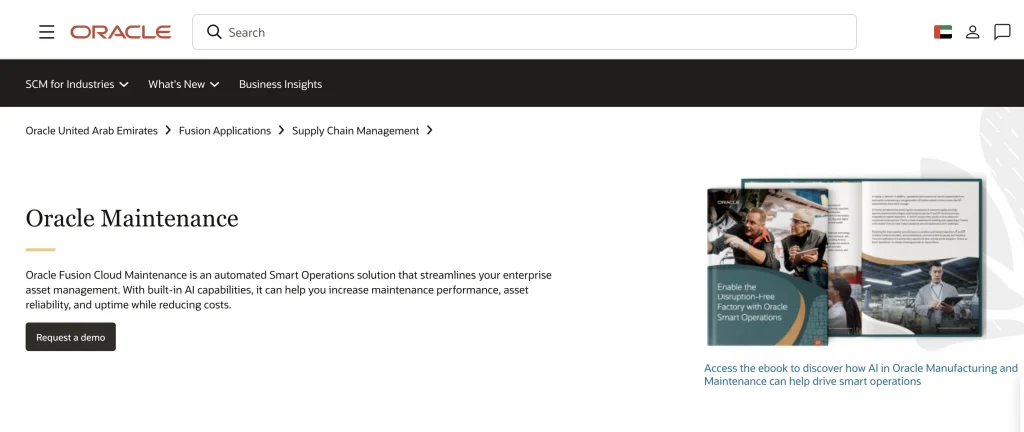
Best for: Manufacturers that already use Oracle Fusion Cloud across supply chain, manufacturing, inventory, procurement, costing, or finance.
What it is
Oracle Fusion Cloud Maintenance is part of the Oracle Fusion Cloud Supply Chain & Manufacturing suite. It manages physical and customer-owned assets, maintenance organizations, maintenance processes, work execution, and reporting, while connecting these workflows to other Oracle applications.
Manufacturing strengths
Oracle’s main manufacturing advantage is its connection to the broader Fusion environment. Asset maintenance can draw on inventory, procurement, costing, manufacturing, parts, warranty, and supply chain information rather than operating as a standalone maintenance database.
Asset lifecycle coverage
Oracle documents full-lifecycle support for physical assets, including asset master data, hierarchies, meters, parts lists, maintenance history, warranties, cost information, work activity, and repair-versus-replace context.
Maintenance and reliability
Oracle supports maintenance programs, work requests, work orders, calendar- and interval-based preventive maintenance, and meter-driven maintenance. For condition-based maintenance, Oracle can use fault and operating data from connected equipment or external monitoring systems to trigger work requests or work orders. Because these workflows depend on connected data and may require additional Oracle services, buyers should confirm the integrations and services needed for their architecture.
Integrations and deployment
Oracle Maintenance is cloud-based and provides enterprise-wide integration across Oracle Fusion Cloud SCM, CX, and ERP Financials. Connected-equipment workflows can incorporate operational information into maintenance decisions. External manufacturing system connections should be evaluated separately from integrations within the Oracle Fusion ecosystem.
Pricing, trial, and demo
Standardized standalone Oracle Maintenance pricing is not published on the current product page reviewed. Oracle provides request-a-demo access and self-guided SCM product tours, with commercial terms handled through its sales process.
Potential limitation
Much of Oracle Maintenance’s strategic advantage stems from its integration with the broader Fusion ecosystem. Manufacturers that do not use Oracle for adjacent supply chain and enterprise processes may capture less value from that architecture.
Final fit: Best suited to manufacturers that want maintenance closely integrated with an existing Oracle SCM and ERP environment.
6. Octave Attune EAM: Best for configurable enterprise asset management
Best for: Asset-intensive manufacturers that need configurable maintenance, asset lifecycle management, inventory, mobility, calibration, and reliability-centered workflows.
What it is
Octave Attune EAM, formerly HxGN EAM, is a cloud-based Enterprise Asset Management platform for managing physical assets, maintenance work, inventory, labor, and asset history. The product originated as Infor EAM, then became HxGN EAM and, following Octave’s 2026 launch as an independent company, Attune EAM.
Manufacturing strengths
Attune EAM supports complex asset hierarchies, work-order automation, labor scheduling, MRO inventory and procurement, calibration, mobile inspections, maintenance history, and asset-risk information. These capabilities make it relevant to manufacturers operating large or highly controlled asset environments.
Asset lifecycle coverage
The platform supports asset records, hierarchies, maintenance history, inspections, inventory, procurement, risk calculations, and work execution across the asset lifecycle. It also includes digital-twin visualization for additional asset context.
Maintenance and reliability
Attune EAM supports preventive maintenance, reliability-centered maintenance, work orders, scheduling, calibration, and inspections.
Advanced Asset Performance Management is provided through the separate Attune APM product, which adds capabilities such as condition monitoring, asset health analytics, and predictive failure analysis.
Integrations and deployment
Attune EAM is cloud-based and supports mobile workflows and enterprise integrations. Buyers should verify the specific ERP, operational-technology, and third-party integrations required for their environment.
Pricing, trial, and demo
Public standardized pricing is not disclosed. Buyers should request a quote and confirm whether the proposed package includes Attune EAM only or also Attune APM. A self-service free trial could not be publicly verified.
Potential limitation
Manufacturers requiring advanced predictive reliability may need Attune APM in addition to Attune EAM, increasing solution scope and implementation requirements.
Final fit: Best suited to asset-intensive manufacturers that need configurable enterprise EAM, with Attune APM available when deeper predictive reliability is required.
7. IFS Ultimo: Best for maintenance-led EAM adoption
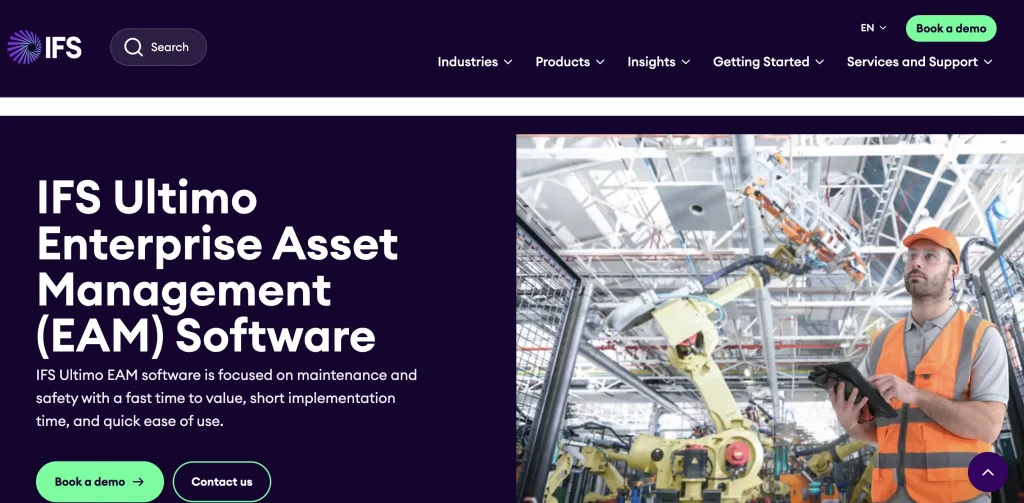
Best for: Manufacturers that want a maintenance-centered EAM with broader asset, reliability, safety, and multi-site capabilities without adopting the complete scope of IFS Cloud.
What it is
IFS Ultimo is a cloud-based SaaS EAM platform aimed at asset-intensive organizations. It brings maintenance, asset records, spare parts, operations, Environment, Health, and Safety (EHS), reporting, and AI-assisted workflows into one environment. IFS positions Ultimo separately from IFS Cloud EAM.
Manufacturing strengths
Ultimo has specific manufacturing positioning around production, utility, and facility equipment. Its current manufacturing offering emphasizes preventive and proactive maintenance, work execution, asset visibility, spare-parts control, safety workflows, mobile access, and multi-site maintenance.
Asset lifecycle coverage
Ultimo maintains asset records, maintenance history, operational and reliability information, parts context, and asset performance data throughout the equipment’s working life. Its orientation is more maintenance-led than the broader design-to-decommission positioning of IFS Cloud EAM.
Maintenance and reliability
Ultimo supports work orders, preventive maintenance, asset history, spare parts, and reliability workflows. The current product material describes time-, usage-, and condition-oriented maintenance, as well as FMECA and AI-supported proactive/predictive capabilities. More advanced reliability requirements should still be evaluated against the exact Ultimo edition and compared with the wider IFS APM offering.
Integrations and deployment
Ultimo is delivered as SaaS. Premium includes extensive integration capabilities for connecting Ultimo with systems such as ERP and Supply Chain Management platforms. Desktop and mobile access are documented; manufacturers with offline requirements should validate the exact workflow before purchase.
Pricing, trial, and demo
Ultimo currently lists Professional, Premium, and Enterprise editions, all with pricing on request. Professional starts at five users, Premium at 10, and Enterprise at 50. Professional is positioned for out-of-the-box deployment, while Premium and Enterprise use more configurable implementation approaches. Personalized demos are available.
Potential limitation
Manufacturers requiring the broader ERP, service, project, or advanced APM scope of IFS Cloud should not assume that Ultimo provides the same breadth simply because both products are part of IFS.
Final fit: Best suited to manufacturers using maintenance as the starting point for broader EAM adoption while preferring a focused SaaS platform with implementation options that vary by edition.
8. Aptean EAM: Best for manufacturing-focused asset and maintenance management
Best for: Manufacturers seeking EAM and CMMS capabilities from a vendor with a wider manufacturing-software portfolio.
What it is
Aptean EAM is an Enterprise Asset Management platform designed for asset-intensive organizations, including manufacturing. Current Aptean material emphasizes maintenance planning, work orders, asset performance and history, preventive maintenance, inventory, multi-site operations, and long-term repair-versus-replace decisions.
Manufacturing strengths
Aptean’s EAM is explicitly positioned around manufacturing and other equipment-intensive operations. It supports preventive maintenance, work-order management, spare-parts inventory, asset-performance monitoring, configurable reporting, and maintenance visibility across sites, lines, and teams.
Asset lifecycle coverage
Aptean’s current EAM positioning extends beyond work-order execution to asset performance, history, maintenance, repair-versus-replace decisions, and long-term reliability. Its manufacturing material also describes support from equipment purchase and installation through maintenance and eventual disposal.
Maintenance and reliability
Aptean supports preventive maintenance, work orders, approvals, labor assignment, spare-parts tracking, inspections, performance reporting, and asset health workflows. Current material also positions the product around predictive maintenance and reliability challenges, although buyers should validate the precise analytical depth required for their use case.
Integrations and deployment
Aptean EAM supports integration with ERP, condition-monitoring, control, HR, and other external systems through APIs, web services, and interface modules. Aptean also offers adjacent ERP, MES, OEE, and manufacturing products. However, verify which connections to those products are prebuilt versus API- or custom-integration dependent.
Pricing, trial, and demo
Aptean does not publish standardized EAM subscription pricing on the current product page reviewed. It provides a self-guided product tour and directs buyers to request a personalized demo. A self-service free trial could not be verified.
Potential limitation
Public information about Aptean’s exact package boundaries, integration depth, and advanced reliability functionality is less granular than that of some enterprise-suite vendors. Buyers should confirm those requirements at the proposed package level rather than extrapolating from Aptean’s broader manufacturing portfolio.
Final fit: Best suited to manufacturers that value manufacturing-focused EAM capabilities and are prepared to validate how the platform integrates with their existing ERP, MES, OEE, and shop-floor systems.
Manufacturing EAM capabilities compared
No single status can capture every detail of an EAM platform, especially when functionality varies by edition or module. To keep the comparison consistent, each capability below uses only one of five classifications:
- Native: Available directly in the evaluated product without requiring a separate product or third-party system.
- Module: Requires an additional first-party module, package, edition, or separately licensed capability.
- Integration: Depends materially on another system, connector, or external data source.
- Limited: Supported, but with narrower functionality than a dedicated or more advanced solution.
- Not publicly verified: Current public information does not provide sufficient evidence to confidently classify the capability.
Package and implementation qualifications are explained separately in the notes rather than embedded in the status cells.
Core EAM and maintenance capabilities
| Platform | Lifecycle coverage | Multi-site support | Calendar-based PM | Meter/usage-based maintenance | Spare parts |
| EZO EAM | Native | Native | Module | Module | Native |
| IBM Maximo Application Suite | Native | Native | Native | Native | Native |
| SAP S/4HANA Asset Management | Native | Native | Native | Native | Native |
| IFS Cloud EAM | Native | Native | Native | Native | Native |
| Oracle Fusion Cloud Maintenance | Native | Native | Native | Native | Native |
| Octave Attune EAM | Native | Native | Native | Native | Native |
| IFS Ultimo | Native | Native | Native | Native | Native |
| Aptean EAM | Native | Native | Native | Native | Native |
Reliability, mobile, and integration capabilities
| Platform | Condition-based maintenance | Predictive/APM | Mobile workflows | Offline execution | ERP/API connectivity | IoT/condition-data connectivity |
| EZO EAM | Module | Limited | Native | Module | Integration | Integration |
| IBM Maximo Application Suite | Module | Module | Native | Native | Integration | Module |
| SAP S/4HANA Asset Management | Native | Module | Module | Module | Native | Integration |
| IFS Cloud EAM | Native | Module | Native | Native | Native | Integration |
| Oracle Fusion Cloud Maintenance | Integration | Integration | Native | Not publicly verified | Native | Integration |
| Octave Attune EAM | Native | Module / separate product | Native | Native | Integration | Integration |
| IFS Ultimo | Native | Limited | Native | Native | Integration | Integration |
| Aptean EAM | Native | Not publicly verified | Not publicly verified | Not publicly verified | Integration | Not publicly verified |
Important comparison notes
- EZO EAM: Full preventive maintenance and work-order functionality depends on CMMS packaging or the applicable enterprise plan. Condition- and usage-triggered maintenance should therefore be interpreted in the context of that packaging.
- IBM Maximo: Advanced asset health, monitoring, reliability, and predictive capabilities span the wider Maximo Application Suite rather than one undifferentiated EAM feature set.
- SAP: SAP S/4HANA Asset Management supports preventive and counter-based maintenance. More advanced asset-performance capabilities are provided through SAP Asset Performance Management, which should be evaluated separately.
- IFS Cloud EAM: Advanced APM functionality should not be treated as standalone core EAM functionality; IFS states that its Asset Performance Management capability requires integration with IFS Operational Intelligence.
- Oracle: Condition-based workflows can depend on connected equipment or operational data flowing into Oracle Maintenance. Predictive functionality should be evaluated separately rather than inferred from condition-based maintenance.
- Octave Attune EAM: Buyers should confirm the exact packaging of advanced reliability and predictive functionality in the proposed deployment.
- IFS Ultimo: Ultimo supports condition- and maintenance-led asset management, but manufacturers requiring deeper enterprise APM should compare its scope with the broader IFS Cloud offering.
- Aptean EAM: Buyers should verify advanced reliability, IoT, offline mobile, and package-specific integration capabilities during procurement.
- Not publicly verified does not mean unsupported. It means the available public evidence is insufficient to confidently classify the capability.
Pricing visibility
| Platform | Public pricing visibility |
| EZO EAM | Published core pricing |
| IBM Maximo Application Suite | Selected starting pricing published |
| SAP S/4HANA Asset Management | Contact vendor |
| IFS Cloud EAM | Contact vendor |
| Oracle Fusion Cloud Maintenance | Contact vendor |
| Octave Attune EAM | Private offer/contact vendor |
| IFS Ultimo | Pricing on request |
| Aptean EAM | Contact vendor |
Capability availability does not indicate equal feature depth. For example, recording a condition reading, triggering maintenance from a threshold, ingesting sensor data, calculating asset health, detecting anomalies, and predicting future failure are different capabilities. Buyers should verify both the availability and depth of each requirement in the exact package being proposed.
How manufacturing EAM connects with ERP, MES, SCADA, IoT, and APM
The relationship between EAM and surrounding manufacturing systems is easier to understand visually than in prose. The diagram below shows the typical role of each system and the kinds of data that commonly move between them.
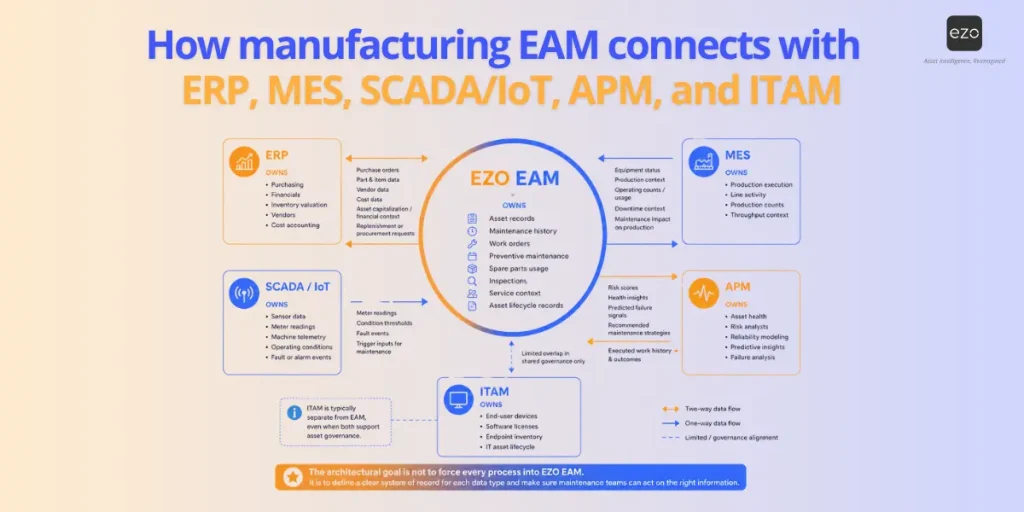
Manufacturing EAM does not replace every surrounding enterprise system. The more important question is which system owns which data and how those systems exchange context. In most environments, EAM acts as the operating system of record for physical asset maintenance, while ERP, MES, SCADA/IoT, APM, and ITAM each own different adjacent processes.
Enterprise Resource Planning (ERP)
ERP typically owns purchasing, vendor records, financials, and inventory valuation. EAM should exchange asset, parts, vendor, and cost context with ERP without duplicating financial ownership.
Manufacturing Execution System (MES)
MES typically owns production execution and line-level operating context. EAM should receive the production or usage information needed to understand how maintenance affects equipment performance and availability.
Supervisory Control and Data Acquisition (SCADA) and Internet of Things (IoT)
SCADA and IoT systems usually generate machine telemetry, meter readings, fault events, and condition data. EAM can use that information to trigger or inform maintenance activity, but the telemetry itself usually originates elsewhere.
Asset Performance Management (APM)
APM extends beyond maintenance execution to encompass asset health, risk, reliability, and predictive analytics. EAM and APM often work together: APM produces insight, while EAM executes and records the maintenance response.
IT Asset Management (ITAM)
ITAM manages end-user devices, software, and IT lifecycle governance. It may align with enterprise asset governance, but it should not be treated as interchangeable with EAM for production and facility assets.
Closing sentence
The architectural goal is not to force every process into EAM. It is to define a clear system of record for each data type and ensure maintenance teams can act on the right information without manually rebuilding context.
Security and compliance due diligence for EAM vendors
Enterprise asset data can reveal plant structures, maintenance practices, equipment condition, operational schedules, employees, contractors, and costs. Security should therefore be a mandatory part of vendor due diligence. It is not scored in the comparison above because security documentation varies in depth and requirements differ by organization, deployment, geography, and regulatory environment.
Shortlisted vendors should be evaluated directly across the following areas.
Identity and access
Confirm support for:
- Single sign-on
- Multi-factor authentication
- Role-based permissions
- Site-level access restrictions
- Contractor roles
- Separation between technicians and administrators
Data protection
Ask how the vendor handles:
- Encryption in transit
- Encryption at rest
- Backups
- Disaster recovery
- Data retention
- Data residency
- Customer data export
Auditability
A maintenance record should preserve enough evidence to answer who changed what and when.
Evaluate:
- User-attributed actions
- Work-order history
- Approval records
- Inspection results
- Change timestamps
- Supporting documents
- Version history where required
Certifications and regulated environments
Depending on your requirements, ask vendors for relevant assurance evidence, such as a current SOC 2 report, ISO/IEC 27001 certification where applicable, and documentation of GDPR-related privacy and data-processing controls.
Regulated manufacturers may also need to evaluate workflows supporting calibration, safety inspections, GMP documentation, quality requirements, or other industry controls.
Software can support compliance processes. Purchasing an EAM does not, by itself, make the organization compliant.
How much does manufacturing EAM software cost?
There is no standard EAM price.
Manufacturing EAM may be licensed by:
- Named users
- Concurrent users
- Technicians
- Administrators
- Assets
- Sites
- Modules
- Usage credits
- Enterprise agreement
The subscription is only the first layer.
Licensing
EZO publishes asset-based pricing for its core EAM plans, while IBM publishes starting pricing for selected Maximo packages. Several of the other platforms in this comparison require a sales quote or enterprise proposal.
Implementation
Budget for work such as:
- Data migration
- Asset hierarchy design
- Configuration
- Integrations
- Consulting
- Validation
- Training
- Change management
Ongoing operating cost
Also consider:
- Platform administration
- Integration maintenance
- Support
- New sites
- Additional modules
- Mobile hardware
- Sensors or gateways
- Data-quality work
- Process governance
Comparing only license prices can obscure the full three-year cost of implementation, integration, administration, and operation.
How to calculate the business case for manufacturing EAM
The business case for EAM should compare measurable operational benefits with the full cost of implementation and operation over the same period. A three-year model is often more useful than looking at subscription cost or first-year savings alone.
Potential benefit categories include:
- Avoided production losses from unplanned downtime
- Reduced maintenance labor or overtime
- Lower inventory carrying, stockout, or obsolescence costs
- Avoided or deferred equipment replacement
- Reduced administrative and reconciliation effort
Define each benefit category separately so the same improvement is not counted twice. For example, if avoided downtime already includes the value of recovered production and associated labor, do not double-count those same labor hours as technician productivity savings.
Use two calculations:
Annual net benefit = annual quantified benefits − recurring annual costs
Recurring costs may include software subscriptions, support, administration, integration maintenance, additional modules, and other ongoing operating expenses.
For the full investment:
ROI = (total quantified benefits − total costs) ÷ total costs × 100
Total costs should include both recurring expenses and one-time costs such as implementation, data migration, configuration, integrations, consulting, validation, training, and change management.
Calculate both benefits and costs over the same analysis period, such as three years. Treat implementation, migration, and integration as year-one costs unless your financial model deliberately amortizes them over the evaluation period.
Measure the baseline
Before implementation, establish consistent measures for:
- Unplanned downtime
- Cost of downtime
- Preventive maintenance compliance
- Planned versus unplanned work
- Mean Time to Repair (MTTR)
- Mean Time Between Failures (MTBF)
- Maintenance backlog
- Emergency work
- Spare-parts stockouts
- Maintenance labor
- Asset replacement
- Administrative reconciliation time
Then measure results using the same definitions after implementation.
For payback, track the point at which cumulative quantified benefits exceed cumulative implementation and operating costs rather than assuming a fixed payback period.
Finally, do not attribute every improvement automatically to the software. Results also depend on data quality, workflow design, technician adoption, maintenance discipline, integration quality, and management follow-through.
How to choose the right EAM platform for your manufacturing operation
1. Define the asset and site scope
Start with what needs to be governed.
How many plants are involved? Which assets belong in the platform? Will it include only production machinery, or also tools, vehicles, facilities, mobile equipment, and stock?
Also determine whether equipment moves between sites.
2. Decide whether you need CMMS or EAM
Do this before building the shortlist.
If maintenance execution is the only major pain point, evaluate CMMS products alongside EAM rather than assuming broader software is automatically better.
3. Map integration ownership
For every major dataset, decide who owns it.
Ask:
- Which system creates the asset?
- Which owns its financial value?
- Where do meter readings originate?
- Which system creates production downtime?
- Which system initiates maintenance?
- Where is inventory authoritative?
- What happens when two systems disagree?
This exercise often reveals more about implementation complexity than a feature comparison.
4. Assess maintenance maturity
Do not purchase a predictive maintenance vision when the plant cannot reliably maintain basic asset records.
Determine whether the organization already has the data and discipline needed for:
- PM
- Meter-based schedules
- Failure coding
- Criticality
- Condition monitoring
- Reliability analysis
- Predictive maintenance
Build maturity in layers.
5. Test technician usability
Technicians determine whether the digital record reflects reality.
Give them the actual device they would use and ask them to:
- Find an assignment
- Scan an asset
- Open history
- Follow instructions
- Enter a reading
- Add a photo
- Consume a part
- Complete work
Count how many unnecessary steps the workflow requires.
6. Calculate implementation capacity
A sophisticated EAM platform will not simplify operations if the organization lacks the capacity to implement and govern it.
Consider:
- Executive sponsorship
- Internal system owner
- Data-cleaning resources
- Integration expertise
- Plant champions
- Training capacity
- Ongoing administration
7. Compare total cost
Model at least:
Subscription + modules + implementation + migration + integration + training + administration + expansion
over a realistic period.
8. Run the five scenario tests
Finally, make every shortlisted vendor demonstrate the same failure, meter, parts, transfer, and audit scenarios described earlier.
That produces a far more useful comparison than eight separate scripted product demonstrations.
Manufacturing EAM implementation roadmap
Phase 1: Define scope and ownership
Establish the business problem first.
Name an executive sponsor, operational system owner, initial plants, asset classes, and desired outcomes.
Phase 2: Prepare asset data
Clean the records that drive operational workflows:
- Asset IDs
- Names
- Locations
- Hierarchies
- Criticality
- Meter units
- PM schedules
- Parts
- Custody
- Statuses
- Manufacturer/model data
Do not migrate inconsistency simply because it already exists.
Phase 3: Configure and integrate
Set up:
- Permissions
- Requests
- Work orders
- Priorities
- PMs
- Escalations
- Inventory
- ERP integrations
- Mobile workflows
Avoid recreating every legacy exception before users have tested the new process.
Phase 4: Pilot a representative site
The easiest plant is not always the best pilot.
Choose a facility complex enough to reveal real operating issues while remaining manageable.
Measure:
- Adoption
- PM completion
- Work-order quality
- Data completeness
- Downtime capture
- Parts availability
Phase 5: Standardize and expand
Turn pilot lessons into a reusable rollout framework.
Standardize definitions and data to ensure comparability while allowing justified variation in how plants perform work.
Phase 6: Add advanced reliability
After foundational maintenance data becomes trustworthy, evaluate:
- Condition monitoring
- Failure analysis
- Health scoring
- Predictive maintenance
- Reliability-centered maintenance
Advanced analytics become much more valuable once the underlying operating record is reliable.
Questions to ask during an EAM vendor demo
Use the same questions with every shortlisted vendor:
- Which asset lifecycle stages are native to this product?
- Can the system model plants, areas, lines, equipment, and components?
- Can preventive maintenance use both dates and usage?
- Can operators submit requests without requiring full technician licenses?
- How does the platform calculate downtime?
- Can parts be reserved and issued against work orders?
- Does mobile functionality work offline?
- How are workflows governed across plants?
- Which capabilities require another module?
- Which ERP, MES, SCADA, IoT, or APM integrations are prebuilt?
- What is available through APIs?
- How are site and role permissions controlled?
- How is historical maintenance data migrated?
- What normally determines implementation time?
- Which internal resources will we need?
- How is licensing calculated?
- Which onboarding and support services are included?
- Can we export complete asset and maintenance data?
- Which security certifications are current?
- Can you demonstrate our five manufacturing scenarios in the live product?
Final verdict: which manufacturing EAM platform should you choose?
The right manufacturing EAM depends less on the size of the feature list and more on three factors: your existing enterprise ecosystem, the depth of reliability capabilities you need, and the amount of implementation and administration your organization can support.
Manufacturers already standardized on major ERP platforms may benefit from EAM that closely aligns with those environments, while organizations managing critical assets may need deeper capabilities in condition monitoring, reliability engineering, or Asset Performance Management. Others may prioritize a more focused platform that connects asset lifecycle, maintenance, inventory, and multi-site operations without introducing unnecessary enterprise complexity.
The strongest shortlist should therefore reflect your actual plant structure, asset criticality, maintenance maturity, integration requirements, and internal resources.
Before making a final decision, require shortlisted vendors to demonstrate the same manufacturing scenarios using your real workflows and clarify which capabilities are native, separately licensed, or integration-dependent.