Editorial note. EZO publishes this guide and develops EZO EAM, one of the eight platforms covered. The same criteria, evidence rules, and pricing disclosure rule are applied to every product, including EZO’s. Profiles run in alphabetical order by product name, not by rank or preference. Capabilities, packaging, ownership, and pricing were verified against current vendor sources on September 21, 2026.
Why multi-plant spare parts control breaks down
A multi-plant spare parts problem can appear straightforward: one plant is short of a bearing while another has excess stock sitting unused. The deeper issue is often not total inventory, but fragmented part definitions, limited visibility into available stock across locations, and the lack of a dependable process for transferring surplus before buying more.
As manufacturers add plants, these inconsistencies can multiply. One site may identify a motor by manufacturer part number, another by an internal item number, and a third by a supplier-specific identifier. Reorder levels may reflect different lead times, while buyers use different suppliers. Maintenance may reserve parts against work orders, finance may record purchases in the ERP, and storeroom staff may reconcile balances in spreadsheets. Each record may work locally, but the network still cannot answer a basic question: Do we already own what this plant is about to buy?
This can create a familiar multi-plant imbalance: too much inventory across the network, yet too little stock where and when it is needed. A company can carry excess stock overall yet still incur emergency freight costs, delay planned work, or prolong downtime because the right part is unavailable at the right plant.
Multi-plant spare parts management is therefore not simply a question of having more or less inventory. It is about knowing what you have, where it is, whether it is available for use, and whether it can be moved between locations before purchasing new stock. The goal is appropriate availability, not the smallest storeroom.
An effective EAM architecture should connect spare parts with the plants, storerooms, assets, bills of materials, work orders, suppliers, approvals, receipts, and transfers that determine how those parts are used. These capabilities may be built into the EAM platform itself, delivered through adjacent modules in the same software suite, or enabled through integrations with other enterprise systems. That distinction can affect how seamlessly maintenance, inventory, and procurement workflows operate.
This guide compares eight platforms across four questions: how they provide cross-plant inventory visibility, how they support transfer-before-buy workflows, how maintenance demand drives replenishment, and how they integrate with enterprise procurement.
Key takeaways
- Multi-plant spare parts control depends on knowing what is truly available across locations, not simply what exists across the network.
- Transfer-before-buy requires approvals, shipment, receipt, and audit controls, not just cross-site inventory visibility.
- Standardized part identities are essential because duplicate descriptions and units fragment demand and encourage redundant purchasing, making inventory organization critical.
- EAM selection should start by defining which systems own inventory, procurement, maintenance demand, and financial records before designing EAM integrations.
- Plants need local stocking policies within centralized catalog, approval, role, and enterprise reporting standards.
- Proofs of concept should test vendors with identical plant data, exceptions, transfer workflows, reservations, replenishment, and ERP synchronization.
- Inventory optimization should protect maintenance readiness and uptime, not simply minimize stock, so inventory KPIs should be evaluated alongside maintenance performance.
The eight platforms evaluated in this guide
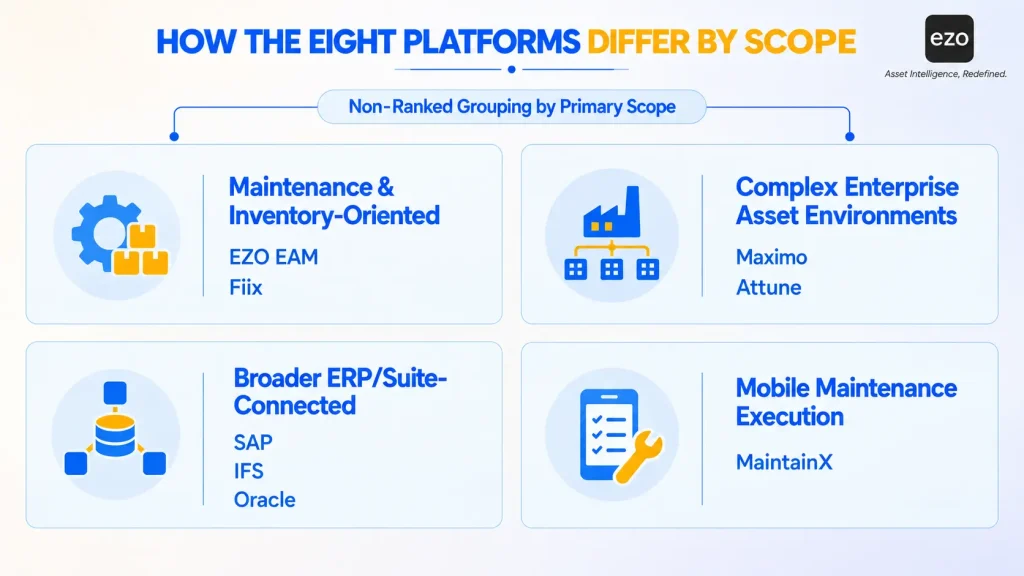
The eight platforms evaluated here are EZO EAM, Fiix, IBM Maximo Application Suite, IFS Cloud EAM, MaintainX, Octave Attune EAM (formerly HxGN EAM), Oracle Fusion Cloud Maintenance, and SAP S/4HANA Asset Management. They are listed and profiled in alphabetical order by product name, not ranked. The platforms also differ in scope: EZO EAM and Fiix are oriented toward maintenance and inventory workflows; Maximo and Attune support more complex asset environments; SAP, IFS, and Oracle connect maintenance with broader enterprise and ERP capabilities; and MaintainX places a strong emphasis on mobile maintenance execution. Start with how your plants actually work, not with the platform that has the longest feature list.
How to read the comparison tables
Each capability is evaluated across three dimensions rather than reduced to a single label:
- Capability status: Classified as Documented, Partial, or Not publicly verified based on available public documentation.
- Packaging: Identifies the plan or module required to access the capability.
- System boundary: Identifies whether the workflow sits within the named product, an adjacent component of the same suite, or an external system connected through integration.
Not publicly verified means the capability could not be confirmed through the sources reviewed; it should not be interpreted as evidence that the capability does not exist.
Capability comparison
| Platform | Cross-plant stock visibility | Inter-plant transfer workflow | Replenishment and reorder | Enterprise system boundary |
|---|---|---|---|---|
| EZO EAM | Documented: plants as locations and sublocations, quantities by location | Documented: stock transfer and transfer requests with approval, from Advanced plan | Documented: location thresholds, low-stock alerts, purchase orders from Advanced Plan | External ERP integration via API and webhooks; QuickBooks Online named |
| Fiix | Documented: cross-site part search and inventory sharing, Professional and Enterprise with multi-site configurations | Documented with named constraints: direct location-to-location transfer, enabled by Fiix, not FIFO-compatible, permission-gated | Documented: minimum quantities, purchase requests and orders, cycle counts | External ERP integration; Integration Hub, custom API, and SSO are Enterprise add-ons |
| IBM Maximo | Documented: storerooms, sites, and organizations | Documented: storeroom transfers, issues, and receipts | Documented: reorder points and replenishment; Inventory Optimization packaged separately | External ERP integration via connectors and integration frameworks |
| IFS Cloud EAM | Documented through connected IFS Cloud supply-chain components | Documented through connected IFS Cloud components | Documented through connected IFS Cloud components | Same-suite components within IFS Cloud |
| MaintainX | Documented at Enterprise: global parts and multi-location parts | Not publicly verified: no end-to-end shipment-and-receipt chain in current public evidence | Documented: minimum and maximum levels, purchase-order restocking, allocation by location | External ERP integration; custom ERP integrations at Enterprise |
| Octave Attune EAM | Documented: multi-organization and multi-site stores | Documented: stores and materials management, issues, returns, repairable spares | Documented: requisitions and purchasing inside the EAM | External ERP integration via DataBridge and related tooling |
| Oracle Fusion Cloud Maintenance | Documented through Oracle Inventory Management | Documented: interorganization transfers within Oracle SCM scope | Documented through Inventory Management and Procurement | Same-suite components within Oracle Fusion |
| SAP S/4HANA Asset Management | Documented through S/4HANA materials capability | Documented: stock transfers in the S/4HANA materials environment | Documented through Inventory Management and Sourcing and Procurement | Same-suite components within S/4HANA |
Ownership, pricing, and minimum package
Published list prices are reported with the date of capture and the relevant pricing unit, such as per user or per asset. Where a vendor does not publish pricing, the entry is identified as quote-based, with the available cost drivers noted where applicable. The same standard is applied to the publisher’s own product.
| Platform | Owner | Published price (captured September 21, 2026) | Minimum package to evaluate for multi-plant spare parts | Deployment |
|---|---|---|---|---|
| EZO EAM | EZO | Essential $63.55, Advanced $85.51, Premium $100.88 per month at 300 tracked items; Enterprise custom; CMMS priced separately by admin user | Advanced for stock transfer, purchase orders, and API; Premium for multi-tier approvals, LDAP and SAML, and the CMMS add-on; Enterprise for offline mobile | Cloud |
| Fiix | Rockwell Automation | Free $0; Basic $45; Professional $75 per user per month; Enterprise custom | Professional for multi-site management, purchasing, and cycle counts; Enterprise for Integration Hub, custom API, and SSO | Cloud |
| IBM Maximo | IBM | Maintenance entry package from under US$40,000 per year at 150 AppPoints; other configurations quote-based | Manage for storeroom and purchasing; Inventory Optimization licensed separately | Cloud, client-managed, or hybrid |
| IFS Cloud EAM | IFS | Quote-based; driven by modules, users, countries, integrations, and services | EAM plus the IFS Cloud inventory, procurement, and planning components named in your scope map | Cloud |
| MaintainX | Autodesk (acquisition closed August 3, 2026) | Essential $20 and Premium $65 per user per month billed annually ($25 and $75 billed monthly); Enterprise custom; requester accounts free | Premium for parts inventory and purchase orders; Enterprise for global parts, multi-location parts, approvals, cycle counting, SSO, and custom ERP integrations | Cloud |
| Octave Attune EAM | Octave; product formerly HxGN EAM | Quote-based; driven by users, modules, deployment, integrations, migration, and localization | Named modules for materials, purchasing, mobile, analytics, and integration, itemized in the quote | Cloud; verify current on-premises availability |
| Oracle Fusion Cloud Maintenance | Oracle | Quote-based; driven by applications and user roles licensed | Maintenance plus Inventory Management, Procurement, Cost Management, and Product Hub as applicable | Cloud |
| SAP S/4HANA Asset Management | SAP | Quote-based; driven by edition, users, components, deployment, and services | Asset Management plus the Inventory Management and Sourcing and Procurement capabilities required | Cloud or on-premises |
Source note. Prices, packaging, ownership, and capabilities were captured on September 21, 2026, from vendor pricing pages, product documentation, help centers, and the acquirer’s announcement for the Autodesk transaction. Published prices change without notice; confirm figures and plan inclusions in writing before budgeting.
How we evaluated the platforms
Selection methodology
The eight products were selected for their documented relevance to multi-plant maintenance, inventory, and procurement, not for general software popularity. The evaluation considered eleven questions:
- Can authorized users see available parts by plant, storeroom, and bin?
- Can the platform distinguish on-hand, available, reserved, and in-transit quantities?
- Can sites request, ship, receive, and audit inter-plant transfers?
- Can the organization govern one item catalog while retaining plant-specific stocking rules?
- Can parts be linked to assets, bills of materials, work orders, and preventive maintenance?
- Can each location set reorder points, safety stock, suppliers, and lead times?
- Are requisitions, approvals, purchase orders, partial receipts, returns, and suppliers supported?
- How does the platform connect with ERP, finance, and procurement systems?
- Can technicians and storeroom teams receive, issue, return, transfer, scan, and count stock on mobile devices?
- Can leaders compare stockouts, duplicate purchases, transfers, excess stock, and planned-work readiness across plants?
- What implementation, ownership, and administration demands accompany the capability?
Evidence standards
Conclusions prioritize official product pages, documentation, licensing information, integration materials, and named customer examples, with each source listed under the profile it supports and the date it was checked. Independent reviews may help assess usability and support quality, but they are not considered evidence of technical capability. Accordingly, usability and adoption statements in this comparison are not presented as measured comparative results. Where available public evidence does not establish a function, it is marked Not publicly verified. The same standard should be applied to your own software evaluation and procurement process.
What to look for in multi-plant EAM software
Enterprise-wide spare parts visibility
Multi-plant visibility should allow authorized users to see a part’s availability and status across locations without manually reconciling separate plant records. A total quantity is not enough. Ten units across the network may mean eight are reserved for shutdown work, one is quarantined, and the remaining unit is in transit.
Available quantity is a starting point, not proof that a requirement can be met. Location, condition, transfer lead time, reservation priority, and user permissions can all affect whether stock is actually usable. The system should provide visibility into quantity on hand, available quantity, reservations, in-transit stock, plant, storeroom and bin, condition, expected replenishment, and movement history. The information may sit across different records or views, but users should be able to trace it without manually reconciling separate systems. Where another system owns the inventory data, evaluate how frequently these fields are synchronized and what users see when an integration fails or data becomes stale.
Transfer-before-buy workflows
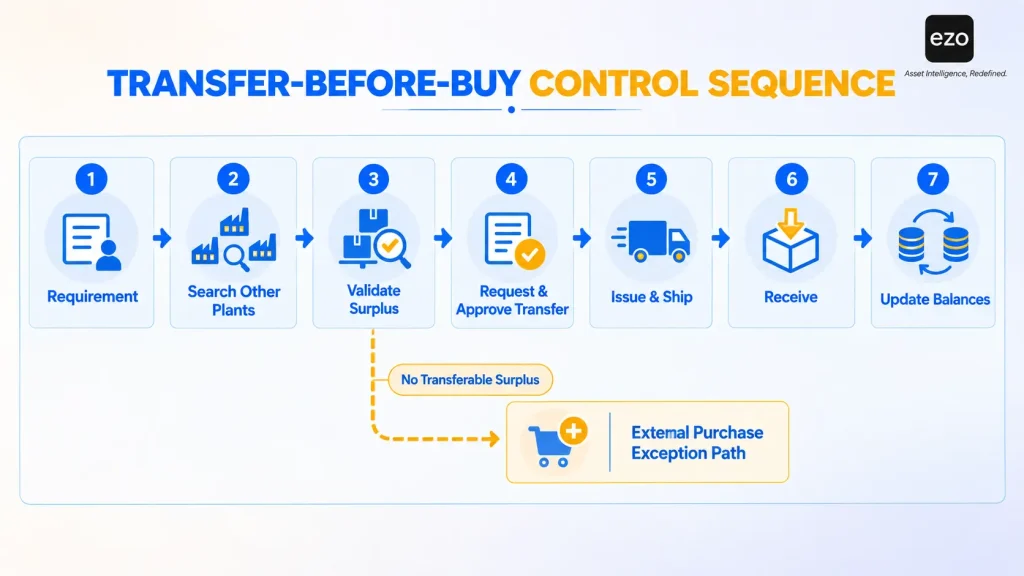
Transfer-before-buy is a control sequence, not simply a search feature. A plant identifies a requirement, the system checks authorized stock at other locations, and the sending site confirms that the stock is available for transfer without compromising its own requirements. The transfer is then requested and approved, the part is issued and moved, and the receiving site records the receipt.
Treat it as a required check, not a mandatory transfer. Purchasing may still be the right option when a transfer would be slower or more expensive, or when moving the part would reduce critical stock coverage at another plant. A global inventory search can reveal where stock exists, but without transfer, receipt, and audit controls, it does not provide a reliable process for moving parts between sites.
Standardized parts catalogs
Redundant buying often starts before the requisition. If the same coupling exists under three descriptions and two units of measure, demand and inventory records can become fragmented across multiple part numbers and histories. Stock numbers, manufacturer and supplier part numbers, units of measure, equivalents, substitutes, superseded parts, bills of materials, and where-used relationships need an authoritative source, whether that is the EAM, ERP, master-data system, or PLM. That information should also remain visible to EAM users wherever it is governed.
Some platforms flag probable duplicates; others primarily store cross-references. Either way, someone still has to determine whether two records represent the same or technically interchangeable part. That makes standardized catalog and inventory organization as much a data-management problem as a software problem.
Maintenance-driven inventory planning
Maintenance creates two distinct types of demand. Planned work makes future requirements more visible through preventive schedules, job plans, reservations, and kits. Corrective work creates more intermittent demand, where the consequences of a stockout depend on asset criticality, redundancy, failure patterns, lead time, and the cost of waiting. A useful EAM should connect both types of demand to consumption history without assuming that every rare failure can be forecast precisely.
Replenishment and procurement controls
Each plant may require different minimum and maximum levels, reorder points, lead times, suppliers, and approval thresholds for the same part. The platform should support the full purchasing workflow, including requisitions, approval routing, purchase orders, partial receipts, returns, preferred suppliers, contract pricing, delivery performance, and audit history. Automation should follow defined purchasing controls, whether through explicit approval, exception-based review, or pre-approved automatic replenishment within established contract and policy thresholds.
ERP and financial-system integration
The EAM and ERP may own different parts of the process. The split below is one common arrangement, not a universal standard; in many architectures, inventory balances and reservations are mastered in the ERP or a warehouse management system instead. What matters is that ownership is defined for each data object and that the integration itself is documented at the field level.
| EAM responsibility (example) | ERP responsibility (example) |
|---|---|
| Work-order demand | Financial commitments |
| Parts reservations | Accounts payable |
| Storeroom issues and returns | Invoice processing |
| Maintenance bills of material | General ledger |
| Critical-spares planning | Enterprise purchasing controls |
| Operational consumption | Financial inventory valuation |
Mobile storeroom execution
A correct desktop balance can become wrong at the storeroom door. Mobile barcode or QR scanning should support receiving, issuing, returning, transferring, cycle counting, and adjustments with appropriate permissions. Offline behavior matters in remote or shielded plant areas and is often gated to a higher plan. Test what is stored locally, when synchronization occurs, and how conflicts are resolved.
Multi-plant governance and analytics
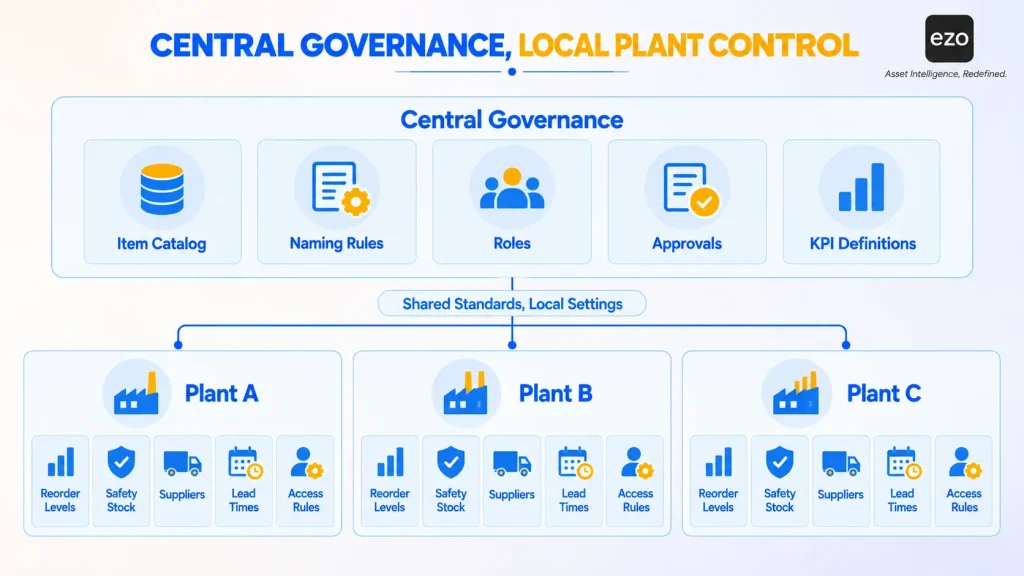
Centralization should standardize what needs to be consistent without forcing every plant to operate in exactly the same way. Central teams may own the item catalog, naming conventions, roles, approval segregation, and KPI definitions, while plants retain control over local reorder levels, criticality assessments, suppliers, and access rules. A suitable platform should make this boundary configurable and report both plant-level performance and enterprise-wide inventory exposure.
1. EZO EAM: Evaluate when you need centralized parts control across plants
Ownership. Developed by EZO, the publisher of this guide.
What distinguishes it: Asset and inventory records can be organized by locations and sublocations, with unlimited users and locations on the listed plans, subject to EZO’s published fair-usage policy. This can support organizations in which many requesters, technicians, and storeroom users need system access, while maintenance administration remains centralized. Confirm the user-to-item limits for your configuration rather than treating “unlimited” as unconditional.
Multi-plant inventory and transfers
Plants can be organized as locations and sublocations, with quantities by location, reservations, checkout records, stock transfers, barcode or QR scanning, and transaction history. For a multi-plant manufacturer, these capabilities can provide visibility into where stock is held, allow teams to reserve parts for planned work, and support transfers between sites without relying on separate plant-level spreadsheets. Thresholds and low-stock alerts can also support plant-specific replenishment.
The important distinction is between seeing stock across sites and controlling how that stock moves.
Stock transfers, custody transfers, custody audits, and standard access controls are available at Advanced; multi-tier approval, location audit, advanced roles, and the automation engine are available at Premium. EZO does not publicly describe an automated recommendation capability for selecting the best transfer source, so test how users search network-wide stock and confirm that surplus is available before initiating a transfer.
Procurement and ERP boundary
Purchase orders, vendor management, receiving, costs, and audit history are supported. Purchase orders and API access are available from Advanced, while multi-tier approvals, contracts, and the QuickBooks Online integration are available from Premium.
The QuickBooks Online integration covers accounting and work-order cost synchronization; it should not be assumed to provide purchase-order, receipt, item-master, or inventory-valuation synchronization. Scope those requirements separately. Broader ERP connections can be evaluated via the API, webhooks, or custom integrations.
Pricing, packaging, and deployment
Captured September 21, 2026: Essential is $63.55, Advanced is $85.51, and Premium is $100.88 per month at 300 tracked items; Enterprise is quote-based. A 15-day trial is available. Pricing scales by tracked items rather than by users, and stock-unit caps for bulk items are 5,000, 15,000, and 30,000, depending on the plan.
EZO EAM is cloud-hosted and provides iOS and Android apps. The offline mobile app is available only with Enterprise, which may be a concern for plants with unreliable connectivity. Full work-order and preventive-maintenance functionality is provided through the CMMS capabilities within EZO EAM; the CMMS add-on at Premium is priced separately by administrative users. EZO documents SOC 2, ISO 27001, GDPR, and AWS hosting.
Points to evaluate
- Test transfer-before-buy with real plant data, including a rejected transfer.
- Confirm the ERP integration model object by object, including synchronization direction and error handling.
- Price Advanced or Premium, along with the CMMS add-on, based on your actual tracked-item count and administrative-user requirements.
Best-fit decision. EZO EAM is most relevant when fragmented plant records and disconnected maintenance, inventory, and purchasing workflows are the primary problems to solve, particularly when the organization does not need a broader ERP or SCM suite to manage the same workflows. Evaluate other architectures in which procurement requires capabilities such as strategic sourcing, supplier risk management, or global financial controls that are typically owned by an ERP.
Sources checked. Pricing and plan matrix (pricing page, September 21, 2026) | Location-based thresholds, transfer requests, and purchase orders (product documentation) | Security (trust page)
2. Fiix: Evaluate when maintenance leads the program across multiple sites
Ownership. A Rockwell Automation product.
What distinguishes it: Public documentation covers many of the workflows a multi-plant buyer would need to verify, including minimum stock quantities, purchase requests and orders, ERP synchronization, cycle counts, QR scanning, bills of material, cross-site visibility, inter-facility part requests, and parts forecasting. Its scope is centered on maintenance operations rather than serving as a broader enterprise procurement backbone.
Multi-plant inventory and transfers
Users can view parts across sites, request stock from other facilities, set minimums, count inventory, scan parts, and search by location and inventory code. Inventory sharing between sites is documented for Professional and Enterprise in multi-site configurations.
Fiix documents direct stock transfers between locations and includes three constraints to account for. The feature is not enabled by default and must be enabled by a Fiix representative; it is not compatible with FIFO costing; and execution is restricted to administrators and users with the transfer-stock permission, with the part active at both locations. Public documentation does not establish a distinct workflow for request, approval, shipment, and receipt comparable to a dedicated enterprise materials process. Test the complete transfer sequence rather than treating cross-site inventory visibility as evidence of end-to-end transfer control.
Procurement and ERP boundary
Purchase requests, purchase orders, RFQs, approvals, vendors, and receipts are supported, with purchasing and RFQs available from Professional. Fiix describes updating receipts, stock, parts, and purchase orders in an ERP through integration. The Integration Hub, custom API integrations, single sign-on, and custom workflows are available at the Enterprise level and may incur additional costs.
Pricing, packaging, and deployment
Captured September 21, 2026: Free at $0 with limited users; Basic at $45 and Professional at $75 per user per month; Enterprise quote-based. The listed plans do not include setup or hardware fees. Professional is the relevant tier to evaluate for multi-site use, as it adds multi-site management, purchasing and RFQs, inventory cycle counts, asset criticality, and custom analytics. Lite License operator access and the Fiix MAX assistant are priced separately.
Fiix is cloud-based with mobile apps. Its documentation states that adding a part from another site is web-app only, so validate cross-site workflows, offline behavior, receiving, and transfers rather than assuming that all functions are available across interfaces. Test the Professional parts forecaster against your own intermittent-demand history.
Points to evaluate
- Ask Fiix to enable and demonstrate stock transfers, then run the complete inter-site request, movement, receipt, and balance-update process.
- Confirm the FIFO costing constraint against your inventory valuation method.
- If ERP synchronization is required, price Enterprise together with the Integration Hub, custom API work, and SSO as a complete configuration.
Best-fit decision. Fiix is relevant when maintenance owns the improvement program and needs parts, inventory, and purchasing workflows across multiple sites. Evaluate other architectures when procurement, supplier controls, financial valuation, or global item-master ownership are central requirements.
Sources checked. Fiix pricing (pricing page, September 21, 2026) | Parts and inventory management (product page) | Share inventory across sites, add or remove stock from a location, and add parts to a work order (help center) | Transfer stock between locations (help center, updated June 9, 2026)
3. IBM Maximo Application Suite: Evaluate when asset and MRO complexity is the problem
Ownership. An IBM product.
What distinguishes it: Maximo integrates maintenance, repair, and operations (MRO) inventory with broader asset management workflows, rather than treating inventory as a standalone stock list. Its published capabilities include spare parts management, multi-location support, supplier integration, mobile and offline work, barcode and RFID scanning, and a separately packaged Inventory Optimization capability. That breadth can matter when parts policy, maintenance planning, and asset criticality need to be managed together across a large asset estate.
Multi-plant inventory and transfers
Maximo provides visibility into part availability, reorder points, warehouse locations, usage, and stock across locations. Storeroom and site structures, reservations, issues, transfers, counts, and replenishment can be configured around enterprise rules. Parts can also be planned, reserved, and issued against work orders, while job plans and preventive maintenance can expose future material requirements. Inventory Optimization is separately packaged and should not be treated as synonymous with Maximo’s standard inventory and replenishment capabilities.
Procurement and ERP boundary
Maximo Manage includes purchasing, inventory, and work management. Integration scope and licensing vary by connector and architecture: Maximo supports APIs, integration frameworks, and packaged connectors, so an ERP connection is not necessarily an additional product in every architecture. Implementation choices determine which processes remain in Maximo and which are handed off to the ERP.
A demonstration should trace a single transaction from requisition through approval, purchase order creation, receipt, invoice handoff, and exception recovery.
Pricing, packaging, and deployment
IBM uses AppPoints, a credit-based licensing model in which a pool of points is allocated across deployed applications and user types. The published Maintenance entry package starts at under US$40,000 per year for 150 AppPoints, subject to stated capacity limits. Other configurations are quote-based, while Inventory Optimization is listed separately and also starts at under US$40,000 per year, plus a service package.
Deployment options include SaaS, client-managed, and hybrid models, with online and offline mobile capabilities. The deployment model, therefore, affects security, auditing, infrastructure, and operational responsibilities.
Points to evaluate
- Separate Maximo Manage’s core inventory capabilities from the separately packaged Inventory Optimization capability.
- Model AppPoints, environments, users, add-ons, integration, and implementation services together when estimating total cost.
- Define the site, storeroom, item set, and organizational structure before implementation.
Best-fit decision. Maximo is relevant when asset and materials complexity are central requirements, and the organization can support the associated enterprise architecture, data governance, and implementation effort. It may be more extensive than necessary when the primary requirement is multi-site inventory visibility with straightforward purchasing controls.
Sources checked. Maximo EAM capabilities (product page, September 21, 2026) | Maximo pricing (pricing page, September 21, 2026)
4. IFS Cloud EAM: Evaluate when maintenance, supply chain, and procurement must connect
Ownership. An IFS product.
What distinguishes it: IFS positions spare parts within a broader supply-chain environment rather than as a standalone storeroom function, connecting asset management with procurement and finance. Its published service-parts capabilities include centralized inventory and logistics, warehouse replenishment, van stock, and parts optimization. These capabilities sit within the wider IFS Cloud portfolio and may involve different modules or licensing from the EAM configuration being evaluated.
Multi-plant inventory and transfers
Cross-site inventory, warehouse replenishment, availability, logistics, and transfer processes can be supported by connected IFS Cloud supply-chain components. The EAM label alone therefore does not establish which capabilities are included in a given configuration. Spare-part lists, asset relationships, planned work, and material demand can inform replenishment. Test optimization claims against your own intermittent-demand patterns and critical-spares requirements rather than assuming that a standard forecasting model will fit every part category.
Procurement and ERP boundary
IFS Cloud procurement covers sourcing and purchasing within the wider suite, with supplier and finance processes available on the same platform. This can allow maintenance demand, inventory, purchasing, and cost data to operate within a connected enterprise environment rather than across separately integrated systems.
The practical question is which modules you need and which team will own the underlying master data.
Pricing, packaging, and deployment
Pricing is quote-based and can vary by module, user, country, integration, and service. Compare a defined configuration that covers EAM, inventory, procurement, finance, planning, and analytics, rather than relying on a generic IFS Cloud estimate. Delivery is cloud-based, with enterprise integration, identity, audit, and reporting capabilities. The broader suite can reduce the need for some external integrations, while making module ownership, data governance, and release management important implementation decisions.
Points to evaluate
- Require a module-by-module capability map and confirm which claims depend on service parts functionality rather than core EAM functionality.
- In a demonstration, run site-to-site availability, transfer, reservation, replenishment, and receipt as one end-to-end scenario.
- Confirm ownership of master data across maintenance, supply chain, procurement, and finance teams.
Best-fit decision. IFS Cloud is relevant when maintenance, supply chain, field service, and procurement need to operate as connected enterprise processes. It may be broader than necessary when the primary requirement is a CMMS-led storeroom and maintenance workflow.
Sources checked. IFS Cloud EAM (product page, September 21, 2026) | IFS service parts management (adjacent capability material, September 21, 2026)
5. MaintainX: Evaluate when mobile execution and technician adoption are the constraint
Ownership. An Autodesk product
What distinguishes it: The plan matrix clearly identifies which capabilities are included at each tier, and the product is designed around mobile-first execution.
Multi-plant inventory and transfers
MaintainX documents parts availability, statuses, vendors, low-stock alerts, global parts and part sharing, multi-location quantities, minimum and maximum stock levels, purchase order restocking, and fulfillment allocation by location. Global parts, multi-location parts, cycle counting, and multi-site management are listed at the Enterprise level, making it the relevant tier for evaluating cross-plant visibility and replenishment.
Public documentation does not establish a complete inter-plant shipment-and-receipt workflow. That capability, therefore, remains unverified publicly and should be tested via a proof of concept rather than inferred from multi-location inventory visibility.
Procurement and ERP boundary
Purchase orders and custom purchase order fields at Premium, while purchase order approval workflows are available at Enterprise. An open REST API is available from Premium, with custom ERP integrations at Enterprise. Depending on the architecture, purchase order activity may therefore remain in MaintainX or be connected to another system.
Confirm how the configuration handles partial receipts, returns, supplier contracts, and financial ownership before treating the purchasing workflow as an end-to-end procurement process.
Pricing, packaging, and deployment
Captured September 21, 2026: Essential is $20, and Premium is $65 per user per month when billed annually, or $25 and $75 when billed monthly; Enterprise is quote-based. Requester accounts are free across all tiers. Parts inventory and purchase orders require Premium, while multi-location and global parts, approval workflows, cycle counting, multi-site management, SSO, and custom ERP integrations require Enterprise.
MaintainX is cloud-based, with parts usage tied to work orders, time, and cost, and QR and barcode scanning to support field execution. Its mobile-first design is intended to support in-context data capture; test this with your own maintenance teams rather than treating the design claim as a measure of adoption. Offline mode is listed under Premium. The vendor states alignment with SOC 2, ISO 27001, and GDPR.
Points to evaluate
- Ask the vendor to demonstrate the complete inter-plant transfer workflow; do not infer it from multi-location visibility alone.
- Obtain written confirmation of packaging, pricing, and roadmap or integration commitments during the Autodesk integration period.
- Test offline synchronization, permissions, and data recovery in the actual plant environment.
Best-fit decision. MaintainX is relevant when mobile execution and technician adoption are central requirements and advanced procurement or financial controls can remain in an ERP. Evaluate other architectures when the EAM itself needs to provide deeper enterprise materials, sourcing, or financial controls.
Sources checked. MaintainX pricing and feature matrix (pricing page, September 21, 2026) | Autodesk completes acquisition of MaintainX (acquirer announcement, August 3, 2026)
6. Octave Attune EAM (formerly HxGN EAM): Evaluate when global MRO control needs depth
Ownership and naming. The product previously known as HxGN EAM is now Octave Attune EAM. The name change matters when reviewing older evaluations, integrations, app listings, and implementation materials, many of which may still use the HxGN name. Check the version and product documentation behind each technical claim, and confirm current ownership and support commitments in writing.
What distinguishes it: Octave describes Attune EAM as covering maintenance, MRO, inventory, procurement, reporting, and analytics. Its customer material also describes centralized maintenance and purchasing across more than 40 plants.
Multi-plant inventory and transfers
Attune EAM supports multi-organization and multi-site structures, stores and materials management, stock records, issues and returns, repairable spares, and mobile materials activity. Repairable and rotable spares are particularly relevant in asset-intensive environments because a component may need to be tracked through removal, repair, return, and reinstallation, rather than treated as a one-way consumable. That creates a different lifecycle from a consumable such as a filter.
Ask for an end-to-end demonstration covering availability, surplus identification, transfer, receipt, condition changes, and repair cycles.
Procurement and ERP boundary
Requisitions, purchase orders, suppliers, approvals, and purchasing controls can be managed within the EAM, while DataBridge, Octave’s integration tooling, connects external systems. The platform supports centralized standards alongside plant-level execution, but the required configuration, localization, and ERP boundary should be defined during implementation.
Pricing, packaging, and deployment
Pricing is quote-based and can depend on users, modules, deployment, integrations, migration, localization, and services. Include administration, implementation, and specialist configuration when comparing the total cost with simpler cloud products.
Attune EAM is offered as a cloud solution. On-premises deployment is more readily documented in legacy HxGN EAM material than in current Octave materials, so treat current availability as a point to verify rather than assuming that legacy deployment options remain unchanged. Public documentation states that the connected iPad application includes materials management and requires a network connection, whereas older HxGN EAM mobile variants supported offline operation.
Points to evaluate
- Use the current Attune name while reviewing HxGN-era documentation, and record the product version behind each technical claim.
- Ask for materials, purchasing, mobile, analytics, and integration capabilities to be itemized in the quote.
- Confirm current cloud and on-premises availability, and identify which mobile client supports disconnected work.
Best-fit decision. Attune EAM is relevant when global asset and materials management requires deep configuration, formal controls, and complex MRO processes. It may involve more implementation and configuration effort when the primary requirement is rapid technician adoption across a smaller number of plants.
Sources checked. Attune EAM product page (product page, September 21, 2026) | Multi-plant customer example (customer video) | DataBridge integration tooling (product video)
7. Oracle Fusion Cloud Maintenance: Evaluate when the enterprise already runs on Fusion
Ownership. An Oracle product.
What distinguishes it: Maintenance, inventory, procurement, costing, and finance can operate within the same Fusion environment. Oracle Maintenance tracks material usage and costs against work orders; Inventory Management manages material records and reservations; Procurement manages suppliers and purchasing; and Cost Management values transactions. The resulting workflow therefore spans several Oracle applications rather than residing entirely within Maintenance.
Multi-plant inventory and transfers
Oracle Inventory Management provides organization, subinventory, locator, serial, lot, movement, replenishment, cycle-counting, and cross-location inventory capabilities, while Maintenance uses those records and updates reservations as work progresses. Interorganization transfers and related supply-execution capabilities are part of the broader Oracle SCM environment, so the required components must be licensed and configured.
Work orders can carry planned and actual material, labor, and resource transactions, with material demand supported through work orders, parts availability, automated replenishment, and cost analysis by asset or work order.
Procurement and ERP boundary
Maintenance can identify parts requirements and support purchasing from maintenance workflows, but supplier agreements, sourcing, requisitions, purchase orders, approvals, receipts, and supplier analysis depend on Oracle Procurement and related applications. Maintenance bills of material, item structures, and item master data are governed through Inventory Management and, where licensed and implemented, Product Hub. Confirm which application owns each object in your configuration.
Pricing, packaging, and deployment
Pricing is quote-based, and an end-to-end workflow may require Maintenance, Inventory Management, Procurement, Cost Management, Product Hub, and potentially additional planning capabilities. Price the required module and user-role combination rather than evaluating the Maintenance component in isolation.
Delivery is cloud-based, with integration across Oracle SCM and ERP Financials. Connections to systems outside Fusion require their own integration design. Evaluate mobile task execution, security roles, update testing, and data access across the applications included in the configuration.
Points to evaluate
- Document every module dependency and identify which user roles create additional licensing requirements.
- In a demonstration, run an interorganization transfer and an external purchase as separate end-to-end paths.
- Test reservation updates, receipt timing, costing, and failed-transaction handling.
Best-fit decision. Oracle Fusion Cloud Maintenance is particularly relevant when maintenance, inventory, procurement, and finance already operate within Fusion Cloud and the organization wants these processes on a shared enterprise platform. Evaluate the architecture carefully when Oracle adoption is limited to finance or when plant maintenance requires independent release and change-management cycles.
Sources checked. Oracle Maintenance (product page, September 21, 2026) | Application dependencies and interactions (product documentation, release 25D)
8. SAP S/4HANA Asset Management: Evaluate when SAP is the material and financial backbone
Ownership. A SAP product.
What distinguishes it: The value proposition is not a standalone maintenance-inventory module, but the way Asset Management connects with the broader S/4HANA environment for materials management, sourcing and procurement, inventory valuation, and finance. This can reduce the number of systems exchanging data, provided the required components are licensed and implemented.
Multi-plant inventory and transfers
Plants, storage locations, material masters, batches, serial numbers, reservations, stock transfers, and valuation are managed through the S/4HANA materials environment rather than Asset Management alone. Maintenance orders can reference material components and bills of material, creating reservations or other material requirements, while reservations can protect stock for scheduled maintenance. Cross-plant availability therefore depends on the broader S/4HANA design, authorizations, material master rules, and availability check configuration.
Procurement and ERP boundary
Purchase requisitions, purchase orders, approval workflows, contracts, suppliers, and invoice processes are handled through SAP’s sourcing, procurement, and finance capabilities rather than as standalone Asset Management functions. This can benefit SAP-centered organizations because maintenance demand can flow into the same procure-to-pay controls. It also means the full workflow should not be described as native to Asset Management.
The practical question is not whether SAP can integrate with the ERP. It is which SAP component owns each record and how changes move between them.
Pricing, packaging, and deployment
Pricing is quote-based and depends on the edition, number of users, components, deployment, and services. There is no useful standalone price for this workflow because it can span Asset Management, Inventory Management, Sourcing and Procurement, and potentially planning and analytics.
Cloud and on-premises options exist across the S/4HANA landscape, with identity, segregation of duties, audit, and integration governed by the wider SAP environment. Release cadence varies by edition. For Cloud Public Edition, evaluate customizations against the applicable major upgrades, continuous feature delivery, and patch schedule; Private Edition and on-premises follow different release models.
Points to evaluate
- Map each requirement to a specific SAP component rather than evaluating the workflow against the general statement that “SAP supports it.”
- Pay particular attention to material-master harmonization and organizational design before configuration.
- In a demonstration, run cross-plant availability, reservation, transfer, requisition, receipt, and valuation as one end-to-end process.
Best-fit decision. SAP S/4HANA Asset Management is particularly relevant when the enterprise already uses SAP as its material and financial backbone and wants maintenance demand to use the same master data and procure-to-pay controls. Evaluate the architecture carefully when maintenance requires release and change-management processes that are independent of the wider SAP environment.
Sources checked. SAP Asset Management (product page, September 21, 2026) | SAP Help Portal, S/4HANA Cloud (product documentation and release information, September 21, 2026)
Compare the platforms by operational requirement
This matrix is a shortlist guide, not a ranking. Each row names an observable basis rather than an impression, so you can audit it against the vendor evidence. Verify the qualification with your own data and against the wider set of EAM options for manufacturing.
| Operational requirement | Platforms to consider | Observable basis | Qualification to verify |
|---|---|---|---|
| Cloud delivery with no ERP or SCM suite prerequisite | EZO EAM; Fiix; MaintainX | Single-product scope, cloud-only delivery, no adjacent suite required for the core workflow | Migration effort and the ceiling on enterprise controls |
| Deep MRO and materials configuration | IBM Maximo; Octave Attune EAM | Storeroom, repairable-spares, and purchasing depth documented in-product | Implementation and ongoing administration effort |
| SAP-native material and finance environment | SAP Asset Management | Shared S/4HANA material master and procure-to-pay controls | Which S/4HANA components are licensed and implemented |
| Maintenance and supply-chain convergence | IFS Cloud EAM; Oracle Fusion Cloud Maintenance | Inventory, procurement, and planning delivered on the same platform | Module and role licensing, and master-data ownership |
| Documented inter-plant transfer states | IBM Maximo; Octave Attune EAM; EZO EAM | Transfer, issue, and receipt records documented in-product | Approval routing and discrepancy handling with your own data |
| Mobile execution at the point of work | MaintainX; Fiix | Mobile scanning documented; offline mode at named tiers | Web-to-mobile parity, transfer states, and procurement depth |
| Published list pricing for early budgeting | EZO EAM; Fiix; MaintainX | List prices published with plan inclusions | Add-ons and tier gates that change the configured total |
Which EAM approach fits your plants?
Four architectures cover many multi-plant situations. Identify yours before comparing features, because the architecture determines which capabilities need to be native to the EAM and which can remain in the ERP or another enterprise system.
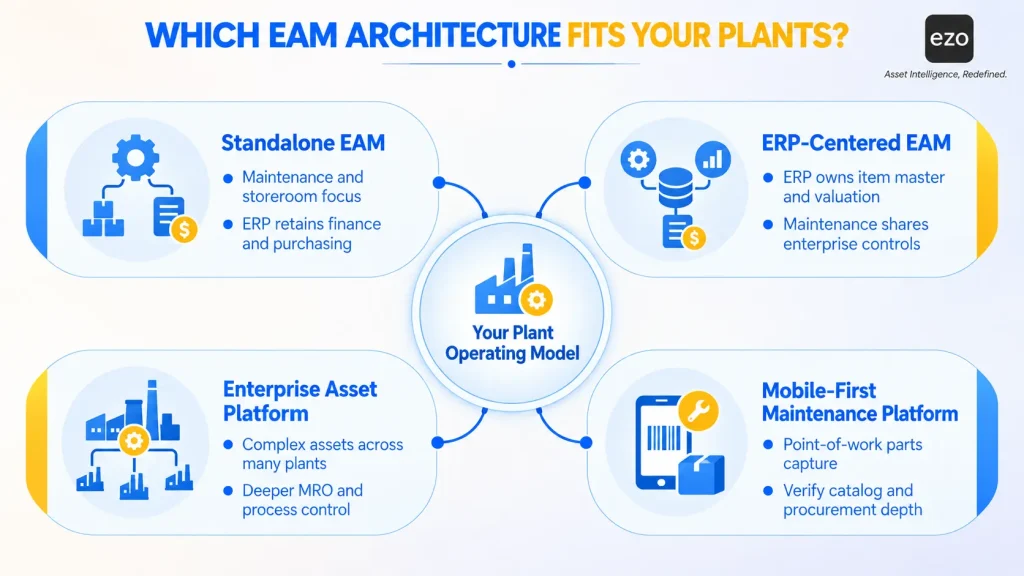
- Standalone EAM. Maintenance and storeroom processes need improvement, while finance and enterprise purchasing are already well established. The integration contract must define which system creates the requisition, owns the purchase order, posts the receipt, and values inventory. These boundaries can become a source of reconciliation problems across sites, which is one reason the CMMS and EAM labels matter less than the scope and system boundaries you actually buy.
- ERP-centered EAM. SAP, Oracle, or another ERP already owns the item master, procurement, inventory valuation, and financial controls. The trade-off is dependency: a change to one maintenance workflow may require coordination across several enterprise components, data owners, and governance processes.
- Enterprise asset platform. Complex asset hierarchies, many plants, regulated processes, repairable spares, and dedicated implementation resources make the broader asset management architecture relevant. Maximo and Attune provide capabilities for complex asset and materials environments, while IFS connects maintenance with supply chain and service processes. The key question is which of those capabilities are required in your operating model and which can remain in adjacent systems.
- Mobile-first maintenance platform. The operational constraint may be that technicians and storeroom staff do not reliably record parts activity at the point of work. Test how users will scan and record parts on the floor, then evaluate catalog control, transfer states, reservations, and procurement separately. Ease of use can improve data capture without, by itself, proving that the underlying financial and procurement process is complete.
How to evaluate EAM software in a proof of concept
A scripted demonstration gives the vendor control over the data, sequence, and exceptions. A proof of concept should put every vendor through the same data, the same exceptions, and the same acceptance criteria. Give each vendor the same imperfect plant data and ask them to complete the same six tasks, including the edge cases that matter most to your operation.
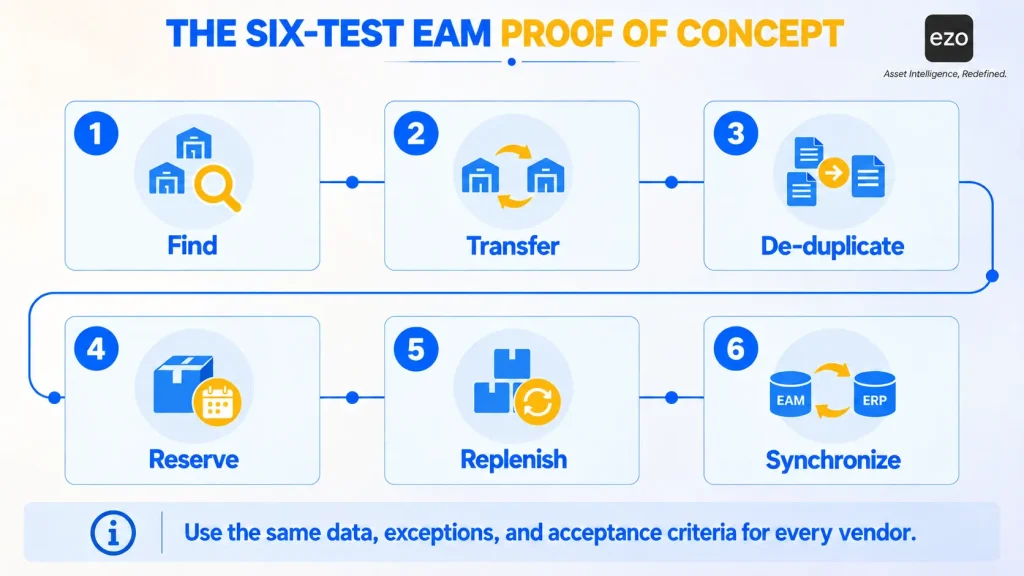
Test 1: Find a part across every plant
Show available, reserved, in-transit, quarantined, and expected quantities by plant, storeroom, bin, and condition. Ask what timestamp “current” refers to and which system is the source of truth for each quantity. Test whether users can distinguish stock that exists from stock that is actually available for transfer or use.
Test 2: Transfer stock instead of creating a purchase order
Run the complete transfer process: request, approval, issue, shipment, receipt, balance update, and audit trail. Include a rejected transfer and a quantity discrepancy at receipt. Note which states the system records separately and which it treats as a single adjustment.
Test 3: Control duplicate part records
Import different descriptions, manufacturer and supplier part numbers, alternate units of measure, equivalents, and superseded numbers. Test the entire duplicate-control process, not just native detection: what the software flags, what it cross-references, how a potential duplicate is reviewed and resolved, and how an external master-data system would participate. Observe what the software detects and what still requires human judgment.
Test 4: Reserve parts for planned maintenance
Create a future work order or shutdown package and reserve its materials. Confirm that reserved stock is no longer presented as generally available and that shortages become visible before the work is scheduled. Test whether the reservation also affects replenishment requirements.
Test 5: Replenish stock by plant
Configure different minimums, maximums, safety stock levels, lead times, suppliers, and approval thresholds for the same part across two plants. Trigger replenishment and inspect the resulting recommendation or requisition. Confirm which inputs drive the recommendation and whether the workflow respects plant-specific controls.
Test 6: Synchronize procurement with the ERP
Identify which system creates the requisition and purchase order, how receipts and cancellations synchronize, how frequently updates run, who owns each master record, and how failed jobs are detected and corrected. Keep transactional and master-data integration separate from analytics feeds, which may follow different data paths and synchronization cadences.
18 questions to ask before choosing an EAM
- Can users search for available parts across all authorized plants?
- Does availability distinguish on-hand, reserved, in-transit, quarantined, under-repair, and expected stock?
- Can the system recommend or at least enforce a transfer check before a new purchase?
- Does it support transfer requests, approvals, shipments, receipts, discrepancies, and audit records as discrete states?
- Can plants maintain different reorder points, safety stock, lead times, and suppliers for the same part?
- Can parts be reserved and kitted for scheduled work?
- Is duplicate detection native, configurable, dependent on an external master-data tool, or unverified?
- Can internal, manufacturer, and supplier part numbers be cross-referenced?
- Which procurement features are native, separately licensed, or dependent on an ERP?
- Are requisitions, approvals, purchase orders, partial receipts, returns, and cancellations supported?
- Which integrations are bidirectional, and at the level of which objects and fields?
- How are failed synchronization jobs detected, assigned, corrected, and replayed?
- Can central teams govern the item catalog while plants control local replenishment?
- Which requirements need a higher plan, module, implementation service, or custom development, and what does each cost?
- What data-cleansing and master-data work is included during implementation?
- Can the vendor provide references from manufacturers with a comparable plant network?
- What measured inventory, procurement, and maintenance changes have comparable customers achieved?
- Has the product changed ownership recently, and what is committed in writing on pricing, packaging, and roadmap?
KPIs to track after implementation
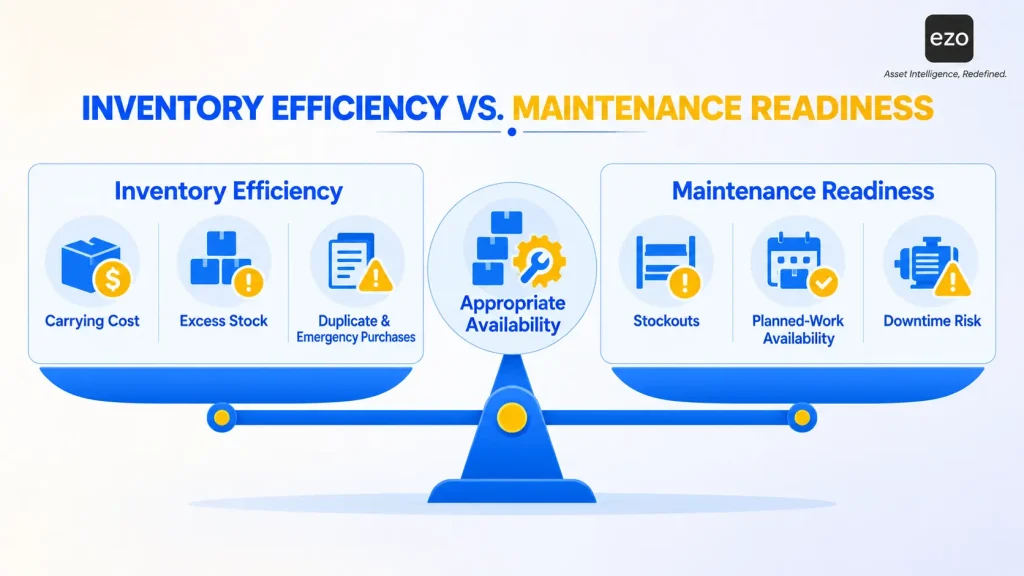
A lower inventory total is not automatically an improvement. The right target depends on part criticality, supplier lead time, industry, redundancy, and required service levels. Segment every inventory KPI by plant and part class so that aggregate improvements do not conceal a critical shortage.
| KPI | What it measures | How to read it |
|---|---|---|
| Inventory accuracy | Recorded versus physical quantity and location | Determines whether availability can be trusted at all |
| Duplicate purchase rate | Purchases made while usable stock existed elsewhere | Measures transfer-before-buy effectiveness |
| Emergency purchase rate | Unplanned expedited purchases | Reveals planning and stockout exposure |
| Inventory turnover | Consumption relative to average inventory | Segment by criticality and service-level policy; low turnover on critical spares is often intentional and should not be optimized away |
| Stockout rate | Required parts unavailable when needed | Connects inventory to maintenance delay |
| Excess and obsolete stock | Stock with limited expected use | Identifies working-capital exposure |
| Planned-work readiness | Scheduled jobs with all parts available | Measures maintenance preparedness |
| Inter-plant transfer rate | Requirements filled through internal movement | Volume alone is not a goal; track transfers that avoided an external purchase, plus transfer lead time, logistics cost, and donor-site impact |
| Requisition-to-receipt time | Elapsed purchasing cycle | Reveals procurement friction |
| Inventory carrying cost | Cost of holding parts | Connects stocking policy to financial impact |
Read these alongside your maintenance KPIs. Inventory performance and maintenance performance move together, and one can hide a problem in the other.
Common implementation risks
Treating software as a substitute for a clean parts catalog
A new platform can centralize duplicate records without resolving them. If plants continue creating local descriptions and units of measure, fragmented demand and purchasing can return. Assign ownership for new-part creation, equivalence decisions, supersession, and periodic duplicate review.
Integrating systems without defining record ownership
Integration can make disagreement travel faster. Assign an owner for the item master, supplier record, quantity on hand, purchase order, receipt, inventory value, and work-order consumption. For each data object, document the source of truth, synchronization direction, frequency, and correction process.
Making every decision centrally
Enterprise standards should govern identity, approvals, and reporting without eliminating legitimate differences in asset criticality, supplier lead times, or local operating risk. Centralize definitions; configure local policy within those definitions.
Migrating every historical record
More data is not automatically more truth. Prioritize active parts, current balances, critical spares, open orders, valid suppliers, bills of material, and enough consumption history to establish replenishment policies. Archive the rest unless a legal, audit, or analytical requirement justifies migration.
Where balances are uncertain, use a risk-based count before go-live. Prioritize critical and high-value parts, uncertain locations, and sites with known accuracy issues, rather than attempting a network-wide count, which may be expensive and disruptive.
Measuring inventory reduction without maintenance risk
Reducing inventory can yield a visible financial benefit, while the operational risk of insufficient availability of critical spares may remain hidden until equipment fails. Track inventory reduction alongside planned-work readiness, stockouts, emergency purchases, and production delays. The goal is appropriate availability, not the smallest storeroom.
Expecting a single cutover
There is no defensible universal timeframe for a multi-plant rollout. Duration depends on plant count, item master quality, open transactions, asset and bill of materials data, integrations, approval design, localization, security, migration scope, and change management. A phased deployment can validate the operating model at one or two plants before scaling it across the network.
Final recommendation
Start with system ownership. Decide which system will own the item master, purchasing transaction, receipt, and financial inventory value. Without that answer, a feature comparison can reward duplicated functionality rather than stronger control.
Organizations looking for a multi-site maintenance and inventory layer can evaluate EZO EAM and Fiix against their requirements. MaintainX is relevant when mobile execution is a primary constraint; given the Autodesk transition, confirm current packaging, integrations, and roadmap commitments in writing. Organizations with more complex asset and MRO requirements can evaluate Maximo and Attune based on the depth of configuration and control they need.
SAP- and Oracle-centered manufacturers should first establish what their existing enterprise environments already provide before adding another system. IFS is relevant when maintenance, service parts, supply chain, and procurement need to operate as interconnected processes within a single broader architecture.
A shortlist should not advance on feature claims alone. Ask every vendor to work with the same plant, storeroom, part, supplier, reservation, transfer, and ERP data, including the same exceptions and failure scenarios. If a system cannot distinguish between stock that exists and stock that is actually available, it cannot reliably support decisions about either working capital or maintenance readiness.