Key Takeaways:
- AssetSonar is well-suited for mid-market IT teams once CVEs reach inventory, keeping ownership, ITSM workflows, controlled patch deployment, tracking, and closure evidence connected in one endpoint workflow.
- Lansweeper best suits discovery-led security programs, combining broad IT, OT, IoT, cloud, and network visibility with better context for prioritizing vulnerabilities.
- Device42 fits complex hybrid environments where application dependencies and business-service relationships help teams assess remediation impact before making infrastructure changes.
- Vulnerability interoperability differs: Lansweeper offers dedicated Tenable integration, AssetSonar emphasizes customizable APIs and workflows, while Device42 supplies CMDB context through APIs and webhooks.
- The choice should follow the workflow bottleneck: Lansweeper for visibility and triage, Device42 for dependency intelligence, and AssetSonar for remediation execution and closure.
- Buyers should compare complete vulnerability workflows rather than base prices because vulnerability insights, integrations, patching, and service workflows depend on different packages.
Knowing a vulnerability exists does not mean the risk is controlled. IT still needs to identify affected assets and determine ownership. IT teams must prioritize remediation, deploy fixes, and verify that the vulnerability is no longer present.
These steps often span asset, security, endpoint, and IT service management tools. Each handoff can increase investigation time and fragment critical operational data. The right ITAM platform can make that process easier to manage.
AssetSonar, Lansweeper, and Device42 approach the problem differently. AssetSonar connects vulnerability findings with asset operations and patch workflows. Lansweeper combines broad discovery with detailed vulnerability intelligence. Device42 adds deeper infrastructure relationships and application dependencies.
How we evaluated vulnerability management across these ITAM platforms
We evaluated the asset-to-remediation workflow relevant to IT managers. This is not an assessment of every enterprise vulnerability-management capability. We evaluate discovery and remediation coverage separately because finding an asset does not mean a platform can remediate it directly.
- Asset ownership and operational context
- Discovery and vulnerability coverage
- Infrastructure and dependency context
- Vulnerability intelligence and prioritization
- Vulnerability scanner integrations and interoperability
- Remediation workflow and ITSM coordination
- Patch deployment and scheduling
- Remediation tracking and closure evidence
Each “Best fit” reflects documented capabilities within that criterion. We do not calculate a weighted overall score.
AssetSonar vs Lansweeper vs Device42 at a glance
| Capability | AssetSonar | Lansweeper | Device42 |
| Asset ownership and operational context | Device, user, lifecycle, ITSM | Asset, user, location data | CI and service relationships |
| Discovery and vulnerability coverage | Agent-led endpoint CVE matching | IT, OT, IoT, cloud + CPE | Hybrid discovery + vulnerability reporting |
| Infrastructure and dependency context | IT Graph relationships | Asset topology and relationships | ADM + Business Services |
| Vulnerability intelligence and prioritization | CVSS + asset/owner context | CVSS + EPSS + exploit intelligence | VulnDB/CVSS + infrastructure context |
| Scanner integrations and data exchange | API, web requests, webhooks | Tenable connector + Flow Builder | REST APIs and webhooks |
| Remediation workflow and ITSM coordination | Native ITAM + ITSM workflows | Flow Builder + remediation tracking | CMDB + integrated workflows |
| Patch deployment and scheduling | Native; admin-uploaded patches (beta) | Orchestrated through external tools | External remediation workflows |
| Remediation tracking and closure | Patch states + CVE verification | Fix Verification + SLA/closure tracking | Rediscovery + reporting |
AssetSonar
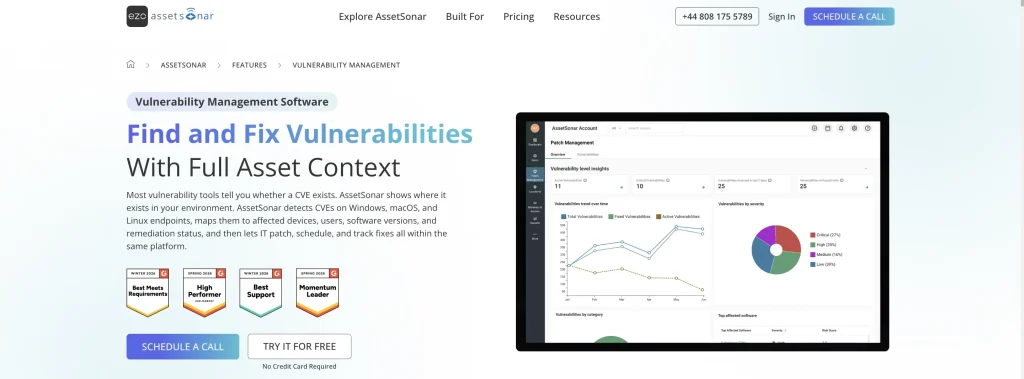
AssetSonar approaches vulnerability management through IT asset operations. Its ITAM Agent maps installed software to known vulnerabilities listed in NIST using CVE identifiers. Findings remain connected with the affected device, user, ownership, and service records.
Its main advantage is workflow continuity. IT teams can move from an identified software vulnerability into remediation without separating asset, service, and patch information across multiple records.
Strengths:
- Connected IT operations: Asset, ownership, software, and service information stay linked.
- Native remediation path: Vulnerability findings can move into controlled patch deployment.
- ITAM and ITSM alignment: Asset and service workflows operate from shared operational data.
Weaknesses:
- Manual patch intake: Administrators must locate and upload the appropriate patch.
- Agent dependency: Vulnerability identification depends on supported ITAM Agent versions.
What users have to say:
AssetSonar holds a 4.5/5 rating on G2. Reviewers commonly highlight centralized asset tracking, usability, integrations, and accountability. Some users want more reporting flexibility and dashboard customization. Most reviews assess the broader ITAM platform rather than its newer patching capabilities.
Lansweeper
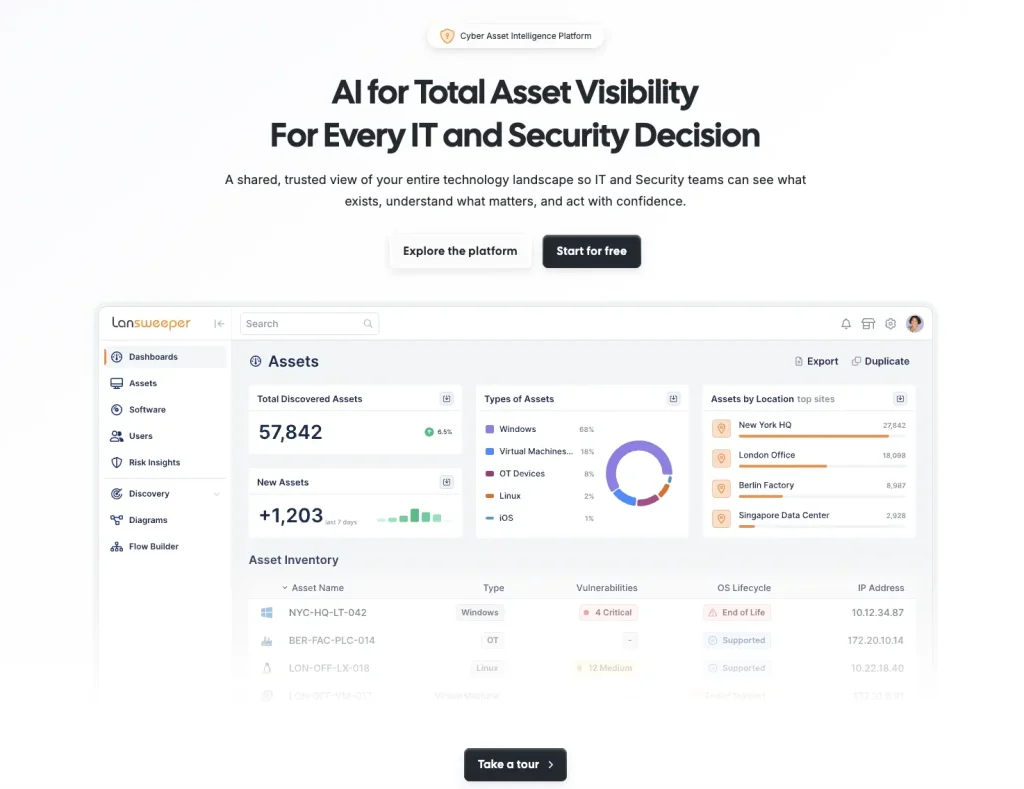
Lansweeper approaches vulnerability management from an asset intelligence foundation. It combines broad technology discovery with Vulnerability Insights, which adds risk information to discovered assets.
Its main advantage is visibility and prioritization. Lansweeper helps teams identify affected technology across varied environments and understand which known vulnerabilities deserve attention first.
Strengths:
- Extensive discovery: Covers IT, OT, IoT, cloud, network, and remote assets.
- Detailed vulnerability intelligence: Adds exploitability, severity, and patch information.
- Security workflow integration: Tenable integration and Flow Builder support connected remediation processes.
Weaknesses:
- External patch execution: Vulnerability Insights does not install patches directly.
- Higher feature tier: Vulnerability Insights and full integrations require Pro or Enterprise.
- Learning curve: Some reviewers describe navigation and setup as initially demanding.
What users have to say:
Lansweeper holds a 4.4/5 rating on G2. Reviewers often praise asset discovery, inventory depth, network visibility, and reporting. Some users mention navigation and configuration challenges during initial adoption.
Device42
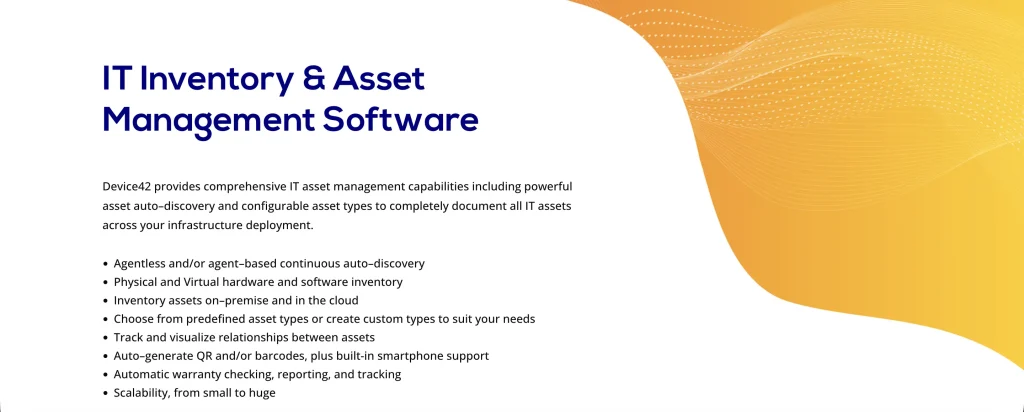
Device42 approaches vulnerability risk through infrastructure discovery and CMDB relationships. Its strongest value lies in showing how devices, applications, services, and infrastructure depend on one another.
This makes Device42 particularly useful when remediation decisions require business-service or dependency awareness. Its role is strongest around infrastructure understanding and change impact.
Strengths:
- Infrastructure discovery: Builds detailed visibility across hybrid technology environments.
- Dependency mapping: Connects applications, services, and supporting infrastructure.
- CMDB relationships: Provides operational relationships around affected systems.
Weaknesses:
- Implementation depth: Rich infrastructure mapping requires configuration and planning.
- ADM setup: Dependency models depend on discovery jobs and calculation rules.
- Endpoint focus: Its infrastructure depth may exceed simpler endpoint-led use cases.
What users have to say:
Device42 holds a 4.7/5 rating on G2. Reviewers often praise infrastructure discovery, dependency mapping, and centralized visibility. Some users report a learning curve during setup and navigation, with occasional performance concerns in larger environments.
How do AssetSonar, Lansweeper, and Device42 compare for vulnerability management?
1. Asset ownership and operational context
Finding an affected endpoint does not immediately tell IT who should act. IT teams also need ownership, software, lifecycle, and service information.
AssetSonar connects vulnerability findings with its wider operational data model. IT can see the affected device and installed software. Ownership, user, location, and lifecycle information add accountability. Service records can provide additional context during remediation.
Lansweeper provides detailed inventory around devices and users. IT teams can organize assets by owners, locations, and other attributes. This works particularly well across large technology estates.
Device42 provides another type of context. Its CMDB connects infrastructure components with services and responsible departments. That makes it valuable when responsibility follows infrastructure rather than end users.
Best fit: AssetSonar is more suitable for endpoint-focused IT operations, since ownership and service context stay close to the affected endpoint and reduce lookup work before remediation begins.
2. Discovery and vulnerability coverage
Vulnerability analysis depends on seeing the affected technology that can impact your IT environment. Different discovery methods reveal different parts of that environment.
AssetSonar combines agent-based discovery with network and connected data sources. Its integrations include platforms such as Intune, Jamf Pro, and SCCM. The ITAM Agent then provides endpoint software data for CVE matching. Vulnerability detection and native patching require supported/latest versions of the AssetSonar ITAM Agent.
Lansweeper covers a broader range of technology environments. It discovers IT, OT, IoT, cloud, network, and remote assets. Vulnerability Insights then connects discovered technology with relevant vulnerability information. Lansweeper combines agentless discovery with agents where remote or disconnected endpoint coverage requires them.
Device42 also provides extensive hybrid infrastructure discovery. Its CMDB captures endpoints, servers, applications, cloud resources, and network devices. It maintains relationships alongside those records. Device42 primarily uses discovery jobs and appliance-based collection to inventory infrastructure and installed software.
Best fit: Lansweeper, particularly for heterogeneous technology estates where broad discovery helps close visibility gaps that could otherwise increase security risk.
3. Infrastructure and dependency context
Vulnerability severity does not reveal the operational importance of every system. Dependencies can change how quickly IT teams should remediate an affected component.
AssetSonar’s IT Graph connects assets with software, users, tickets, and workflows. This context supports operational decisions around managed IT resources.
Lansweeper adds topology and relationship information to its inventory. IT teams can use diagrams to understand connections across discovered infrastructure. This strengthens investigation when asset relationships matter.
Device42 goes deeper into application dependencies. ADM discovers communication patterns between services. Administrators use calculation rules to shape Application Groups, while Business Services provide a curated view of related business functions.
Best fit: Device42, because its deeper infrastructure relationships help IT teams understand the downstream service impact of remediating a vulnerable component when remediation decisions depend heavily on those dependencies.
4. Vulnerability intelligence and prioritization
A long CVE list provides information, but not necessarily direction. Prioritization requires enough context to identify the most urgent exposure.
AssetSonar starts with CVSS severity and affected endpoints. IT teams can also consider asset counts, ownership, device criticality, and patch availability. Target dates add operational urgency to remediation.
Lansweeper adds dedicated security intelligence around its findings. Lansweeper adds EPSS scores, exploit maturity, exploited-in-the-wild status, CISA actions, CVSS data, and patch information. These signals help distinguish likely exploitation from severity alone.
Device42 approaches prioritization through infrastructure context. CVSS can establish technical severity. Dependency maps then show which applications or business services rely on affected systems.
Best fit: Lansweeper, given its stronger vulnerability intelligence and detailed exploitability data, which help IT security teams prioritize triage with greater context.
5. Vulnerability scanner integrations and interoperability
Existing security tools can influence the value of any ITAM platform. Good interoperability reduces duplicate records and manual data movement.
AssetSonar supports custom integrations through its API and workflow automation engine. IT teams can exchange data with external systems, send web requests from workflows, and trigger automated actions through incoming webhooks.
This gives IT teams flexibility around existing security processes. They can exchange data and trigger workflow actions around external events. The exact implementation depends on the systems and data involved.
Lansweeper offers a dedicated Tenable Vulnerability Management connector. It communicates with Tenable through its REST API. The connector can work with vulnerability, asset, scanner, and related records.
Device42 provides comprehensive REST APIs and configurable webhooks. IT teams can programmatically retrieve, update, and exchange CMDB information. Webhooks can also trigger external actions when configuration data changes.
Best fit: Lansweeper has the clearest path for Tenable environments through its dedicated connector. AssetSonar and Device42 provide API and webhook-based integration paths for custom workflows.
6. Remediation workflow and ITSM coordination
Finding and prioritizing a vulnerability still leaves operational work to complete. Someone must own the task and move it toward resolution.
AssetSonar can keep that work connected across IT operations. Asset-driven automation can respond to ownership and lifecycle context. Service workflows can route tickets, notifications, updates, and escalations.
That shared data model reduces repeated investigation between ITAM and ITSM. Technicians can work with asset context already attached to service activity. IT teams can therefore spend less time rebuilding the remediation story.
Lansweeper can automate remediation handoffs through Flow Builder. Workflows can create tickets, notify owners, and trigger actions in connected systems. Lansweeper also supports remediation SLA tracking by severity.
Device42 also supplies context to surrounding operational systems. REST APIs, webhooks, and packaged integrations can move CMDB information into service workflows. Infrastructure relationships remain useful during change planning and execution.
Best fit: AssetSonar suits teams wanting ITAM and ITSM remediation in one platform. Lansweeper is stronger when remediation is orchestrated across an existing toolchain.
7. Patch deployment and scheduling
Prioritization has limited value until a selected vulnerability reaches remediation. The deployment process should also minimize user disruption.
AssetSonar provides remediation references, after which an administrator uploads the selected patch. This adds manual preparation, especially across larger vulnerability queues. IT teams can then target affected devices and choose immediate or scheduled deployment.
Patch scheduling gives IT more control over business impact. IT teams can place deployments inside planned maintenance windows. AssetSonar tracks each deployment through its different execution states.
Lansweeper guides IT teams through mitigation using available patch and reference information. IT teams apply the selected remediation and then rescan affected assets. The next scan shows whether those assets remain associated with the CVE.
Device42 provides infrastructure context before remediation. Dependency information can help IT teams understand change impact. This becomes useful when planning updates across connected production services.
Best fit: AssetSonar provides the most direct native patch-deployment path here, although administrators must supply patches and the capability remains beta.
8. Remediation tracking and closure evidence
A completed deployment task does not always prove the exposure has disappeared. IT needs a reliable way to confirm the outcome.
AssetSonar tracks deployments through scheduled, active, pending, success, and failure states. Its vulnerability workflow also supports closure verification and activity history. Dashboards surface critical CVEs, aging vulnerabilities, and patch outcomes.
This creates a stronger operational record around each remediation cycle. Alerts can surface important CVEs and patch status changes. Daily digests help IT teams review outstanding work without constant dashboard monitoring.
Lansweeper combines remediation tracking with post-fix rescanning. It can track assigned, resolved, and open findings against remediation SLAs. Rescanning then confirms whether an affected asset still maps to the CVE.
Device42 refreshes infrastructure data through its discovery processes. Updated CMDB information can then support ongoing risk and change analysis. Its audit and relationship data remain useful when reviewing affected infrastructure.
Best fit: AssetSonar is stronger for native endpoint patch-state and CVE verification. Lansweeper is stronger for SLA-driven remediation tracking across connected workflows.
AssetSonar vs Lansweeper vs Device42 pricing
Pricing depends on more than the base subscription. Vulnerability insights, integrations, patching, and service workflows may require different packages. Buyers should compare the complete workflow each plan supports.
| Product | Pricing approach | Relevant packaging | Buying consideration |
| AssetSonar | From $0.75 per asset/month for ITAM (billed annually) | Advanced SAM adds $0.42 per asset/month | Patch Management is included with Advanced SAM |
| Lansweeper | Annual asset-based plans starting from $239/month (billed annually) | Pro or Enterprise | Pro includes Vulnerability Insights and all integrations |
| Device42 | Annual device-based subscription | Capabilities depend on licensing | Final cost depends on device count and selected functionality |
AssetSonar starts with packages for 100 assets, giving mid-market IT estates a lower entry point. Lansweeper’s Pro plan starts at 2,000 assets and becomes the relevant tier for vulnerability use cases. Device42 uses quote-based licensing tied to managed devices and selected capabilities.
The better comparison, then, is not simply the lowest subscription price. IT teams should consider how much additional tooling they need after identifying a vulnerability. That includes ITSM coordination, integrations, patch execution, and remediation tracking.
How should you choose between AssetSonar, Lansweeper, and Device42?
The best choice depends on the bottleneck inside your current process. Start with where vulnerability work loses the most time or context. Then evaluate which platform fixes that specific problem.
Choose AssetSonar if:
AssetSonar fits IT teams that own both assets and remediation. It works well when endpoint ownership determines who must take action. Connected ITSM workflows also help IT teams coordinate remediation without rebuilding asset context.
Its strongest value appears after a relevant CVE reaches the asset inventory. IT can move from endpoint context into controlled patch deployment. Deployment tracking then keeps the remediation outcome visible.
This model suits IT teams trying to reduce operational handoffs. It is especially relevant when ITAM, service management, and patching share ownership.
Choose Lansweeper if:
Lansweeper fits IT teams where incomplete technology visibility creates the greatest risk. Its broad discovery model can expose assets across diverse environments. Vulnerability intelligence then helps IT security teams decide what deserves attention first.
It also fits organizations with established remediation processes. The Tenable connector is particularly useful for organizations that already support vulnerability operations in Tenable. Lansweeper can strengthen those workflows with richer asset intelligence.
This model suits discovery-led security programs. It prioritizes understanding exposure before changing the existing remediation stack.
Choose Device42 if:
Device42 fits IT teams where infrastructure relationships influence remediation decisions. Its dependency models show how applications, services, and infrastructure connect. That information helps IT teams anticipate operational impact before making changes.
It is especially useful across complex hybrid environments. Business Services can connect technical dependencies with important organizational functions. That gives IT infrastructure teams more context during remediation planning.
This model suits organizations with mature infrastructure operations. Its value rises when dependency awareness matters as much as endpoint-level exposure.
Final verdict: Match the tool to your workflow
AssetSonar, Lansweeper, and Device42 solve different parts of the vulnerability-management problem. Lansweeper emphasizes discovery and risk intelligence, while Device42 adds infrastructure and dependency context. AssetSonar focuses more directly on moving identified endpoint vulnerabilities into IT operations through connected asset records, service workflows, patch deployment, and remediation tracking.
For IT managers, the better choice depends on where the current process breaks down. Compare each platform against the visibility, prioritization, remediation, and verification capabilities your team actually needs rather than treating vulnerability management as a single feature.

![[How-to] Automate Vulnerability Monitoring and Patching in AssetSonar](https://cdn.ezo.io/wp-content/uploads/2025/09/05101658/AS-Blog-scaled.jpg)