
Cybersecurity asset management is often described from the perspective of dedicated security operations teams. This guide is for mid-market IT teams that manage operations across IT asset management, service delivery, software, audits, and employee lifecycle workflows.
For these teams, CSAM connects routine IT operations to security decisions: what exists, who owns it, which controls cover it, how exposed it is, and what action remains open. The goal is not simply a larger inventory, but a current view that helps teams prioritize remediation and verify closure.
What is cybersecurity asset management?
Cybersecurity asset management (CSAM) is the continuous practice of discovering and reconciling cyber assets, enriching them with ownership and security context, identifying exposures and control gaps, prioritizing action, and verifying closure. An asset is what must be protected. A vulnerability is a weakness; an exposure is a condition that makes harm possible; a control gap is a missing or ineffective safeguard; and risk reflects likelihood and business impact.
A useful cyber asset inventory should answer:
- What exists, and when was it last observed?
- Who owns or is accountable for it?
- Which vulnerabilities, exposures, or control gaps affect it?
- How critical is it to the business?
- What action, exception, or verified closure is recorded?
This broader model is consistent with NIST CSF 2.0, which separates asset management, vulnerability identification, prioritization, exception tracking, and risk response.
*This article uses CSAM as an abbreviation for cybersecurity asset management; vendors may use related terms differently.
CSAM, ITAM, and CAASM: Key differences
These terms often overlap, but they do not mean the same thing.
| Discipline | Primary purpose | Primary inputs | Best used for |
| ITAM | Maintain ownership, lifecycle, cost, custody, and service context | Procurement, discovery, contracts, endpoint, and service desk records | Operational control, lifecycle decisions, and audit support |
| CSAM | Continuously identify assets and reduce asset-related exposure | Asset, vulnerability, identity, cloud control, and business context | Prioritizing, assigning, and verifying security remediation |
| CAASM | Correlate asset and exposure data to reveal visibility and control gaps | APIs from IT, security, cloud, identity, and exposure tools | Querying consolidated data and prioritizing gaps at scale |
These disciplines are complementary, not hierarchical. ITAM contributes ownership, lifecycle, cost, and service context. CSAM combines asset and security data to drive prioritization and remediation. Cyber Asset Attack Surface Management (CAASM) correlates information across IT, security, cloud, identity, and external sources, including environments where formal ITAM coverage is incomplete. Strong ITAM improves context, but it is not a universal prerequisite for CSAM or CAASM.
CSAM coordinates asset and exposure context. It does not replace endpoint management and response, vulnerability scanning, identity governance, cloud security posture management, external attack surface management, secrets management, or a CMDB. Those tools detect or manage specialized problems; CSAM connects their findings to assets, owners, priorities, and remediation.
Why cybersecurity asset management matters for IT teams
Security teams may own the risk program, but IT often owns the asset reality.
IT teams:
- provision devices
- assign software
- manage tickets
- support onboarding
- handle offboarding
- get asked for audit evidence
When asset data is wrong, every downstream security process becomes harder.
Unmanaged assets create real exposure
Verizon’s 2025 DBIR reported that, among infostealer-compromised systems containing possible corporate login data, 46% were not enterprise-managed; the report could not confirm device ownership. The finding shows why organizations need visibility into devices that can access corporate accounts even when those devices sit outside standard management.
When no authoritative process can identify an asset and assign responsibility, control coverage and remediation ownership become difficult to verify. A current inventory does not prevent every breach, but it reduces the time spent establishing what exists, who owns it, and which action is required.
Asset inventory supports audit evidence
Asset inventories support audits by showing what exists, who owns it, how it is classified, and where coverage gaps remain. However, an inventory does not prove compliance on its own.
Depending on the control and audit scope, teams may also need policies, approvals, review logs, change history, exception records, test results, and remediation evidence. Treat inventory records as state evidence and workflow history as process evidence.
What counts as a cyber asset?
For this guide, a cyber asset is a technology, service, identity, credential, or data resource that the organization must protect or manage. Ownership, entitlements, findings, and controls describe relationships or conditions around an asset; they are not interchangeable asset classes.
| Asset type | Examples | Common security concerns |
| Hardware | Laptops, desktops, servers, mobile devices, network devices, and IoT equipment | Unmanaged devices, missing controls, outdated software, or incorrect ownership |
| Software | Operating systems, installed applications, browser extensions, and local tools | Vulnerabilities, unsupported versions, unauthorized installations, or missing patches, contributing to Shadow IT |
| SaaS | Collaboration, design, marketing, finance, and administrative applications | Shadow SaaS, stale accounts, excessive access, or risky third-party integrations |
| Cloud resources | Virtual machines, containers, serverless functions, storage buckets, and databases | Misconfiguration, public exposure, unknown ownership, or short-lived resources that escape inventory |
| Data | Customer, employee, configuration, financial, and source-code data | Excessive access, unknown location, weak retention controls, or unintended exposure |
| Identities | Employee, contractor, guest, and administrator accounts | Dormant accounts, excessive privileges, incomplete deprovisioning, or unclear ownership |
| Non-human identities | Service accounts, workload identities, and automation accounts | No accountable owner, excessive privilege, missing review dates, or continued access after use |
| Credentials and secrets | API keys, access tokens, passwords, and encryption keys | Exposure, weak storage, missing rotation, excessive permissions, or continued validity after use |
| Network and external assets | Domains, subdomains, public IP addresses, network interfaces, and internet-facing services | Unknown ownership, exposed services, misconfiguration, or unsupported technology |
Assets that create operational risk often sit outside formal provisioning. A contractor laptop, abandoned SaaS account, exposed cloud service, or old API key may not appear in a device inventory. A permission is an entitlement linking an identity to an asset, not an asset by itself.
Where cybersecurity asset management breaks down
For mid-market IT teams, asset data is often split across endpoint and network tools, ITAM and service desk records, cloud and SaaS apps, identity systems, security tools, and finance or procurement data. Connecting those sources is only the first step.
A reliable inventory also needs a shared schema, stable matching identifiers, duplicate handling, source-of-authority rules for each attribute, freshness thresholds, and a queue for unresolved conflicts. For example, if two MDMs report the same device differently, match the records using a stable identifier, retain the authoritative value for each field, and flag stale or conflicting data for review.
In practice, the breakdown usually looks like this:
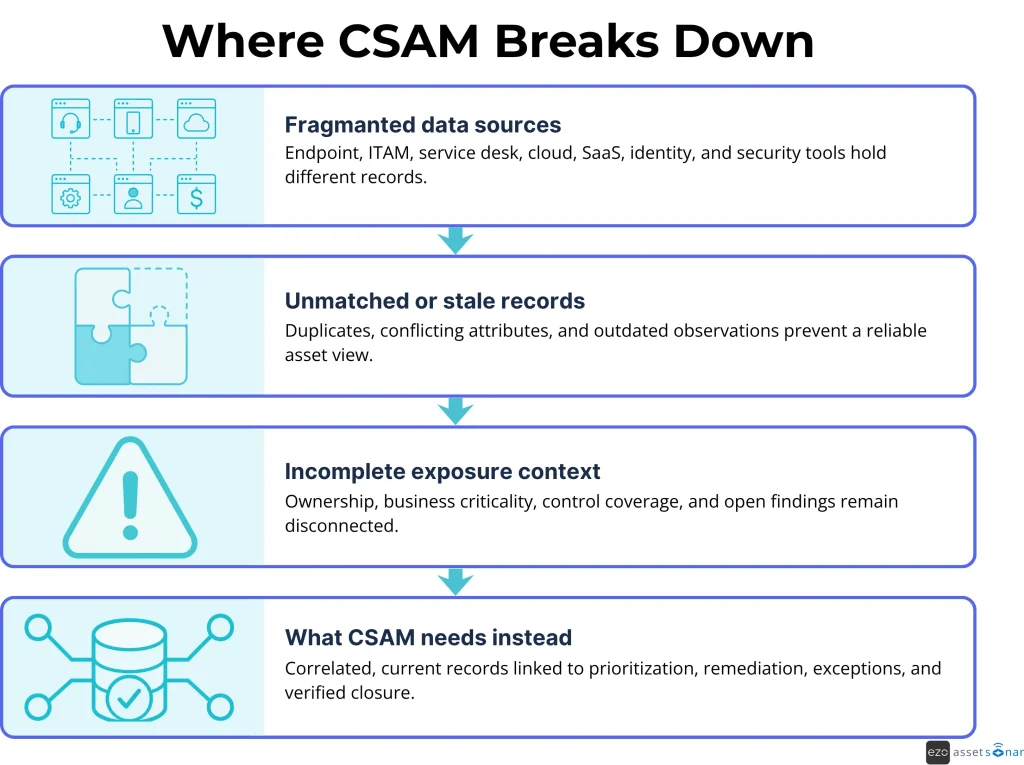
Fragmented data becomes a security problem when records cannot be matched, kept current, or turned into verified action.
The result is three common operational gaps.
1. Assets exist without clear ownership
An asset without accountable ownership may miss patching, license renewal, recovery, or retirement. Required ownership fields should match the asset class. A device may need an assigned user and custodian; a shared service may need technical and business owners; and a cloud workload may need a service owner, environment, criticality, and data classification.
2. Security and operational context is fragmented
Operational context includes ownership, IT asset lifecycle state, last check-in, installed software, tickets, and support status. Security-exposure context includes vulnerability severity and exploitability, internet reachability, configuration status, control coverage, data sensitivity, approved exceptions, the source, and when each observation was last seen.
Keeping these categories separate makes it clearer whether a record is merely incomplete, genuinely exposed, or high-risk because of business impact.
3. Offboarding leaves hidden leftovers
Offboarding is one use case where disconnected records create security gaps. Collecting a laptop and disabling the primary identity does not necessarily revoke SaaS accounts, active sessions, OAuth grants, group memberships, admin roles, tokens, shared-folder permissions, or third-party access.
Link devices, identities, licenses, entitlements, and workflow records so each required action has an owner and due date. Closure should be supported by system evidence, such as a successful account disablement, session revocation, asset return, approved exception, or access-review record.
Use software and SaaS records to trigger access reviews
Software and SaaS records can reveal inactive assignments, but license reclamation is not identity deprovisioning. Removing a seat does not necessarily disable an account, revoke sessions or OAuth grants, remove group membership, or end data access.
Treat an unused license or inactive assignee as a signal. Trigger the appropriate access review, complete identity and data-transfer actions in your ITAM supporting CSAM, then reclaim the license and update the records. SaaS visibility also depends on the integrations and usage data available for each application.
How cybersecurity asset management works
CSAM is a continuous operating loop that turns asset observations into prioritized and verifiable action. Each stage helps teams move from fragmented records to accountable remediation and measurable results.
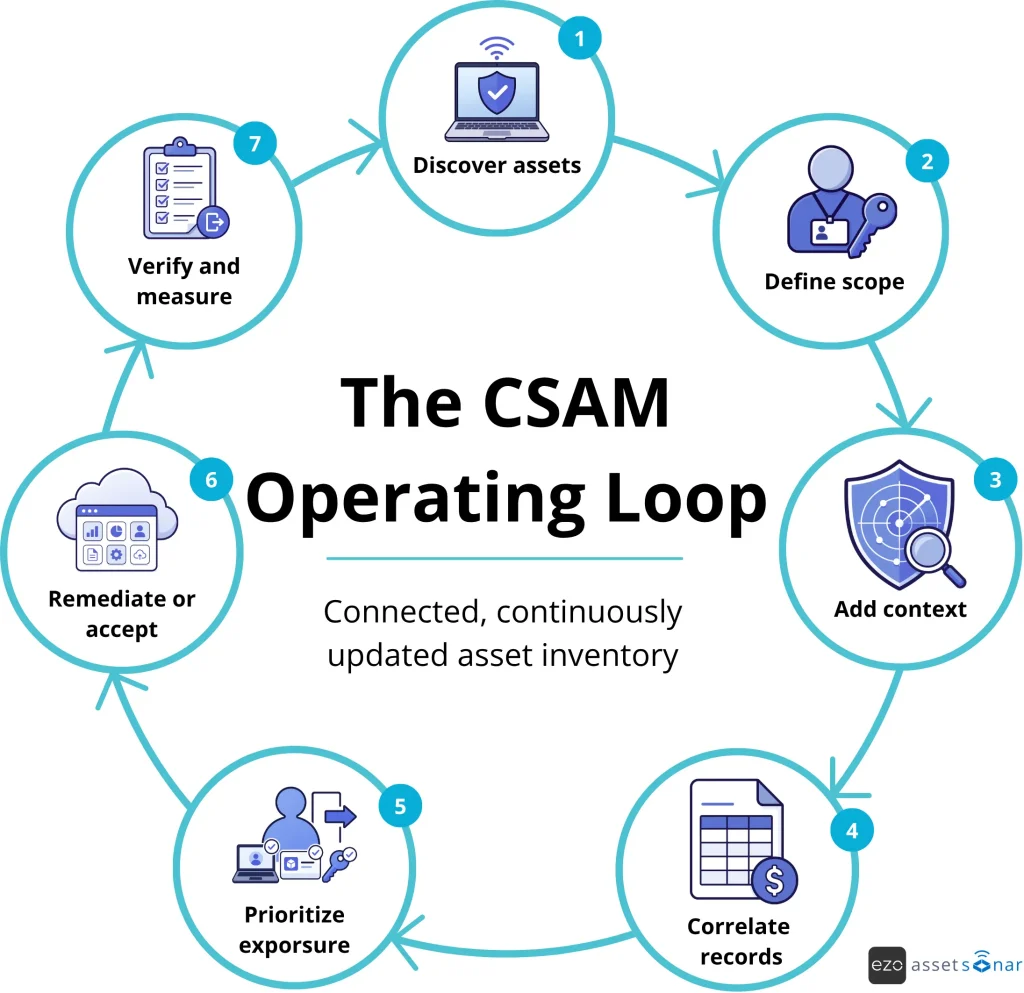
Each step strengthens the next, turning asset inventory into an active system for visibility, ownership, and risk reduction.
1. Define scope and source authority
Start by defining which asset environments your ITAM covers. Assign data owners and identify the authoritative source for important attributes such as ownership, lifecycle status, vulnerability data, and control coverage.
2. Discover assets
Collect asset observations from relevant IT, security, cloud, identity, and business systems. Record where each observation came from and when the asset was last seen so teams can distinguish current records from stale data.
3. Normalize and correlate records
Standardize software names and vendors, match records that refer to the same asset, and merge duplicates. Apply software-matching rules to conflicting attributes and send unresolved mismatches for review.
4. Add business and security context
Enrich each asset with the context needed for decisions. This may include ownership, lifecycle status, business criticality, data sensitivity, external exposure, vulnerabilities, control coverage, and approved exceptions.
5. Identify and prioritize exposure
Identify vulnerabilities, misconfigurations, missing controls, unsupported software, excessive access, and unknown ownership. Prioritize them using factors such as exploitability, internet exposure, business impact, data sensitivity, and existing controls.
6. Remediate or accept risk
Assign each prioritized issue an owner, action, due date, and required closure evidence. If the risk is accepted, record the rationale, approver, compensating controls, review date, and expiry.
7. Verify closure and measure
Recheck the system or source that identified the issue before marking it resolved. Track records, unknown ownership, control coverage, remediation SLA attainment, expired exceptions, and evidence completeness to measure improvement.
Offboarding, software and SaaS reviews, audit evidence, vulnerability management, and incident management, including incident response, are use cases that run through this loop rather than separate stages within it.
A practical 30/60/90 day CSAM plan backed by ITAM
IT teams do not need to operationalize every CSAM capability at once. The following example sequence establishes a reliable data foundation first, then introduces exposure management, remediation, and measurement. Timelines should be adjusted according to the organization’s environment, risk profile, and available resources.
Days 1 to 30: Define the foundation
Define the initial scope, asset classes, owners, and authoritative data sources. Establish a baseline of active assets, preserve relevant historical records, and create a backlog for records that cannot yet be verified.
Days 31 to 60: Improve data quality and context
Connect priority sources, normalize identifiers, merge duplicate records, and define source-precedence and freshness rules. Add the ownership, business, lifecycle, and security context needed to evaluate exposure.
Days 61 to 90: Connect findings to action
Prioritize exposures, route remediation to accountable owners, and establish an exception process. Verify closure using current source evidence and publish the first metrics for freshness, ownership, control coverage, remediation, and exceptions.
Where AssetSonar fits
AssetSonar’s role in CSAM is to provide ITAM-backed asset and service context. Its IT Graph is the connected data layer that links assets, users, software, licenses, contracts, tickets, locations, and lifecycle history.
The capability boundaries should remain clear:
- Core platform: ITAM and ITSM records, relationships, ownership, lifecycle, and service context.
- Data or module dependent: Agent and MDM discovery, identity or SaaS synchronization, software usage, license optimization, and endpoint vulnerability and patch workflows.
With the Patch Management module and supported agents and platforms, AssetSonar can connect endpoint and software records to vulnerability and remediation data. Software usage and license reclamation depend on metering or direct integrations. This makes AssetSonar a contributor to a CSAM program without implying that it covers every cyber asset or exposure type.
Secure the cyber asset inventory itself
A consolidated inventory may reveal technologies, owners, locations, vulnerabilities, privileged access, and control gaps. Protect it with role-based access, separation of duties, change and export logs, encrypted integrations, secure API-credential handling, retention limits, and regular access reviews. For employee or BYOD data, collect only what the approved business purpose requires and involve privacy or legal reviewers where needed.
Conclusion
Cybersecurity asset management helps IT and security turn fragmented observations into prioritized, verifiable action. For mid-market teams, the practical starting point is a defined scope and a reconciled inventory enriched with ownership, business criticality, security findings, control coverage, and source freshness.
That inventory is a foundation, not a substitute for specialized security tools. Its value comes from helping teams agree on what exists, route remediation to the right owner, manage exceptions, and verify closure. Start with a few authoritative sources and measurable gaps, then expand coverage as the process matures.