Employee offboarding becomes a compliance issue when the employment record is closed before the organization has fully revoked access, recovered assets, transferred ownership, and handled company data.
A completed HR checklist may confirm that a person has left. It does not necessarily prove that their digital and operational footprint has been closed. The laptop may still be outside the company’s control. A SaaS seat may remain active. A local account may survive outside single sign-on. Files, customer records, or shared mailboxes may still be owned by someone who no longer works for the company.
The central question is not whether each department completed its own task. It is whether the organization can show, in one connected record, what the employee had, what action was taken, when it happened, who owned it, and what remained unresolved.
That is the difference between an offboarding checklist and a defensible compliance control.
Why offboarding is a compliance control
Offboarding sits at the intersection of people operations, technology, security, finance, and legal obligations. HR knows the departure date. IT controls accounts and devices. The manager owns the transfer of work. Security may need to review privileged access. Finance needs licenses and company property accounted for. Legal may need to preserve records or place data on hold.
Each team can complete its own task, and the overall process can still fail.
The weakness usually appears in the handoff. HR sends a message and assumes access has been removed. IT disables the primary identity but is unaware of standalone applications. The manager confirms knowledge transfer but leaves files, customer accounts, or approvals assigned to the former employee. Finance closes its clearance process without seeing whether software seats were reclaimed.
From one department’s view, the exit is complete. From the organization’s view, it is not.
A compliant process therefore needs more than a list of tasks. It needs a defined trigger, visible ownership, coordinated execution, escalation for exceptions, and evidence that the process operated as intended.
What auditors and compliance teams need to see
Different frameworks use different terminology, but the operational evidence they require is often similar. A reviewer may ask:
- When did the person’s employment or authorized access end?
- Which systems, applications, devices, software licenses, shared resources, and physical access points were assigned to them?
- When was each item revoked, recovered, transferred, retained, deleted, or formally accepted as an exception?
- Who completed and approved each action?
- Can the organization produce the record without rebuilding the timeline from email, chat, spreadsheets, and separate tickets?
The SOC 2 Trust Services Criteria address logical access controls. ISO/IEC 27001 includes controls related to access rights, asset return, and responsibilities after employment. GDPR requires appropriate safeguards for personal data and limits unnecessary retention. HIPAA calls for procedures to terminate access to electronic protected health information when a workforce relationship ends. PCI DSS also requires disciplined management of user accounts and access to payment environments.
These frameworks do not establish a single universal deadline for every departure. Timing should reflect company policy, role sensitivity, system risk, and the nature of the exit. A planned departure may be coordinated around the final working hour. A high-risk or involuntary termination, on the other hand, may require access to be removed before the discussion concludes.
The control is defensible when the timing is defined in advance, assigned to an accountable owner, followed consistently, and supported by evidence.
The four gaps that make offboarding difficult to defend
1. Access remains active outside the obvious account
Disabling email or the main identity provider is an important first step, but it does not always remove every route into company systems. Former employees may retain access through developer tools, cloud consoles, finance applications, customer portals, local accounts, shared credentials, password managers, partner accounts, or applications that were never connected to single sign-on.
Privileged roles require particular care. A person may lose their standard account while an administrative role, API token, service credential, or secondary identity remains active.
The right question is not, “Was the email account closed?” It is, “Were all relevant access paths reviewed and resolved?”
2. Devices and data remain outside company control
A laptop is not only an item to recover. It may contain customer information, credentials, cached browser sessions, locally stored documents, and access to internal tools. Phones, badges, security tokens, external drives, and home-office equipment can create similar exposure.
The organization should be able to show who had each item, whether it was returned, whether it was locked or wiped when necessary, and how any data on the device was handled.
Data also needs a deliberate decision. Some information must be transferred to a manager. Some must be retained under policy or legal hold. Some should be deleted after their retention purpose ends. Closing the employee record does not answer those questions.
3. Work and ownership are not transferred
Offboarding can revoke access while leaving operational work stranded. Files, shared mailboxes, customer relationships, approval chains, project ownership, open tickets, and recurring responsibilities may remain attached to the departing employee.
This is more than a continuity issue. It affects whether the company can locate records, respond to customers, preserve evidence, and maintain accountable ownership after the employee leaves.
4. Evidence is scattered across systems
Many organizations perform most of the required work but cannot show the full sequence. HR holds the departure date. IT has deactivation logs. Finance has a clearance form. The manager has a handover email. Security has a privileged-access review. The device return sits in an asset system.
When those records are disconnected, proving completion becomes a reconstruction exercise. The company may have performed the control correctly and still struggle to demonstrate that it did.
Compliance depends on both execution and evidence. A defensible process preserves the record while the work is being completed rather than trying to recreate it later.
How to build the process backward from proof
A practical way to improve offboarding is to begin with the evidence the organization may eventually need to produce. Then design the workflow so that evidence is created as part of normal execution.
- Start with a tracked HR termination event that includes the confirmed last working date and access cutoff.
- Create assigned tasks for HR, the manager, IT, Security, Finance, and Legal where their involvement is required.
- Disable the primary identity and review non-SSO, local, shared, privileged, and secondary access.
- Recover, lock, wipe, or otherwise secure assigned devices, badges, tokens, and company property in accordance with policy.
- Reclaim or reassign software and SaaS licenses.
- Transfer ownership of files, mailboxes, customer accounts, projects, approvals, and open work.
- Apply retention, deletion, and legal-hold requirements before data is changed.
- Record each action, owner, approval, exception, and timestamp.
- Escalate unresolved items and close the offboarding only when they are completed or formally accepted.
The objective is not to create more administration. It is to remove ambiguity.
A mature process should allow an authorized reviewer to open one record and understand what the employee had, what action was taken, what remains open, and who owns the next step.
Where technology strengthens the control
Technology does not make an offboarding process compliant on its own. It cannot define policy, interpret legal obligations, or replace accountable owners.
It can reduce the process’s dependence on memory, informal messages, and manual reconstruction.
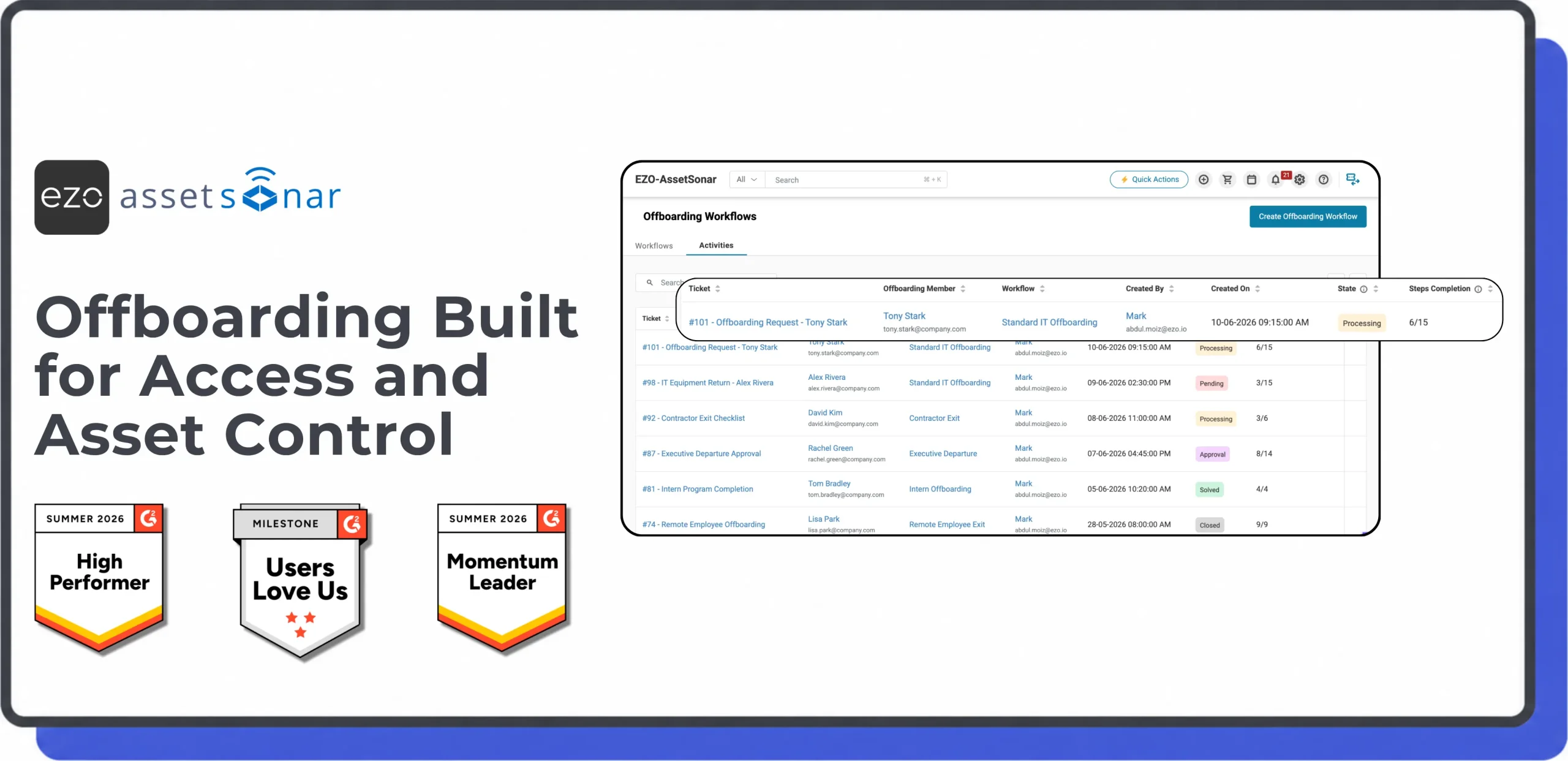
AssetSonar can support an offboarding workflow that begins from an HR termination record or service request. The workflow can create a linked ticket with assigned devices, software licenses, access tasks, approvals, and recovery steps, while preserving timestamps as actions are completed.
Member automations can support actions such as revoking assigned licenses or locking devices through connected mobile device management systems. The AssetSonar IT Graph connects user, device, software, license, and ticket context so IT can review the departing employee’s footprint without rebuilding it from separate tools.
The value is not the reminder alone. The value is the closed loop: a trusted trigger, assigned owners, completed actions, documented exceptions, and evidence that can be produced later.
Who should own employee offboarding compliance?
No single department can own the whole process in isolation.
HR should own the trusted departure trigger and the employment context. IT and Security should own technical access removal, device actions, and system evidence. Managers should own the transfer of work, information, and business relationships. Finance should account for licenses and property. Legal or Privacy teams should guide retention, deletion, and legal-hold decisions when required.
One team may coordinate the workflow, but accountability must remain visible across all participating functions.
The process is complete only when the organization can show that access, assets, data, and ownership were handled according to policy.
The control ends when the evidence is complete
An employee’s last working day may be an HR date, but the organization’s responsibility continues until the person’s access, assets, data, and work ownership have been resolved.
Strong offboarding does not depend on one department remembering to alert another. It starts from one trusted event, makes ownership visible across functions, records actions as they happen, and keeps unresolved items open until someone accepts responsibility for them.
That is what turns offboarding from an administrative checklist into a defensible compliance control.
Editorial note: This article provides operational guidance, not legal advice. Regulatory obligations vary by jurisdiction, industry, system scope, contracts, and organizational policy.