
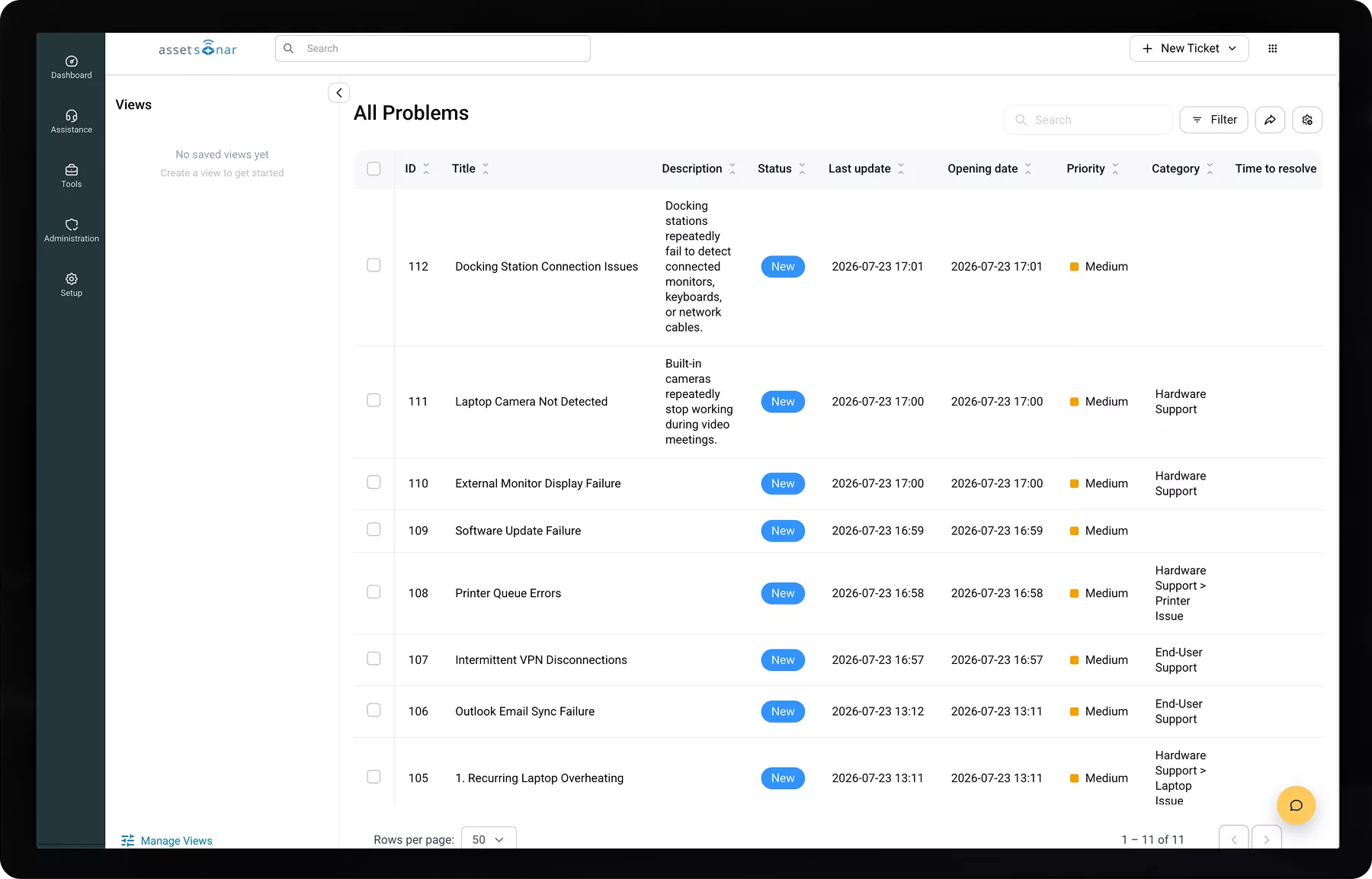






AssetSonar Features Problem Management
IT Problem Management Software
Turn Recurring Incidents Into Root-Cause Fixes
Proven Impact Across IT Teams
90%
Automated Asset Discovery
20%
Faster Ticket Resolution Setup
100%
Automated CMDB
Built to Close Root Causes, Not Just Track Problems
Give Every Recurring Issue a Record
Escalate a recurring incident or open a problem manually, then move it through a defined New-to-Solved lifecycle so every root cause reaches a documented close.
Link Incidents to See Full Impact
Attach every affected incident to one problem record and see affected users, involved assets, and total ticket volume before deciding where to focus the investigation.
Document Cause, Impact, Symptoms
Capture Impacts, Causes, and Symptoms in a dedicated Analysis section, keeping every finding tied to the problem record instead of scattered across tickets.
Use Knowledge Base to Speed Up Fixes
Surface relevant knowledge articles and troubleshooting steps when similar issues return, so technicians can reuse documented guidance instead of starting from scratch.
Trace Fixes From Problem to Change
Create a linked change request from the problem record so the incident-to-problem-to-change chain stays traceable for reviews, approvals, and post-incident follow-up.
Summarize Similar Tickets With AI
Use AI-backed Smart Summaries to highlight common issues, frequently involved assets, and resolution patterns from resolved tickets before technicians begin the investigation.
Trusted by High-Performing IT Teams


Find the Root Cause. Stop Repeat Incidents With AssetSonar
Problem Management Workflows Backed by Asset Context
Link Assets to Problems
Problem Lifecycle
AI-Powered Incident Context
Document Root Cause
Knowledge Base
Problem-to-Change
Link Assets to Problems
Investigate Problems With Live Asset Context
The problem starts with context, not a blank form. Link affected assets from the IT Graph directly to the problem record so technicians can see model, ownership, assignment, and lifecycle history without leaving the investigation. When one device model keeps generating incidents, the linked asset record turns a hunch into a clear, traceable pattern.
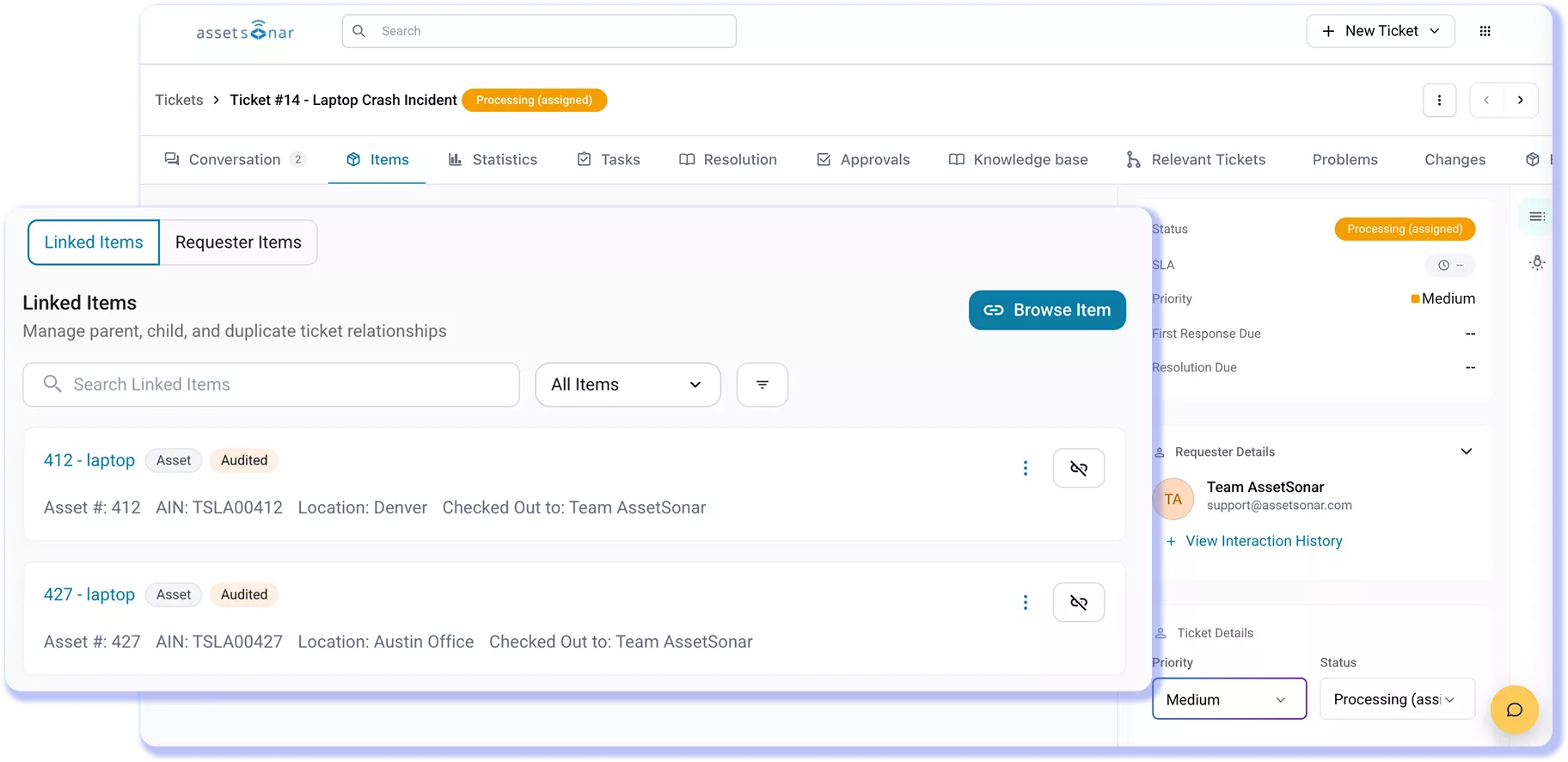
Problem Lifecycle
Give Every Recurrence a Formal Path
Escalate an incident to a problem in one action, or open a problem manually when a pattern emerges. Move it through a defined lifecycle (New, Processing, Pending, Solved, and Closed) so status and ownership stay clear. Every problem is recorded as a separate ticket type, so root-cause work gets its own record instead of disappearing inside an incident thread.
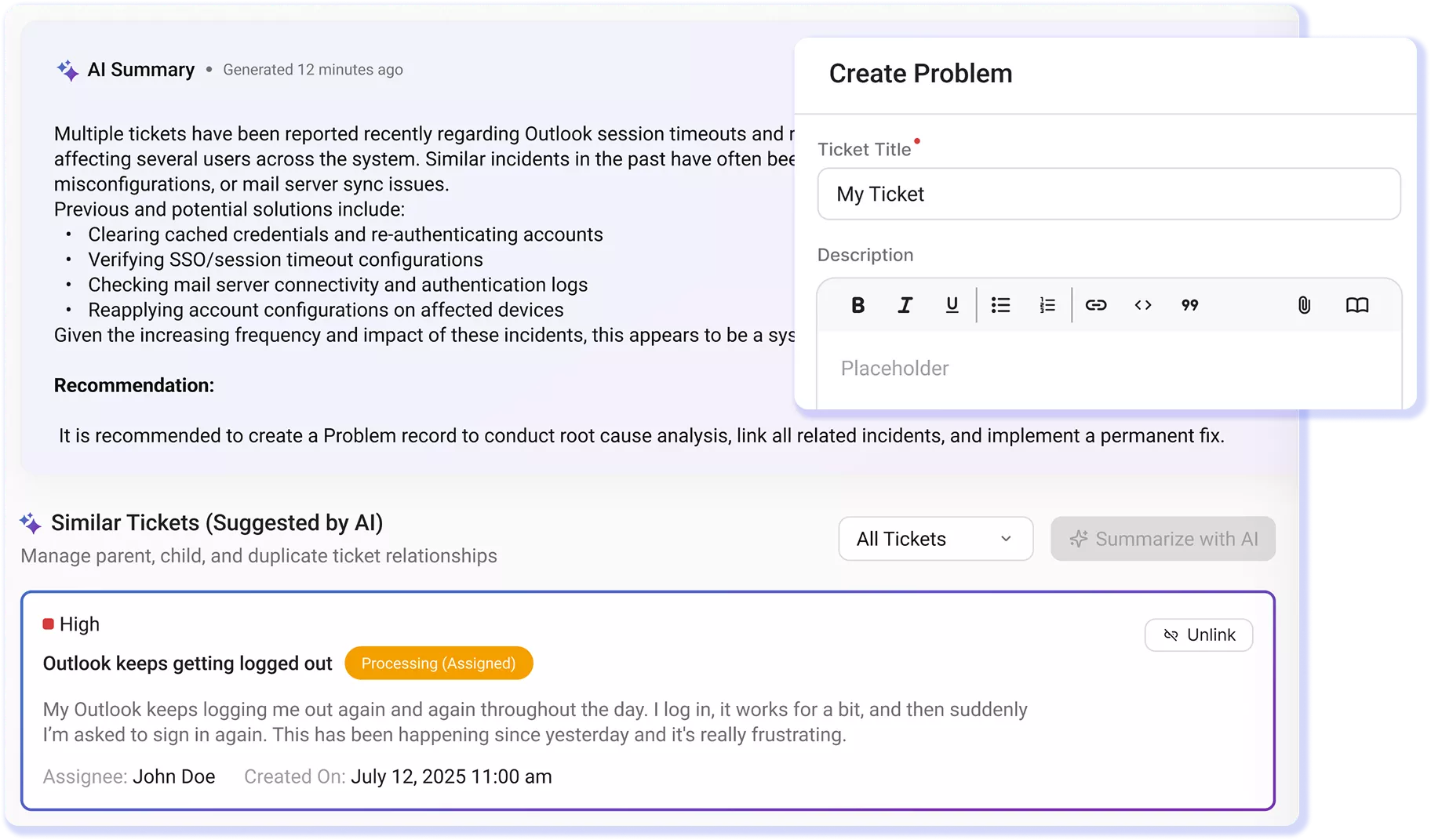
AI-Powered Incident Context
See Full Impact, Then Let AI Summarize It
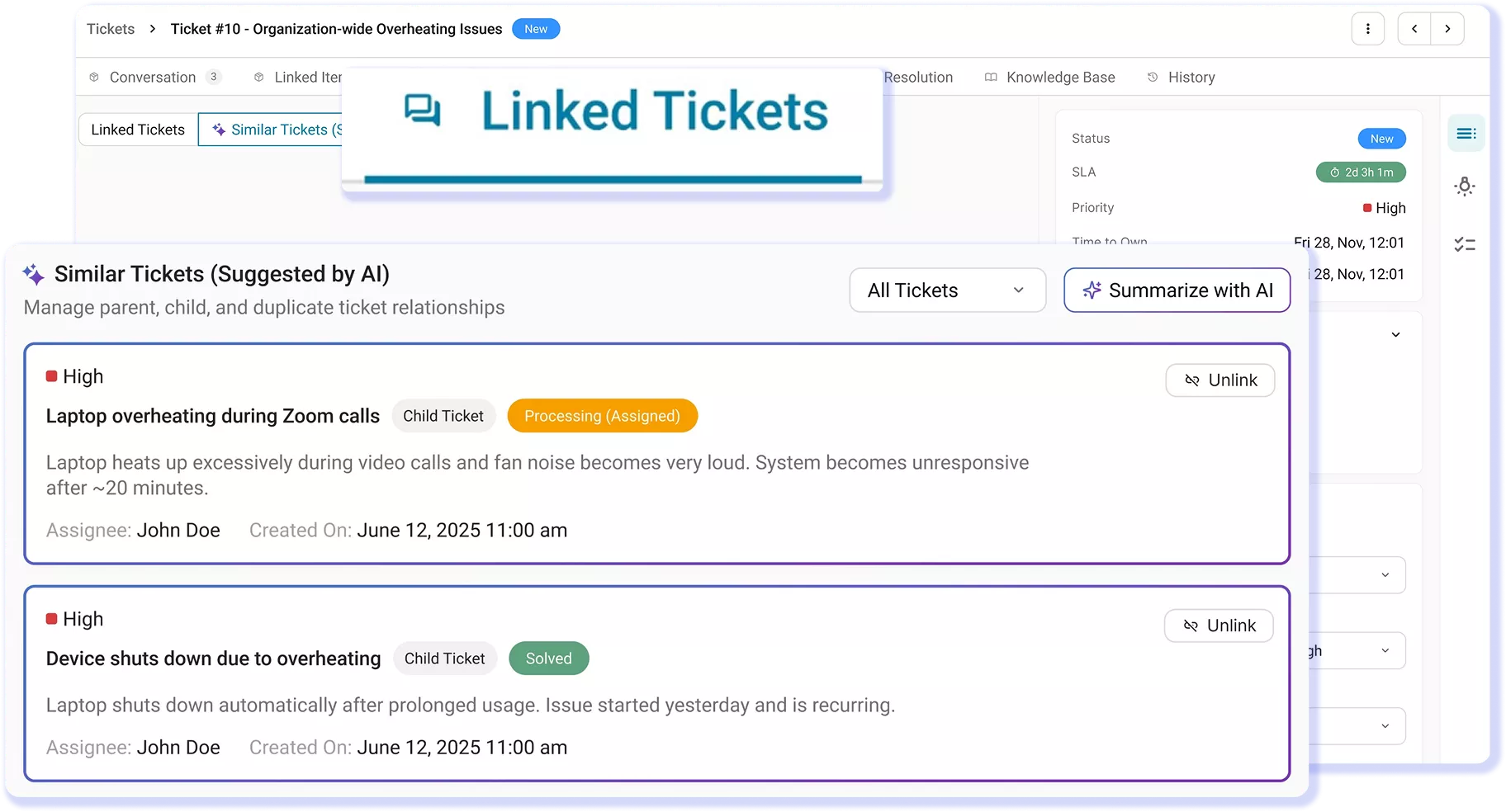
Link every affected incident to one problem record to see affected users, involved assets, and linked-ticket volume before investigating. In the Similar Tickets sub-tab, Smart Summaries highlight common issues, involved assets, and resolution patterns from resolved tickets, giving technicians a clear starting point without the need to read each ticket line by line.
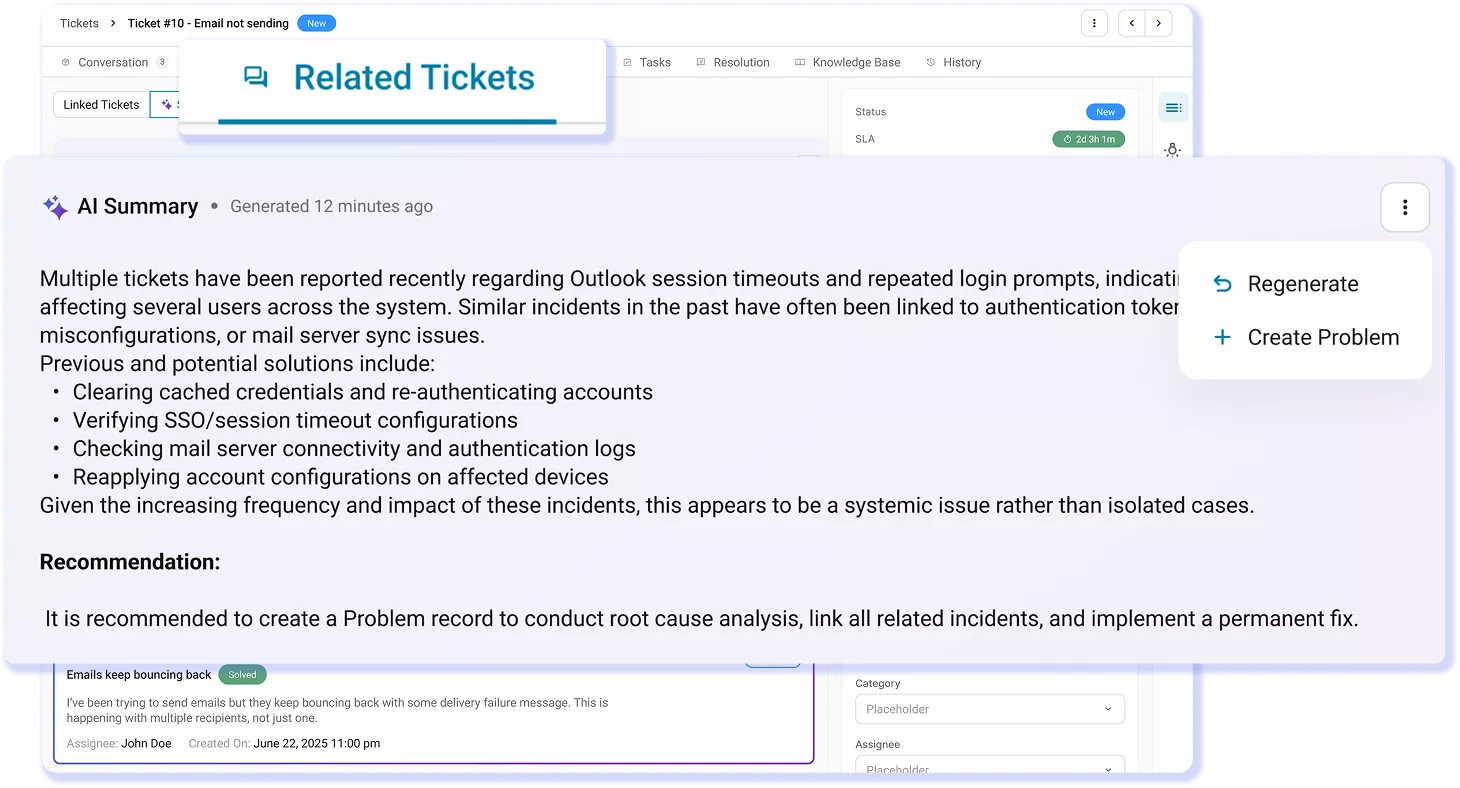
Document Root Cause
Document the Cause Before Resolution
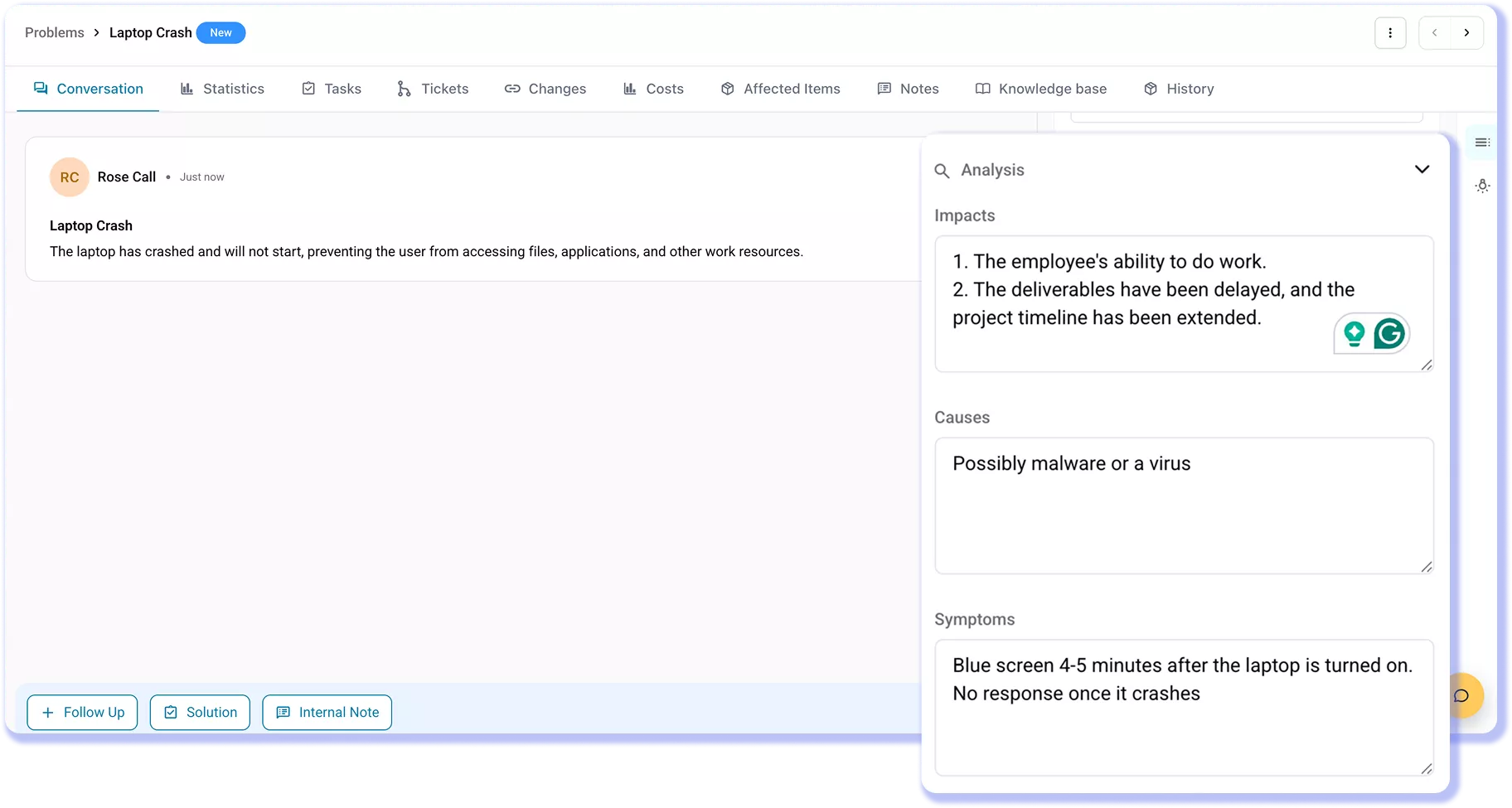
Every problem record includes a dedicated Analysis section for Impacts, Causes, and Symptoms, separate from the ticket conversation. Technicians can record what is affected, what is driving the issue, and how it appears. The findings stay searchable and attached to the problem, alongside linked incidents and asset context, instead of being buried in replies.
Knowledge Base
Surface Known Fixes Before Starting Over
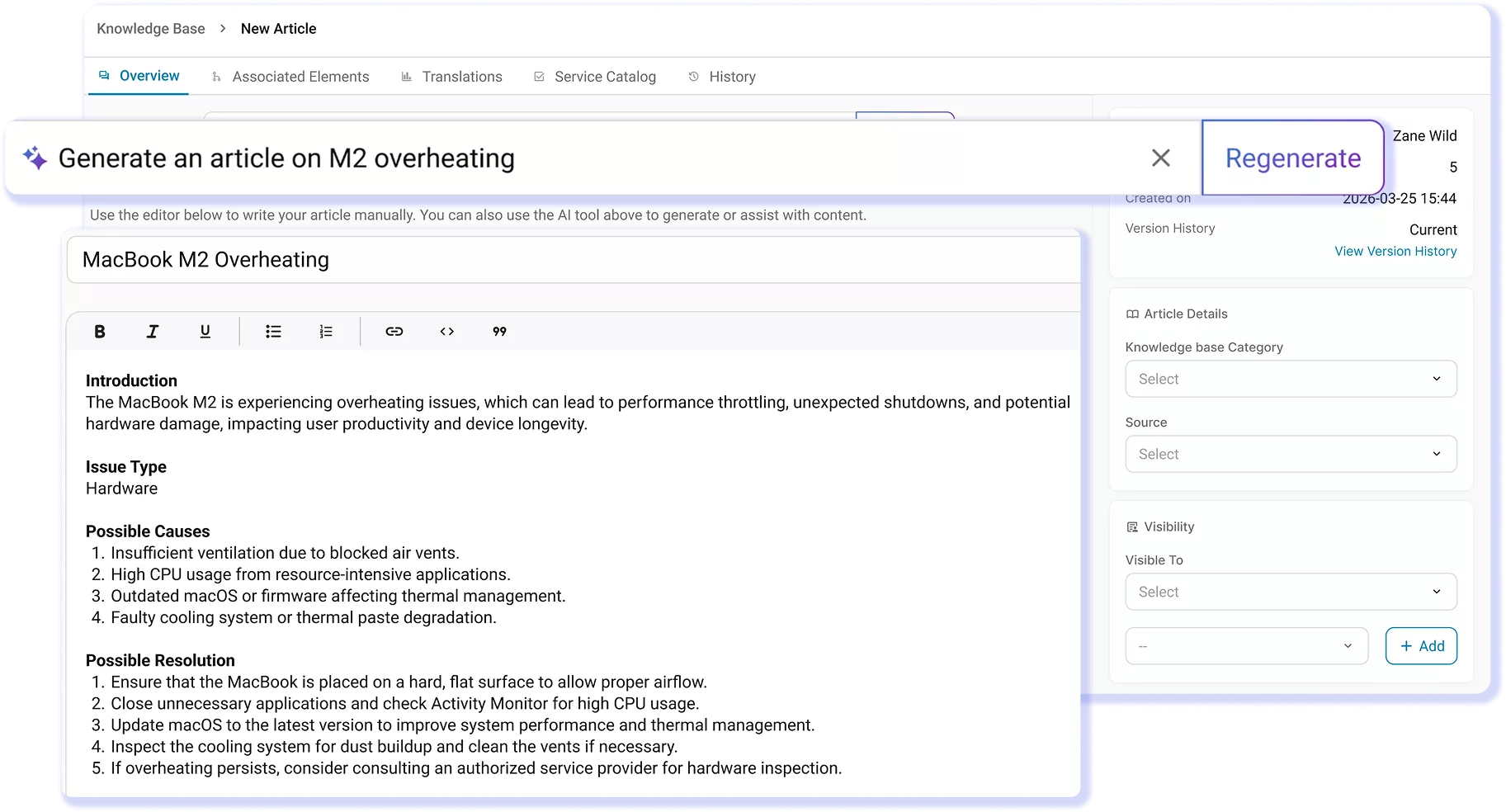
Turn resolved analysis into a knowledge article that the IT team can search and reuse. Link the article to a problem and surface relevant guidance when a similar issue returns. The next technician starts with established troubleshooting steps instead of reopening a closed ticket or rebuilding the investigation. Zoe can even draft the article from the resolved ticket.
Problem-to-Change
Convert Problems Into Change Requests
When a permanent fix requires controlled implementation, create a change request directly from the problem record. The incident, problem, and change stay linked so approvers can review the investigation context and follow the path from symptom to fix. The connected record supports reviews and audit traceability without rebuilding the history manually.
Customer Testimonials
Turn Repeat Incidents Into Lasting Fixes
Read More on Problem Management
Frequently Asked Questions
AssetSonar, the IT problem management software, connects problem records with related incidents, affected assets, configuration items, documented resolutions, knowledge articles, and proposed changes. It should also support prioritization, ownership, investigation notes, lifecycle statuses, dashboards, reporting, automation, and searchable resolution history. AssetSonar keeps these records in one ITSM environment, preserving the path from recurring incidents through investigation, approval, change implementation, and final resolution.
AssetSonar is suited to mid-market and enterprise IT teams that want problem management connected to IT asset management, incident management, change management, and a CMDB. It supports distributed organizations managing many users, assets, applications, locations, and recurring service issues. Asset-based ITSM pricing and unlimited service agents let technicians, managers, and approvers participate without separate agent licenses.
Problem Management is included in the AssetSonar ITSM plan at a published price of $1.44 per asset per month, with volume discounts for organizations managing more than 1,000 assets. The plan also covers ITAM, incident, request, change, knowledge, service catalog, SLA, AI diagnostics, and workflow capabilities. Unlimited service agents are included, so there is no separate license fee for each technician or approver. Confirm final pricing, scope, discounts, and optional modules with the AssetSonar team based on your requirements.
Yes. AssetSonar offers a 7-day free trial with no credit card required. Teams can test how problem records connect with incidents, assets, changes, knowledge articles, and service workflows. For a realistic evaluation, recreate a recurring issue, link related tickets and incidents to one problem, document the investigation, capture the cause in the Analysis fields, review affected assets, and turn the proposed fix into a change request. Guided demos are also available for complex integrations or migrations.
Most AssetSonar implementations take about two weeks, depending on data quality, team size, integrations, workflow complexity, and rollout scope. IT teams can start with users, locations, assets, incident categories, and core problem workflows, then add automation, CMDB relationships, software management, and reporting in phases. Managed implementation and a dedicated customer success manager help guide the setup.
Yes. AssetSonar Problem Management works within the broader ITSM platform, connecting incidents, changes, requests, knowledge, and service catalog workflows. IT teams can link related incidents to problems, document the investigation in the Analysis fields, publish the resolution as a knowledge article, and turn a proposed fix into a change request. This keeps the full path from disruption to diagnosis, approval, remediation, and resolution connected, while technicians reuse the documented resolution until the permanent change is implemented.
AssetSonar connects problem investigations with related assets, users, software, tickets, locations, and configuration items. The AssetSonar IT Graph (auto-populated CMDB) helps IT teams assess impact beyond ticket descriptions. Technicians can identify whether recurring incidents share a device model, application, location, user group, or configuration item before prioritizing remediation. Accurate analysis depends on keeping discovery data and record relationships current.
AssetSonar uses Zoe, its AI co-pilot, to summarize ticket information with available asset and service context. In the Similar Tickets sub-tab, AI Smart Summaries review resolved tickets and highlight common issues, involved assets, and recurring resolution patterns, reducing manual ticket review. AI supports the investigation, but the problem owner still validates the evidence, identifies the cause, assesses risk, and approves any resulting changes.
Yes. AssetSonar supports integrations across asset discovery, mobile device management, identity, endpoint, SaaS, procurement, warranty, and service workflows. These connections bring user, asset, software, and infrastructure context into problem investigations. APIs can also support data exchange and custom processes when a native integration does not meet a specific requirement.
EZO maintains SOC 2 Type II and ISO 27001 certifications and provides a Data Processing Agreement where applicable. AssetSonar also supports role-based access and activity history for records containing infrastructure details, investigation notes, and approvals. Security suitability ultimately depends on each organization’s policies, controls, and system configuration.
Close the Loop on Every Recurring Incident
Give IT teams a structured path from recurring incidents to documented causes, reusable knowledge, and controlled changes with live asset context.